Fallopian Tube Cancer: Understanding Risks, Symptoms, and Treatment Options

Updated: 3 days ago
Medically reviewed by Dr. Baraa Alnahhal, MD · Last reviewed: October 2026
Quick Answer: What is fallopian tube cancer?
Fallopian tube cancer is a rare cancer that starts in the fallopian tubes. It is highly curable when caught early but is often diagnosed after spreading because early stages lack symptoms. It is strongly linked to BRCA gene mutations, and symptoms include pelvic pain, bloating and unusual vaginal discharge. Treatment centers on surgery to remove reproductive organs, plus chemotherapy.
What the research says
A tubal precursor lesion found at risk-reducing surgery signals a much higher later cancer risk. In an individual patient data meta-analysis of 3,121 women carrying a pathogenic variant who had risk-reducing salpingo-oophorectomy (115 had serous tubal intraepithelial carcinoma, or STIC, the postulated origin of high-grade serous cancer), the hazard ratio for later peritoneal carcinomatosis was 33.9 (95% CI 15.6–73.9) with STIC versus without; five- and ten-year risks were 10.5% and 27.5% with STIC versus 0.3% and 0.9% without (PubMed: Steenbeek et al., J Clin Oncol, 2022 [1]).
Removing the tubes during other pelvic surgery is an established prevention strategy. A Canadian guideline reported that adding opportunistic salpingectomy to a planned hysterectomy or permanent sterilization did not increase hospital readmission or blood transfusion rates but added operating time (about 16 and 10 minutes, respectively) in a retrospective review of 43,931 women; experts project that removing the tubes at every hysterectomy and sterilization could reduce high-grade serous cancer rates by 40% over 20 years (PubMed: Salvador et al., J Obstet Gynaecol Can, 2017 [2]).
Overview of Fallopian Tube Cancer
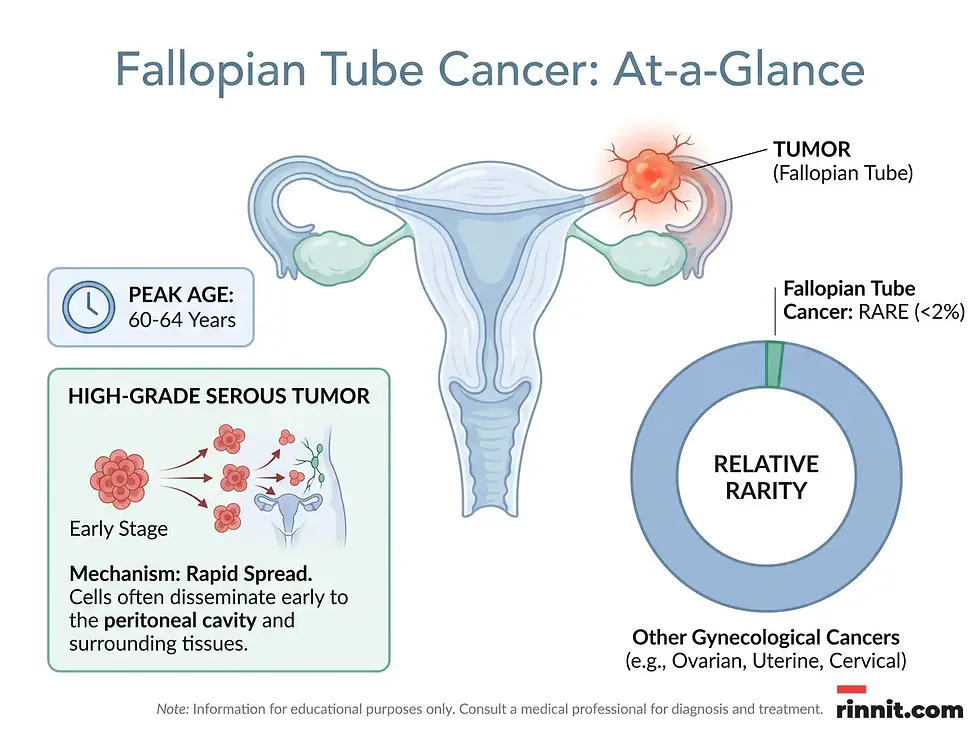
Fallopian tube cancer is a malignancy that develops within the tubes connecting the ovaries to the uterus. Although rare, it is a significant health concern because it often serves as the starting point for high-grade serous tumors, which are the most common type of ovarian cancer [3]. Because these cells spread quickly, the disease is frequently advanced by the time it is identified [3].
Key Fact | Detail |
Prevalence | Rare compared to other gynecological cancers |
Common Age | Most frequently diagnosed in women aged 60–64 |
Primary Challenge | Often asymptomatic in early stages; spreads rapidly |
Curability | High if treated early before spreading |
Understanding the Ovarian Connection
Recent medical research indicates that many cases previously classified as ovarian cancer actually originate in the fallopian tubes. Specifically, epithelial ovarian cancer is now believed to start in the glands that line the fallopian tubes [3]. This makes the health of these tubes central to broader gynecological oncology.
Symptoms and Warning Signs
The symptoms of fallopian tube cancer can be subtle and easily mistaken for less serious conditions, such as gastrointestinal upset or menstrual irregularities. As the cancer progresses, these signs typically become more pronounced.
Symptom Category | Specific Signs |
Pelvic & Abdominal | Pelvic pain, abdominal swelling, bloating, or a detectable lump |
Gastrointestinal | Loss of appetite, feeling full quickly, nausea, or changes in bowel habits |
Urinary | Increased frequency of urination |
Reproductive | Irregular periods, postmenopausal bleeding, or watery/bloody discharge |
Causes and Risk Factors
While the exact cause of fallopian tube cancer remains unknown, it is established that most cases begin in the epithelial tissue, the glands that line the internal organs [3]. A smaller percentage of these cancers start in the connective tissues, known as sarcomas [3].
Genetic and Health Risks
Certain genetic mutations and pre-existing health conditions significantly elevate the risk of developing this rare cancer [3]. Understanding these factors is essential for proactive screening.
Risk Factor | Description |
Genetic Mutations | BRCA gene mutations significantly increase risk |
Family History | Greater risk if a first-degree relative had breast, ovarian, or fallopian cancer |
Health Syndromes | Lynch syndrome and Peutz-Jeghers syndrome are linked to higher risk |
Medical Conditions | Endometriosis is a known risk factor |
Obesity | A Body Mass Index (BMI) above 30 increases susceptibility |
Reproductive History and Menstruation
A person’s reproductive timeline also plays a role in their overall risk profile. Factors that increase the number of ovulations or hormonal exposure over a lifetime are often associated with higher cancer rates.
Reproductive Factor | Increased Risk Profile |
Pregnancy | Never having been pregnant or first full-term pregnancy after age 35 |
First Period | Starting menstruation before age 12 |
Menopause | Entering menopause after age 51 |

Diagnosis and Staging
Diagnosis often begins when a healthcare provider detects a mass during a routine pelvic exam [3]. Because early detection is difficult, providers use a combination of blood tests, imaging, and surgical procedures to confirm the presence of cancer [3].
Diagnostic Procedures
Test Type | Purpose |
CA-125 Blood Test | Measures cancer antigen 125; high levels may indicate cancer |
Imaging Scans | Ultrasound, CT, MRI, or PET scans to visualize tumors or cysts |
Biopsy/Paracentesis | Removing tissue or abdominal fluid to test for cancer cells |
Exploratory Surgery | Direct examination of organs and removal of suspicious tissue |
Cancer Staging
Staging describes the extent of the cancer’s spread, which is vital for determining the most effective treatment plan.
Stage | Description of Spread |
Stage I | Cancer is limited to one or both fallopian tubes |
Stage II | Cancer involves the tubes and nearby pelvic tissues |
Stage III | Cancer has spread beyond the pelvis to lymph nodes or nearby organs |
Stage IV | Cancer has reached distant organs like the liver, lungs, or brain |
Treatment and Management Options
Treatment for fallopian tube cancer is aggressive due to the speed at which the disease spreads. The primary goal is the complete removal of all detectable cancer cells through surgery, followed by systemic therapy to address any remaining microscopic disease [3].
Surgical Interventions
For most patients, surgery involves the removal of several reproductive organs to ensure the cancer is fully eradicated. This typically includes [3]:
Hysterectomy: Removal of the uterus.
Salpingectomy: Removal of the fallopian tubes.
Oophorectomy: Removal of the ovaries.
Systemic and Targeted Therapies
Treatment Type | How It Works |
Chemotherapy | Drugs used to shrink tumors before surgery or kill lingering cells after |
Targeted Therapy | Attacks specific cancer cells with minimal damage to healthy tissue |
Immunotherapy | Uses the body’s immune system to fight specific genetic mutations |
Palliative Care | Focuses on managing symptoms and improving quality of life |

Outlook and Recovery
The prognosis for fallopian tube cancer is generally positive if the disease is caught in its early stages. Approximately 80% of patients experience remission following their initial treatment [3]. However, the risk of recurrence remains a significant concern, particularly for those diagnosed at more advanced stages [3].
Stage at Diagnosis | Recurrence Rate |
Early-Stage | Approximately 1 in 4 cases recur |
Advanced-Stage | Up to 8 in 10 cases recur |
Long-Term Monitoring
Patients must commit to regular follow-up appointments, especially during the first five years after treatment [3]. These checkups are essential for detecting recurrence early and managing any long-term side effects of surgery or chemotherapy.
Prevention and Risk Reduction
While fallopian tube cancer cannot be entirely prevented, those at high risk can take significant steps to lower their chances of developing the disease. For individuals with confirmed BRCA mutations, a prophylactic salpingo-oophorectomy can reduce the risk of gynecological cancers by as much as 96% [3].
Strategy | Actionable Step |
Genetic Testing | Pursue BRCA testing if there is a strong family history of cancer |
Birth Control | Use of hormonal contraceptives can lower overall risk |
Lifestyle | Maintain a healthy weight, limit alcohol, and avoid smoking |
Proactive Surgery | Consider tubal ligation or removal of tubes if finished with childbearing |
Conclusion and Next Steps
Fallopian tube cancer is a rare but serious condition that requires prompt medical attention. By understanding the risk factors, particularly genetic links like the BRCA mutation, and recognizing the subtle warning signs, individuals can take charge of their gynecological health. Early diagnosis remains the most effective way to ensure a successful outcome and long-term remission.
If you have a family history of breast or ovarian cancer, consider the following steps:
Genetic Counseling: Discuss your family history with a specialist to determine if testing is appropriate.
Routine Screenings: Ensure you attend regular pelvic exams and report any new symptoms immediately.
Risk-Reduction Discussion: Talk to your provider about surgical or hormonal options to lower your risk.
Related on Rinnit: Ovarian Cancer: Symptoms, Causes, Diagnosis and Treatment · Salpingectomy: Understanding Fallopian Tube Removal Surgery
Further reading: Cleveland Clinic — Fallopian Tube Cancer
Frequently Asked Questions
1. Is fallopian tube cancer the same as ovarian cancer?
No, they are distinct cancers, but they are closely related. Recent research suggests that the most common type of ovarian cancer, epithelial ovarian cancer, may actually begin in the fallopian tubes before spreading to the ovaries.
2. How rare is fallopian tube cancer?
Fallopian tube cancer is considered very rare compared to other gynecological cancers like uterine or ovarian cancer. However, its importance has grown as doctors realize many “ovarian” cancers likely start in the tubes.
3. Can fallopian tube cancer be cured?
Yes, it is curable if it is caught and treated in the early stages. When the cancer is localized to the fallopian tubes, surgery can often remove all of the cancer cells successfully.
4. What is the most common age for diagnosis?
Most women diagnosed with fallopian tube cancer are between the ages of 60 and 64. However, those with certain genetic mutations may be at risk at an earlier age.
5. Does a BRCA mutation increase risk?
Yes, mutations in the BRCA gene significantly increase the risk of fallopian tube cancer, as well as breast and ovarian cancers. Testing is recommended for those with a strong family history.
6. What are the first signs of fallopian tube cancer?
Early signs are often subtle but can include pelvic pain, a lump in the pelvic area, abdominal bloating, and unusual watery or bloody vaginal discharge.
7. What surgery is used for fallopian tube cancer?
The standard treatment is a hysterectomy (removal of the uterus), a salpingectomy (removal of the fallopian tubes), and an oophorectomy (removal of the ovaries).
8. How often does fallopian tube cancer come back?
Recurrence depends on the stage at diagnosis. Early-stage cancer returns in about 25% of cases, while advanced-stage cancer can recur in up to 80% of cases.
9. Can you prevent fallopian tube cancer?
While not 100% preventable, high-risk individuals can lower their risk by up to 96% through the surgical removal of their ovaries and fallopian tubes.
10. Is bloating a symptom of fallopian tube cancer?
Yes, abdominal swelling and bloating are common symptoms, though they are often not noticed until the cancer has begun to spread.
Related Reading
CA-125 Blood Test: What It Measures, Normal Levels and What High Results Mean explains the blood test used to monitor ovarian cancer, normal CA-125 levels and why a high result isn't a diagnosis on its own.
References
Steenbeek MP, van Bommel MHD, Bulten J, et al. Risk of peritoneal carcinomatosis after risk-reducing salpingo-oophorectomy: a systematic review and individual patient data meta-analysis. J Clin Oncol. 2022;40(17):1879-1891. doi:10.1200/JCO.21.02016. PMID: 35302882.
Salvador S, Scott S, Francis JA, Agrawal A, Giede C. No. 344-Opportunistic salpingectomy and other methods of risk reduction for ovarian/fallopian tube/peritoneal cancer in the general population. J Obstet Gynaecol Can. 2017;39(6):480-493. doi:10.1016/j.jogc.2016.12.005. PMID: 28527613.
Cleveland Clinic. Fallopian tube cancer. Cleveland Clinic Health Library. Medically reviewed; last updated July 23, 2026. https://my.clevelandclinic.org/health/diseases/21540-fallopian-tube-cancer
Medical Disclaimer
This article is for informational purposes only and does not constitute medical advice. Always seek the advice of your physician or other qualified health provider with any questions you may have regarding a medical condition. Never disregard professional medical advice or delay in seeking it because of something you have read here.



Comments