Understanding Primary Peritoneal Cancer: Symptoms, Risks, and Care

Updated: 3 days ago
Medically reviewed by Dr. Baraa Alnahhal, MD · Last reviewed: October 2026
Primary peritoneal cancer is a rare cancer that forms in the peritoneum, the thin tissue lining the abdomen and covering internal organs. Early signs are vague, such as bloating and pelvic pain, and advance to fatigue and fluid buildup. It is often linked to genetic mutations (BRCA1/BRCA2) and abnormal growth of epithelial cells, and management typically involves cytoreductive surgery followed by chemotherapy or targeted therapy.
Quick Answer
Primary peritoneal cancer is a rare cancer that develops in the peritoneum, the thin tissue lining the abdominal cavity and protecting organs such as the intestines and bladder. It is closely related to ovarian cancer but starts in the abdominal lining. Early symptoms are vague, so many cases are found late. Treatment usually involves surgery followed by chemotherapy. [1]
What the research says
Chemotherapy before surgery gave similar survival to upfront surgery, with fewer severe complications, in trials that included primary peritoneal cancer. A meta-analysis of five randomized trials (2,380 women with stage III–IV epithelial ovarian, fallopian tube, or primary peritoneal cancer) found no difference in overall survival (HR 1.00, 95% CI 0.90–1.12) or progression-free survival (HR 1.03, 95% CI 0.92–1.16) between neoadjuvant chemotherapy followed by interval surgery and primary debulking surgery; grade 3 or higher perioperative complications were less frequent (RR 0.43, 95% CI 0.25–0.74) and complete macroscopic resection more likely (RR 2.02, 95% CI 1.26–3.24) (Secchi et al., Eur J Cancer, 2026).
BRCA mutations are found in a minority of these cancers, which is why genetic counseling is discussed. In a multi-institutional Thai study of 139 analyzed patients with ovarian, fallopian tube, or primary peritoneal cancers, BRCA1/2 mutations were found in tumor tissue in 24 patients (17.3%); the overall prevalence was 6.5% for somatic and 8.7% for germline mutations, and the rate was highest in high-grade serous cancer (27.3%) (Lertkhachonsuk et al., Asian Pac J Cancer Prev, 2020).
The role of heated chemotherapy inside the abdomen (HIPEC) is still debated. A review of recent randomized trials in primary advanced epithelial ovarian cancer reported that two phase III trials suggest adding HIPEC to interval debulking surgery after neoadjuvant chemotherapy improves progression-free and overall survival, while HIPEC did not appear to offer an advantage after primary debulking surgery, and several phase III trials are ongoing (Gadducci et al., Anticancer Res, 2022).
Research summaries are based on article abstracts retrieved from PubMed.
What is Primary Peritoneal Cancer?
Primary peritoneal cancer is a rare form of malignancy that originates in the peritoneum, a thin, protective layer of epithelial cells that lines the abdominal cavity. This tissue serves a critical role by producing a lubricating fluid that allows organs such as the bladder, intestines, and uterus to move smoothly within the abdomen. When cells within this lining begin to grow abnormally, it results in primary peritoneal cancer. [1]
While it is distinct from secondary peritoneal cancer—which occurs when cancer spreads from another part of the body—primary peritoneal cancer is often compared to ovarian cancer. Both involve similar epithelial cells and follow a comparable spread pattern, which can make identifying the exact point of origin challenging for healthcare providers.
Feature | Primary Peritoneal Cancer | Ovarian Cancer |
Origin | Abdominal lining (peritoneum). | Ovaries or fallopian tubes. |
Patient Age | Typically diagnosed in older individuals (60+). | Often diagnosed at a slightly younger age. |
Prognosis | Generally considered more challenging. | Varies, but often has a better comparative outlook. |

What are the symptoms and risk factors of primary peritoneal cancer?
One of the most significant challenges with primary peritoneal cancer is that early symptoms are often vague and easily overlooked. Many individuals do not notice significant changes until the cancer has advanced. Early signs may include persistent abdominal or pelvic pain, a sense of bloating, and bowel changes such as increased gas or constipation.
As the condition progresses, more severe symptoms may develop, including:
Fluid Accumulation: A buildup of fluid in the abdomen known as ascites, which can cause significant swelling.
Systemic Effects: Persistent fatigue, nausea, vomiting, and unintended weight changes.
Respiratory and Physical: Shortness of breath (dyspnea) and swelling in the legs as the cancer affects surrounding systems.
Risk factors for this rare cancer are similar to those of ovarian cancer. Women have a higher overall risk, particularly those aged 60 and older. Genetic mutations, such as BRCA1 or BRCA2, and hereditary conditions like Lynch syndrome significantly increase the likelihood of development. Other potential risks include endometriosis, obesity, and a reproductive history that includes infertility or having no biological children. [1]
How is primary peritoneal cancer diagnosed?
Because symptoms are often vague, primary peritoneal cancer is frequently diagnosed at stage 3 or 4. Healthcare providers typically begin with a thorough medical history and physical examination, followed by specialized diagnostic tests to identify tumors and assess their spread.
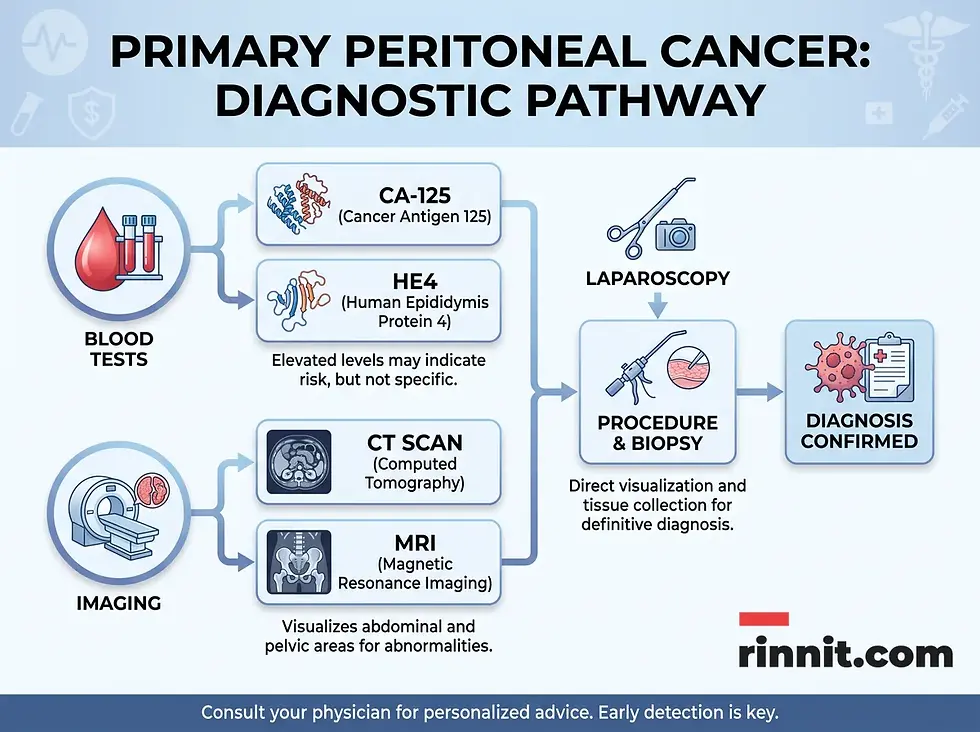
Common diagnostic tools include:
Blood Testing: Checking for chemical markers like CA-125 and proteins such as HE4, which are often elevated in the presence of peritoneal cancer cells.
Imaging Studies: Utilizing ultrasound, MRI, or CT scans to visualize the abdominal cavity, though tumors in the peritoneum can be difficult to detect.
Biopsy and Laparoscopy: A surgical procedure where small incisions are made to allow a direct view of the abdomen and the removal of tissue samples for microscopic examination.
Paracentesis: If fluid buildup (ascites) is present, a sample may be taken to test for the presence of cancer cells. [1]
How is primary peritoneal cancer managed and treated?
The management of primary peritoneal cancer depends on several factors, including the stage of the cancer, the size and location of the tumors, and the patient's overall health. The primary goal of treatment is to remove as much of the cancer as possible and manage systemic spread.
The first treatments tend to be surgery followed by chemotherapy or targeted therapy. [1]

Treatment strategies typically include:
Cytoreductive Surgery: A procedure aimed at removing all visible cancerous tissue from the abdominal cavity. Outcomes are generally improved when this surgery is performed by a gynecologic oncologist.
Systemic Therapy: Chemotherapy or targeted therapy is often administered following surgery to eliminate remaining cancer cells and prevent recurrence.
Managing Complications: Advanced cases may require interventions for bowel or urinary tract obstructions, as well as palliative care to manage abdominal pain and nausea.
Conclusion and Next Steps
Primary peritoneal cancer is a serious and rare condition that requires a comprehensive, specialized approach to care. While the vague nature of early symptoms can make detection difficult, understanding the risk factors and seeking medical evaluation for persistent abdominal changes is essential. If you have a family history of related cancers or are experiencing ongoing bloating and pain, consult a healthcare provider to discuss appropriate screening and diagnostic options.
Frequently Asked Questions
Is primary peritoneal cancer the same as ovarian cancer?
No, they are different cancers, though they share similar cell types and treatment approaches.
Who is at the highest risk for this cancer?
Women over the age of 60, especially those with BRCA gene mutations or a family history of related cancers.
What is the peritoneum?
The peritoneum is a thin layer of tissue that lines the abdomen and covers the internal organs.
Why is it often diagnosed at a late stage?
The early symptoms are often vague and can be easily mistaken for less serious conditions.
What is cytoreductive surgery?
Cytoreductive surgery is a surgical procedure designed to remove as much visible cancerous tissue as possible from the abdomen.
Can men get primary peritoneal cancer?
While much rarer, it can affect men, though women have a significantly higher risk.
What is ascites?
Ascites is a buildup of fluid in the abdominal cavity, which is a common symptom of advanced peritoneal cancer.
Are there blood tests for this cancer?
Yes, tests for markers like CA-125 and HE4 can help in the diagnostic process.
Does endometriosis increase the risk?
Yes, having endometriosis is considered a risk factor for developing primary peritoneal cancer.
What is the difference between primary and secondary peritoneal cancer?
Primary starts in the peritoneum, while secondary starts elsewhere and spreads to the peritoneum.
Related Reading
CA-125 Blood Test: What It Measures, Normal Levels and What High Results Mean explains the blood test used to monitor ovarian cancer, normal CA-125 levels and why a high result isn't a diagnosis on its own.
References
Cleveland Clinic. Primary Peritoneal Cancer. Cleveland Clinic Health Library. Last updated April 12, 2022. https://my.clevelandclinic.org/health/diseases/22721-primary-peritoneal-cancer
Secchi M, Signorelli M, Rulli E, et al. Neoadjuvant chemotherapy followed by interval surgery versus primary debulking surgery in FIGO stage III-IV epithelial ovarian cancer: A systematic review and meta-analysis. Eur J Cancer. 2026;232:116116. PMID: 41259943. DOI: 10.1016/j.ejca.2025.116116
Lertkhachonsuk AA, Suprasert P, Manchana T, et al. Prevalence of Tissue BRCA Gene Mutation in Ovarian, Fallopian Tube, and Primary Peritoneal Cancers: A Multi-Institutional Study. Asian Pac J Cancer Prev. 2020;21(8):2381-2388. PMID: 32856869. DOI: 10.31557/APJCP.2020.21.8.2381
Gadducci A, Cosio S, Lippolis PV. Hyperthermic Intraperitoneal Chemotherapy in the Management of Primary Epithelial Ovarian Cancer: A Debated Issue for Gynecologic Oncologists. Anticancer Res. 2022;42(10):4659-4665. PMID: 36191972. DOI: 10.21873/anticanres.15970
Medical disclaimer
This article is for informational purposes only and is not a substitute for professional medical advice, diagnosis, or treatment. Always seek the advice of your physician or other qualified health provider with any questions you may have about a medical condition.



Comments