Troponin Test: What It Is, Why It's Done, Normal Range and What High Levels Mean

Updated: 2 days ago
Written and medically reviewed by Dr. Baraa Alnahhal, MD · Last reviewed: November 2026 · How we review
Quick Answer: What is a troponin test?
A troponin test is a blood test that looks for troponin, a protein found inside heart muscle cells. When heart muscle is damaged, as in a heart attack, troponin leaks into the bloodstream, and higher levels mean more damage. It's one of the most important tests for diagnosing a heart attack. [1]
What the research says
A very low result can safely rule out a heart attack in many people. In 6,304 people with suspected heart attack, a high-sensitivity troponin I below 5 ng/L at arrival was found in 61% of those without a heart attack, and it ruled out a heart attack or cardiac death within 30 days with 99.6% accuracy (negative predictive value). (Shah et al., The Lancet, 2015) [2]
One undetectable troponin T plus a normal ECG is reassuring. Across 11 studies of 9,241 emergency patients with chest pain, 30.6% had an undetectable high-sensitivity troponin T and no ischemia on ECG. Only 0.5% of this low-risk group had a heart attack, giving a pooled sensitivity of 98.7%. (Pickering et al., Annals of Internal Medicine, 2017) [3]
Key takeaways
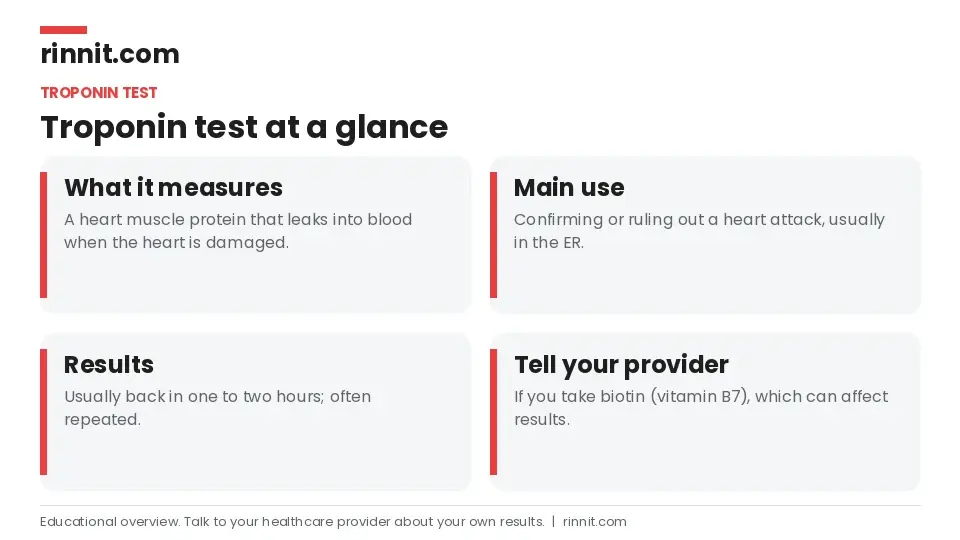
Troponin is a protein inside heart muscle cells; it leaks into the blood when the heart is damaged. [1]
The test is mainly used in the emergency room to confirm or rule out a heart attack. [1]
Levels usually rise 3 to 12 hours after a heart attack and peak about 24 hours later. [1]
Other conditions, such as kidney disease, heart failure, sepsis and pulmonary embolism, can also raise troponin. [1]
Tell your provider if you take biotin (vitamin B7), because it can affect the result. [1]
Results usually come back in one to two hours, and the test is often repeated. [1]
What is troponin?
Troponin is a protein found in certain types of muscle. Normally it stays inside the muscle cells, with only tiny amounts in your blood. Two forms are especially useful for spotting heart damage: [1]
Type | What makes it useful | How long it stays high after a heart attack |
Troponin I (cTnI) | Found only in heart muscle | At least 5 to 7 days |
Troponin T (cTnT) | The heart's version has a unique structure | Up to 3 weeks |
Sources: [1]
Newer high-sensitivity versions of the test can pick up far smaller amounts than before, which helps diagnose a heart attack faster. You may see the test written as cTn, cTnI or cTnT. Some tests measure one type and some measure both. [1]
Why is a troponin test done?
The most common reason is to confirm or rule out a heart attack. Because any damage to heart muscle can release troponin, the test is also useful when other tests are unclear or symptoms are vague. [1]
Other causes of high troponin
Besides a heart attack, these conditions can raise troponin: [1]
Chronic kidney disease
Pulmonary embolism (a blood clot in the lungs)
Congestive heart failure
Heart surgery
Heart valve disease
Irregular heart rhythms (arrhythmias)
Sepsis
Infection or inflammation of the heart
Cardioversion (an electric shock used to reset the heart rhythm)
Exercising too much or too hard
Extreme emotional strain, such as grief or stress
Where is the test done?
Most troponin tests are done in hospital emergency rooms when a recent heart attack is suspected. It may also be done for people already in the hospital when their care team needs to check for heart damage. [1]
How do you prepare?
Because heart attacks are unpredictable, there is usually no way to prepare. One important step: tell your provider if you take biotin (vitamin B7) and how much, because it can interfere with the result. Depending on the dose, it may take several hours before biotin stops affecting the test. [1]
Your care team will not wait for the result to start treatment if they suspect a heart attack. They often treat based on your symptoms and other tests, since every minute matters. If troponin stays normal after 12 hours, they can adjust your care. [1]
What happens during the test?
A phlebotomist or other trained professional takes a blood sample from a vein, usually in your arm. If you already have an IV line, they may draw the sample from it. [1]
The test is commonly repeated. Comparing levels over time shows how much damage there is and helps predict how you will do. With high-sensitivity tests, a rise between two samples is a sign of heart muscle damage. [1]

Are there risks?
Risks are minimal. You may feel a small pinch when the needle goes in and may get a small bruise that fades within a few days. [1]
What do troponin results mean?
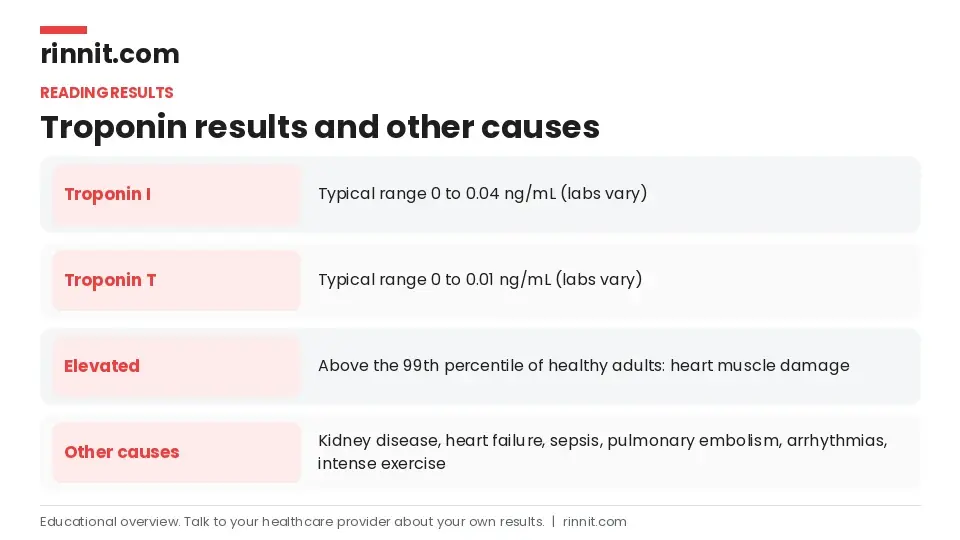
In healthy adults, troponin is very low or undetectable. Reference ranges vary by lab and test type, so always compare your result with the range on your own report. [1]
Test | Typical reference range |
Troponin I | 0 to 0.04 ng/mL |
Troponin T | 0 to 0.01 ng/mL |
Sources: [1]
Some labs report results in nanograms per liter (ng/L) or picograms instead. A result is considered elevated when it is above the 99th percentile of healthy adults, allowing for the test's precision. A high level points to heart muscle damage, and your provider combines it with your symptoms, ECG, other tests and history to confirm or rule out a heart attack. [1]
When will I get results?
Results usually come back in one to two hours. Some people need more testing and care because of ongoing symptoms, while others may be well enough to go home. [1]
When to get emergency care
A heart attack is an emergency. Call 911 or your local emergency number right away if you have chest pain or pressure, shortness of breath, or pain spreading to your arm, jaw or back. Do not wait to see if it passes.
Conclusion
The troponin test is one of the best tools for diagnosing a heart attack quickly and accurately. Modern high-sensitivity tests are faster and more precise than older versions, which helps your team give the right care sooner. [1]
A high troponin does not always mean a heart attack, and a single normal value is often repeated to be sure. Your provider will explain what your numbers mean in your situation. If you were tested while traveling, you can ask for your results to be shared with your regular provider. [1]
Keep learning: Read our guide to the electrocardiogram (EKG) or our guide to NSTEMI heart attacks. For more trusted, doctor-reviewed health guides, visit Rinnit.com.
FAQ
What is a troponin test?
It is a blood test that measures troponin, a heart muscle protein that leaks into the blood when the heart is damaged. [1]
What is a normal troponin level?
Troponin is normally very low or undetectable. Typical ranges are 0 to 0.04 ng/mL for troponin I and 0 to 0.01 ng/mL for troponin T, but labs vary. [1]
What does a high troponin level mean?
It means heart muscle damage, most often from a heart attack, though other conditions can also raise it. [1]
How soon does troponin rise after a heart attack?
It usually rises within 3 to 12 hours and peaks about 24 hours later. [1]
Can troponin be high without a heart attack?
Yes. Kidney disease, heart failure, sepsis, pulmonary embolism, arrhythmias, heart inflammation and intense exercise can raise it. [1]
Why is the troponin test repeated?
Comparing levels over time shows whether they are rising, which helps confirm heart damage and judge how severe it is. [1]
Do I need to prepare for a troponin test?
Usually not, but tell your provider if you take biotin, because it can affect the result. [1]
How long do troponin results take?
Results usually come back in one to two hours. [1]
How long does troponin stay high?
Troponin I stays high for at least 5 to 7 days, and troponin T for up to 3 weeks. [1]
What is the difference between troponin I and troponin T?
Troponin I is found only in heart muscle, while the heart's troponin T has a unique structure and stays high longer. [1]
Related Reading
Cardiac Blood Tests: Heart Disease Risk Tests and Ideal Levels explains the blood tests used to estimate heart disease risk.
Enzyme Markers: Blood Tests for Heart, Liver and Muscle Damage explains blood tests that detect heart, liver and muscle damage.
Understanding STEMI: The Severe Heart Attack explains the most severe type of heart attack, the main condition a troponin test helps confirm.
NSTEMI Heart Attack: Essential Guide to Symptoms, Risks, and Recovery covers heart attacks that rely heavily on troponin results for diagnosis.
What Is Myocarditis? A Plain-Language Guide to the Heart Muscle Inflammation That Often Hides explains heart muscle inflammation, one of the other causes of high troponin.
Congestive Heart Failure: Symptoms, Stages, and How It's Treated covers heart failure, a condition that can raise troponin levels.
Pulmonary Embolism Guide: Symptoms, Causes, Diagnosis, and Treatment explains blood clots in the lungs, which can also raise troponin.
Sepsis: Complete Guide to Symptoms, Causes, Risks, and Treatment covers sepsis, a severe infection that can strain the heart and raise troponin.
Chronic Kidney Disease: What It Is, Its 5 Stages, Causes, and How It's Treated explains chronic kidney disease, a known cause of higher troponin levels.
Heart Arrhythmia: Symptoms, Types, Causes, Diagnosis & Treatment — Complete Guide covers irregular heart rhythms, which can also raise troponin.
References
Cleveland Clinic. Troponin Test: What it Is and Normal Range. Cleveland Clinic. Last updated March 17, 2022. https://my.clevelandclinic.org/health/diagnostics/22770-troponin-test
Shah ASV, Anand A, Sandoval Y, et al. High-sensitivity cardiac troponin I at presentation in patients with suspected acute coronary syndrome: a cohort study. Lancet. 2015;386(10012):2481-2488. PMID 26454362. https://doi.org/10.1016/S0140-6736(15)00391-8
Pickering JW, Than MP, Cullen L, et al. Rapid Rule-out of Acute Myocardial Infarction With a Single High-Sensitivity Cardiac Troponin T Measurement Below the Limit of Detection: A Collaborative Meta-analysis. Ann Intern Med. 2017;166(10):715-724. PMID 28418520. https://doi.org/10.7326/M16-2562
Medical disclaimer
This article is for general education only and does not replace advice from a qualified healthcare professional. Talk to your doctor about your own diagnosis and treatment, and seek emergency care right away for severe or sudden symptoms.



Comments