Understanding Lymphocytes: The Specialized Defense of Your Immune System

Updated: 3 days ago
Medically reviewed by Dr. Baraa Alnahhal, MD · Last reviewed: October 2026
Lymphocytes are a type of white blood cell that helps your immune system fight cancer and foreign viruses and bacteria. They circulate through your blood and your lymphatic system, and your lymphocyte count can be checked with a routine blood test [1].
Quick Answer: What are lymphocytes?
Lymphocytes are white blood cells that play a central role in the immune system, making up about 20% to 40% of white blood cells. The two main types are T cells, which control immune responses and attack infected cells, and B cells, which make antibodies. Memory cells remember past invaders, which is why vaccines work. Abnormal counts usually reflect infection. [1]
What the research says
A low lymphocyte count is common among hospital patients and signals higher risk. In a systematic review and meta-analysis of 15 observational studies, 38% (95% CI 34% to 42%) of all-cause hospital admissions had lymphopenia. It was linked to higher in-hospital mortality (relative risk 2.44; 95% CI 1.71 to 3.47) and septic shock (relative risk 2.72; 95% CI 1.02 to 7.21), but not to an infection diagnosis at admission (Elcioglu et al., BMC Infect Dis, 2023 [2]).
Higher lymphocyte counts during cancer radiotherapy were linked to better survival. In a model-based meta-analysis of 35 studies, patients without lymphopenia one month after starting radiotherapy had a modeled 10.28% higher 24-month progression-free survival and 3.92% higher overall survival, and the figures were 5.82% and 2.78% for those without lymphopenia at 6 months. These are model estimates from observational data, not trial results (Pham et al., Comput Biol Med, 2025 [3]).
Workplace stress was linked to lower overall immunity, but not clearly to white blood cell counts. In a meta-analysis of 7 studies with 9,952 participants, greater effort-reward imbalance at work was associated with lower immunity (r = -0.09; 95% CI -0.14 to -0.05), while the link with white blood cell (leukocyte) measures was not significant (r = -0.02; 95% CI -0.04 to 0.01) (Eddy et al., J Psychosom Res, 2016 [4]).
What Are Lymphocytes?
Lymphocytes are a type of white blood cell and an important part of your immune system, which is an intricate web of immune cells, lymph nodes, lymph tissue, and lymphatic organs. About 20% to 40% of your white blood cells are lymphocytes. They help your immune system recognize foreign substances called antigens, such as viruses and bacteria, and fight them [1].
Lymphocytes are found in your blood and in all parts of your lymphatic system, including the lymph and lymph nodes. There are two main types, and they work together [1]:
Feature | T lymphocytes (T cells) | B lymphocytes (B cells) |
|---|---|---|
Primary role | Control the immune response and directly attack infected and tumor cells | Make antibodies |
Where they mature | Develop in the bone marrow, then travel to the thymus gland | Develop in the bone marrow, then travel to lymph nodes and organs |
Key function | Help kill infected cells and tumor cells | Antibodies target viruses, bacteria, and other foreign invaders |
Memory | Some activated cells become memory cells | Memory B cells multiply and quickly produce the right antibody on re-exposure |
What are the types and functions of lymphocytes?
Your immune system relies on the coordinated work of different lymphocyte types. They identify threats and mount a precise response [1].
T Lymphocytes (T Cells)
T cells help kill infected cells and control your body's immune response to foreign substances. Most T cells need the help of another immune cell to become activated. Once activated, they multiply and specialize into different types [1]:
Cytotoxic (killer) T cells: attach to antigens on infected or abnormal cells, then kill them by making holes in their cell membranes and inserting enzymes into them.
Helper T cells: help your other immune cells. Some help B cells make antibodies against invaders, and others help activate cytotoxic T cells.
Regulatory (suppressor) T cells: make substances that help end the immune response to an attack and sometimes prevent harmful responses.
B Lymphocytes (B Cells)
B cells have receptors on their surfaces where antigens attach. They learn to recognize different antigens and produce a specific antibody to attack each one. B cells respond in two ways [1]:
Primary immune response: when an antigen attaches to a receptor, some B cells change into memory cells and others change into plasma cells. Plasma cells make an antibody specific to that antigen, and producing enough of it can take several days.
Secondary immune response: if your B cells meet the same antigen again, the memory cells remember it, multiply, change into plasma cells, and quickly produce the correct antibody.

Lymphocytes have a large nucleus and divide into T cells (cytotoxic, helper, regulatory) and B cells (plasma, memory).
Where do lymphocytes come from, and what do they look like?
Lymphocytes develop in your bone marrow and then mature and exit into your bloodstream. Some travel to your thymus gland and become T cells, while others travel to your lymph nodes and organs and become B cells [1].
Lymphocytes are bigger than red blood cells, but they are still microscopic. Each has a large, dark purple nucleus at its center, surrounded by purplish, jelly-like cytoplasm [1].
What do counts of lymphocytes in the blood mean?
Lymphocyte levels vary depending on your age, race, sex, altitude, and lifestyle [1].
Group | Normal lymphocyte range (per microliter of blood) |
|---|---|
Adults | 1,000 to 4,800 |
Children | 3,000 to 9,500 |
High Lymphocyte Levels (Lymphocytosis)
A high lymphocyte count is called lymphocytosis. It is usually due to an infection or illness, because your body sometimes makes extra lymphocytes to help fight them. But more serious conditions can also cause it, including [1]:
Hepatitis, syphilis, mononucleosis, tuberculosis, and HIV/AIDS
Underactive thyroid (hypothyroidism)
Infections such as whooping cough, toxoplasmosis, or cytomegalovirus
Blood cancers such as lymphoma or leukemia
Low Lymphocyte Levels (Lymphocytopenia)
A low count is called lymphocytopenia, or lymphopenia. The flu or other mild infections can cause it, but it can also result from more serious conditions, including [1]:
HIV/AIDS, tuberculosis or typhoid fever, and viral hepatitis
Blood diseases such as Hodgkin's disease
Autoimmune diseases such as lupus
Rare inherited conditions such as severe combined immunodeficiency (SCID), ataxia-telangiectasia, DiGeorge syndrome, and Wiskott-Aldrich syndrome
Radiation or chemotherapy treatments
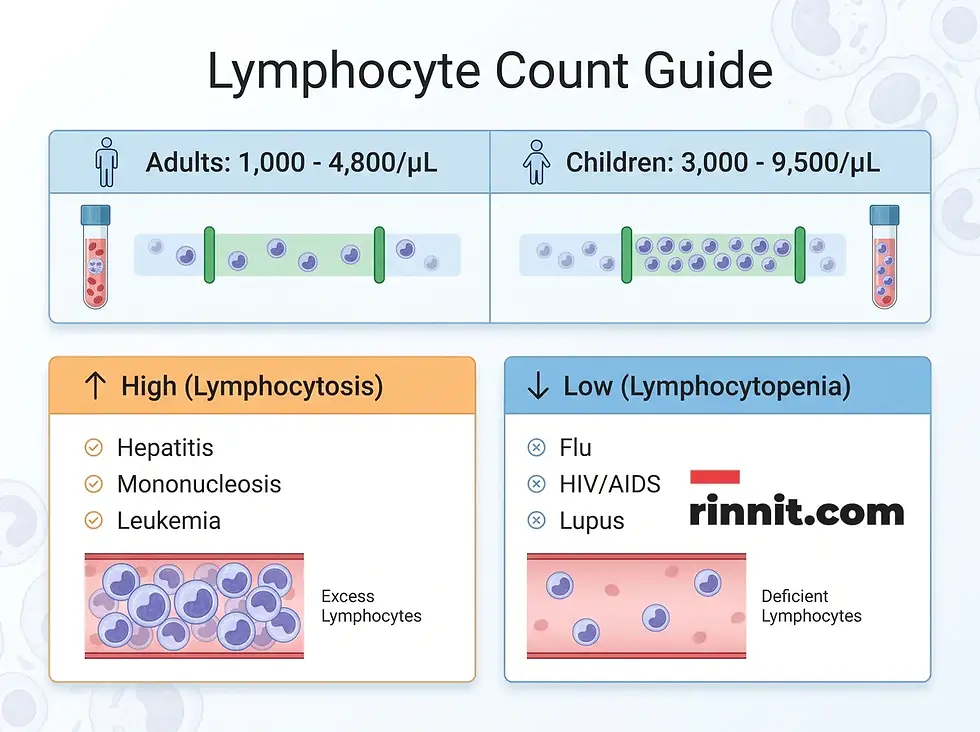
Normal lymphocyte ranges for adults and children, with common causes of high and low counts.
Tests That Check Your Lymphocytes
Two blood tests can tell you the number of lymphocytes in your blood [1]:
Absolute lymphocyte count: part of a complete blood count (CBC), it gives the number of cells as an absolute number instead of a percentage. You can get it by multiplying your total white blood cell count by the percentage of white blood cells that are lymphocytes.
Flow cytometry: your blood is processed in a special laboratory and sent through a laser instrument that scatters light into patterns that make the different cell types easy to see and count.
What are the warning signs of an abnormal lymphocyte count?
High or low levels of lymphocytes usually cause no symptoms on their own, but a blood disorder or cancer behind a high count may cause warning signs such as swollen lymph nodes, night sweats or fever. But if a blood disorder or cancer causes a high count, you may have symptoms of that disease, which can include [1]:
Swollen lymph nodes
Night sweats and fever
Abdominal pain and loss of appetite
Shortness of breath
How can you support your lymphocytes and immune health?
Lymphocyte counts cannot be raised by any proven self-care method, but vaccination, routine blood work and asking your provider about out-of-range results are the best-supported steps. These steps are the best supported [1][4]:
Get vaccinated: after an encounter with an antigen, memory lymphocytes recognize it and respond quickly, which is why getting vaccinated can prevent certain diseases [1].
Keep up with routine blood work: your lymphocyte count can be taken during a normal blood test at your provider's office [1].
Ask your provider about out-of-range results: many times, a high or low number means your body has been helping you fight an infection, and your provider can find the underlying cause [1].
Maintain healthy daily habits: balanced nutrition and stress management support your overall well-being, although the evidence that stress directly changes lymphocyte counts is limited [4].

Balanced nutrition, stress management, regular check-ups, and vaccination support overall immune health.
What is the bottom line on lymphocytes?
Lymphocytes are the specialized defenders of your immune system. T cells directly attack infected and tumor cells and control the immune response, B cells make antibodies, and memory cells give your body long-term protection against infections you have already met. Knowing your lymphocyte count is a simple way to keep an eye on your overall immune health [1].
Your next step: if you have swollen lymph nodes, night sweats, fever, or other symptoms that don't go away, or if your lymphocyte count is out of range, talk with your healthcare provider about next steps, which may include a complete blood count (CBC) [1].
Frequently Asked Questions
What is the main function of lymphocytes?
Lymphocytes' primary role is to help your immune system fight cancer and foreign invaders such as viruses and bacteria.
What is the difference between T cells and B cells?
T cells control the immune response and directly attack and kill infected cells and tumor cells, while B cells make antibodies that target viruses, bacteria, and other foreign invaders.
What causes a high lymphocyte count?
A high lymphocyte count is usually due to an infection or illness, such as mononucleosis or hepatitis, but more serious conditions such as lymphoma or leukemia can also cause it.
Is a low lymphocyte count serious?
The flu or other mild infections can lower the count, but low levels can also be caused by more serious conditions such as HIV/AIDS, autoimmune diseases like lupus, inherited immune deficiencies, or radiation and chemotherapy.
How are lymphocytes measured?
Lymphocytes are measured with an absolute lymphocyte count, which is part of a complete blood count (CBC), or with a test called flow cytometry.
Where are lymphocytes produced?
Lymphocytes develop in the bone marrow. Some travel to the thymus gland and become T cells, while others travel to the lymph nodes and organs and become B cells.
What do lymphocytes look like under a microscope?
Lymphocytes are bigger than red blood cells but still microscopic, with a large, dark purple nucleus at the center surrounded by purplish, jelly-like cytoplasm.
How do lymphocytes remember infections?
After an encounter with an antigen, some lymphocytes turn into memory cells. When memory cells meet the same antigen again, they recognize it and respond quickly, which is why you don't get infections like measles or chickenpox more than once and why vaccines work.
Can stress affect my lymphocyte count?
Long-term workplace stress has been linked to lower measures of immune function, but in one meta-analysis the link with white blood cell measures was not significant, so it is not certain that stress changes your lymphocyte count.
Do lymphocytes fight cancer?
Yes. Lymphocytes help your immune system fight cancer, and T cells directly attack and kill tumor cells.
Related Reading
Lymphopenia: Low Lymphocyte Count, Causes, Symptoms and Treatment explains what a low lymphocyte count means and how it is treated.
Regulatory T Cells: Function, Development and Immune Regulation describes the T cells that keep immune responses in check.
Complete Blood Count (CBC): What It Measures, Normal Ranges and Abnormal Results explains the routine blood test that measures lymphocyte counts.
Chronic Lymphocytic Leukemia: Symptoms, Diagnosis, Treatment and Support covers a common adult blood cancer that starts in lymphocytes.
References
Cleveland Clinic. Lymphocytes. Cleveland Clinic. June 20, 2022. https://my.clevelandclinic.org/health/body/23342-lymphocytes
Elcioglu ZC, Errington L, Metes B, et al. Pooled prevalence of lymphopenia in all-cause hospitalisations and association with infection: a systematic review and meta-analysis. BMC Infect Dis. 2023;23(1):848. PMID 38042792. https://doi.org/10.1186/s12879-023-08845-1
Pham TN, Coupey J, Thariat J, et al. Impact of circulating lymphocyte kinetics following radiotherapy on patient survival: a model-based meta-analysis. Comput Biol Med. 2025;186:109702. PMID 39864332. https://doi.org/10.1016/j.compbiomed.2025.109702
Eddy P, Heckenberg R, Wertheim EH, et al. A systematic review and meta-analysis of the effort-reward imbalance model of workplace stress with indicators of immune function. J Psychosom Res. 2016;91:1-8. PMID 27894456. https://doi.org/10.1016/j.jpsychores.2016.10.003
Medical disclaimer
This article is for informational purposes only and is not a substitute for professional medical advice, diagnosis, or treatment. The clinical information in this guide reflects source material last reviewed in June 2022.



Comments