Pelvic Exam: What to Expect, How to Prepare and What It Checks

Updated: 4 days ago
Written and medically reviewed by Dr. Baraa Alnahhal, MD · Last reviewed: November 2026 · How we review
Quick Answer: What is a pelvic exam?
A pelvic exam is a routine physical exam of your reproductive organs, including the vulva, vagina, cervix, uterus, fallopian tubes and ovaries. A provider looks at and gently feels these organs to check for infections, growths or other problems, and may do a Pap test at the same visit. It usually takes about 10 minutes and shouldn't be painful. [1]
What the research says
Routine exams in women without symptoms have limited proven benefit. A review for the US Preventive Services Task Force found no trials showing that screening pelvic exams reduce deaths or illness; in four ovarian cancer studies (26,432 women), positive predictive value was 0% to 3.6%. (Guirguis-Blake et al., JAMA, 2017) [2]
Many exams in teens may be unnecessary. In a national survey of 3,410 US females aged 15 to 20, about 2.6 million had a bimanual pelvic exam in the past year, and 54.4% of these exams were potentially unnecessary. (Qin et al., JAMA Internal Medicine, 2020) [3]
Key takeaways
A pelvic exam checks the vulva, vagina, cervix, uterus, fallopian tubes, ovaries and bladder. [1]
Your first pelvic exam is usually by age 21; how often you need one depends on your health. [1]
No special preparation is needed, but avoid putting anything in the vagina for 24 hours before. [1]
It takes about 10 minutes; some pressure is normal, but tell your provider if it hurts. [1]
A pelvic exam is not the same as a Pap test, though both can happen at one visit. [1]
What does a pelvic exam check?
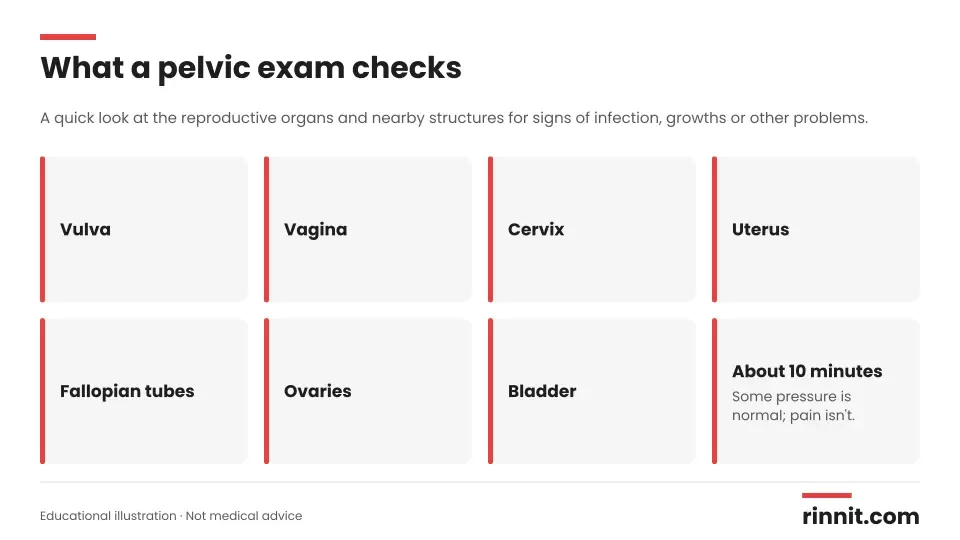
A pelvic exam is a fast, safe way for your provider to make sure your pelvic organs look and feel healthy. The organs checked include your: [1]
Vulva
Vagina
Cervix
Uterus
Fallopian tubes
Ovaries
Bladder
Gynecologists do most pelvic exams, but some primary care physicians and nurse practitioners do them too. [1]
Pelvic exam vs Pap test
A pelvic exam is a physical check of your pelvic organs. A Pap test is one specific test, often done during a pelvic exam, that collects cells from your cervix to look for cervical cancer or precancerous changes. Not every pelvic exam includes a Pap test. [1]
Why do you need a pelvic exam?
Pelvic exams are part of routine care and can also find the cause of symptoms. You should have your first pelvic exam by age 21, and then every year or every few years based on your age, health risks and other factors. Your provider may also recommend one for: [1]
A family history of ovarian or cervical cancer
A history of HPV or abnormal Pap test results
Pelvic pain or pain during sex
Unusual vaginal discharge
Irregular bleeding or bleeding between periods
Checking for uterine fibroids or ovarian cysts
Concerns about sexually transmitted infections (STIs)
Pregnancy
Checking the fit of an intrauterine device (IUD)
Who needs a pelvic exam, and how often?
Pelvic exams are often done between ages 21 and 65, but for people without symptoms, experts disagree on routine exams, so decide with your provider. People who have transitioned but have not completed female-to-male surgery still have these organs and need exams to check for problems, STIs and cancer. [1]
Recommendations on how often vary. Some providers suggest a yearly visit, and others every three years until age 65. Ask your provider what's right for you. [1]
How do you prepare for a pelvic exam?
You don't need to do anything special. Helpful steps include: [1]
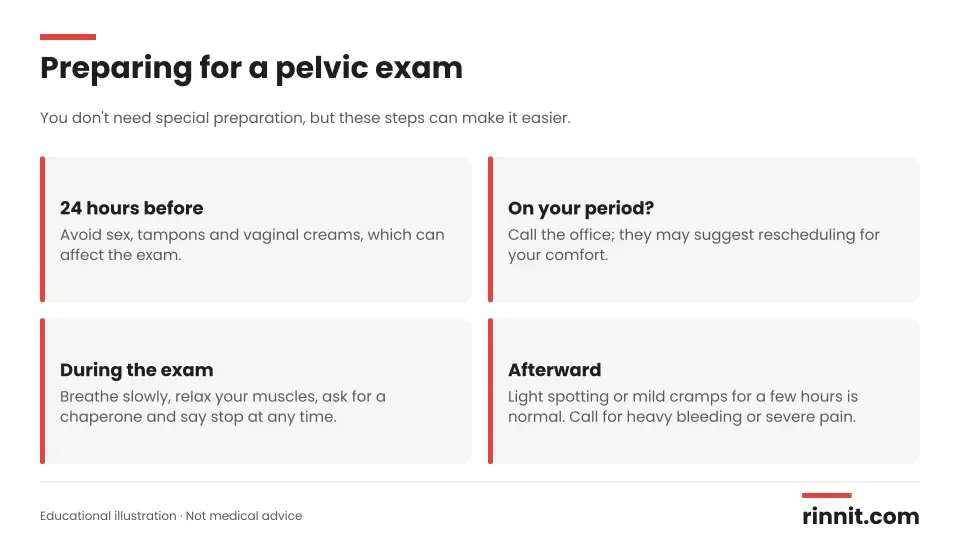
Avoid putting anything in your vagina for 24 hours before, including sex, tampons and vaginal creams
If you're on your period on exam day, call the office; they may suggest rescheduling for your comfort
Empty your bladder before the exam; you may be asked for a urine sample
If it's your first exam, tell the office when you book and remind your provider at the visit
You can choose the provider who does your exam, for example a female provider if you prefer. [1]
What happens during a pelvic exam?
First, your provider asks about your health history and any symptoms or concerns. Then you undress in private, put on a gown and cover your lap with a sheet. You lie back with your hips at the edge of the table and your feet in holders called stirrups, letting your knees fall outward. [1]
A pelvic exam may include: [1]
Part | What happens |
External exam | The provider looks at the vulva and vagina for infection, irritation or abnormal discharge |
Speculum exam | A speculum gently widens the vagina so the walls and cervix can be seen |
Pap and HPV tests | A small brush or wand collects cervical cells to screen for cervical cancer and high-risk HPV |
Manual (bimanual) exam | One or two gloved fingers go inside the vagina while the other hand presses on the belly to feel the uterus and ovaries |
Rectovaginal exam | A finger in the rectum checks for tumors or other problems behind the uterus |
Sources: [1]
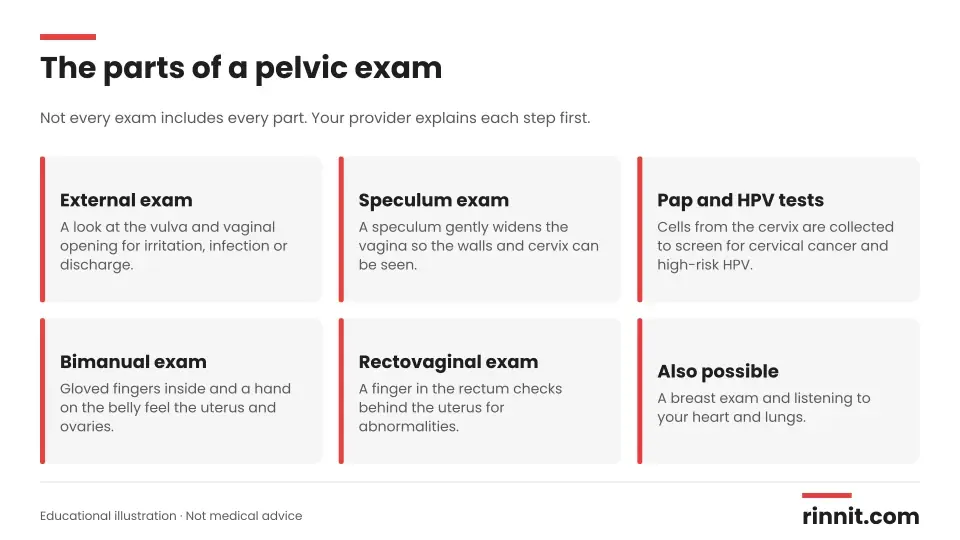
Your provider may also listen to your heart and lungs and do a breast exam. A chaperone may be in the room, and you can ask for one, or bring a friend, partner or family member. [1]
Is a pelvic exam painful?
You may feel a little discomfort or pressure, especially during the manual exam and when the speculum opens, but it shouldn't hurt. Tell your provider if you feel pain; they may be able to adjust the speculum. To relax: [1]
Take slow, deep breaths
Relax your shoulders, belly and leg muscles
Ask your provider to explain each step before doing it
If you have experienced sexual trauma, tell your provider before the exam so they can support you. You can stop the exam at any time. [1]
What can a pelvic exam find?
A pelvic exam helps your provider check for: [1]
Cervical cancer: A Pap test looks for cell changes that could become cancer.
Ovarian cancer: The provider feels for unusual lumps or changes in the size or shape of the ovaries.
STIs: Swabs can test for chlamydia and gonorrhea, and warts or sores can be seen.
Pelvic inflammatory disease (PID): Signs such as unusual discharge or pelvic pain.
It can also help find the cause of irregular bleeding or pelvic pain. [1]
After the exam and results
Light spotting for a few hours is normal, and mild cramping may occur. Call your provider if you have heavy bleeding or severe cramping or pain. [1]
Your provider can share some findings during the visit. Pap and HPV test results usually take several days. Pelvic exams are considered very safe. [1]
Conclusion
A pelvic exam can feel personal and awkward, but it's quick, safe and one of the main ways your provider checks your reproductive health, including for infections and cancers. [1]
If you feel nervous, say so before the exam starts. Ask your provider how often you need one based on your age and history, and don't skip care if you have pelvic pain, unusual discharge or bleeding.
Keep learning: Read our guide to cervical cancer or learn about ovarian cysts. For more background, see ACOG's FAQ on pelvic exams.
FAQ
What is a pelvic exam?
It is a physical exam of the vulva, vagina, cervix, uterus, fallopian tubes, ovaries and bladder to check for problems. [1]
Is a pelvic exam the same as a Pap smear?
No. A Pap test collects cervical cells to screen for cancer and is often done during a pelvic exam, but they are different. [1]
At what age should I have my first pelvic exam?
You should have your first pelvic exam by age 21, or earlier if your provider recommends it. [1]
How often do I need a pelvic exam?
It varies; some providers suggest yearly and others every three years until 65, based on your history and symptoms. [1]
How do I prepare for a pelvic exam?
Avoid sex, tampons and vaginal creams for 24 hours, and call ahead if you're on your period. [1]
How long does a pelvic exam take?
A pelvic exam usually takes about 10 minutes. [1]
Does a pelvic exam hurt?
It may cause some pressure or discomfort but shouldn't be painful; tell your provider if it hurts. [1]
Is bleeding after a pelvic exam normal?
Light spotting for a few hours is normal; call your provider if bleeding is heavy. [1]
Do I need a pelvic exam during pregnancy or after menopause?
Yes. You'll usually have one at your first prenatal visit, and your provider will advise how often you need them after menopause. [1]
Can I have a chaperone during a pelvic exam?
Yes. You can ask for a chaperone or bring a friend, partner or family member. [1]
Related Reading
Cervical Cancer: Symptoms, Screening, Diagnosis, Treatment and Support explains the cancer that a Pap test during a pelvic exam screens for.
Ovarian Cysts: Symptoms, Causes, and Treatment Options Explained covers growths a pelvic exam can help find.
Pelvic Inflammatory Disease: Symptoms, Causes & Treatment — A Clear Guide explains an infection a pelvic exam can detect.
What Is Bacterial Vaginosis? Symptoms, Causes, and Treatment covers a common cause of unusual vaginal discharge.
Ovarian Cancer: Symptoms, Causes, and Treatment — A Clear Guide to Understanding and Managing the Disease explains why a provider feels for changes in the ovaries.
References
Cleveland Clinic. Pelvic Exam: Procedure Details, Schedule & Results. Cleveland Clinic. Last updated May 28, 2024. https://my.clevelandclinic.org/health/diagnostics/17343-pelvic-exam
Guirguis-Blake JM, Henderson JT, Perdue LA. Periodic Screening Pelvic Examination: Evidence Report and Systematic Review for the US Preventive Services Task Force. JAMA. 2017;317(9):954-966. PMID 28267861. https://doi.org/10.1001/jama.2016.12819
Qin J, Saraiya M, Martinez G, Sawaya GF. Prevalence of Potentially Unnecessary Bimanual Pelvic Examinations and Papanicolaou Tests Among Adolescent Girls and Young Women Aged 15-20 Years in the United States. JAMA Intern Med. 2020;180(2):274-280. PMID 31904768. https://doi.org/10.1001/jamainternmed.2019.5727
Medical disclaimer
This article is for general education only and does not replace advice from a qualified healthcare professional. Talk to your doctor about your own diagnosis and treatment, and seek emergency care right away for severe or sudden symptoms.



Comments