Due Date Calculator: How Your Pregnancy Due Date Is Calculated

Updated: 5 days ago
Written and medically reviewed by Dr. Baraa Alnahhal, MD · Last reviewed: November 2026 · How we review
Quick Answer: What is a due date calculator?
A due date calculator estimates the day your baby is likely to be born. The most common at-home method counts 40 weeks forward from the first day of your last menstrual period, while conception and IVF transfer dates use shorter counts. An early ultrasound from your pregnancy care provider gives the most reliable, official due date. [1]
What the research says
Early ultrasound predicts the delivery day better than period dates. In 17,221 singleton pregnancies scanned at 8-16 weeks, ultrasound beat a certain last-period date by at least 1.7 days at every stage, and using it cut the share of pregnancies labeled post-term from 10.3% to 2.7%. (Taipale et al., Obstetrics and Gynecology, 2001) [2]
Natural pregnancy length varies by more than a month. In 125 natural pregnancies with a known ovulation date, the median time from ovulation to birth was 268 days (38 weeks, 2 days), and term pregnancies still spanned a 37-day range. (Jukic et al., Human Reproduction, 2013) [3]
Many babies arrive after the due date. Among 21,451 pregnancies dated by second-trimester ultrasound, 22.9% were still ongoing 7 days after the estimated due date and 3.6% were still ongoing 14 days after it. (Kessler et al., Acta Obstetricia et Gynecologica Scandinavica, 2019) [4]
Key takeaways
Only about 4% of babies are born on their exact due date, so treat it as an estimate, not an appointment. [1]
Counting 40 weeks from the first day of your last period is the most reliable at-home method. [1]
From a known conception date, count 38 weeks (266 days); after IVF, count 261 or 263 days from the transfer, depending on embryo age. [1]
An ultrasound at your first prenatal visit gives the most accurate date, and your provider's date is the official one. [1, 2]
Your due date can shift by a few days after an ultrasound, and a pregnancy is considered full term after 37 weeks. [1]
What is a due date, and why does it matter?
A due date, also called an estimated due date, is the day your baby is predicted to be born. It is built on the fact that a baby takes about 38 weeks, or 266 days, to develop after conception. [1]
Babies rarely follow the calendar exactly. Labor can start before or after the due date, and many factors influence when it begins. [1]
Knowing your due date still matters. It gives your pregnancy care provider a schedule for checking milestones, timing prenatal vitamins and screenings, and tracking your baby's size and position to confirm normal growth. [1]
It also helps you plan practical steps, such as packing a hospital bag, buying a car seat and preparing older children for a new sibling. [1]
How is a due date calculated?
There are two main ways to estimate a due date at home: from the first day of your last period or from the day you conceived. If you had IVF, the embryo transfer date is used instead. Your provider then confirms the date with an ultrasound. [1]

Each method starts from a different day, which is why each one adds a different number of days.
Method | Starting point | What to add | How reliable |
Last menstrual period (LMP) | First day of your last period | 40 weeks (280 days) | Most reliable at-home method |
Naegele's rule | First day of your last period | 7 days, minus 3 months | Assumes a 28-day cycle |
Conception date | Day you conceived | 38 weeks (266 days) | Less accurate; exact day is hard to know |
IVF, day-5 transfer | Embryo transfer date | 261 days | Confirmed by your provider |
IVF, day-3 transfer | Embryo transfer date | 263 days | Confirmed by your provider |
Ultrasound | Size of the fetus | Provider measures gestational age | Most reliable overall |
Sources: [1]
How do you calculate your due date from your last period?
Find the first day of your last menstrual period and count forward 40 weeks. This is the most reliable method you can use at home, partly because many people already track their periods in an app or calendar. [1]
The method is less dependable if your periods are irregular or if you were using birth control around the time you conceived. [1]
What is Naegele's rule?
Naegele's rule is a shortcut for the same 40-week count. It assumes you have a regular 28-day cycle. [1]
Write down the first day of your last period.
Add 7 days.
Subtract 3 months.
Add 1 year if the result falls in the next calendar year.
For example, if your last period began on February 1, adding 7 days gives February 8. Subtracting 3 months gives a due date of November 8. [1]
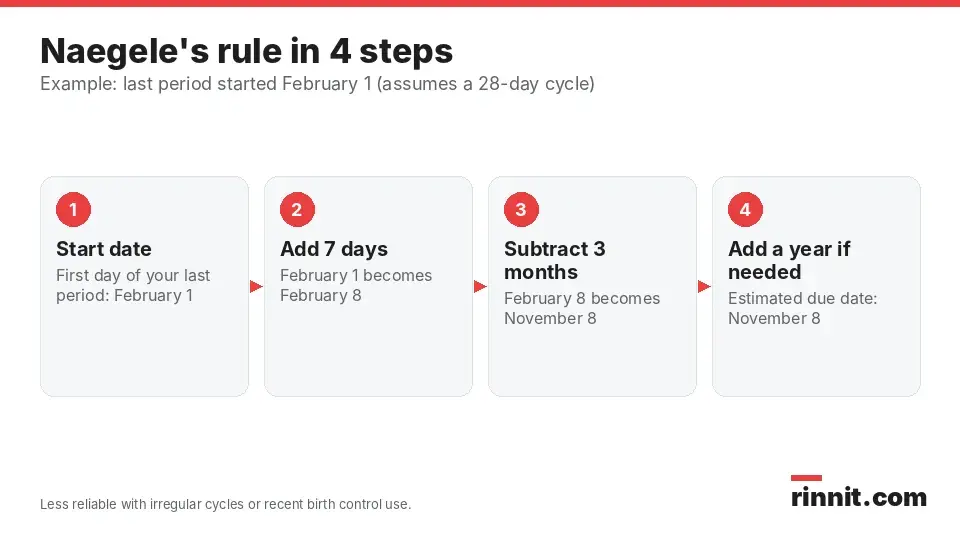
The worked example below applies the same steps to several start dates.
Worked examples of Naegele's rule
First day of last period | Add 7 days | Subtract 3 months | Estimated due date |
January 10, 2026 | January 17 | October 17 | October 17, 2026 |
February 1, 2026 | February 8 | November 8 | November 8, 2026 |
June 20, 2026 | June 27 | March 27 | March 27, 2027 (year added) |
October 5, 2026 | October 12 | July 12 | July 12, 2027 (year added) |
Sources: [1]
Can you calculate a due date from the conception date?
Yes. If you know the day you conceived, count 38 weeks (266 days) forward. [1]
This method is harder to use and less accurate, because you need to be sure of the exact day of conception. Knowing when you ovulated does not settle it: sperm can survive in the body for up to five days, and releasing an egg takes about 24 hours. [1]
Research that tracked ovulation with daily hormone tests found a median of 268 days from ovulation to birth, close to the 266-day estimate. [3]
How is a due date calculated after IVF?
With IVF, the embryo transfer date replaces the period or conception date as the starting point. The count depends on how many days after egg retrieval the embryo was transferred. [1]
Your fertility or pregnancy care provider should confirm the final date. [1]
One pregnancy, every method
The table below shows how each method lands on the same due date for one example pregnancy. In a real pregnancy, the methods can give slightly different dates, and your provider sets the official one. [1]
Method | Starting date | Count | Estimated due date |
Last period | February 1, 2026 | + 280 days | November 8, 2026 |
Naegele's rule | February 1, 2026 | + 7 days, minus 3 months | November 8, 2026 |
Conception | February 15, 2026 | + 266 days | November 8, 2026 |
IVF, day-3 transfer | February 18, 2026 | + 263 days | November 8, 2026 |
IVF, day-5 transfer | February 20, 2026 | + 261 days | November 8, 2026 |
Sources: [1]
How does ultrasound dating work?
Your provider usually confirms your due date with an ultrasound at your first prenatal appointment. The scan measures the fetus to determine gestational age, which is how far along the pregnancy is. [1]
Ultrasound is the most reliable way to date a pregnancy, and the date your provider gives you should be treated as your official due date. [1]
If you don't know when your last period started, an ultrasound can still estimate how far along you are and set a due date. [1]
In a large study of early scans, ultrasound predicted the day of spontaneous delivery better than a certain last-period date, and the most precise early measurement had an average prediction error of about 7.3 days. [2]
How accurate is a due date calculator?
Any calculator gives an estimate, not a guarantee. Only about 4% of babies are born on their due date. [1]
At-home results are less reliable if:
You are unsure when your last period started.
Your periods are irregular.
You don't know when you conceived.
You were using birth control around the time of conception. [1]
Even when the starting date is known exactly, natural pregnancy length varies widely between people. [3]
Can your due date change?
Yes, and that is normal. An ultrasound may show that you are not as far along as you thought, or that a larger fetus means your due date should move a few days earlier. [1]
A pregnancy is considered term from 37 weeks and full term from 39 weeks, and your baby may arrive before or after the due date. [1]
Does carrying twins or triplets change the due date?
Providers calculate the due date for twins or triplets the same way, using your last period and ultrasound. [1]
Providers usually aim to deliver multiples at around 36 or 37 weeks, so these babies often arrive earlier than the due date suggests. [1]
Why are you four weeks pregnant two weeks after conceiving?
Pregnancy is counted from the first day of your last period, not from conception. Because a menstrual cycle is about four weeks long, you are already about four weeks pregnant by the time you miss a period. [1]
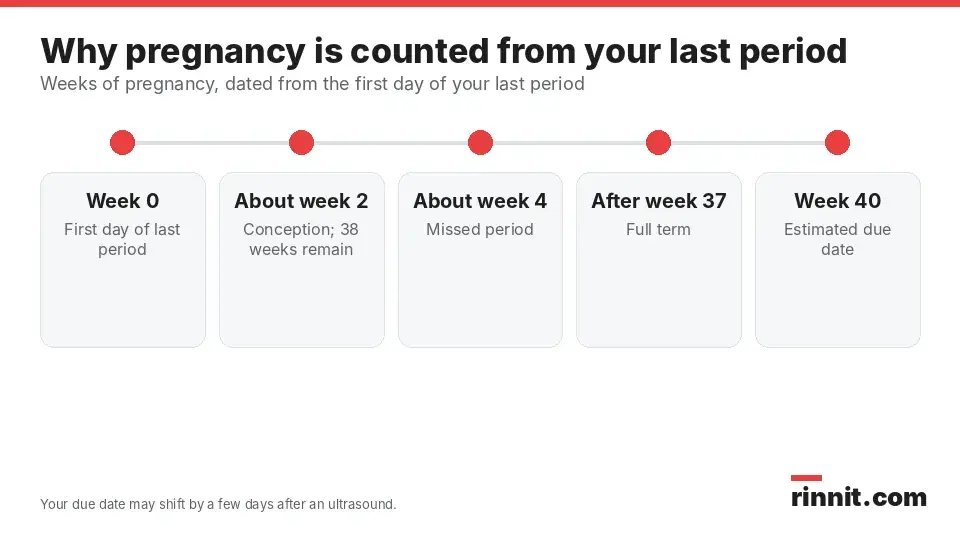
This timeline shows why the 40-week and 38-week counts end on the same day.
What is a reverse due date calculator?
A reverse due date calculator works backward. Subtract 266 days from your due date to estimate the day you conceived. [1]
For example, a due date of November 8, 2026, points to an estimated conception date of February 15, 2026. [1]
Conclusion
A due date is a planning tool built on simple counts: 40 weeks from your last period, 38 weeks from conception, or 261 to 263 days from an IVF transfer. These methods help you get a first estimate at home. [1]
Your provider's ultrasound-based date is the one to rely on, and it may shift by a few days as your pregnancy progresses. Since few babies arrive on the exact day, expect delivery any time around your due date once you reach full term. [1, 2]
Keep learning: Read the In Vitro Fertilization (IVF): A Comprehensive Patient Guide to understand embryo transfer timing, and Fetal Pole: Early Pregnancy Development and Ultrasound Sign to see what early pregnancy scans look for.
FAQ
What is a due date calculator?
A due date calculator estimates when your baby will be born, usually by counting 40 weeks from the first day of your last period. Your provider confirms the date with an ultrasound.
How do I calculate my due date from my last period?
Count 40 weeks forward from the first day of your last menstrual period. With Naegele's rule, add 7 days, subtract 3 months and add a year if needed.
How do I calculate my due date from the conception date?
Count 38 weeks (266 days) forward from the day you conceived. This method is less accurate because the exact day of conception is hard to know.
How is the due date calculated after IVF?
Count 261 days from a day-5 embryo transfer or 263 days from a day-3 transfer. Your provider should confirm the date.
What is the most accurate way to find my due date?
An ultrasound, usually done at your first prenatal visit, is the most reliable method. The scan measures the fetus to determine how far along you are.
How many babies are born on their due date?
Only about 4% of babies are born on their exact due date. Many arrive in the days before or after it.
Can my due date change?
Yes. An ultrasound may show you are less far along than expected, or a larger fetus may move the date a few days earlier, which is normal.
When is a pregnancy considered full term?
A pregnancy is considered term from 37 weeks and full term from 39 weeks. Babies can be born before or after the due date.
What if I don't know the date of my last period?
Your provider can perform an ultrasound to estimate how far along you are and set your due date. A provider's date is considered the most accurate.
Why am I four weeks pregnant if I conceived two weeks ago?
Pregnancy is dated from the first day of your last period, not conception. Because a cycle is about four weeks long, you are about four weeks pregnant when you miss a period.
How do I estimate my conception date from my due date?
Subtract 266 days from your due date. This reverse calculation gives an estimated conception date.
Related Reading
Abnormal Menstruation: Understanding Irregular Periods explains why cycles become irregular, one of the main reasons a last-period due date can be off.
Preterm Labor Guide: Symptoms, Causes, Diagnosis, and Treatment covers the warning signs of labor that starts well before your due date.
Premature Birth: Complete Guide to Signs, Causes, and Care explains what happens when a baby is born before 37 weeks and the care premature babies need.
High-Risk Pregnancy: Understanding Management, Factors, and Care covers pregnancies that need closer monitoring, where an accurate due date guides the timing of tests and delivery planning.
References
Cleveland Clinic. Due Date Calculator: How Many Weeks Pregnant Are You? Cleveland Clinic. Last updated May 31, 2024. https://my.clevelandclinic.org/health/diagnostics/22052-due-date-calculator
Taipale P, Hiilesmaa V. Predicting delivery date by ultrasound and last menstrual period in early gestation. Obstet Gynecol. 2001;97(2):189-94. PMID 11165580. https://doi.org/10.1016/s0029-7844(00)01131-5
Jukic AM, Baird DD, Weinberg CR, et al. Length of human pregnancy and contributors to its natural variation. Hum Reprod. 2013;28(10):2848-55. PMID 23922246. https://doi.org/10.1093/humrep/det297
Kessler J, Johnsen SL, Ebbing C, et al. Estimated date of delivery based on second trimester fetal head circumference: A population-based validation of 21 451 deliveries. Acta Obstet Gynecol Scand. 2019;98(1):101-105. PMID 30168856. https://doi.org/10.1111/aogs.13454
Medical disclaimer
This article is for general education only and does not replace advice from a qualified healthcare professional. Talk to your doctor about your own diagnosis and treatment, and seek emergency care right away for severe or sudden symptoms.



Comments