Abnormal Menstruation: Understanding Irregular Periods

Updated: 2 days ago
Medically reviewed by Dr. Baraa Alnahhal, MD · Last reviewed: October 2026
Quick Answer: Defining a "Normal" vs. "Irregular" Cycle
A normal menstrual cycle lasts 21 to 35 days, with bleeding for 4 to 7 days and mild to moderate cramping. A cycle is irregular if it is shorter than 21 or longer than 35 days, varies by more than 9 days, bleeds longer than 7 days, soaks a pad or tampon every hour, or causes severe pain.
Feature | Normal Range | Irregular Examples |
Cycle Length | 21 to 35 days (Average: 29) | Fewer than 21 or more than 35 days. |
Duration | 4 to 7 days | Lasting longer than 7 days. |
Predictability | Varies slightly cycle-to-cycle | Varies by more than 9 days between cycles. |
Menstrual Flow | Consistent with personal history | Soaking 1+ tampons/pads per hour. |
Pain Level | Mild to moderate cramping | Severe pain, nausea, or vomiting. |
What the research says
Antifibrinolytics such as tranexamic acid are among the most effective first-line options for heavy periods. A Cochrane overview and network meta-analysis of nine Cochrane reviews found that antifibrinolytics probably reduce menstrual blood loss by about 80 mL per cycle (mean difference −80.32 mL, 95% CI −127.67 to −32.98; moderate-certainty evidence), ranking second only to the levonorgestrel-releasing intrauterine system (Bofill Rodriguez et al., Cochrane Database Syst Rev, 2022).
Irregular cycles can signal more than a fertility issue. A systematic review and meta-analysis of 23 observational studies including 346,486 women linked oligo-amenorrhea or menstrual irregularity to a higher risk of overall cardiovascular disease (RR 1.29, 95% CI 1.09–1.53), coronary heart disease (RR 1.22) and heart attack (RR 1.37), with results broadly consistent after further adjustment for obesity. These are observational associations, not proof of cause (Lo et al., Eur Heart J Open, 2023).
What is Abnormal Menstruation?
Abnormal menstruation occurs when a person's menstrual cycle deviates significantly from the typical biological patterns. A standard menstrual cycle usually occurs every 28 days, though a range of 21 to 35 days is considered clinically normal. Most periods last between four and seven days. Irregularity is defined not by a single slight variation, but by persistent patterns such as missing three or more periods in a row, having cycles that are too frequent or too infrequent, or experiencing a flow that is dramatically heavier or lighter than your usual baseline [1].
Medical professionals use specific terms to categorize these irregularities. Amenorrhea refers to the complete absence of periods for 90 days or more (excluding pregnancy or menopause). Oligomenorrhea describes infrequent cycles that occur more than 35 days apart. Dysmenorrhea is the term for exceptionally painful periods, while Abnormal Uterine Bleeding covers prolonged bleeding or spotting between monthly cycles. Recognizing these distinctions helps in identifying the specific underlying cause [1].
What are the symptoms and signs of abnormal menstruation?
Abnormal menstruation shows up through changes in cycle timing, bleeding and pain that can signal something may be wrong. Beyond the timing of the cycle, the nature of the bleeding itself is a primary symptom. Heavy menstrual flow, characterized by soaking through a tampon or sanitary pad every hour, is a significant sign of abnormality. Similarly, bleeding or spotting that occurs between periods, after menopause, or following sexual intercourse should be carefully monitored [1].
Physical sensations also play a major role in identifying irregular menstruation. While some discomfort is normal, severe pain and cramping that are accompanied by nausea or vomiting are considered abnormal. Additionally, if the length of time between your cycles varies by more than nine days—for example, one cycle is 28 days and the next is 37—this lack of predictability is a hallmark of irregular menstruation. Tracking these symptoms over several months is essential for an accurate diagnosis [1].

What causes irregular periods, and who is at risk?
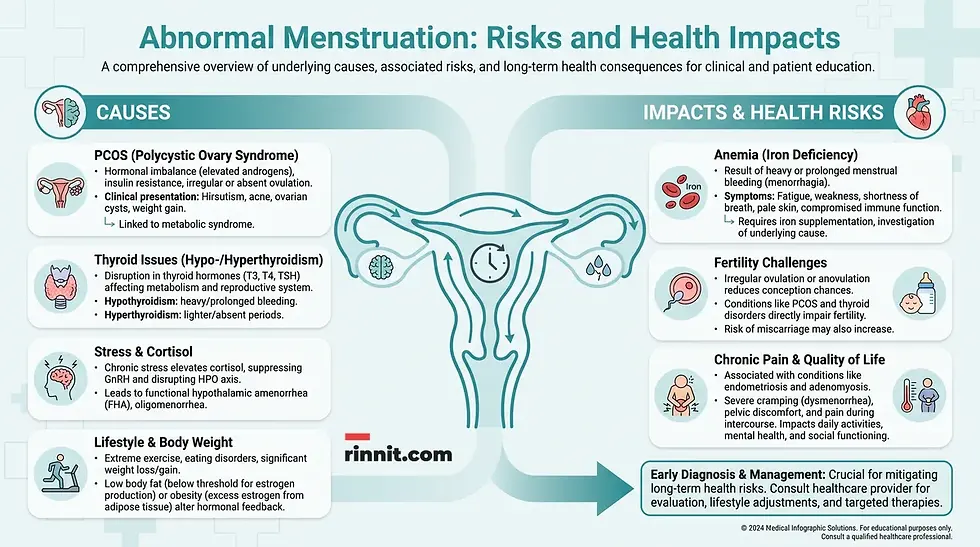
The causes of abnormal menstruation range from temporary lifestyle shifts to chronic medical conditions. Hormonal imbalances are the most frequent culprit, often driven by the thyroid or pituitary glands.
Medical Conditions: Polycystic Ovary Syndrome (PCOS) is a common cause where high androgen levels prevent regular ovulation. Endometriosis, Pelvic Inflammatory Disease (PID), and uterine fibroids or polyps can also disrupt the cycle and cause abnormal bleeding [1].
Lifestyle Factors: Significant stress, rapid weight gain or loss, and extreme exercise routines that lead to very low body fat can all cause the body to "shut down" menstruation temporarily.
Medications: Starting or stopping hormonal birth control is a major factor, as the body may take up to six months to regulate after discontinuing the pill. Other medications, like steroids or blood thinners, can also impact flow and timing [1].
How are irregular periods diagnosed and treated?
Diagnosing irregular periods begins with the patient. Healthcare providers strongly recommend keeping a detailed record of period start and end dates, flow intensity, and any symptoms like large clots or severe pain. During a consultation, a provider will perform a physical and pelvic exam and may order diagnostic tests. These can include a pelvic ultrasound to check for physical abnormalities like cysts or fibroids, an endometrial biopsy to sample the uterine lining, or a hysteroscopy to view the inside of the uterus directly [1].
Treatment is highly individualized and focuses on the underlying cause:
Hormonal Regulation: Birth control pills, rings, injections, or IUDs are often the first line of defense for regulating cycles and reducing heavy flow.
Medication: Specific drugs like tranexamic acid can be used to control heavy bleeding, while pain relievers help manage dysmenorrhea.
Addressing Root Causes: If a thyroid disorder or infection like PID is identified, treating those specific conditions often restores menstrual regularity [1].

What is the long-term outlook for irregular periods, and can they be prevented?
For most people, abnormal menstruation is a manageable condition. When lifestyle factors like stress or extreme exercise are the cause, cycles often return to normal once the body finds balance. In cases involving medical conditions like PCOS or endometriosis, long-term management through medication can successfully regulate the cycle and protect reproductive health. However, untreated irregularities can sometimes lead to complications, including anemia from heavy blood loss or difficulties with fertility [1].
Early detection is the most effective form of prevention. By maintaining a regular menstrual diary and seeking medical advice when persistent changes occur, individuals can address issues before they become severe. It is important to remember that while the occasional irregular period is rarely a cause for alarm, consistent patterns of abnormality deserve professional attention to ensure overall health and well-being [1].
Frequently Asked Questions
Is it normal for my period to be a few days late?
Yes. Slight variations in cycle length are normal and can be caused by minor stress, illness, or even travel. It is only considered "irregular" if the variation is persistent or significant.
Can stress really stop my period?
Yes. High levels of stress can interfere with the part of your brain that controls the hormones responsible for your cycle, leading to delayed or missed periods.
How many missed periods are a cause for concern?
Missing three or more periods in a row (if you are not pregnant) is considered abnormal and should be evaluated by a healthcare provider.
Can I get pregnant if my periods are irregular?
Yes, but it may be more difficult because irregular periods often mean you are not ovulating predictably.
Does "heavy flow" always mean something is wrong?
Not necessarily, but if you are soaking through a pad or tampon every hour or passing large blood clots, you should consult a doctor to rule out conditions like fibroids or anemia.
Why did my period change after I turned 40?
As you approach menopause (perimenopause), your hormone levels naturally fluctuate, which often causes cycles to become shorter, longer, or less predictable.
Can exercise be "too much" for my cycle?
Yes. Extreme physical training combined with low body fat can cause the body to stop producing the hormones needed for menstruation.
What is the difference between a polyp and a fibroid?
Both are growths in the uterus. Polyps are typically smaller and grow from the lining, while fibroids are made of muscle tissue and can grow quite large.
Can a thyroid problem cause irregular periods?
Absolutely. Both an overactive and underactive thyroid can significantly disrupt the hormonal balance required for a regular cycle.
Is spotting between periods normal?
Occasional spotting can happen, but persistent bleeding between cycles should be checked to rule out infections, polyps, or hormonal issues.
How does birth control help regulate periods?
Hormonal birth control provides a steady dose of hormones that overrides your natural cycle, creating a predictable withdrawal bleed.
What is PCOS?
Polycystic Ovary Syndrome is a hormonal disorder common among women of reproductive age that causes enlarged ovaries with small cysts on the outer edges.
Can an STI cause irregular periods?
Yes. Untreated STIs can lead to Pelvic Inflammatory Disease (PID), which often causes irregular bleeding and pelvic pain.
Should I track my period even if it's regular?
Yes. Having a baseline record makes it much easier to notice when something changes.
What should I bring to my doctor's appointment?
Bring your menstrual diary or tracking app data, a list of any medications you are taking, and a summary of your symptoms.
Conclusion
Abnormal menstruation is a common experience, but it should never be ignored when it becomes a persistent pattern. Whether the cause is a simple lifestyle change or a complex medical condition, modern diagnostic tools and treatments offer effective ways to restore regularity and protect your health. By staying informed and proactive, you can ensure that your menstrual health supports your overall well-being.
For more expert guides on reproductive health and wellness, visit Rinnit.com.
Medical Disclaimer
The information provided in this article is for educational purposes only and is not intended as medical advice. Always seek the advice of your physician or other qualified health provider with any questions you may have regarding a menstrual condition or reproductive health.
Related Reading
Due Date Calculator: How Your Pregnancy Due Date Is Calculated: Our due date calculator guide explains why irregular periods make a last-period due date less reliable and how ultrasound dating sets the official date.
References
Cleveland Clinic. Irregular Periods (Abnormal Menstruation): Causes & Treatment. Cleveland Clinic. Last updated January 18, 2023. https://my.clevelandclinic.org/health/diseases/14633-abnormal-menstruation-periods
Bofill Rodriguez M, Dias S, Jordan V, et al. Interventions for heavy menstrual bleeding; overview of Cochrane reviews and network meta-analysis. Cochrane Database Syst Rev. 2022;5(5):CD013180. PMID 35638592. https://doi.org/10.1002/14651858.CD013180.pub2
Lo ACQ, Lo CCW, Oliver-Williams C. Cardiovascular disease risk in women with hyperandrogenism, oligomenorrhea/menstrual irregularity or polycystic ovaries (components of polycystic ovary syndrome): a systematic review and meta-analysis. Eur Heart J Open. 2023;3(4):oead061. PMID 37404840. https://doi.org/10.1093/ehjopen/oead061



Comments