APOE Gene Test: What APOE4 Means for Alzheimer's Risk and How Testing Works

Updated: 2 days ago
Written and medically reviewed by Dr. Baraa Alnahhal, MD · Last reviewed: November 2026 · How we review
Quick Answer
The APOE gene test is a genetic test that shows which versions of the apolipoprotein E (APOE) gene you carry. Carrying APOE4 increases the risk of late-onset Alzheimer's disease, while APOE2 is linked to lower risk. It shows risk, not a diagnosis: many people with APOE4 never develop Alzheimer's. Genetic counseling before and after testing is recommended.
What the research says
APOE4 risk is large but varies by ancestry: in 68,756 people, carrying one APOE4 copy alongside ε3 raised the odds of Alzheimer's about 3.5-fold in White individuals, 4.5-fold in East Asian, 2.2-fold in Black and 1.9-fold in Hispanic individuals, while APOE2 was linked to lower risk in most groups (Belloy ME et al., JAMA Neurology, 2023) [2]
APOE also affects cholesterol and heart risk: a large meta-analysis found LDL cholesterol rose steadily from ε2 to ε4 genotypes; compared with ε3/ε3, ε2 carriers had a 20% lower risk of coronary heart disease and ε4 carriers a slightly higher risk (Bennet AM et al., JAMA, 2007) [3]
Key takeaways
Identifies your two APOE versions: ε2, ε3 and/or ε4.
APOE4 raises Alzheimer's risk; APOE2 is linked to lower risk.
About 15–25% of people carry one APOE4 copy and 2–5% carry two.
It shows risk, not a diagnosis, and no gene directly causes typical late-onset Alzheimer's.
Healthy habits can lower dementia risk whatever your genes; genetic counseling helps you decide and understand results.
What is the APOE gene?
The APOE gene tells your body how to make apolipoprotein E, a protein that combines with fats to form lipoproteins, which carry cholesterol and other fats through the blood. In the brain, it also helps move fats and clear proteins such as amyloid, which builds up in Alzheimer's disease. The version you carry affects how well these jobs are done. Sources: [1, 2]

You inherit one APOE version from each parent.
What do the different versions mean?
Genotype | What it generally means |
ε3/ε3 | The most common; average Alzheimer's risk |
ε2/ε3 or ε2/ε2 | Lower Alzheimer's risk; if it develops, it tends to start later |
ε3/ε4 | Increased Alzheimer's risk |
ε4/ε4 | Higher Alzheimer's risk, with earlier onset on average |
ε2/ε4 | Mixed effect; risk somewhat above average |
Sources: [1, 2]

APOE4 is common, and it isn't destiny.
APOE also affects cholesterol: ε4 tends to raise LDL cholesterol and ε2 to lower it. Rarely, people with ε2/ε2 develop a lipid disorder with very high triglycerides. This is different from familial hypercholesterolemia, which is caused by other genes. Sources: [3]
Why is it done?
You have a biological family history of Alzheimer's and want to know your risk.
A provider may order it if you have Alzheimer's, to help guide treatment; some newer Alzheimer's medicines carry higher side-effect risks in people with two APOE4 copies.
In research studies of Alzheimer's risk.
Many people learn their APOE status from at-home genetic tests. Sources: [1]
APOE testing is voluntary and isn't recommended for routine screening. It also isn't used to diagnose early-onset Alzheimer's, which can have other genetic causes. Sources: [1]
How is the test done?
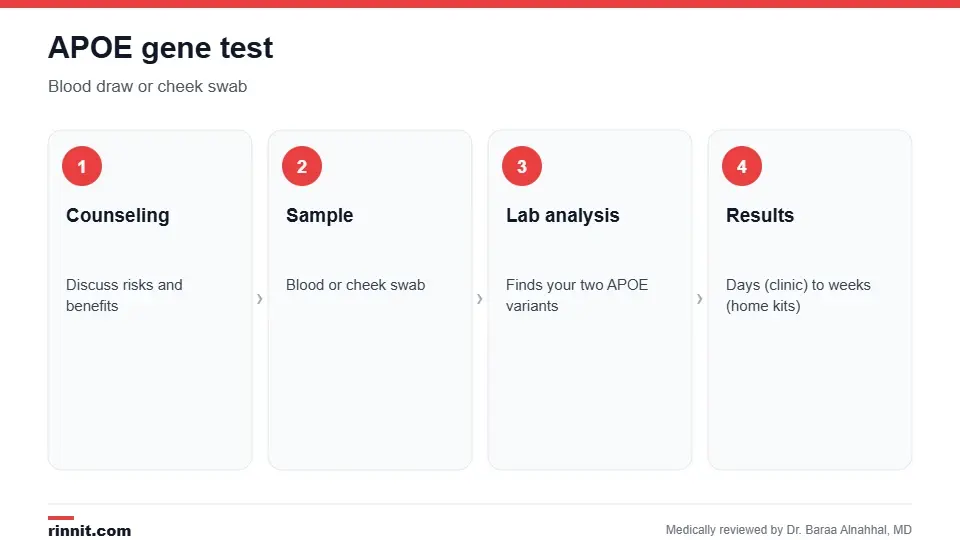
Results take days in a clinic or weeks with home kits.
Talk with your provider or a genetic counselor about what the test can and can't tell you.
A blood sample is drawn or the inside of your cheek is swabbed.
The lab identifies your two APOE versions.
Your provider or counselor reviews the results with you. Sources: [1]
No special preparation is needed. Clinical results usually take a few days; at-home kits can take weeks to months. Sources: [1]
Understanding your results
Your report lists your two alleles, such as ε3/ε4. "APOE4 positive" means you have at least one copy. A higher-risk result doesn't mean you'll get Alzheimer's, and a lower-risk result doesn't mean you won't. Results from home kits may look different from clinical reports, so review them with a professional. Sources: [1, 2]
Risks and limits
There are no physical risks beyond a blood draw. The main risks are emotional: results can cause worry, anxiety or fear, and may not give the answers you hoped for. Learning your status can also tell you something about your relatives' risk. Sources: [1]
What can I do if my risk is higher?
Stay physically active and exercise regularly.
Get enough sleep.
Stay socially connected.
Keep your mind active with reading, puzzles or learning new skills.
Manage blood pressure, blood sugar and cholesterol, which also protect against vascular dementia; a lipid panel helps track cholesterol. Sources: [1, 3]
Conclusion
The APOE gene test tells you which versions of a gene linked to Alzheimer's risk you carry. It can help with planning and research, but it doesn't predict your future with certainty. Talk with a genetic counselor before testing so you understand what results will mean for you and your family.
Keep learning: read about Alzheimer's disease and genetic testing.
Frequently asked questions
What does the APOE gene test show?
Which two versions of the APOE gene you carry: ε2, ε3 or ε4.
Does APOE4 mean I'll get Alzheimer's?
No. It raises risk, but many carriers never develop the disease.
How common is APOE4?
About 15–25% of people have one copy and 2–5% have two.
Is APOE2 protective?
It's linked to lower Alzheimer's risk.
How is the test done?
With a blood sample or a cheek swab.
Do I need genetic counseling?
It's strongly recommended before and after testing.
Can APOE affect cholesterol?
Yes. ε4 tends to raise LDL cholesterol and ε2 to lower it.
Are home APOE tests accurate?
They can be, but review results with a professional.
Why might a doctor order APOE testing?
To guide some Alzheimer's treatments or to assess risk with a family history.
Can I lower my risk if I carry APOE4?
Yes. Exercise, sleep, social activity and heart-healthy habits help.
Related Reading
Alzheimer's Disease: Symptoms, Causes, Treatment & Complete Guide the dementia most linked to APOE4.
Early-Onset Alzheimer's Disease (EOAD): Symptoms, Causes, Genetics, Diagnosis, Treatment and When to See Your Provider — What You Need to Know Alzheimer's that starts before age 65.
Genetic Testing (DNA Tests): Types, Uses, Risks and What Results Mean an overview of genetic tests.
High Blood Cholesterol: What Your Numbers Mean, Why It Matters, and How to Lower It cholesterol levels that APOE can influence.
Familial Hypercholesterolemia: The Inherited Cholesterol Condition Most People Never Know They Have an inherited cholesterol disorder.
References
Cleveland Clinic. APOE Gene Test: What It Is, How It Works & Results. Cleveland Clinic. Last updated August 21, 2024. https://my.clevelandclinic.org/health/diagnostics/apoe-gene-test
Belloy ME, Andrews SJ, Le Guen Y, et al. APOE genotype and Alzheimer disease risk across age, sex, and population ancestry. JAMA Neurol. 2023;80(12):1284-1294. PMID 37930705. https://doi.org/10.1001/jamaneurol.2023.3599
Bennet AM, Di Angelantonio E, Ye Z, et al. Association of apolipoprotein E genotypes with lipid levels and coronary risk. JAMA. 2007;298(11):1300-1311. PMID 17878422. https://doi.org/10.1001/jama.298.11.1300
Medical disclaimer
This article is for general education only and does not replace advice from a qualified healthcare professional. Talk to your doctor about your own diagnosis and treatment, and seek emergency care right away for severe or sudden symptoms.



Comments