Genetic Disorders: Understanding Types, Causes, and Diagnosis

Updated: 2 days ago
Medically reviewed by Dr. Baraa Alnahhal, MD · Last reviewed: October 2026
Quick Answer
A genetic disorder is a health condition caused by a harmful change, or mutation, in one or more genes that disrupts the body's ability to make essential proteins [1]. Disorders are classified as monogenic, chromosomal or multifactorial [1]. Diagnosis typically relies on specialized blood tests or prenatal screening [1]. Most are lifelong but can often be managed with therapies, medications and lifestyle adjustments.
What the research says
Genome sequencing finds a genetic diagnosis in a large share of children with suspected genetic disorders. A systematic review and meta-analysis of 39 studies found a pooled diagnostic yield of 38.6% (95% CI 32.6–45.0) for whole genome sequencing, 37.8% (95% CI 32.9–42.9) for whole exome sequencing, and 7.8% (95% CI 4.4–13.2) for usual care (see Nurchis et al., Arch Public Health, 2023) [2].
Early diagnosis through newborn screening is linked to better outcomes in at least one inherited metabolic disorder. In a meta-analysis of 20 studies (240 individuals with classic isovaleric aciduria), those identified by newborn screening had fewer neurological symptoms (13.0% vs 44.9%; p = 0.0040), less developmental delay (6.1% vs 51.2%; p < 0.0001), and lower mortality (1.1% vs 10.9%; p = 0.0320) (see Reischl-Hajiabadi et al., J Inherit Metab Dis, 2025) [3].
What are Genetic Disorders?
Genetic disorders arise when a pathogenic variant, or mutation, affects the instructions contained within a person's genes [1]. Genes are segments of DNA (deoxyribonucleic acid) that serve as the blueprint for every cell's function and for the physical characteristics that make each individual unique [1]. These disorders can be present at birth or appear later in life as the body grows and develops [1].
Primary Categories of Genetic Disorders
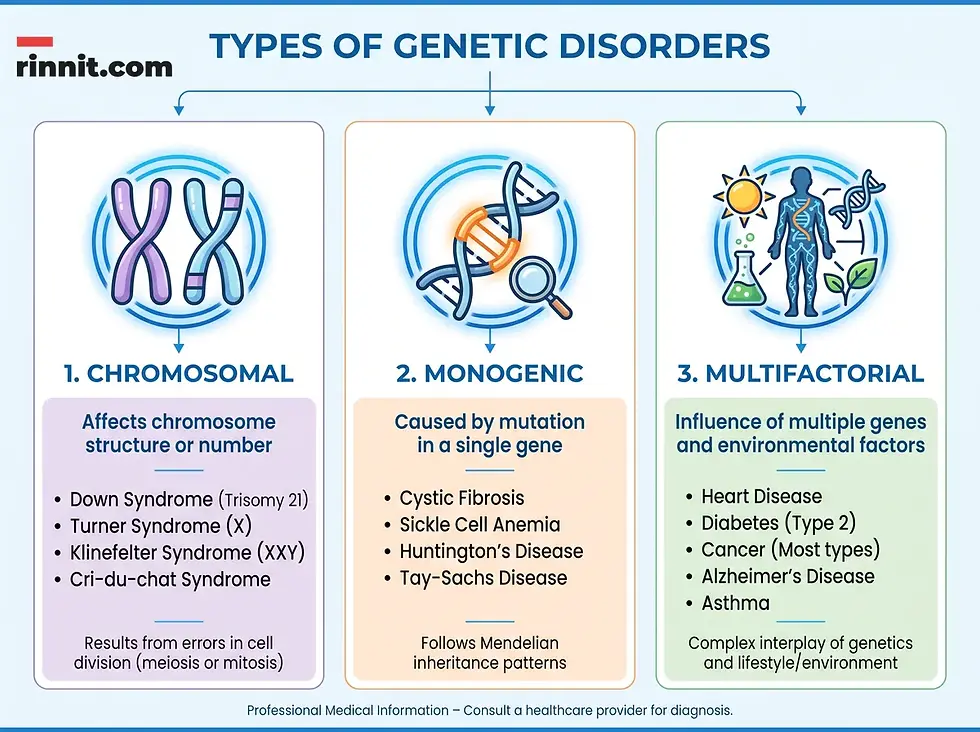
Genetic conditions are classified based on how the mutation affects the genetic material.
Category | Description | Common Examples |
Chromosomal | Affects the structures holding the DNA; involves missing or extra genetic material [1]. | Down syndrome, Turner syndrome [1] |
Monogenic | Caused by a mutation in a single specific gene [1]. | Cystic fibrosis, Sickle cell disease [1] |
Multifactorial | Results from a combination of gene mutations and environmental triggers [1]. | Diabetes, Heart disease, Arthritis [1] |

Symptoms and Clinical Presentation
Because genetic disorders can affect any organ system, symptoms vary widely depending on the specific condition and its severity [1]. Recognizing early signs is important for starting appropriate management.
Common Warning Signs
Developmental Delays: Challenges with speech, social skills, or motor milestones.
Physical Anomalies: Distinctive facial features or limb irregularities, such as a cleft palate [1].
Neurological Issues: Frequent seizures, muscle stiffness, or cognitive deficits [1].
Growth Problems: Short stature or failure to thrive despite adequate nutrition.
Sensory Loss: Progressive or congenital vision and hearing impairments [1].
Digestive Challenges: Difficulty swallowing or an inability to process specific nutrients [1].
Causes and Environmental Triggers
Many genetic disorders are passed down from biological parents, but the DNA within genes can also change because of external factors [1]. These changes affect how genes instruct the body to make proteins, which are the building blocks of healthy cell function [1].
The Role of Mutagens
External factors known as mutagens can increase the risk of spontaneous genetic mutations:
Chemical Exposure: Contact with toxic substances in the environment or workplace [1].
Radiation: High-energy waves that can damage DNA strands [1].
Lifestyle Factors: Smoking and excessive alcohol consumption during pregnancy.
UV Exposure: Prolonged, unprotected exposure to ultraviolet rays from the sun [1].
Diagnosis and Genetic Testing
Advances in medical technology make it possible to identify genetic risks before, during, and after pregnancy. Genetic counseling is often the first step for families with a history of a specific condition [1].
Types of Genetic Screening
Carrier Testing: A blood test for prospective parents to find out whether they carry a mutation that could be passed to their children [1].
Prenatal Screening: Non-invasive blood tests during pregnancy to assess the risk of common chromosomal conditions in the fetus [1].
Prenatal Diagnostic Testing: Procedures such as amniocentesis, which analyze the fluid surrounding the fetus for a definitive diagnosis.
Newborn Screening: Testing shortly after birth to catch metabolic or genetic issues early, allowing timely, potentially life-saving treatment [1].
Management and Treatment Pathways
A definitive cure does not yet exist for most genetic disorders, but modern medicine offers several ways to manage symptoms and slow disease progression [1]. The goal of treatment is to maximize a person's functional abilities and prevent secondary complications.
Therapeutic Options
Targeted Medications: Used to manage specific symptoms or, in some cases, slow abnormal cell growth [1].
Specialized Therapies: Physical, occupational, and speech therapy to help children reach developmental milestones.
Nutritional Support: Dietary supplements and counseling for disorders that affect metabolism [1].
Surgical Intervention: Procedures to repair physical anomalies or treat internal complications [1].
Advanced Procedures: In severe cases, blood transfusions or organ transplants may be necessary [1].

Outlook and Prevention
The long-term outlook for a person with a genetic disorder depends heavily on the specific condition and how early it was diagnosed. Genetic mutations themselves cannot be prevented in the traditional sense, but understanding your family history and using genetic counseling can help you make informed decisions about your health and family planning [1]. Regular medical follow-up and a healthy lifestyle remain the cornerstones of managing these complex conditions.
When to Seek Genetic Counseling
If you have concerns about your family's genetic history or are planning to start a family, talk to a healthcare provider or a certified genetic counselor. Early testing and proactive management are the most effective ways to protect your health and the health of future generations.
Frequently Asked Questions
Does carrying a gene mutation mean I will get the disease?
Not necessarily. Many people carry silent mutations that never develop into a symptomatic disorder. However, these mutations can still be passed on to biological children.
Are all genetic disorders inherited from parents?
No. Some mutations occur spontaneously (de novo) during the formation of reproductive cells or early fetal development, often due to environmental factors.
Can genetic disorders be cured?
Currently, most genetic disorders do not have a cure. Treatment focuses on managing symptoms, preventing complications, and improving quality of life.
What is the most common chromosomal disorder?
Down syndrome (Trisomy 21) is one of the most well-known and common chromosomal disorders, occurring when an individual has an extra copy of chromosome 21.
Is genetic testing safe during pregnancy?
Many prenatal screenings are non-invasive blood tests and are considered safe. Diagnostic tests like amniocentesis carry a very small risk, which a genetic counselor or obstetrician can discuss with you in detail.
How many rare genetic disorders exist?
Experts estimate there are as many as 7,000 rare genetic diseases, each affecting fewer than 200,000 people in the United States.
What is newborn screening?
Newborn screening is a test performed shortly after birth, usually using a heel-prick blood sample, to check for serious but treatable conditions that may not be apparent at birth. Which conditions are covered depends on the country or region.
Can lifestyle changes prevent genetic disorders?
While you cannot change your DNA, avoiding mutagens like tobacco, excessive UV radiation, and certain chemicals can reduce the risk of spontaneous mutations.
What does a genetic counselor do?
A genetic counselor reviews your family history, explains testing options, interprets results, and provides emotional support and guidance for managing genetic risks.
Content reviewed and produced following the Rinnit editorial framework. Last updated: October 8, 2026.
Related Reading
Genetic Testing (DNA Tests): Types, Uses, Risks and What Results Mean explains the DNA tests that can confirm this condition or show carrier status.
References
Cleveland Clinic. Genetic Disorders. Cleveland Clinic Health Library. Medically reviewed; last updated August 20, 2021. https://my.clevelandclinic.org/health/diseases/21751-genetic-disorders
Nurchis MC, Altamura G, Riccardi MT, et al. Whole genome sequencing diagnostic yield for paediatric patients with suspected genetic disorders: systematic review, meta-analysis, and GRADE assessment. Arch Public Health. 2023;81(1):93. PMID 37231492. doi:10.1186/s13690-023-01112-4
Reischl-Hajiabadi AT, Garbade SF, Gleich F, et al. Impact of newborn screening on survival and developmental outcome in classic isovaleric aciduria: a meta-analysis. J Inherit Metab Dis. 2025;48(6):e70090. PMID 40999734. doi:10.1002/jimd.70090



Comments