Intrauterine Growth Restriction (IUGR): Causes, Risks, and Management

Updated: 2 days ago
Medically reviewed by Dr. Baraa Alnahhal, MD · Last reviewed: October 2026
Quick Answer: Key Facts About IUGR
Intrauterine growth restriction (IUGR) is an estimated fetal weight below the 10th percentile for gestational age, affecting about 10% of pregnancies and often detected after 20 weeks. Causes include placenta or cord problems, maternal conditions and smoking. There is no direct fix, so care centers on close monitoring and sometimes early delivery. Most babies catch up by age 3.
Feature | Details |
Definition | Estimated fetal weight below the 10th percentile for gestational age, meaning smaller than 9 out of 10 fetuses of the same age. [1] |
How common | IUGR affects about 10% of pregnancies. [1] |
Common timing | Often detected after 20 weeks of pregnancy, when fundal height is measured at prenatal visits. [1] |
Primary causes | Problems with the placenta or umbilical cord, maternal conditions such as high blood pressure, diabetes or kidney disease, infections, genetic conditions, and smoking, alcohol or drug use. [1] |
Detection | Fundal height measurement, then ultrasound, including Doppler flow and amniotic fluid checks. [1] |
Treatment | There is no direct fix. Care centers on closer monitoring, treating underlying conditions and, if needed, early delivery. [1] |
Long-term outlook | Most babies catch up in size by age 3. Some have a higher risk of obesity and cardiovascular disease later in life. [1] |
What the research says
Doppler ultrasound of the umbilical artery is associated with fewer perinatal deaths in high-risk pregnancies. A Cochrane review of 19 trials (10,667 women) found fewer perinatal deaths with umbilical artery Doppler (risk ratio 0.71; 1.2% versus 1.7%; moderate-certainty evidence), along with fewer labor inductions and fewer cesarean sections. The authors note that the evidence is not of high quality and that long-term follow-up of the babies is lacking. (Alfirevic et al., Cochrane Database Syst Rev, 2017)
Growth restriction can affect the developing heart, but the long-term meaning is still being studied. A systematic review and meta-analysis of 6 animal and 49 human studies found reduced left ventricular mass and septal thickness in growth-restricted newborns, with no echocardiographic differences found during childhood. Only two studies followed people into adulthood, and the authors rate the quality of the human studies as low. (van de Meent et al., Am J Physiol Heart Circ Physiol, 2024)
What Is Intrauterine Growth Restriction (IUGR)?
Intrauterine growth restriction, which healthcare providers also call fetal growth restriction (FGR), is when a fetus is smaller than it should be for the number of weeks of pregnancy. It means the fetus is not growing at the expected rate inside the uterus. IUGR is defined as weighing less than 9 out of 10 babies (below the 10th percentile) of the same age. [1]
Fetuses grow at different rates, and "measuring small" does not necessarily mean a fetus has IUGR. In most cases, fetuses that measure small are born small but healthy. However, some mothers have an underlying medical condition that causes the fetus to measure small for its gestational age. [1]

Types of IUGR
Symmetric (primary) IUGR: All of the fetal body parts are small. This accounts for up to 30% of IUGR cases.
Asymmetric (secondary) IUGR: Only the fetus's abdomen measures small, while the head and brain are the expected size. This accounts for up to 80% of IUGR cases.
Most pregnancies with IUGR are managed with extra monitoring, and most fetuses diagnosed with IUGR are healthy. [1]
What Causes Restricted Fetal Growth?
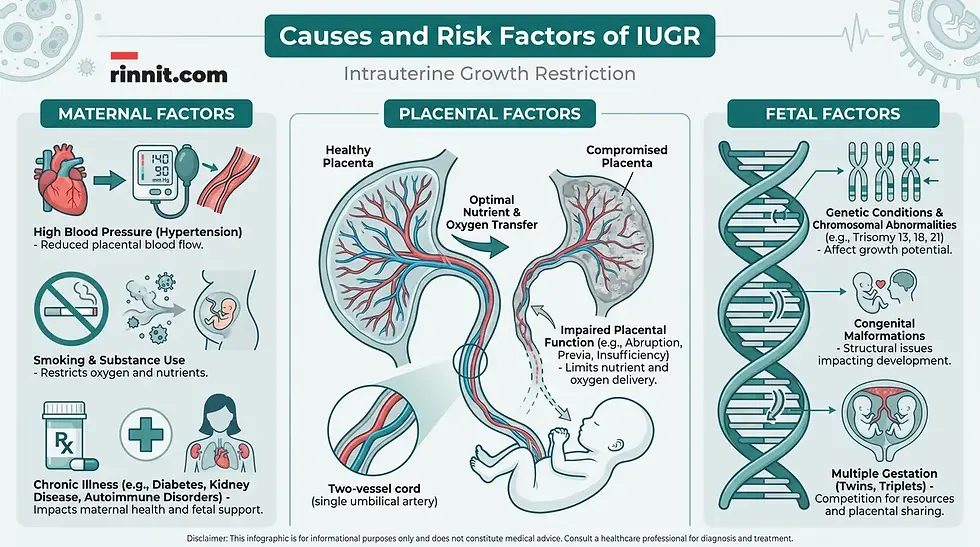
There are several possible causes of fetal growth restriction, and sometimes no cause is found. In some cases, it develops because of a problem with the placenta or umbilical cord, the organs that bring nutrients, oxygen and blood to the fetus. Without the proper amount of nourishment, the fetus can be small for its age. [1]
A fetus can develop growth restriction if the mother:
Is expecting twins or triplets.
Has had a previous baby with IUGR.
Has high blood pressure, heart disease or a low blood count.
Smokes, drinks alcohol or uses recreational drugs.
Has an autoimmune condition, kidney disease or diabetes.
Takes anti-seizure medications.
Has an infection such as rubella, syphilis, cytomegalovirus (CMV) or toxoplasmosis.
Growth restriction can also occur if the baby has a congenital or genetic disorder such as Down syndrome (trisomy 21). Living at high altitude has also been associated with lower birth weight. [1]
How Is IUGR Diagnosed and Monitored?
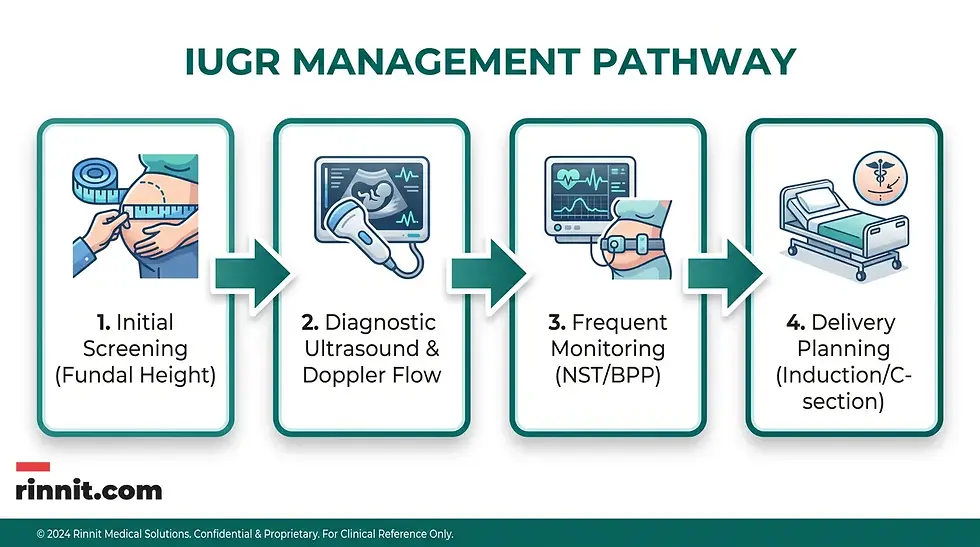
Diagnosis starts with an accurate gestational age, which is found from the first day of the last menstrual period and a first-trimester ultrasound. IUGR is often detected after 20 weeks of pregnancy, when your provider begins measuring your fundal height at each prenatal visit. [1]
Fundal height is the distance from the top of your pubic bone to the top of your uterus, measured in centimeters. After 20 weeks it should be about the same as the number of weeks you are pregnant. If it measures at least 4 cm less than expected, your provider may suspect IUGR and order more tests. [1]
Ultrasound is then used to estimate the baby's size and weight. Providers can also use Doppler flow studies to check blood flow from the placenta through the umbilical cord and the baby's blood vessels, and can measure the amount of amniotic fluid, since too little may indicate IUGR. Other tools include fetal heart rate monitoring and, in some cases, amniocentesis to look for congenital causes. [1]
What Are the Treatment Options for IUGR?
There is no way to "fix" fetal growth restriction. Treatment depends on how far along the pregnancy is and how healthy the fetus is. Your provider will monitor the fetus closely to make sure there are no complications and treat any underlying conditions that contribute to growth restriction. [1]
Increased monitoring: More frequent ultrasounds, tests and prenatal appointments to track growth.
Early delivery: If the pregnancy is not developing as it should or the fetus is at risk, labor may be induced before 37 weeks. Sometimes a C-section is recommended because vaginal delivery can stress growth-restricted babies.
Corticosteroid medication: If an early delivery is planned, medication may be given to help the baby's lungs develop.
In rare or severe cases, you may be admitted to the hospital for closer observation. [1]
Risks for the Baby and Long-Term Outlook
Certain conditions are associated with IUGR, including a higher chance of C-section delivery and premature birth, breathing and eating problems at birth, low oxygen and low blood sugar at birth, trouble regulating body temperature, meconium aspiration, polycythemia (an increased number of red blood cells) and problems fighting infection. Some babies born early or small need extra hospital time or special care in the neonatal intensive care unit (NICU). [1]
Most babies with IUGR reach the size of full-term children their age by age 3. Because all children grow differently, you should not try to overfeed your child, as this could unintentionally lead to conditions such as obesity or diabetes. Your pediatrician will work with you if your baby's growth is not progressing as expected. [1]
There can be long-term effects, depending on the underlying condition, how restricted growth was and how many weeks of pregnancy the baby reached. A child may be at increased risk of cognitive or developmental problems such as hyperactivity, cerebral palsy and poor test scores in school, and of obesity and cardiovascular disease later in life. [1]
What to Do If Your Baby Has IUGR
First, do not panic. You most likely did not do anything to cause IUGR. You can help by: [1]
Keeping all prenatal and fetal testing appointments, such as ultrasounds.
Stopping right away if you smoke, drink alcohol or use drugs.
Eating a healthy diet with enough calories each day.
Getting enough rest and sleep.
Paying attention to any decrease in your baby's movements, and calling your provider or going to labor and delivery right away if your baby is moving less than usual.
Being honest with your provider about any medications you take.
Learn more. For more evidence-based health guides, visit Rinnit.com.
Frequently Asked Questions
Is IUGR the same as a baby simply measuring small?
No. A fetus can measure small without having IUGR, and most fetuses that measure small are born small but healthy. IUGR means the fetus is not growing at the expected rate and weighs less than 9 out of 10 fetuses of the same gestational age.
Can I prevent IUGR?
You cannot prevent every cause, but some risk factors can be changed. Avoiding smoking, alcohol and recreational drugs, eating a healthy diet, gaining enough weight during pregnancy, managing chronic conditions and keeping all prenatal appointments all help.
Does IUGR mean my baby will have a disability?
Not usually. Most babies diagnosed with IUGR do not have health complications. Long-term outcomes depend on the underlying cause, how restricted growth was and how many weeks of pregnancy the baby reached before delivery.
Will I need a C-section if my baby has IUGR?
Not always, but it is more common. If delivery is needed before 37 weeks, labor may be induced, and sometimes a C-section is recommended because vaginal delivery can stress growth-restricted babies.
How often will I need ultrasounds?
It varies. If you are diagnosed with IUGR, you will have additional ultrasounds, tests and prenatal appointments, and the schedule is tailored to your pregnancy and the underlying cause.
What is the 10th percentile?
The 10th percentile means the fetus weighs less than 9 out of 10 fetuses of the same gestational age.
Does IUGR affect a baby's brain development?
Some babies with IUGR may be at increased risk of cognitive or developmental problems, such as hyperactivity, cerebral palsy and lower school test scores. The risk depends on the cause, how restricted growth was and the gestational age at delivery. Most babies with IUGR do not have complications.
What are the signs of IUGR I can look for?
Most people have no symptoms. You may feel that your belly or baby is not as big as it should be, but only a healthcare provider can diagnose IUGR.
Is IUGR a high-risk pregnancy?
Your provider may classify your pregnancy as high-risk depending on the cause of the growth restriction. However, most fetuses diagnosed with IUGR are healthy and simply need more monitoring.
Can a healthy diet reverse IUGR?
There is no guarantee that eating certain foods will increase fetal weight, but a healthy diet with fruits, vegetables, healthy carbohydrates and protein is recommended during pregnancy. Talk to your provider before making major diet changes.
What is Doppler flow?
Doppler flow is an ultrasound technique that checks blood flow from the placenta through the umbilical cord and through the baby's blood vessels. Poor circulation can suggest IUGR.
Does IUGR happen again in later pregnancies?
Having had a previous baby with IUGR is a risk factor for growth restriction in a later pregnancy, but it is not a guarantee that it will happen again.
Will my baby need to stay in the NICU?
Some babies born early or small need extra time in the hospital or special care in the neonatal intensive care unit (NICU).
Does IUGR go away?
The fetus may catch up a little, but the diagnosis does not go away, so your provider will keep monitoring growth for the rest of the pregnancy.
Conclusion
Intrauterine growth restriction is a serious but manageable pregnancy complication that needs careful medical follow-up. By understanding the causes and taking part in regular monitoring, parents and healthcare providers can work together toward the best outcome for the baby. The diagnosis can be stressful, but most babies with IUGR do not have health complications. [1]
Related Reading
Fetal Biometry: Ultrasound Measurements of Baby's Growth Explained explains the ultrasound measurements used to track fetal growth.
Learn more in our guide to Nonstress Test (NST): Why It's Done, What to Expect and Reactive vs Nonreactive Results.
Fundal Height: How It's Measured, Normal Range by Week and What It Means explains how fundal height tracks your baby's growth.
Pregnancy Ultrasound: Why It's Done, When You'll Have One, What to Expect and Results explains when pregnancy scans are done, what they check and why some people need extra ultrasounds.
Biophysical Profile (BPP): Purpose, the Five Parts, Scoring and Results explains the late-pregnancy ultrasound and heart rate test, its five parts and what the score means.
Contraction Stress Test: How It Works and What Results Mean explains the late-pregnancy test of how the baby handles contractions.
References
Cleveland Clinic. Intrauterine Growth Restriction. Cleveland Clinic. Last updated August 18, 2022. https://my.clevelandclinic.org/health/diseases/24017-intrauterine-growth-restriction
Alfirevic Z, Stampalija T, Dowswell T. Fetal and umbilical Doppler ultrasound in high-risk pregnancies. Cochrane Database Syst Rev. 2017;6(6):CD007529. PMID 28613398. https://doi.org/10.1002/14651858.CD007529.pub4
van de Meent M, Nijholt KT, Joemmanbaks SCA, et al. Understanding changes in echocardiographic parameters at different ages following fetal growth restriction: a systematic review and meta-analysis. Am J Physiol Heart Circ Physiol. 2024;326(6):H1469-H1488. PMID 38668703. https://doi.org/10.1152/ajpheart.00052.2024
Medical disclaimer
This article is for general educational purposes only and is not a substitute for professional medical advice. Always seek the advice of your physician or other qualified health provider with any questions about a medical condition or pregnancy.



Comments