Nonstress Test (NST): Why It's Done, What to Expect and Reactive vs Nonreactive Results

Updated: 2 days ago
Written and medically reviewed by Dr. Baraa Alnahhal, MD · Last reviewed: November 2026 · How we review
Quick Answer: What is a nonstress test?
A nonstress test (NST) is a safe, painless pregnancy test that measures the baby's heart rate and how it responds to movement. It's usually done after 28 weeks. A reactive result means the heart rate rose with movement at least twice in 20 minutes. A nonreactive result means more testing may be needed. [1]
What the research says
Routine heart rate tracing hasn't been proven to improve outcomes on its own. A Cochrane review of 6 studies (2,105 women at increased risk) found no clear difference in perinatal deaths with traditional antenatal heart rate monitoring versus none (2.3% vs 1.1%, low-quality evidence). Computerized monitoring was linked with fewer perinatal deaths than traditional monitoring (0.9% vs 4.2%). (Grivell et al., Cochrane Database of Systematic Reviews, 2015) [2]
A nonreactive result during early labor is linked with more fetal complications. In 450 women at 38 to 42 weeks, slow fetal heart rate occurred in 28% of those with a nonreactive NST versus 3.3% with a reactive NST, and low Apgar scores occurred only in the nonreactive group (2.7%). (Raouf et al., Global Journal of Health Science, 2015) [3]
Key takeaways
An NST checks your baby's heart rate response to movement and contractions.
It usually happens after 28 weeks and takes about 30 minutes.
It is safe and painless; "nonstress" means it puts no stress on you or your baby.
Results are reactive (normal) or nonreactive, not pass or fail.
A nonreactive result often just means more information is needed.
What is a nonstress test?
A nonstress test (also called a fetal nonstress test) checks the baby's heart rate and how it changes with movement. It helps your provider make sure your baby is healthy and getting enough oxygen. It typically happens after 28 weeks of pregnancy. [1]
Just as your heart beats faster when you run, a baby's heart rate should rise when they move or kick. If it doesn't, that doesn't mean something is wrong. Your provider uses the results to decide whether you need more tests or whether to induce labor. [1]

When do you need a nonstress test?
Not everyone needs one. Your provider may order an NST when: [1]
You're past your due date. Going past 40 weeks can cause complications, even in a healthy pregnancy.
Your pregnancy is high risk. Conditions like diabetes or high blood pressure mean closer monitoring.
You feel less movement. Your provider may check if you don't feel your baby move, or feel less movement.
Your baby measures small. The test helps if your baby isn't growing as expected.
You're expecting multiples. Twins or more raise the risk of complications.
You're Rh negative. If your baby is Rh positive, your body may make antibodies against their blood.
How does a nonstress test work?
You lie on a reclined chair or exam table.
Your provider places two elastic belts around your belly, each with a sensor. One tracks contractions, even ones you can't feel. The other tracks your baby's heart rate, which you'll hear on a machine.
Your provider records the information for about 30 minutes on a chart.
The test ends once your provider has what they need.
They remove the belts and discuss your results with you.
Sources: [1]

If your baby isn't moving, they may be asleep. Your provider may use a small buzzer or noisemaker on your belly to wake them, much like an alarm clock. A sugary drink or a snack can also help get your baby moving. [1]
How do you prepare?
You don't need to prepare. Your provider may ask you to empty your bladder first. Wear comfortable clothes so you can lift your shirt easily, and plan to sit or lie down for at least 30 minutes. [1]
How long does it take?
A typical NST takes about 30 minutes. It can take longer if your baby isn't moving much, if the heartbeat signal is hard to pick up, or if your provider wants more data to feel confident about the results. [1]
Is a nonstress test safe?
Yes. It is safe and painless. It gets its name because it puts no stress on you or your baby. [1]
What do nonstress test results mean?
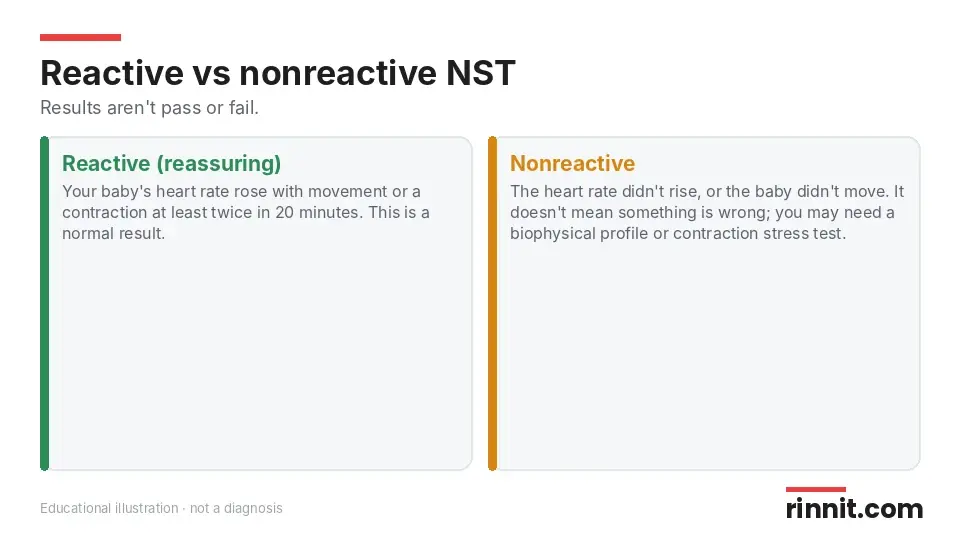
You'll get your results the same day. They're described as reactive or nonreactive, not positive or negative, and not pass or fail. [1]
Result | What it means | What happens next |
Reactive (reassuring) | Your baby's heart rate rose with movement or a contraction at least twice in 20 minutes | Normal result |
Nonreactive | The heart rate didn't rise with movement, or your baby didn't move | More testing to understand why |
Sources: [1]
What tests might follow a nonreactive NST?
Biophysical profile: combines a nonstress test with an ultrasound.
Contraction stress test: checks how your baby reacts to contractions brought on with medicine. These contractions don't start labor.
Sources: [1]
If results show your baby is at risk of complications, you may need closer monitoring or an earlier delivery, depending on how far along you are. [1]
What if your baby doesn't move during the test?
Don't worry. Your baby may be sleeping or just not cooperating that day. Your provider may use a buzzing device to wake them, or give you a sugary drink or snack. [1]
What's the difference between a nonstress test and a stress test?
An NST measures your baby's heart rate to see if it changes with movement, using monitors around your belly. A stress test measures your own heart rate during exercise, usually on a treadmill or stationary bike with monitors on your chest. [1]
Questions to ask your provider
Why do I need a nonstress test, and how often?
What did my result show?
If it's nonreactive, what test comes next?
Could I need an earlier delivery?
Conclusion
A nonstress test is a common, safe way to check on your baby late in pregnancy by watching how their heart rate responds to movement. Most results are reactive and reassuring.
Hearing "nonreactive" can feel scary, but it often just means your provider needs a little more information. It's normal to feel anxious while waiting, so ask your care team any questions you have.
Keep learning: Read our guides to the Bishop score, the fetal echocardiogram, the due date calculator and the exercise stress test. For more, see ACOG: Special Tests for Monitoring Fetal Well-Being.
FAQ
What is a nonstress test in pregnancy?
It is a test that measures your baby's heart rate and how it responds to movement and contractions. [1]
When is a nonstress test done?
It typically happens after 28 weeks of pregnancy. [1]
How long does a nonstress test take?
About 30 minutes, though it can take longer. [1]
What is a reactive nonstress test?
The baby's heart rate rose with movement or a contraction at least twice within 20 minutes, which is normal. [1]
What does a nonreactive NST mean?
The heart rate didn't rise with movement; it doesn't mean something is wrong, but more testing may be needed. [1]
Is a nonstress test safe?
Yes. It is safe and painless and puts no stress on you or your baby. [1]
How do I prepare for an NST?
No special preparation is needed; empty your bladder and wear comfortable clothes. [1]
What if my baby is asleep during the test?
Your provider may use a small buzzer, or give you a sugary drink or snack, to wake your baby. [1]
When will I get my NST results?
The same day, before you leave. [1]
Who needs a nonstress test?
People past their due date, with a high-risk pregnancy, less fetal movement, a small baby, multiples or Rh-negative blood. [1]
Related Reading
Electronic Fetal Monitoring (EFM): Types, Risks and Results explains continuous monitoring of the baby's heart rate during labor.
Learn more in our guide to High-Risk Pregnancy: Understanding Management, Factors, and Care.
Learn more in our guide to Gestational Diabetes: Symptoms, Causes, Risks & Treatment — Complete Guide.
Learn more in our guide to Gestational Hypertension: Managing High Blood Pressure During Pregnancy.
Learn more in our guide to Understanding the Rh Factor: Clinical Significance and Pregnancy Management.
Learn more in our guide to Intrauterine Growth Restriction (IUGR): Causes, Risks, and Management.
Learn more in our guide to Understanding Labor Induction: A Comprehensive Patient Guide.
Biophysical Profile (BPP): Purpose, the Five Parts, Scoring and Results explains the late-pregnancy ultrasound and heart rate test, its five parts and what the score means.
Fetal Heart Rate Monitoring: Normal Range, Types and Decelerations explains how a baby's heart rate is monitored in pregnancy and labor.
Contraction Stress Test: How It Works and What Results Mean explains the late-pregnancy test of how the baby handles contractions.
References
Cleveland Clinic. Nonstress Test (NST): Purpose, Procedure & Results. Cleveland Clinic. Last updated May 14, 2026. https://my.clevelandclinic.org/health/diagnostics/24253-nonstress-test
Grivell RM, Alfirevic Z, Gyte GM, et al. Antenatal cardiotocography for fetal assessment. Cochrane Database Syst Rev. 2015;2015(9):CD007863. PMID 26363287. https://doi.org/10.1002/14651858.CD007863.pub4
Raouf S, Sheikhan F, Hassanpour S, et al. Diagnostic value of non stress test in latent phase of labor and maternal and fetal outcomes. Glob J Health Sci. 2015;7(2):177-182. PMID 25716371. https://doi.org/10.5539/gjhs.v7n2p177
Medical disclaimer
This article is for general education only and does not replace advice from a qualified healthcare professional. Talk to your doctor about your own diagnosis and treatment, and seek emergency care right away for severe or sudden symptoms.



Comments