Fetal Heart Rate Monitoring: Normal Range, Types and Decelerations

Updated: 3 days ago
Written and medically reviewed by Dr. Baraa Alnahhal, MD · Last reviewed: November 2026 · How we review
Quick Answer
Fetal heart rate monitoring checks the speed and pattern of a baby's heartbeat during pregnancy and labor to make sure the baby is getting enough oxygen. A normal baseline fetal heart rate is 110 to 160 beats per minute. Monitoring can be external or internal. An abnormal tracing doesn't always mean the baby is in danger.
What the research says
Continuous monitoring has trade-offs: a Cochrane review of 13 trials with over 37,000 women found continuous electronic monitoring in labor halved neonatal seizures compared with intermittent listening, but didn't reduce cerebral palsy or infant death and increased cesarean births by about 63% (Alfirevic Z et al., Cochrane Database Syst Rev, 2017) [2]
Worrying tracings are usually false alarms: in a California study, certain monitoring patterns such as multiple late decelerations were linked to cerebral palsy, but most babies with these patterns were healthy, giving a false-positive rate of 99.8% (Nelson KB et al., N Engl J Med, 1996) [3]
Key takeaways
Checks your baby's heart rate and pattern in pregnancy and labor.
Normal baseline is 110–160 beats per minute.
External monitoring uses the belly; internal monitoring uses a scalp wire after the water breaks.
Accelerations are reassuring; late decelerations can signal low oxygen.
Abnormal results often lead to simple steps like changing position before any delivery decision.
Why is it done?
Monitoring helps your care team see whether your baby's heart rate is too fast, too slow or changing in a worrying way, which can be a sign of low oxygen. It's used at prenatal visits, during labor and more closely in high-risk pregnancies, such as those with heart disease, preeclampsia, diabetes or poor fetal growth. Sources: [1]
Types of fetal heart rate monitoring
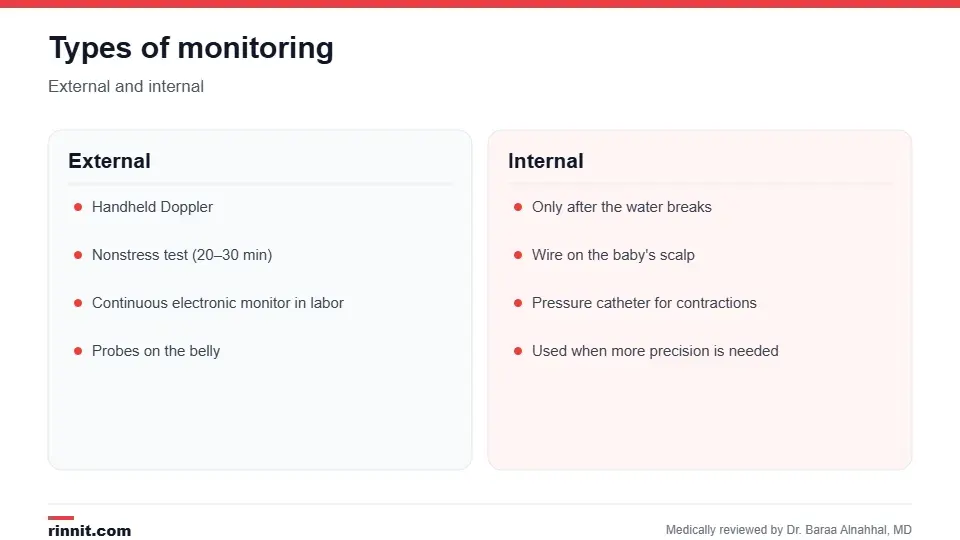
Internal monitoring is used only after the water breaks.
Type | How it works | When it's used |
Handheld Doppler | A small probe with gel on the belly | Prenatal visits; sometimes in low-risk labor |
Records heart rate with baby's movements for 20–30 minutes | Late pregnancy, often in high-risk pregnancies | |
Continuous electronic fetal monitoring | Belts with sensors on the belly | During labor, especially with induction or an epidural |
Internal monitoring | Wire on the baby's scalp; pressure catheter in the uterus | After the water breaks, when more precision is needed |
It may be combined with a biophysical profile in pregnancy. Sources: [1]
What's a normal fetal heart rate?

Ranges vary slightly by stage of pregnancy.
Reading | Beats per minute |
Normal baseline | 110–160 |
Slow (bradycardia) | Below 110 |
Fast (tachycardia) | Above 160 |
Sources: [1]
Accelerations and decelerations
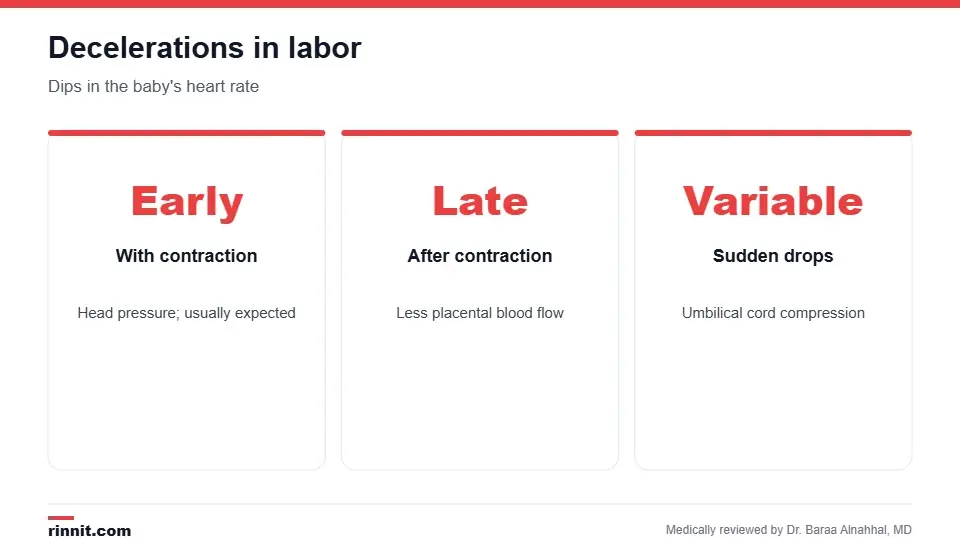
Early decelerations are usually expected during labor.
Accelerations: brief rises in heart rate with movement, usually a reassuring sign of good oxygen.
Early decelerations: dips during a contraction from pressure on the baby's head; common and expected.
Late decelerations: drops after a contraction from reduced blood flow through the placenta; may mean low oxygen.
Variable decelerations: sudden drops that last longer, usually from pressure on the umbilical cord. Sources: [1, 3]
Risks
Monitoring is generally safe. Continuous monitoring can limit movement, may lengthen labor and can give false alarms, which may lead to more C-sections or vacuum and forceps births. Internal monitoring slightly raises the risk of scalp injury to the baby and infection for the mother. Talk with your provider before using a home Doppler device. Sources: [1, 2]
What if results are abnormal?
An abnormal rate or deceleration doesn't always mean your baby is in danger. Your team may keep watching or try steps such as changing your position, giving IV fluids, adding fluid to the uterus or lowering labor medicines like oxytocin. A serious change, such as a slow heart rate lasting 10 minutes or more, may lead to an urgent C-section or assisted delivery. Learn more about fetal distress. Sources: [1, 3]
Conclusion
Fetal heart rate monitoring is a key way to check your baby's wellbeing in pregnancy and labor. Most changes are harmless or easily managed, and your care team uses the full picture to decide whether action is needed.
Keep learning: read about the stages of labor and the nonstress test.
Frequently asked questions
What is a normal fetal heart rate?
About 110–160 beats per minute.
What are the types of monitoring?
External (Doppler, NST, belts) and internal (scalp wire).
When is internal monitoring used?
Only after the water breaks, when more precision is needed.
What are accelerations?
Brief heart rate increases with movement, usually a good sign.
What are late decelerations?
Drops after contractions that may mean low oxygen.
Are early decelerations normal?
Yes. They're common and usually expected.
Does an abnormal tracing mean my baby is in danger?
Not always; it often leads to simple steps first.
Can monitoring lead to a C-section?
Continuous monitoring can increase the chance of one.
Is monitoring safe?
Yes. Internal monitoring has small extra risks.
Should I use a home Doppler?
Talk with your provider first.
Related Reading
Electronic Fetal Monitoring (EFM): Types, Risks and Results explains continuous monitoring of the baby's heart rate during labor.
Nonstress Test (NST): Why It's Done, What to Expect and Reactive vs Nonreactive Results a common fetal heart rate test in pregnancy.
Biophysical Profile (BPP): Purpose, the Five Parts, Scoring and Results a test combining heart rate and ultrasound.
Fetal Distress: Signs, Causes, and Management when monitoring shows signs of trouble.
Understanding the Three Stages of Labor what happens during labor.
Understanding Labor Induction: A Comprehensive Patient Guide when continuous monitoring is often used.
Contraction Stress Test: How It Works and What Results Mean explains the late-pregnancy test of how the baby handles contractions.
References
Cleveland Clinic. Fetal Heart Rate Monitoring: Purpose, Procedures & Results. Cleveland Clinic. Last updated March 12, 2026. https://my.clevelandclinic.org/health/diagnostics/23464-fetal-heart-rate-monitoring
Alfirevic Z, Devane D, Gyte GM, et al. Continuous cardiotocography (CTG) as a form of electronic fetal monitoring (EFM) for fetal assessment during labour. Cochrane Database Syst Rev. 2017;2(2):CD006066. PMID 28157275. https://doi.org/10.1002/14651858.CD006066.pub3
Nelson KB, Dambrosia JM, Ting TY, et al. Uncertain value of electronic fetal monitoring in predicting cerebral palsy. N Engl J Med. 1996;334(10):613-618. PMID 8592523. https://doi.org/10.1056/NEJM199603073341001
Medical disclaimer
This article is for general education only and does not replace advice from a qualified healthcare professional. Talk to your doctor about your own diagnosis and treatment, and seek emergency care right away for severe or sudden symptoms.



Comments