Biophysical Profile (BPP): Purpose, the Five Parts, Scoring and Results

Updated: 2 days ago
Written and medically reviewed by Dr. Baraa Alnahhal, MD · Last reviewed: November 2026 · How we review
Quick Answer: What is a biophysical profile?
A biophysical profile (BPP) is a prenatal test that checks a fetus's health, usually after 32 weeks. It combines an ultrasound that scores body movement, muscle tone, breathing movements and amniotic fluid with a nonstress test of the fetal heart rate, for a maximum score of 10. It takes 30 to 40 minutes and carries no risk.
What the research says
The ultrasound-only profile is reassuring in high-risk pregnancies. In 985 women with conditions such as diabetes, hypertension and lupus, 3,981 ultrasound biophysical profiles done weekly from 32 weeks had a test-positive rate of 1.6% per woman and a stillbirth rate of only 0.3% after a normal result. (Zafman et al., Obstetrics & Gynecology, 2018) [2]
Trial evidence on outcomes is still limited. A Cochrane review of 5 randomized trials found no clear difference in perinatal deaths or low Apgar scores with the biophysical profile versus other monitoring, but the two highest-quality trials (280 women) suggested more cesarean deliveries (RR 1.60), so the authors called for more research. (Lalor et al., Cochrane Database of Systematic Reviews, 2008) [3]
Key takeaways
A biophysical profile checks fetal breathing, movement, muscle tone and amniotic fluid by ultrasound, usually with a nonstress test. [1]
It is typically done after 32 weeks in higher-risk pregnancies, such as those with diabetes, high blood pressure or reduced fetal movement. [1]
A score of 8 with normal fluid is reassuring; 6 may mean repeating the test within 12 to 24 hours; 4 or less may mean delivery is needed soon. [1]
The test is painless, carries no risk and takes 30 to 40 minutes at most. [1]
Results are usually available the same day. [1]
What is a biophysical profile?
A biophysical profile is a diagnostic test that uses ultrasound, often together with a nonstress test, to evaluate how a fetus is doing in the last part of pregnancy. It can be done as a complete profile or as a modified profile. [1]
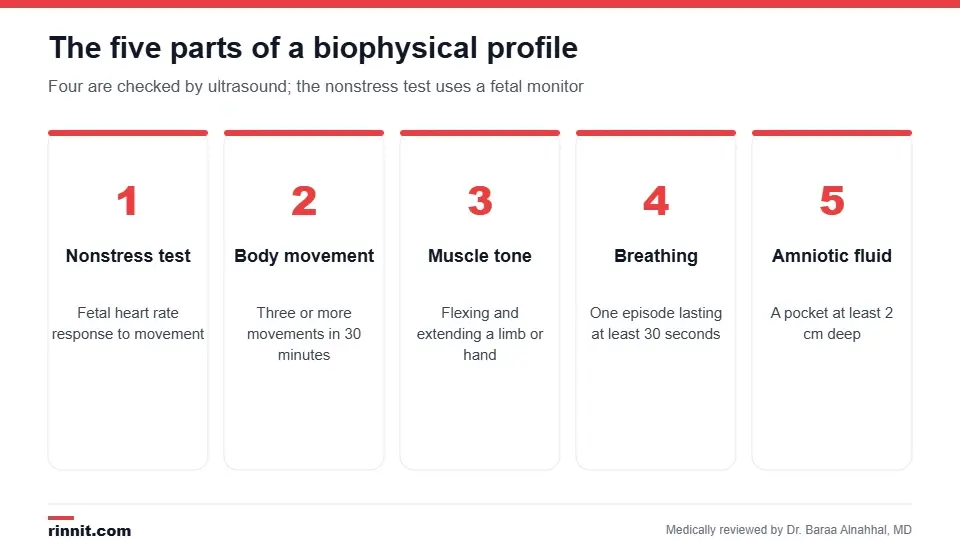
The five components of a biophysical profile.
The five parts of the test
Component | How it is checked | What earns 2 points |
Nonstress test | Fetal heart monitor | Two or more heart rate accelerations within 20 minutes |
Body movement | Ultrasound | Three or more separate body or limb movements in 30 minutes |
Muscle tone | Ultrasound | At least one episode of flexing and extending a limb, or opening and closing a hand |
Breathing movements | Ultrasound | At least one episode of continuous breathing lasting 30 seconds or more |
Amniotic fluid | Ultrasound | At least one pocket measuring 2 cm deep and 1 cm across |
Sources: [1]
Who needs a biophysical profile?
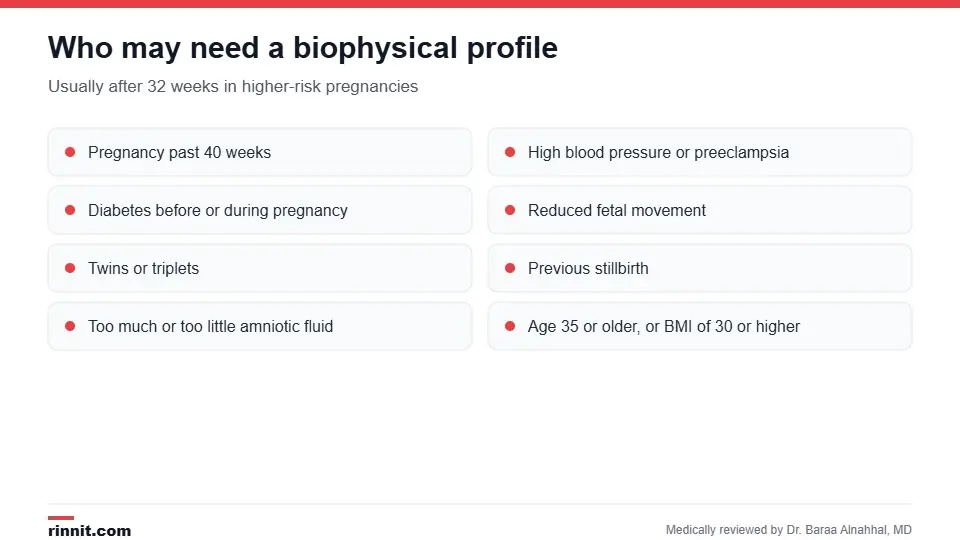
Common reasons for a biophysical profile.
Your provider may order the test if your pregnancy is high risk or goes past 40 weeks, or if you have: [1]
High blood pressure, preeclampsia, lupus, kidney disease or low platelets [1]
Diabetes before pregnancy or gestational diabetes [1]
Decreased fetal movement [1]
A previous stillbirth or other poor pregnancy outcome [1]
Twins or triplets [1]
Possible intrauterine growth restriction [1]
Too much or too little amniotic fluid (polyhydramnios or oligohydramnios) [1]
Rh-negative blood, age 35 or older at delivery, or a BMI of 30 or higher [1]
What happens during a biophysical profile?
For the ultrasound, you lie down or recline while a transducer on your belly sends sound waves that become images. For the nonstress test, a belt with a sensor around your belly records the fetal heart rate; sometimes a second monitor records contractions. The nonstress test usually takes about 20 minutes but can last up to 40 if the fetus is asleep, in which case your provider may use a buzzer to wake it. [1]
The whole biophysical profile takes no longer than 30 to 40 minutes. It is painless and carries no risk to you or the fetus. [1]
How is a biophysical profile scored?

What biophysical profile scores mean.
Each of the four ultrasound components scores 0 or 2 points, never 1, for a maximum of 8. If the nonstress test is included, two heart rate accelerations within 20 minutes add 2 more points. [1]
Score | What it means |
8 (with normal amniotic fluid) | Reassuring |
6 | Possible problems; the test may be repeated in 12 to 24 hours, or early delivery considered |
4 or less | Delivery may be needed right away |
Sources: [1]
Low amniotic fluid calls for closer monitoring even when the other scores are normal. An abnormal result does not always mean there is a problem, because factors such as recent corticosteroid treatment can change fetal breathing and movement for several days. [1]
What are the limits of a biophysical profile?
The test is less reliable before 32 weeks, and it may need to be repeated. [1] Research in high-risk pregnancies shows that a normal ultrasound profile is followed by stillbirth only rarely, [2] but randomized trials have not yet proven that the test improves outcomes compared with other monitoring, and it may increase cesarean deliveries. [3]
What happens after the test?
Results are typically available the same day, and your obstetrician usually explains them at an appointment shortly afterward. [1]
When should you call a doctor?
Call your provider right away if you notice decreased fetal movement, vaginal bleeding, fluid leaking, severe headache or vision changes, whether or not you have a biophysical profile scheduled.
Conclusion
A biophysical profile is a safe, painless way to check on a fetus in the last weeks of a higher-risk pregnancy. It combines ultrasound measures of movement, tone, breathing and fluid with the nonstress test, and a score of 8 with normal fluid is reassuring. [1]
Lower scores guide your care team toward repeat testing, closer monitoring or delivery. Ask your provider what your score means for your pregnancy. [1]
Keep learning: Read our guide to the nonstress test to understand the heart rate part of the biophysical profile.
Frequently asked questions
What is a biophysical profile?
A prenatal test that uses ultrasound and a nonstress test to check fetal breathing, movement, muscle tone, amniotic fluid and heart rate.
When is a biophysical profile done?
Usually after 32 weeks of pregnancy, when the test is most reliable.
Who needs a biophysical profile?
People with high-risk pregnancies, such as those with diabetes, high blood pressure, reduced fetal movement, twins or a pregnancy past 40 weeks.
How long does a biophysical profile take?
No longer than 30 to 40 minutes.
Is a biophysical profile safe?
Yes. It is painless and carries no risk to you or the fetus.
What is a normal biophysical profile score?
A score of 8 with normal amniotic fluid is reassuring; with the nonstress test the maximum is 10.
What does a biophysical profile score of 6 mean?
Possible problems. The test may be repeated in 12 to 24 hours, or early delivery may be considered.
What does a score of 4 or less mean?
Delivery may be needed right away.
What is a modified biophysical profile?
A shorter version that combines the nonstress test with a check of amniotic fluid.
Can steroids affect a biophysical profile?
Yes. Corticosteroids can increase fetal breathing and reduce movement for several days.
Related Reading
Nonstress Test (NST): Why It's Done, What to Expect and Reactive vs Nonreactive Results explains the fetal heart rate test that forms part of the biophysical profile.
Pregnancy Ultrasound: Why It's Done, When You'll Have One, What to Expect and Results covers how ultrasound is used throughout pregnancy.
Preeclampsia: Symptoms, Causes & What Helps — A Complete Guide describes a condition that often leads to biophysical profile testing.
Gestational Diabetes: Symptoms, Causes, Risks & Treatment — Complete Guide explains another common reason for fetal monitoring.
What Is Oligohydramnios? Causes, Signs, and Treatment covers low amniotic fluid, one of the scored components.
Intrauterine Growth Restriction (IUGR): Causes, Risks, and Management describes slow fetal growth, a reason for closer monitoring.
Fetal Heart Rate Monitoring: Normal Range, Types and Decelerations explains how a baby's heart rate is monitored in pregnancy and labor.
Contraction Stress Test: How It Works and What Results Mean explains the late-pregnancy test of how the baby handles contractions.
References
Cleveland Clinic. Biophysical Profile: Purpose, Test & Score. Cleveland Clinic. Last updated December 19, 2022. https://my.clevelandclinic.org/health/diagnostics/21013-biophysical-profile
Zafman KB, Bruck E, Rebarber A, et al. Antenatal Testing for Women With Preexisting Medical Conditions Using Only the Ultrasonographic Portion of the Biophysical Profile. Obstet Gynecol. 2018;132(4):1033-1039. PMID 30130352. https://doi.org/10.1097/AOG.0000000000002811
Lalor JG, Fawole B, Alfirevic Z, et al. Biophysical profile for fetal assessment in high risk pregnancies. Cochrane Database Syst Rev. 2008;(1):CD000038. PMID 18253968. https://doi.org/10.1002/14651858.CD000038.pub2
Medical disclaimer
This article is for general education only and does not replace advice from a qualified healthcare professional. Talk to your doctor about your own diagnosis and treatment, and seek emergency care right away for severe or sudden symptoms.



Comments