Contraction Stress Test: How It Works and What Results Mean

Updated: 3 days ago
Written and medically reviewed by Dr. Baraa Alnahhal, MD · Last reviewed: November 2026 · How we review
Quick Answer
A contraction stress test (CST), also called an oxytocin challenge test, checks how a baby's heart rate responds to contractions to see whether the baby can handle the stress of labor. It's done only at 34 weeks or later. A negative result is normal. It can take up to two hours and is used less often today.
What the research says
The CST is one of several surveillance tools: a review of antepartum fetal surveillance listed the contraction stress test alongside fetal movement counts, nonstress tests and biophysical profiles for pregnancies at higher risk of stillbirth, noting that normal results are reassuring but can't predict sudden events such as placental abruption (Williamson B et al., FP Essent, 2023) [2]
Nipple stimulation can replace oxytocin: a review of contraction stress testing described the nipple stimulation method as an effective, convenient alternative to the more costly and time-consuming oxytocin challenge test (Marshall C, J Obstet Gynecol Neonatal Nurs, 1986) [3]
Key takeaways
Checks how the baby's heart rate responds to contractions.
Done at 34 weeks or later, often when other tests are unclear.
Contractions are triggered by nipple stimulation or IV oxytocin.
Negative is normal; positive means repeated late decelerations.
Used less often today than nonstress tests and biophysical profiles.
Why is it done?
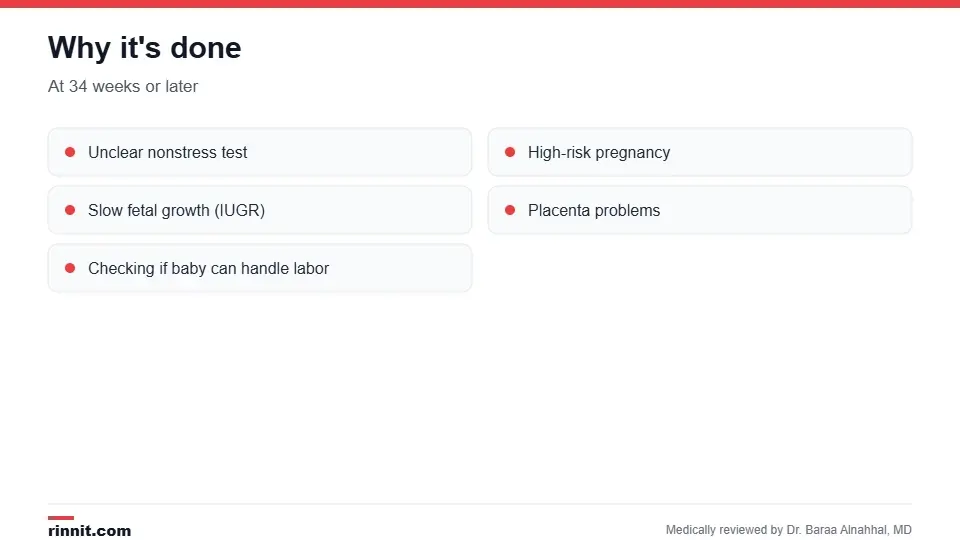
The CST checks whether the baby can tolerate labor.
When a nonstress test or other test results are unclear.
In a high-risk pregnancy.
With placenta problems. Sources: [1, 2]
Today, providers more often use nonstress tests and biophysical profiles, which are quicker and less invasive. Sources: [1]
How do I prepare?
You may be asked not to eat for 4–8 hours, in case an urgent C-section is needed.
Avoid smoking, which can lower the baby's heart rate and affect results. Sources: [1]
What happens during the test?

The test often takes up to two hours.
Two belts with sensors are placed on your belly: one for the baby's heart rate and one for contractions.
The baby's heart rate is recorded before contractions start.
Contractions are triggered by gently massaging your nipples or by oxytocin through an IV.
The goal is at least three contractions lasting at least 40 seconds within 10 minutes.
The team watches how the baby's heart rate responds, then stops the oxytocin and monitors you until contractions settle. Sources: [1, 3]
Understanding your results
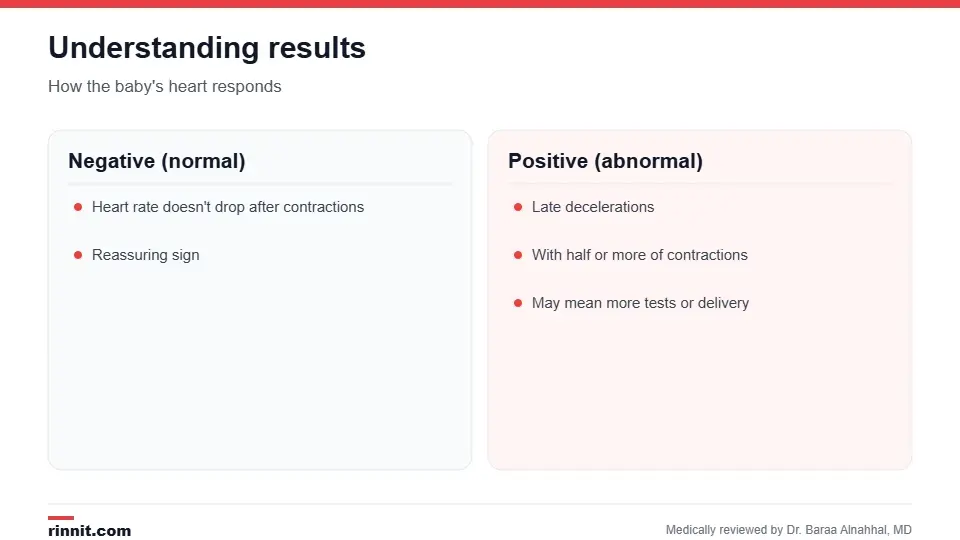
Late decelerations suggest the baby may not tolerate labor well.
Result | What it means |
Negative (normal) | The baby's heart rate doesn't drop after contractions |
Positive (abnormal) | Late decelerations happen with half or more of the contractions |
A positive result needs prompt follow-up, such as more testing right away or planning for delivery. Repeated positive results may lead your provider to recommend delivery. Learn more about fetal heart rate monitoring. Sources: [1, 2]
Risks
The test is generally safe. The main risk is that it could start labor early. It usually isn't done if you have placenta previa, vaginal bleeding late in pregnancy, early (preterm) labor, waters that broke early, a twin or other multiple pregnancy, or a past classical (vertical) C-section or other major uterine surgery. Call your provider right away if labor starts or your water breaks after the test, especially before 37 weeks, which may mean preterm labor. Sources: [1]
Conclusion
The contraction stress test shows how your baby handles contractions before labor begins. Though used less often today, it can help when other tests leave questions, guiding decisions about timing of delivery.
Keep learning: read about the nonstress test and fetal heart rate monitoring.
Frequently asked questions
What is a contraction stress test?
A test of how the baby's heart rate responds to contractions.
When is it done?
At 34 weeks of pregnancy or later.
How are contractions started?
By nipple stimulation or IV oxytocin.
How long does it take?
Often up to two hours.
What does negative mean?
A normal result; the baby's heart rate didn't drop after contractions.
What does positive mean?
Late decelerations with half or more contractions.
Can it start labor?
Rarely, it can trigger early labor.
Should I fast?
You may be asked to fast for 4–8 hours.
Is it still commonly used?
Less often; nonstress tests and biophysical profiles are preferred.
What happens after a positive result?
More testing or, if repeated, possible delivery.
Related Reading
Electronic Fetal Monitoring (EFM): Types, Risks and Results explains continuous monitoring of the baby's heart rate during labor.
Nonstress Test (NST): Why It's Done, What to Expect and Reactive vs Nonreactive Results a more common fetal heart rate test.
Biophysical Profile (BPP): Purpose, the Five Parts, Scoring and Results an ultrasound-based fetal check.
Fetal Heart Rate Monitoring: Normal Range, Types and Decelerations how the baby's heartbeat is tracked.
Intrauterine Growth Restriction (IUGR): Causes, Risks, and Management a reason for extra fetal testing.
Fetal Distress: Signs, Causes, and Management signs the baby may be struggling.
References
Cleveland Clinic. Contraction Stress Test: Purpose, Procedure & Results. Cleveland Clinic. Last updated July 8, 2026. https://my.clevelandclinic.org/health/diagnostics/22849-contraction-stress-test
Williamson B, LeFevre N, Kolker A, et al. Common issues in prenatal care: antepartum fetal surveillance. FP Essent. 2023;525:24-31. PMID 36780556. https://pubmed.ncbi.nlm.nih.gov/36780556/
Marshall C. The nipple stimulation contraction stress test. J Obstet Gynecol Neonatal Nurs. 1986;15(6):459-462. PMID 3641897. https://doi.org/10.1111/j.1552-6909.1986.tb01423.x
Medical disclaimer
This article is for general education only and does not replace advice from a qualified healthcare professional. Talk to your doctor about your own diagnosis and treatment, and seek emergency care right away for severe or sudden symptoms.



Comments