Heliox Therapy: Uses, How It Works and Risks

Updated: 2 days ago
Written and medically reviewed by Dr. Baraa Alnahhal, MD · Last reviewed: November 2026 · How we review
Quick Answer
Heliox is a mix of helium and oxygen that helps people who have trouble breathing. Because helium is lighter than nitrogen, heliox flows more easily through narrowed airways, which reduces the work of breathing. It's used for airway blockages, severe asthma attacks and COPD. It doesn't treat the underlying condition; it buys time while other treatments work.
What the research says
Heliox sped up recovery in severe COPD flare-ups: in a trial of 445 people on noninvasive ventilation for severe COPD flare-ups, heliox didn't prevent ventilation failure (14.7% vs. 14.5%) but improved blood acidity and breathing rate faster (Jolliet P et al., American Journal of Respiratory and Critical Care Medicine, 2017) [2]
It eased breathing distress in infants with bronchiolitis: a meta-analysis of 6 trials with 560 infants found heliox didn't reduce the need for CPAP or intubation or shorten hospital stays, but breathing distress scores improved more than with air and oxygen (Kuitunen I et al., Pediatric Pulmonology, 2022) [3]
Key takeaways
Heliox is a blend of helium and oxygen.
It flows easily through narrowed airways.
It reduces the work of breathing.
It buys time while other treatments work.
It's given by mask, cannula or ventilator.
What is heliox?
Helium is an inert gas; your body doesn't use it and you breathe it back out. Your body uses the oxygen in the mix. Compared with regular air, heliox lowers resistance in the large airways. Sources: [1]
What it's used for
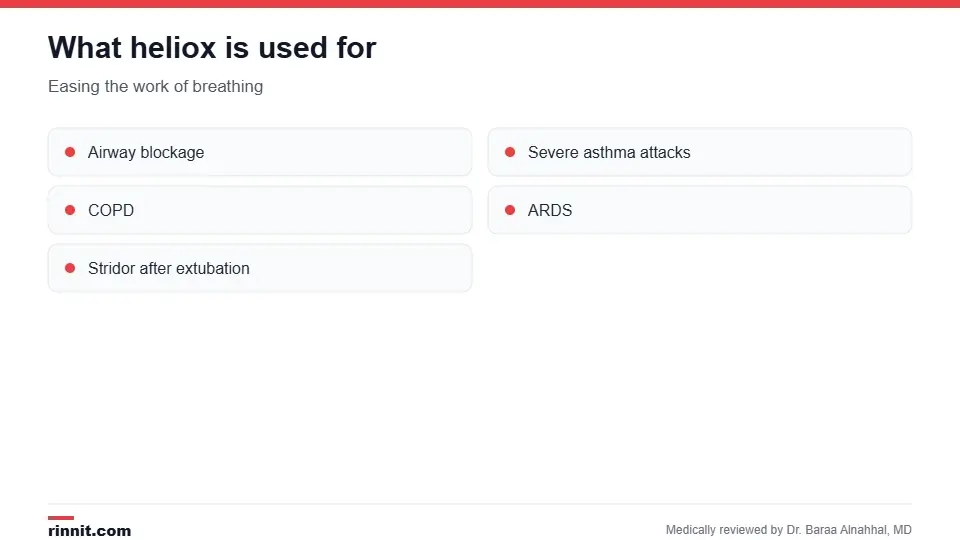
It eases breathing while other treatments work.
Acute respiratory distress syndrome (ARDS).
Airway blockage from a tumor or object.
Severe asthma attacks (status asthmaticus).
COPD.
Decompression sickness in divers.
Stridor (noisy breathing) after extubation. Sources: [1]
Heliox mixtures
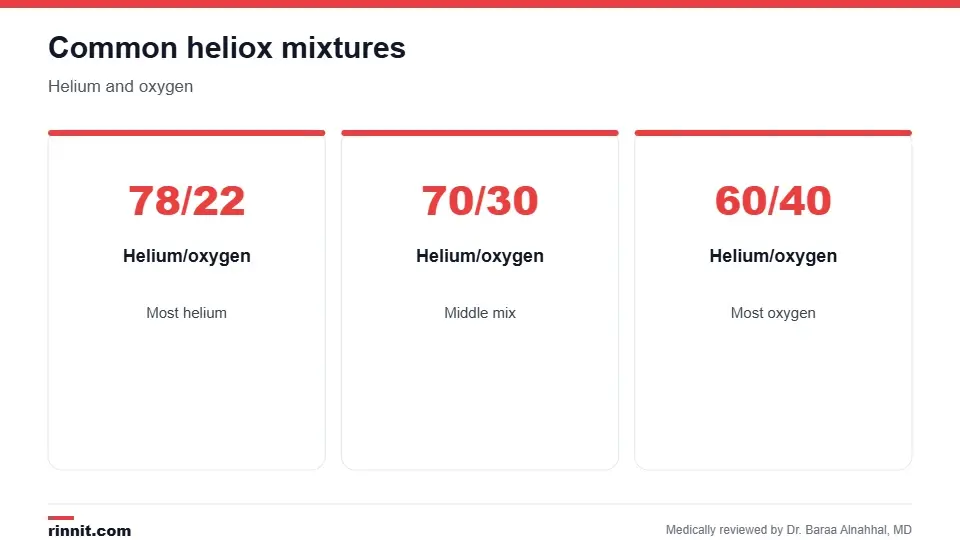
A respiratory therapist or doctor may adjust the mix.
Helium | Oxygen |
78% | 22% |
70% | 30% |
60% | 40% |
For comparison, air is about 78% nitrogen and 21% oxygen. Sources: [1]
How it's given

Treatment continues until you can breathe well on your own.
A face mask.
A nasal cannula.
A ventilator, which breathes for a sedated patient. Sources: [1]
A respiratory therapist or doctor may adjust the helium-to-oxygen ratio. Sources: [1]
Risks
Heliox has little risk when used correctly, but because the mix holds only 21% to 40% oxygen, it isn't suitable if you need a lot of extra oxygen. Providers need special equipment and training, because machine settings and readings can differ from what they expect with regular air. Sources: [1]
How long treatment lasts
Heliox continues until you can breathe well on your own or switch to regular oxygen. Recovery time depends on the condition being treated. Sources: [1, 2]
Outlook
Heliox makes breathing easier and helps you get the oxygen you need while your body heals or other treatments take effect. Studies show it can improve breathing measures faster, though it may not change some outcomes. Sources: [1, 2, 3]
Conclusion
Heliox is a short-term breathing aid that helps air move through narrowed airways. It supports you while other treatments address the cause of your breathing trouble.
Keep learning: read about COPD and asthma attacks.
Frequently asked questions
What is heliox?
A mix of helium and oxygen used to ease breathing.
How does heliox work?
Helium is light, so the mix flows easily through narrow airways.
What conditions use heliox?
Airway blockages, severe asthma, COPD, ARDS and stridor.
Does heliox cure the condition?
No. It buys time while other treatments work.
How is heliox given?
By face mask, nasal cannula or ventilator.
What's in heliox?
Usually 60% to 78% helium and the rest oxygen.
Does the body use helium?
No. You breathe it back out.
Is heliox safe?
Yes, when providers use the right equipment.
How long is heliox used?
Until you can breathe well on your own.
Is heliox used for divers?
Yes, for decompression sickness.
Related Reading
What Is Chronic Obstructive Pulmonary Disease (COPD)? Symptoms, Causes, Stages, and Treatment a lung disease heliox may help.
Asthma Attack: Symptoms, Triggers, Warning Signs & Emergency Treatment — Complete Guide severe asthma attacks.
Extubation: When a Breathing Tube Comes Out, Risks and Recovery removing a breathing tube.
BiPAP Machine: Uses, How It Works and Side Effects breathing support by machine.
Tracheostomy: Purpose, Procedure, Recovery and Living With a Trach a surgical airway.
References
Cleveland Clinic. Heliox: Therapy, Treatment, Uses & Risks. Cleveland Clinic. Last updated April 16, 2024. https://my.clevelandclinic.org/health/treatments/heliox
Jolliet P, Ouanes-Besbes L, Abroug F, et al. A multicenter randomized trial assessing the efficacy of helium/oxygen in severe exacerbations of chronic obstructive pulmonary disease. American Journal of Respiratory and Critical Care Medicine. 2017;195(7):871-880. PMID 27736154. https://doi.org/10.1164/rccm.201601-0083OC
Kuitunen I, Kiviranta P, Sankilampi U, et al. Helium-oxygen in bronchiolitis: a systematic review and meta-analysis. Pediatric Pulmonology. 2022;57(6):1380-1391. PMID 35297227. https://doi.org/10.1002/ppul.25895
Medical disclaimer
This article is for general education only and does not replace advice from a qualified healthcare professional. Talk to your doctor about your own diagnosis and treatment, and seek emergency care right away for severe or sudden symptoms.



Comments