Vocal Cord Lesions: Understanding Nodules, Polyps, and Cysts

Updated: 2 days ago
Medically reviewed by Dr. Baraa Alnahhal, MD · Last reviewed: October 2026
Quick Answer
Benign vocal cord lesions are noncancerous growths, including nodules, polyps and cysts, on the vocal cords, usually from voice overuse or misuse such as chronic yelling. [1] The most common symptom is hoarseness. [1] Nodules usually improve with voice therapy, while polyps and cysts often need surgery plus therapy. [1] See an ENT specialist if hoarseness lasts more than two to three weeks. [1]
What the research says
Most cysts stay the same. In a review of 87 patients with vocal fold cysts who chose observation or waited more than 90 days for surgery, 70.11% of cysts did not change, 12.64% enlarged, 13.79% got smaller, 1.15% resolved, and 1.15% ruptured. Voice therapy did not significantly change the natural history (Kirke and Sulica, Laryngoscope, 2020) [2].
Most injured singers avoid surgery. A review of 438 singers with voice-injury lesions found that nodules made up 58% of lesions, pseudocysts 20%, polyps 14%, and cysts 4%, and that only 14% eventually had surgery. Professional singers without formal voice training were almost 8 times more likely to have surgery than trained amateur singers (Childs et al., Laryngoscope, 2022) [3].
Speech therapy can be an effective first step for polyps. A literature review noted that vocal fold polyps are among the most frequent benign laryngeal lesions, that smoking is an etiological cofactor, and that speech therapy alone may be effective, as well as being a well-established treatment alongside surgery (Vasconcelos et al., Int Arch Otorhinolaryngol, 2019) [4].
What Are Vocal Cord Lesions?
Vocal cord lesions, also called vocal fold lesions, are growths that form on the two bands of muscle and vibratory tissue inside the larynx. [1] These cords come together and vibrate to produce sound when you speak or sing. Lesions can be benign (noncancerous) or malignant (cancerous), and this article focuses on benign ones. When they develop, they interfere with the cords' ability to vibrate normally, which changes voice quality and can make it difficult or even painful to talk or sing.
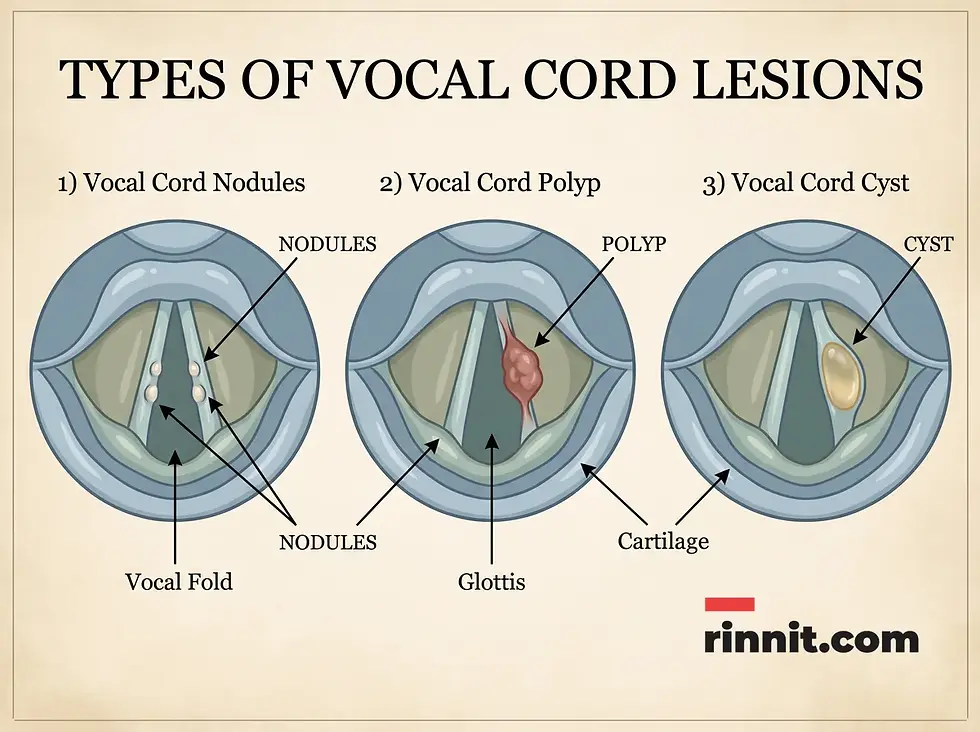
Primary Types of Benign Lesions
Vocal cord nodules: sometimes called singer's or screamer's nodes, these callus-like growths form at the midpoint of the vocal cords, often on both cords, from repeated overuse or misuse of the voice. They are most common in children, heavy voice users such as teachers, trainers, and coaches, and professional voice users such as singers and speakers. [1]
Vocal cord polyps: usually larger than nodules and typically on one cord. They can result from long-term misuse or from a single episode of vocal abuse, such as yelling at a sports event. A type called polypoid corditis (Reinke's edema) is associated almost exclusively with smoking. [1]
Vocal cord cysts: growths with a sac around a fluid-filled or semisolid center, either mucus retention cysts or epidermoid (sebaceous) cysts. They are less common than nodules and polyps and are not necessarily linked to voice overuse. [1]
Symptoms of Vocal Cord Lesions
The most common symptom is hoarseness or a raspy voice. [1] How severe the symptoms are depends on the size of the lesion and how much it interferes with the cords opening, closing, and vibrating together.
Symptom category | Specific sensations |
Voice quality | Hoarseness, breathiness, a harsh, raspy, or scratchy voice, or a voice that breaks easily. [1] |
Vocal performance | Loss of vocal range, vocal fatigue, or loss of your voice. [1] |
Physical discomfort | Frequent coughing or throat clearing, general fatigue, neck pain, or a shooting pain that travels from ear to ear. [1] |
Causes and Contributing Factors
Nodules and polyps form over long periods of overusing or incorrectly using your voice. Speaking or singing for long stretches, yelling, and straining your voice can irritate and inflame the vocal cords until lesions form. Cysts can form when a gland in the vocal cord is blocked or when cell debris becomes trapped in the tissue. [1]
Risk Factors and Triggers

Diagnosis and Evaluation
A provider will examine your head and neck and ask how you use your voice. Accurate diagnosis matters because hoarseness can also come from other conditions, including malignant growths.
Diagnostic Procedures
Laryngoscopy: a thin tube with a light and video camera is passed through your nose or mouth so your provider can see your voice box.
Stroboscopy: a small scope connected to a strobe light shows how your vocal cords vibrate. It is considered the gold standard for evaluating hoarseness [1] and is usually performed by a laryngologist or a voice-specialized speech-language pathologist.
Treatment and Recovery
Treatment ranges from conservative behavioral, medical, and dietary measures to surgery, depending on the type of lesion and how much it affects your voice.
Management Strategies
Treatment type | Goal and application |
Voice therapy | A speech-language pathologist teaches you how to use your voice so your cords can heal and how to prevent future injury. Nodules are typically treated this way first. [1] |
Behavioral changes | Quitting smoking, reducing stress, improving your diet, and reducing vocal strain. |
Treating underlying conditions | Treating reflux, allergies, and sinusitis that inflame the vocal cords. |
Surgery | For nodules that do not improve with conservative treatment, and likely for polyps and cysts, which do not typically improve with voice therapy. Voice therapy after surgery lowers the risk of new lesions. [1] |

Outlook
With treatment, the outlook is excellent. Nodules usually improve within two to six months with voice therapy or vocal rest [1], and surgery for polyps or cysts, together with voice therapy and vocal rest, can help return the voice to normal. Untreated lesions can cause long-term damage to the vocal cords, and untreated cysts may rupture. [1] Benign lesions do not spread through the body, but they can be painful and can seriously affect work for people whose careers depend on their voice.
Prevention
Avoid talking or singing excessively when you have an upper respiratory infection.
Avoid speaking loudly or talking for long periods without resting your voice, and use a microphone when you need to project.
Avoid smoking and smoke-filled rooms, and limit alcohol and caffeine.
Drink plenty of water, get enough sleep, and use a humidifier at home to keep your vocal cords hydrated.
Warm up your voice before singing or long periods of speaking.
Use stress reduction techniques to lessen muscle tension, and get treatment for GERD, sinusitis, allergies, and hypothyroidism.
When to See a Provider
If you are hoarse or have other symptoms of a vocal cord lesion for more than two to three weeks, see an otolaryngologist (ENT) [1] or a laryngologist, who has extra training in voice disorders. Do not delay care, because even benign lesions can lead you to overcorrect your voice and injure your vocal cords.
Frequently Asked Questions
1. Are vocal cord nodules cancerous?
No. Nodules are benign (noncancerous) growths. Still, hoarseness that lasts should always be evaluated to rule out other conditions, including malignant growths.
2. Can nodules go away without surgery?
Yes. Most nodules improve or go away with voice therapy, vocal rest, and changes in how you use your voice. Most people do not need surgery.
3. Why does smoking affect the vocal cords?
Smoking irritates and inflames the vocal cords. It is associated almost exclusively with a type of polyp called Reinke's edema (polypoid corditis), so a smoker who becomes hoarse should be evaluated by a provider.
4. Is voice therapy necessary after surgery?
Voice therapy is often recommended after surgery to reduce the risk of irritating your vocal cords and developing new lesions.
5. How long does recovery take?
Nodules usually improve within two to six months with voice therapy or vocal rest. Recovery from surgery varies, but it usually involves vocal rest and voice therapy.
6. Can children get vocal cord nodules?
Yes. Nodules are most common in children, heavy voice users such as teachers and coaches, and professional voice users such as singers.
7. What is the difference between a polyp and a nodule?
Nodules are callus-like growths that often form on both vocal cords. Polyps are usually larger and typically form on one cord. Polyps and cysts are less likely than nodules to improve with voice therapy alone, though some polyps do.
8. Does acid reflux cause vocal cord lesions?
Chronic acid reflux (GERD) can inflame the larynx, which can make you more susceptible to lesions or make existing ones worse.
9. Can a vocal cord cyst burst?
It is possible. Untreated cysts can occasionally rupture, which may cause complications for the voice, although most cysts stay the same size over time.
10. What does a raspy voice mean?
A raspy, scratchy, or hoarse voice can mean the vocal cords are not closing and vibrating properly, which is the most common symptom of a vocal cord lesion.
11. Are professional singers at higher risk?
Yes. Heavy and professional voice users such as singers, teachers, trainers, and coaches are at higher risk because of frequent vocal strain.
12. Can I use my voice when I have a cold?
It is best to rest your voice when you are sick, because talking or singing excessively with an upper respiratory infection raises your risk of injury.
13. What is stroboscopy?
Stroboscopy is a test in which a small scope with a flashing strobe light shows how your vocal cords vibrate. It is considered the gold standard for evaluating hoarseness.
14. Does caffeine affect vocal health?
Too much caffeine, like too much alcohol, can dry out the vocal cords, so it is best to limit both.
15. Can lesions come back?
Yes. Lesions can return if the underlying voice misuse or contributing conditions are not addressed, which is why voice therapy and healthy vocal habits matter.
Related Reading
Voice Therapy: Exercises, Uses and What to Expect explains voice therapy.
Microlaryngoscopy: Vocal Fold Surgery, Recovery and Voice Rest explains the microscope-guided procedure to examine and treat the vocal folds.
Videostroboscopy: How It Shows Your Vocal Cords in Slow Motion explains the slow-motion camera exam of the vocal cords.
Laryngoscopy: What It Is, Why It's Done, Types, Procedure and Results explains how a laryngoscopy lets your provider look closely at your voice box and throat.
Trusted External Resources
References
Cleveland Clinic. Vocal Cord Lesions (Nodules, Polyps and Cysts). Cleveland Clinic. Last updated December 29, 2022. https://my.clevelandclinic.org/health/diseases/15424-vocal-cord-lesions-nodules-polyps-and-cysts
Kirke DN, Sulica L. The natural history of vocal fold cysts. Laryngoscope. 2020;130(9):2202-2207. PMID 31714601. https://doi.org/10.1002/lary.28377
Childs LF, Rao A, Mau T. Profile of injured singers: expectations and insights. Laryngoscope. 2022;132(11):2180-2186. PMID 35023577. https://doi.org/10.1002/lary.30015
Vasconcelos D, Gomes AOC, Araújo CMT. Vocal fold polyps: literature review. Int Arch Otorhinolaryngol. 2019;23(1):116-124. PMID 30647795. https://doi.org/10.1055/s-0038-1675391
Medical Disclaimer
This article is for informational purposes only and does not constitute medical advice. Always seek the advice of your physician or other qualified health provider with any questions you may have regarding a medical condition. Never disregard professional medical advice or delay in seeking it because of something you have read in this article.



Comments