Diarrhea: Causes, Symptoms, Treatments & When to See a Doctor — Complete Guide

Updated: 2 days ago
Medically reviewed by Dr. Baraa Alnahhal, MD · Last reviewed: October 2026
Quick Answer
Diarrhea is loose, watery and often more frequent bowel movements, a common problem that usually clears within a few days. Common causes are viruses, bacteria, parasites and antibiotics. The main risk is dehydration, especially in young children and older adults. See a doctor if it lasts more than two days in adults, or with high fever or bloody stools.
What the research says
Rice- or wheat-based oral rehydration solutions may work slightly better than standard ones. A Cochrane review of 35 trials (4,284 participants; 28 trials in children only) found that, compared with older higher-osmolarity glucose-based solutions, polymer-based ORS may cut total stool output in the first 24 hours by about 65 mL/kg (95% CI 47–84), shorten diarrhea by about 8 hours (95% CI 4–13), and reduce the need for unscheduled IV fluids (relative risk 0.75, 95% CI 0.57–0.98); the evidence was low quality, and comparisons against today's lower-osmolarity solution favored polymer-based ORS but were underpowered. (Gregorio et al., Cochrane Database Syst Rev, 2016) [3]
Rotavirus vaccines work well, even against strains not in the vaccine. A meta-analysis of 31 case-control studies (27,293 participants) found that in high-income countries the monovalent vaccine (RV1) was 90% effective (95% CI 82–94) against severe rotavirus gastroenteritis from vaccine-type strains and about 79–80% effective against other strains; in middle-income countries it was 81% effective against vaccine-type strains and 65–67% against other strains. (Cates et al., Pediatr Infect Dis J, 2021) [4]
Handwashing with soap lowers children's diarrhea risk by about 30%. A Lancet systematic review and meta-analysis of 124 studies in low- and middle-income countries (including 41 hygiene comparisons covering 98,416 children) found that promoting handwashing with soap cut diarrhea risk by 30% (relative risk 0.70, 95% CI 0.64–0.76), while treating drinking water at the point of use cut risk by up to 50%. (Wolf et al., Lancet, 202200937-0)) [5]
Diarrhea at a Glance
Aspect | Summary |
What it is | Loose, watery, possibly more-frequent bowel movements |
Typical duration | A few days; longer may signal another condition |
Most common causes | Viruses, bacteria, parasites, medicines (especially antibiotics) |
Main complication | Dehydration, which can be life-threatening if untreated |
When to see a doctor | Beyond 2 days (adults) or 24 hours (children); high fever, bloody/black stools, severe pain, dehydration |
First-line care | Fluid replacement, semisolid low-fiber foods, rest |
Medical treatment | Fluids and electrolytes, antibiotics/anti-parasitics when needed, IV fluids, treating underlying conditions |
What Is Diarrhea?
Your small intestine and colon are the working parts of your digestive tract. They process the foods you eat: the intestines extract nutrients, and what is not absorbed continues along the tract and is expelled as stool during a bowel movement.
Diarrhea — loose, watery, and possibly more-frequent bowel movements — happens when something disrupts this process in the small intestine or the large intestine. It is a common problem. Sometimes it is the only symptom. At other times, it arrives with nausea, vomiting, abdominal pain, or weight loss.
Here is the key thing to know about timing: diarrhea is usually short-lived, lasting no more than a few days. But when it lasts beyond a few days into weeks, it usually means there is another problem — such as irritable bowel syndrome (IBS) or a more serious disorder, including an ongoing infection, celiac disease, or inflammatory bowel disease (IBD).

Symptoms of Diarrhea
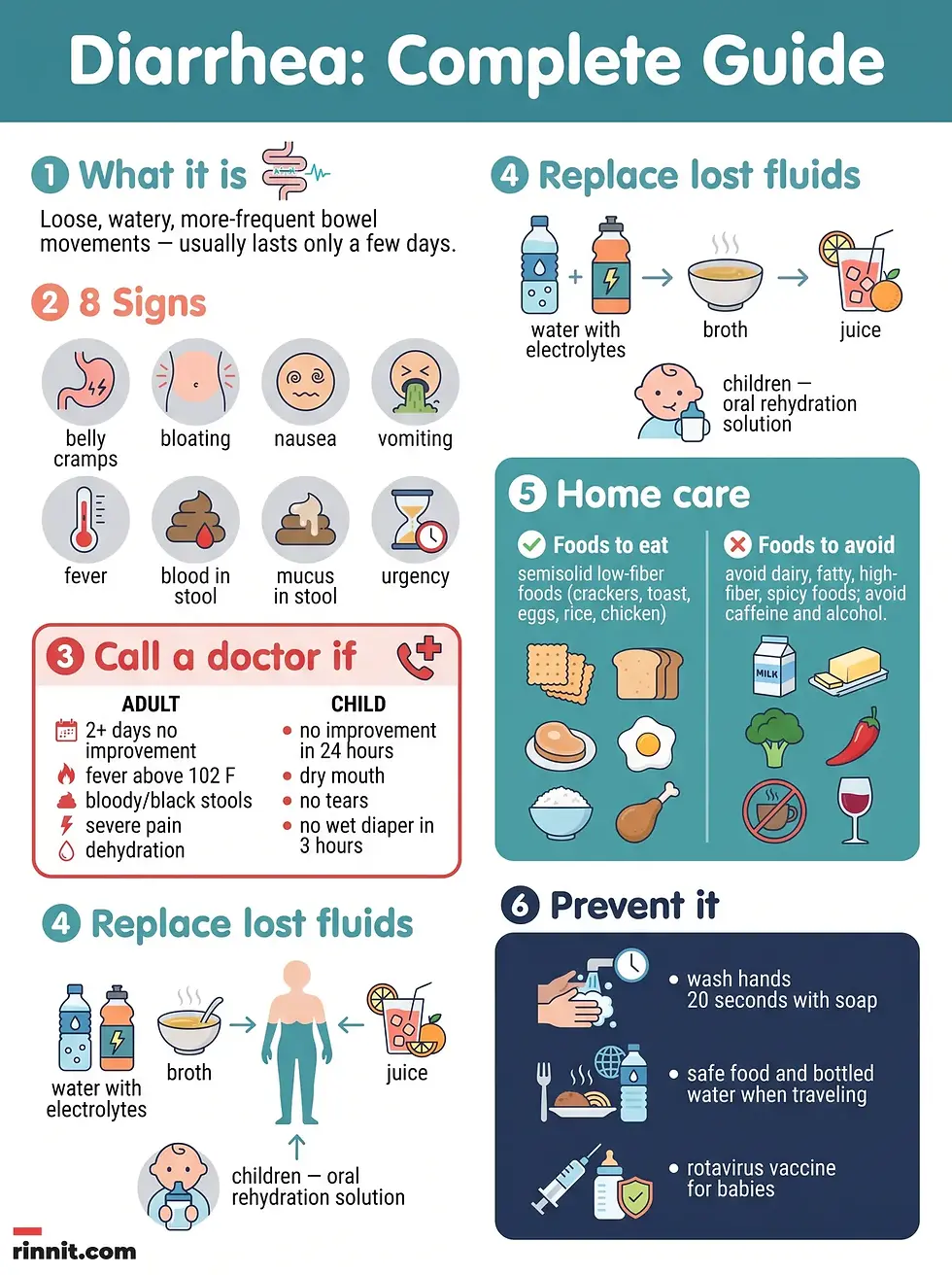
Diarrhea itself — loose, watery stools — is the core symptom. It is often accompanied by other signs that help point to the cause and severity:
Symptom | What it looks like |
Belly cramps or pain | Achy or sharp abdominal discomfort |
Bloating | Swollen, full feeling in the belly |
Nausea | Upset stomach, urge to vomit |
Vomiting | Often paired with nausea |
Fever | Can signal an infection |
Blood in the stool | A red-flag sign — see a doctor |
Mucus in the stool | Slimy material in the stool |
Urgent need for a bowel movement | Sudden, hard-to-delay urgency |
When to See a Doctor
Diarrhea is usually harmless on its own, but certain signs mean you should not wait it out.
Adults — see your doctor if:
Your diarrhea persists beyond two days with no improvement
You become dehydrated
You have severe abdominal or rectal pain
You have bloody or black stools
You have a fever above 102 F (39 C)
Children — diarrhea can quickly lead to dehydration in children, particularly young children. Call your doctor if your child's diarrhea does not improve within 24 hours, or if your child:
Becomes dehydrated
Has a fever above 102 F (39 C)
Has bloody or black stools
What Causes Diarrhea?
A number of diseases and conditions can cause diarrhea. The causes fall into two rough groups — short-term (acute) triggers and ongoing (chronic) ones.
Acute Causes
1. Viruses. Viruses that can cause diarrhea include Norwalk virus (norovirus), enteric adenoviruses, astrovirus, cytomegalovirus, and viral hepatitis. Rotavirus is a common cause of acute childhood diarrhea. The virus that causes COVID-19 has also been associated with gastrointestinal symptoms, including nausea, vomiting, and diarrhea.
2. Bacteria and parasites. Exposure to certain bacteria, such as E. coli, or parasites through contaminated food or water leads to diarrhea. A parasite called cyclospora causes an intestinal illness called cyclosporiasis; in the United States, outbreaks have been linked to fresh produce, with illness reports often rising in spring and summer. When traveling in developing countries, diarrhea caused by bacteria and parasites is often called traveler's diarrhea. Clostridioides difficile (C. diff) is another bacterium that causes diarrhea — it can occur after a course of antibiotics or during a hospitalization.
3. Medicines. Many medicines, such as antibiotics, can cause diarrhea. Antibiotics get rid of infections by killing bad bacteria, but they also kill good bacteria. This disturbs the natural balance of bacteria in your intestines, leading to diarrhea or an infection such as C. diff. Other diarrhea-causing drugs include anti-cancer drugs and antacids with magnesium.
Chronic Causes
4. Lactose intolerance. Lactose is a sugar found in milk and other dairy products. People who have trouble digesting lactose get diarrhea after eating dairy products. Lactose intolerance can increase with age because levels of the enzyme that helps digest lactose drop as you get older.
5. Fructose. Fructose is a sugar found naturally in fruits and honey, and is sometimes added as a sweetener to certain beverages. It can lead to diarrhea in people who have trouble digesting it.
6. Artificial sweeteners. Sorbitol, erythritol, and mannitol — artificial sweeteners that are nonabsorbable sugars found in chewing gum and other sugar-free products — can cause diarrhea in some otherwise healthy people.
7. Surgery. Partial intestine or gallbladder removal surgeries can sometimes cause diarrhea.
8. Other digestive disorders. Chronic diarrhea has several other causes, such as IBS, Crohn's disease, ulcerative colitis, celiac disease, microscopic colitis, and small intestinal bacterial overgrowth (SIBO).
Type of cause | Examples | When diarrhea typically happens |
Viruses | Norovirus, rotavirus, adenovirus, viral hepatitis | Days — often with nausea, fever |
Bacteria and parasites | E. coli, cyclospora, C. diff | Days — after contaminated food, water, antibiotics, or hospital stays |
Medicines | Antibiotics, anti-cancer drugs, magnesium antacids | During or after the course |
Food intolerances | Lactose (dairy), fructose (fruits, honey, sweetened drinks) | After eating the trigger food |
Artificial sweeteners | Sorbitol, erythritol, mannitol | After sugar-free gum or products |
Surgery | Partial intestine or gallbladder removal | Can persist |
Digestive disorders | IBS, Crohn's, ulcerative colitis, celiac disease, microscopic colitis, SIBO | Weeks or longer — signals another condition |
Complications: Dehydration
Diarrhea can cause dehydration, which can be life-threatening if untreated. Dehydration is particularly dangerous in children, older adults, and those with weakened immune systems.
Signs of Dehydration in Adults
Excessive thirst
Dry mouth or skin
Little or no urination
Weakness, dizziness, or lightheadedness
Fatigue
Dark-colored urine
Signs of Dehydration in Infants and Young Children
No wet diaper in three or more hours
Dry mouth and tongue
Fever above 102 F (39 C)
Crying without tears
Drowsiness, unresponsiveness, or irritability
Sunken appearance to the belly, eyes, or cheeks
If you have signs of serious dehydration, seek medical help.
Prevention
Preventing Infectious Diarrhea: Wash Your Hands
Wash your hands to prevent the spread of infectious diarrhea. To make sure hand-washing is actually adequate:
Wash frequently. Wash your hands before and after preparing food, after handling uncooked meat, using the toilet, changing diapers, sneezing, coughing, and blowing your nose.
Lather with soap for at least 20 seconds. After putting soap on your hands, rub them together for at least 20 seconds — about as long as it takes to sing "Happy Birthday" twice through.
Use hand sanitizer when washing isn't possible. Use an alcohol-based hand sanitizer (at least 60% alcohol). Apply it as you would hand lotion, covering the fronts and backs of both hands.
Handle fresh produce safely. Some parasites, such as cyclospora, can spread through contaminated fresh fruits and vegetables. Wash produce under running water before eating, cutting, or cooking. Use a clean produce brush to scrub firm produce such as melons and cucumbers. Cut away bruised or damaged areas, and refrigerate cut, peeled, or cooked produce within two hours.
Vaccination
You can help protect your infant from rotavirus — the most common cause of viral diarrhea in children — with one of two approved vaccines. Ask your baby's doctor about having your baby vaccinated.
Preventing Traveler's Diarrhea
Diarrhea commonly affects people who travel to countries with inadequate sanitation and contaminated food. To reduce your risk:
Watch what you eat. Eat hot, well-cooked foods. Skip raw fruits and vegetables unless you can peel them yourself. Do not eat raw or undercooked meats and dairy foods.
Watch what you drink. Drink bottled water, soda, beer, or wine served in its original container. Avoid tap water and ice cubes. Use bottled water even for brushing your teeth, and keep your mouth closed while you shower. Beverages made with boiled water, such as coffee and tea, are probably safe. Remember that alcohol and caffeine can aggravate diarrhea and worsen dehydration.
Ask your health care team about antibiotics. If you are traveling to a developing country for an extended time, ask a member of your health care team about antibiotics before you go — especially if you have a weakened immune system.
Check for travel warnings. The Centers for Disease Control and Prevention maintains a travelers' health website where disease warnings are posted for various countries. Check there before traveling outside the United States.
How Is Diarrhea Diagnosed?
Your health care professional will ask about your medical history, review the medications you take, conduct a physical exam, and may order tests to determine what is causing your diarrhea. Possible tests include:
Test | What it does |
Blood test | A complete blood count, electrolyte measurement, and kidney function tests indicate the severity of your diarrhea |
Stool test | Checks whether a bacterium or parasite is causing your diarrhea |
Hydrogen breath test | Helps determine lactose intolerance; after drinking a high-lactose liquid, your breath is measured for hydrogen — too much hydrogen means you are not fully digesting and absorbing lactose |
Flexible sigmoidoscopy or colonoscopy | A thin, lighted tube inserted in the rectum lets the doctor see inside the colon (lower colon with sigmoidoscopy; the entire colon with colonoscopy) and take a biopsy |
Upper endoscopy | A long, thin tube with a camera examines your stomach and upper small intestine; a tissue sample may be removed for analysis |
How Is Diarrhea Treated?
Most cases of acute diarrhea clear on their own within a couple of days without treatment. If you have tried lifestyle changes and home remedies without success, your doctor might recommend medicines or other treatments.
1. Antibiotics or Anti-Parasitics
Antibiotics or anti-parasitic medicines might help treat diarrhea caused by bacteria or parasites. If a virus is causing your diarrhea, antibiotics won't help.
2. Treatment to Replace Fluids
Your doctor will likely advise you to replace fluids and salts. For most adults, that means drinking water with electrolytes, juice, or broth. If drinking liquids upsets your stomach or causes vomiting, your doctor might recommend getting IV fluids.
Water is a good way to replace fluids, but it does not contain the salts and electrolytes — minerals such as sodium and potassium — that are essential for your body to function. You can help maintain electrolyte levels by drinking fruit juices for potassium or eating soups for sodium. But certain fruit juices, such as apple juice, might make diarrhea worse.
For children, ask your doctor about using an oral rehydration solution to prevent dehydration or replace lost fluids.
3. Adjusting Medicines You're Taking
If your doctor determines that an antibiotic caused your diarrhea, they might lower your dose or switch to another medicine.
4. Treating Underlying Conditions
If your diarrhea is caused by a more serious condition, such as inflammatory bowel disease, your doctor will work to control that condition. You might be referred to a specialist, such as a gastroenterologist, who can help devise a treatment plan.
Lifestyle and Home Remedies
Diarrhea usually clears up quickly without treatment. To help you cope with symptoms until it goes away, try the following:
Drink plenty of liquids, including water, broths, and juices. Avoid caffeine and alcohol.
Add semisolid and low-fiber foods gradually as your bowel movements return to normal. Try soda crackers, toast, eggs, rice, or chicken.
Don't eat certain foods for a few days — dairy products, fatty foods, high-fiber foods, or highly seasoned foods.
Ask about anti-diarrheal medicines. Nonprescription options such as loperamide and bismuth subsalicylate might reduce the number of watery bowel movements and control severe symptoms. However, certain medical conditions and infections — bacterial and parasitic — can be worsened by these medicines, because they prevent your body from getting rid of what is causing the diarrhea. Some of these medicines are not recommended for children. Check with your doctor before taking them or giving them to a child.
Consider taking probiotics. These microorganisms may help restore a healthy balance to the intestinal tract by boosting good bacteria. It is not clear if they can shorten a bout of diarrhea. Probiotics come in capsule or liquid form and are also added to some foods, such as certain brands of yogurt. Further research is needed on which strains help most and what doses are needed.
Coping and Support
Most diarrhea episodes pass quickly with simple home care, and knowing the warning signs is the best support you can give yourself. For parents, the most important habit is watching infants and young children closely for dehydration — no wet diaper in three hours, no tears when crying, and unusual drowsiness are all reasons to call the doctor right away. If diarrhea keeps coming back or lasts for weeks, ask for a referral to a gastroenterologist to look for an underlying digestive condition.
Preparing for Your Appointment
You might start by seeing a member of your primary health care team. If you have persistent diarrhea, you may be referred to a doctor who specializes in the digestive system, called a gastroenterologist.
What You Can Do
When you make the appointment, ask if there is anything you need to do in advance, such as fasting before certain tests. Make a list of:
Your symptoms, including when they began and any that seem unrelated to the reason for your appointment
Key personal information, including major stresses, recent life changes, or travel
Medications, vitamins, or supplements, including doses. If you recently took an antibiotic, note what kind, for how long, and when you stopped
Questions to ask your doctor
Some basic questions to ask include:
What is likely causing my diarrhea?
Could my diarrhea be caused by a medicine I'm taking?
What tests do I need?
Is my diarrhea likely temporary or chronic?
What is the best course of action?
What are the alternatives to the primary approach you're suggesting?
I have other health conditions. How can I best manage them with the diarrhea?
Are there restrictions I should follow?
May I take medicine such as loperamide to slow the diarrhea down?
Should I see a specialist?
Don't hesitate to ask other questions.
What to Expect From Your Doctor
Your doctor is likely to ask:
When did your symptoms begin?
Have your symptoms been continuous or occasional?
How severe are your symptoms?
What, if anything, seems to improve your symptoms?
What, if anything, appears to worsen your symptoms?
Does your diarrhea awaken you at night?
Do you see blood, or are your bowel movements black in color?
Have you recently been around anyone who has diarrhea?
Have you recently stayed in a hospital or nursing home?
Have you taken antibiotics recently?
What You Can Do in the Meantime
While you wait for your appointment, you may ease your symptoms if you drink more fluids — water, juice, and broth — to help avoid dehydration, and avoid foods that can aggravate diarrhea, such as fatty, high-fiber, or highly seasoned foods.
Frequently Asked Questions (FAQ)
What exactly is diarrhea?
Diarrhea is loose, watery, and possibly more-frequent bowel movements. It is a common problem that sometimes appears alone and sometimes comes with nausea, vomiting, abdominal pain, or weight loss.
Why do I get diarrhea after taking antibiotics?
Antibiotics kill bad bacteria to cure infections, but they also kill the good bacteria in your intestines. This disturbs the natural bacterial balance and can lead to diarrhea — or even an infection such as C. diff.
Can food cause diarrhea?
Yes. Lactose in dairy products, fructose in fruits, honey, and sweetened beverages, and artificial sweeteners such as sorbitol, erythritol, and mannitol in sugar-free gum can all cause diarrhea in people who have trouble digesting or absorbing them.
What are the warning signs of dehydration from diarrhea?
In adults, watch for excessive thirst, dry mouth or skin, little or no urination, dark urine, weakness, dizziness, and fatigue. In infants and young children, watch for no wet diaper in three or more hours, dry mouth and tongue, crying without tears, drowsiness, and a sunken appearance to the belly, eyes, or cheeks.
How should I eat and drink while I have diarrhea?
Drink plenty of liquids such as water, broths, and juices, while avoiding caffeine and alcohol. Gradually add semisolid, low-fiber foods like soda crackers, toast, eggs, rice, or chicken, and avoid dairy, fatty, high-fiber, and highly seasoned foods for a few days.
Should I take an anti-diarrheal medicine?
Over-the-counter options like loperamide and bismuth subsalicylate can help control severe symptoms — but bacterial and parasitic infections can be worsened by them, and some are not recommended for children. Check with your doctor first.
When should I see a doctor for diarrhea?
Adults should see a doctor if diarrhea lasts beyond two days without improvement, or if there is dehydration, severe abdominal or rectal pain, bloody or black stools, or a fever above 102 F (39 C). Call a doctor for a child if diarrhea doesn't improve within 24 hours, or if the child becomes dehydrated, has a high fever, or has bloody or black stools.
Conclusion
The main lessons of this guide:
Most diarrhea is short and harmless. It usually clears on its own within a couple of days — the priority is replacing lost fluids and resting your digestive tract.
Dehydration is the real danger. It can be life-threatening if untreated, and children, older adults, and people with weakened immune systems are at highest risk — learn the warning signs.
Duration is a warning signal. Diarrhea lasting into weeks usually points to another condition, such as IBS, celiac disease, or inflammatory bowel disease, and deserves a medical workup.
This guide has walked you through what diarrhea is, its eight main causes, the dehydration warning signs for adults and children, prevention habits, diagnosis, treatment, and home care. If you found it useful, keep reading: our complete guide to dehydration covers the main complication of diarrhea in depth, and our guide to antibiotic-associated diarrhea explains one of the most common causes.
Your Next Steps
Share your thoughts — Have questions or experiences with diarrhea? Leave a comment below.
Stay updated — Sign up on rinnit.com for new complete health guides delivered to you.
Disclaimer: This content is provided for informational purposes only and is not a substitute for professional medical advice, diagnosis, or treatment. Always seek the advice of your physician or other qualified health provider with any questions you may have regarding a medical condition.
References
Mayo Clinic Staff. Diarrhea - Symptoms and causes. Mayo Clinic. July 18, 2026. https://www.mayoclinic.org/diseases-conditions/diarrhea/symptoms-causes/syc-20352241
Mayo Clinic Staff. Diarrhea - Diagnosis and treatment. Mayo Clinic. July 18, 2026. https://www.mayoclinic.org/diseases-conditions/diarrhea/diagnosis-treatment/drc-20352246
Gregorio GV, et al. Polymer-based oral rehydration solution for treating acute watery diarrhoea. Cochrane Database Syst Rev. 2016;12(12):CD006519. PMID 27959472. https://doi.org/10.1002/14651858.CD006519.pub3
Cates JE, et al. Do Rotavirus Strains Affect Vaccine Effectiveness? A Systematic Review and Meta-analysis. Pediatr Infect Dis J. 2021;40(12):1135-1143. PMID 34870393. https://doi.org/10.1097/INF.0000000000003286
Wolf J, et al. Effectiveness of interventions to improve drinking water, sanitation, and handwashing with soap on risk of diarrhoeal disease in children in low-income and middle-income settings: a systematic review and meta-analysis. Lancet. 2022;400(10345):48-59. PMID 35780792. https://doi.org/10.1016/S0140-6736(22)00937-0



Comments