PEG Tube (Percutaneous Endoscopic Gastrostomy): Placement and Care

Updated: 2 days ago
Written and medically reviewed by Dr. Baraa Alnahhal, MD · Last reviewed: November 2026 · How we review
Quick Answer
Percutaneous endoscopic gastrostomy (PEG) is a procedure to place a feeding tube through the belly wall into the stomach. It delivers nutrition, fluids and medicine when you can't safely chew or swallow or can't eat enough by mouth. It takes about 20 to 30 minutes, and most people go home the same day or the next morning.
What the research says
Endoscopic and radiologic placement work equally well: in 5 randomized trials with 544 people, PEG and radiologic gastrostomy had similar success, death and complication rates, though the radiologic method took about 19 minutes longer (Meine MC et al., JPEN Journal of Parenteral and Enteral Nutrition, 2024) [2]
Early feeding after PEG is safe: in 6 randomized trials with 467 people, starting tube feeds within 4 hours of PEG placement caused no more complications or deaths within 72 hours than waiting longer (Bechtold ML et al., Nutrition in Clinical Practice, 2024) [3]
Key takeaways
A PEG tube delivers nutrition directly into the stomach.
It's used when you can't safely swallow or eat enough.
Placement takes about 20 to 30 minutes.
Most people go home the same day or the next morning.
Call your provider right away if the tube falls out.
What is a PEG tube?
A PEG tube is a type of feeding tube about as wide as a pen or pencil. After placement, 6 to 12 inches of tube stay outside your body. A disc called an external bumper keeps it from slipping further into the stomach, and a cap at the tip lets you give food, water or medicine. Sources: [1]
Why it's done
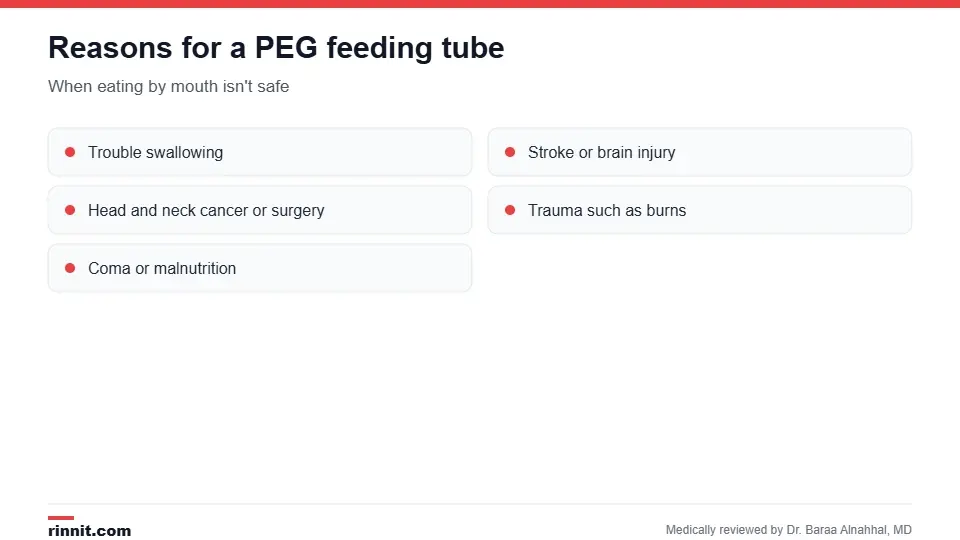
It's used when eating by mouth isn't safe or enough.
Stroke, brain injury or neurological disorders.
Head and neck cancer or surgery.
Trauma, such as severe burns.
Coma.
Malnutrition. Sources: [1]
Parts of a PEG tube
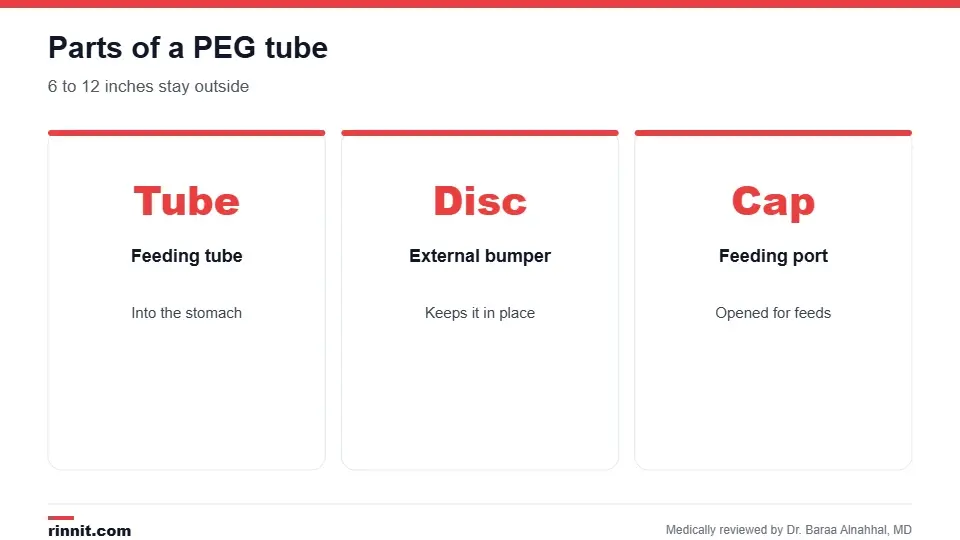
About 6 to 12 inches stay outside your body.
Part | What it does |
Tube | Carries food, water and medicine into the stomach |
External bumper | Keeps the tube from moving further inside |
Cap or plug | Prevents leaks; opened to give feeds |
Sources: [1]
What happens during placement
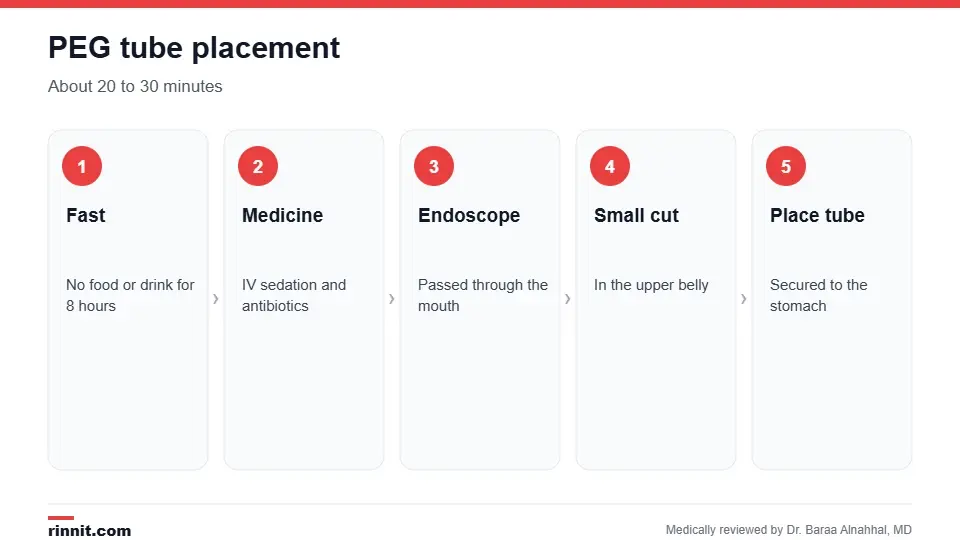
The procedure takes about 20 to 30 minutes.
Don't eat or drink for at least 8 hours beforehand.
You get IV medicine for comfort and IV antibiotics to prevent infection.
A flexible endoscope is passed through your mouth into the stomach.
The provider makes a small cut in your upper belly and places the tube through it.
The tube is connected to the stomach and secured. Sources: [1]
For short-term feeding, a nasogastric tube through the nose is another option.
Risks
Risk | Notes |
Tube moving or coming out | Needs care within 24 hours |
Aspiration | Food or liquid getting into the lungs |
Infection or pain at the site | Daily cleaning helps |
Leakage around the tube | Can irritate skin |
Bleeding or a hole in the bowel | Rare |
Sources: [1, 2]
Recovery and care
Pain from the incision or gas cramps should ease within 24 to 48 hours.
Some drainage is normal for up to 48 hours.
Your surgeon will usually tell you to remove the bandage after 1 to 2 days.
Clean the tube and skin every day.
A dietitian will teach you how to use the tube.
See your provider every 6 to 12 months to check the tube. Sources: [1, 3]
How long it lasts
PEG tubes can last months or years. A worn or clogged tube can be replaced without surgery or anesthesia. If you no longer need it, the tube is removed and the opening closes on its own. Sources: [1]
When to call your provider
Right away if the tube falls out or moves; the opening can close within 24 hours.
Signs of infection, such as redness, swelling or pus.
Leaking around the tube.
Pain that gets worse. Sources: [1]
Conclusion
A PEG tube is a safe, quick way to keep your body nourished when eating by mouth isn't possible. Learning daily tube care and staying in touch with your care team helps prevent problems.
Keep learning: read about tube feeding and dysphagia.
Frequently asked questions
What is a PEG tube?
A feeding tube placed through the belly into the stomach.
Is a PEG tube the same as a G-tube?
Yes. A PEG tube is a type of G-tube.
Why would someone need a PEG tube?
When they can't safely swallow or eat enough by mouth.
How long does placement take?
About 20 to 30 minutes.
Is PEG placement painful?
You get IV medicine for comfort; soreness eases within 1 to 2 days.
How long does a PEG tube last?
Months or years.
Can I eat by mouth with a PEG tube?
Sometimes small bites or sips, if your provider says it's safe.
What if the tube falls out?
Call your provider right away; it needs care within 24 hours.
Can a PEG tube be removed?
Yes. The opening closes on its own.
How do I care for a PEG tube?
Clean the tube and skin daily and follow your dietitian's instructions.
Related Reading
Tube Feeding (Enteral Nutrition): Types, Placement, Feeding Methods, Care and Risks an overview of tube feeding.
Dysphagia (Trouble Swallowing): Symptoms, Causes, Diagnosis & Treatment — Complete Guide a common reason for a feeding tube.
Nasogastric Tube (NG Tube): A Guide to Temporary Medical Support a temporary feeding tube through the nose.
Understanding Parenteral Nutrition: A Guide to Intravenous Feeding nutrition through a vein.
Refeeding Syndrome: Symptoms, Causes, Diagnosis, and Prevention a risk when restarting nutrition.
References
Cleveland Clinic. PEG Tube Placement (Percutaneous Endoscopic Gastrostomy). Cleveland Clinic. Last updated January 13, 2026. https://my.clevelandclinic.org/health/treatments/4911-percutaneous-endoscopic-gastrostomy-peg
Meine MC, Tusato IH, Hoffmeister N, et al. Percutaneous radiologic gastrostomy versus percutaneous endoscopic gastrostomy for enteral feeding: a systematic review and meta-analysis. JPEN Journal of Parenteral and Enteral Nutrition. 2024;48(6):667-677. PMID 38806284. https://doi.org/10.1002/jpen.2646
Bechtold ML, Tarar ZI, Yousaf MN, et al. When to feed after percutaneous endoscopic gastrostomy: a systematic review and meta-analysis of randomized controlled trials. Nutrition in Clinical Practice. 2024;39(5):1191-1201. PMID 38971978. https://doi.org/10.1002/ncp.11184
Medical disclaimer
This article is for general education only and does not replace advice from a qualified healthcare professional. Talk to your doctor about your own diagnosis and treatment, and seek emergency care right away for severe or sudden symptoms.



Comments