Chemotherapy Drugs: Types, How They Work, and Side Effects

Updated: 6 days ago
Written and medically reviewed by Dr. Baraa Alnahhal, MD · Last reviewed: October 2026 · How we review

Quick Answer: What are chemotherapy drugs?
Chemotherapy drugs are medicines that kill fast-growing cells, such as cancer cells, by disrupting the cell cycle so the cells cannot copy their DNA or divide. The main groups are alkylating agents, antimetabolites, topoisomerase inhibitors, mitotic inhibitors and antitumor antibiotics. Because healthy fast-growing cells are also affected, common side effects include fatigue, hair loss, nausea and infection risk. [1]
What the research says
Combination chemotherapy can cut cancer deaths by about one-third. A meta-analysis of about 100,000 women in 123 randomized trials of early breast cancer found that some taxane-plus-anthracycline regimens, or higher-dose anthracycline regimens, lowered breast cancer death rates by about one-third on average, largely regardless of age or tumor features. (EBCTCG et al., Lancet, 2012)
Nerve-related side effects are common but often fade. A review of 31 studies with 4,179 patients found chemotherapy-related nerve damage in 68.1% of people in the first month after treatment, 60.0% at 3 months, and 30.0% at 6 months or more. (Seretny et al., Pain, 2014)
Nausea can be prevented better than ever. In a trial of 380 people receiving strongly nausea-causing chemotherapy, adding olanzapine to standard anti-nausea drugs raised the share with no nausea over 5 days from 22% to 37%; severe sleepiness occurred in 5% on day 2. (Navari et al., N Engl J Med, 2016)
Key takeaways
Chemotherapy drugs kill fast-growing cells by interfering with the cell cycle.
There are five main classes, plus a group of drugs that don't fit any class.
Doctors often combine drugs to make treatment stronger and lower the chance of drug resistance.
Side effects happen because chemo also hits healthy fast-growing cells in your hair, mouth, gut, skin and bone marrow.
The "best" chemotherapy drug is the one proven to work for your cancer type and stage.
What are chemotherapy drugs?
Chemotherapy drugs are the medicines used during chemotherapy, often called "chemo." [1]
Chemotherapy is one of the most common and effective cancer treatments available. It destroys fast-growing cells, like cancer cells, and stops them from multiplying. [1]
Chemotherapy, surgery and radiation are the three most common cancer treatments. In the United States, about 650,000 people with cancer receive chemotherapy in an outpatient setting each year. [1]
How do chemotherapy drugs kill cancer cells?
Chemotherapy drugs kill cancer cells by interfering with the cell cycle, the process cells use to copy their DNA and divide into new cells. [1]
Here is the difference between healthy cells and cancer cells:
Healthy cells | Cancer cells | |
When they divide | Only when the body needs them | Over and over, out of control |
When they die | When they're no longer useful (a process called apoptosis) | They don't die on schedule |
What they cause | Normal tissue repair and growth | Tumors that can damage healthy tissue |
Chemotherapy drugs break this cycle. They stop cancer cells from making more cancer cells. [1]
Different drugs disrupt the cycle in different ways. Some work best during a specific phase of the cell cycle. Others kill cancer cells at every phase. [1]
Your oncologist plans the best timing and the right dose for each drug before treatment starts. [1]
What conditions do chemotherapy drugs treat?
Chemotherapy drugs are mainly used to treat cancer. Medical oncologists (cancer specialists) often prescribe them alongside other cancer treatments, such as surgery, radiation therapy, immunotherapy or targeted therapy. [1]
Chemotherapy drugs can also treat some conditions that aren't cancer: [1]
Condition | How chemotherapy helps |
Autoimmune diseases | Immune cells attack healthy tissue. Chemo stops these cells from multiplying, which slows the damage. |
Blood disorders | The bone marrow makes abnormal blood cells. Chemo is often given before a stem cell transplant to clear abnormal cells and make room for healthy ones. |
What are the main types of chemotherapy drugs?
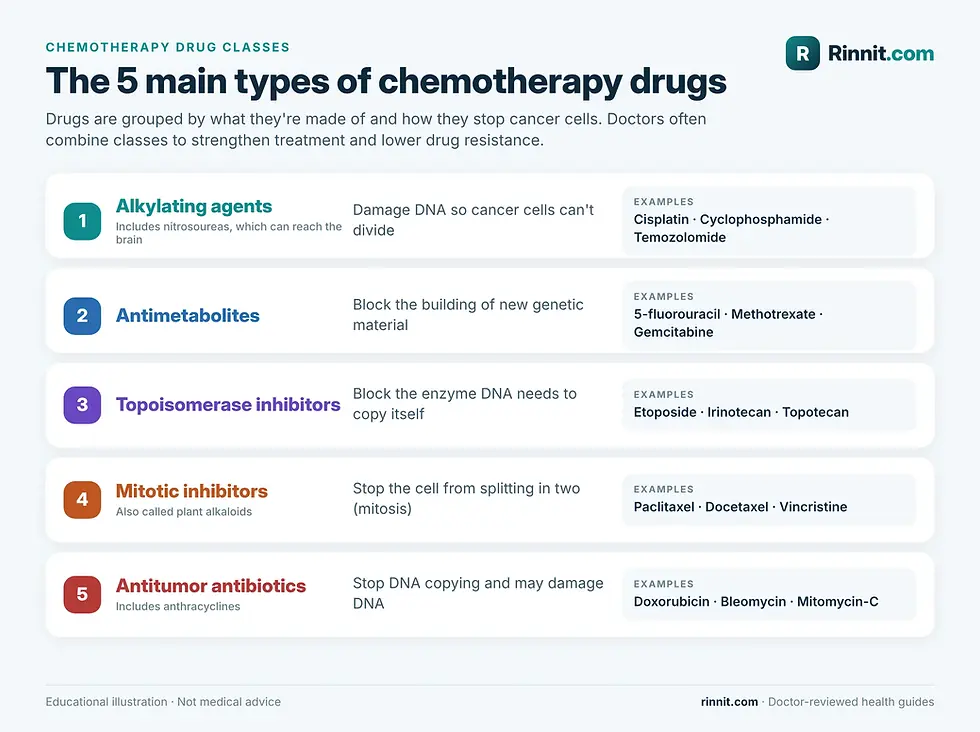
The main types of chemotherapy drugs are alkylating agents, antimetabolites, topoisomerase inhibitors, mitotic inhibitors and antitumor antibiotics. They are grouped by what they're made of and how they destroy cancer cells. [1]
Alkylating agents (including nitrosoureas)
Alkylating agents damage a cell's DNA so cancer cells cannot divide. [1]
Nitrosoureas are a special type. Unlike other alkylating agents, they can travel into the brain and kill cancer cells there, so they are used for some brain tumors. [1]
Examples: altretamine, bendamustine, busulfan, carboplatin, chlorambucil, cisplatin, cyclophosphamide, dacarbazine, ifosfamide, mechlorethamine, melphalan, oxaliplatin, procarbazine, temozolomide, thiotepa, trabectedin.
Nitrosoureas: carmustine, lomustine, streptozocin.
Antimetabolites
Antimetabolites stop cancer cells from making the genetic material they need to build new cells. [1]
Examples: 5-fluorouracil, 6-mercaptopurine, azacitidine, capecitabine, cladribine, clofarabine, cytarabine, decitabine, floxuridine, fludarabine, gemcitabine, hydroxyurea, methotrexate, nelarabine, pemetrexed, pentostatin, pralatrexate, thioguanine, trifluridine/tipiracil.
Topoisomerase inhibitors
Topoisomerase inhibitors block an enzyme called topoisomerase, which DNA needs in order to copy itself. Blocking it stops cancer cells from multiplying and can also damage their DNA. [1]
Examples: etoposide, irinotecan, irinotecan liposomal, mitoxantrone, teniposide, topotecan.
Mitotic inhibitors (plant alkaloids)
Mitotic inhibitors interfere with mitosis, the step where a cell splits into two new cells. They are also called plant alkaloids because they are made from the same material plants use to protect themselves from predators. [1]
Examples: cabazitaxel, docetaxel, nab-paclitaxel, paclitaxel, vinblastine, vincristine, vincristine liposomal, vinorelbine.
Antitumor antibiotics (including anthracyclines)
Antitumor antibiotics stop the DNA inside cancer cells from copying itself, and sometimes damage it. Anthracyclines are a specific type of antitumor antibiotic. [1]
Anthracyclines: daunorubicin, doxorubicin, doxorubicin liposomal, epirubicin, idarubicin, mitoxantrone, valrubicin.
Other antitumor antibiotics: bleomycin, dactinomycin, mitomycin-C.
Mitoxantrone belongs to two groups: it is both a topoisomerase inhibitor and an antitumor antibiotic. [1]
Other chemotherapy drugs
Some chemotherapy drugs don't fit the main groups. These include all-trans-retinoic acid, arsenic trioxide, asparaginase, eribulin, ixabepilone, mitotane, omacetaxine, pegaspargase, procarbazine, romidepsin and vorinostat. [1]
Corticosteroids
Corticosteroids aren't usually classed as chemotherapy. Many people on chemo take them to help manage side effects, and they can also kill cancer cells and stop them from dividing. [1]
Examples: dexamethasone, hydrocortisone, methylprednisolone, prednisolone, prednisone.
Chemotherapy drug classes at a glance
Drug class | How it stops cancer | Example drugs |
Alkylating agents | Damage DNA so cells can't divide | Cisplatin, cyclophosphamide, temozolomide |
Nitrosoureas (alkylating subtype) | Damage DNA and can reach the brain | Carmustine, lomustine |
Antimetabolites | Block the building of new genetic material | 5-fluorouracil, methotrexate, gemcitabine |
Topoisomerase inhibitors | Block the enzyme DNA needs to copy itself | Etoposide, irinotecan, topotecan |
Mitotic inhibitors | Stop cells from splitting in two | Paclitaxel, docetaxel, vincristine |
Antitumor antibiotics | Stop DNA copying and may damage DNA | Doxorubicin, bleomycin, mitomycin-C |
Corticosteroids (supportive) | Ease side effects; can also kill cancer cells | Dexamethasone, prednisone |
Why do doctors combine chemotherapy drugs?
Doctors combine chemotherapy drugs because different drugs attack cancer cells in different ways, which can make treatment more effective. This is called combination chemotherapy. [1]
Combining drugs also lowers the chance that your body becomes resistant to one drug. Once resistance develops, that drug may stop working against the cancer. [1]
Large studies support this approach. In early breast cancer, some combination regimens reduced breast cancer deaths by about one-third on average. [2]
What is the most common chemotherapy drug?
The most commonly prescribed chemotherapy drugs are alkylating agents, which were also the first class of chemo drugs ever developed. [1]
Still, the most common drug or combination for you depends on your type of cancer and its stage (how advanced it is). [1]
What are the benefits of chemotherapy drugs?
Chemotherapy drugs have improved the outlook for many people with cancer. Cancers once considered deadly are now treatable, and many people live longer, fuller lives. [1]
Depending on your diagnosis, chemotherapy drugs can: [1]
Remove cancer from your body so it doesn't come back.
Stop cancer from spreading, so you live longer and feel better.
Ease symptoms, so you can live a full life even with a long-term disease.
What are the side effects of chemotherapy drugs?
Chemotherapy drugs cause side effects because they also harm healthy cells that grow fast, not just cancer cells. [1]
Fast-growing healthy cells | Possible side effects |
Hair follicles | Hair loss |
Mouth lining | Mouth sores |
Digestive tract | Nausea, vomiting, diarrhea, constipation, loss of appetite |
Bone marrow (blood-forming cells) | Low blood counts, anemia, neutropenia (higher infection risk) |
Whole body | Fatigue |

Neutropenia means a low level of a type of white blood cell, which makes it harder for your immune system to fight infections. [1]
Your risk of each side effect depends on the specific drugs you receive. Ask your care team which side effects are most common with your treatment. [1]
Some side effects can now be reduced:
Hair loss: In a trial of 142 women with early breast cancer, half of those who used a scalp cooling device (50.5%) kept most of their hair after 4 chemo cycles, compared with none in the group without cooling. [5]
Nausea: Adding olanzapine to standard anti-nausea medicines increased the share of people with no nausea in the first 24 hours from 45% to 74%. [4]
Nerve damage: Chemotherapy-related nerve damage affects about 2 in 3 people in the first month after treatment, but it often improves; about 30% still have it at 6 months or more. [3] Learn more in our guide to peripheral neuropathy.
Some people also notice memory and focus problems during treatment. See our guide to chemo brain.
What is the outlook with chemotherapy drugs?
The outlook with chemotherapy drugs depends on your overall health, the type and stage of cancer, the other treatments you receive and your treatment goal. [1]
Treatment goal | What chemotherapy does |
First-line (main) treatment | Aims to completely remove the cancer |
Before surgery | Shrinks a tumor so it's easier to remove |
After surgery | Kills cancer cells that surgery couldn't remove |
Symptom relief | Eases symptoms to improve quality of life |
Ask your care team what your outlook is, based on your own treatment goal. [1]
Which chemotherapy drug is best?
The best chemotherapy drug is the one proven to work best for your type of cancer. [1]
Sometimes the best option isn't a single drug but a combination that works well for a specific cancer at a specific stage. Other times, it's the drug that works best alongside surgery or radiation therapy. [1]
Ask your oncologist which drugs you're receiving and how well they work for your cancer type. [1]
When should you call your oncologist about chemotherapy side effects?
You should call your oncologist whenever you have unpleasant side effects during chemotherapy. [1]
Your oncologist can: [1]
Suggest ways to manage side effects.
Prescribe medicines that ease them.
Adjust your dose or treatment schedule.
Switch to other medicines to treat your cancer.
Chemotherapy can lower your white blood cell count, which makes infections harder to fight, so tell your care team about any sign of infection. A temperature of 100.4°F (38°C) or higher during chemotherapy is an emergency: call your oncology team right away, day or night. [1]
Conclusion
Chemotherapy drugs are a cornerstone of cancer care. They work by disrupting the cell cycle, and depending on your cancer, they can remove it completely, help you live longer, or improve your quality of life. [1]
Knowing your drug's class helps you understand how it works and which side effects to watch for. Keep every chemo appointment so your treatment can work as planned, and tell your oncologist about any side effect, because most can be managed. [1]
Bring this guide to your next oncology visit. Use the tables above to ask which drug class you're receiving, what your treatment goal is, and which side effects to expect. For the bigger picture, read our complete cancer guide and explore more trusted, doctor-reviewed health guides on Rinnit.com.
FAQ
How do chemotherapy drugs work?
Chemotherapy drugs work by interfering with the cell cycle. They stop cancer cells from copying their DNA or dividing, which kills the cells and prevents them from making more cancer cells. [1]
What are the 5 main types of chemotherapy drugs?
The five main types are alkylating agents, antimetabolites, topoisomerase inhibitors, mitotic inhibitors (plant alkaloids) and antitumor antibiotics (including anthracyclines). Some drugs don't fit these groups. [1]
What is the most commonly used chemotherapy drug?
Alkylating agents are the most commonly prescribed chemotherapy drugs. However, the most common drug or combination for a person depends on the cancer type and stage. [1]
Why do chemotherapy drugs cause hair loss?
Chemotherapy drugs target fast-growing cells, and hair follicle cells grow fast. Damage to these cells causes hair loss. Scalp cooling helped half of women in one breast cancer trial keep most of their hair. [1][5]
Can chemotherapy drugs treat diseases other than cancer?
Yes. Chemotherapy drugs can treat some autoimmune diseases by slowing harmful immune cells, and they are often used before a stem cell transplant for certain blood disorders. [1]
Why do doctors use more than one chemotherapy drug?
Combining drugs can make treatment more effective because each drug attacks cancer cells differently. It also lowers the chance that the cancer becomes resistant to a single drug. [1]
Are corticosteroids a type of chemotherapy?
Corticosteroids aren't usually considered chemotherapy. They are often given during chemo to manage side effects, but they can also kill cancer cells and stop them from dividing. [1]
How are chemotherapy drugs given?
Chemotherapy can be given through a vein (IV), as pills or liquids by mouth, as shots, or directly into a body area. Your oncologist chooses the method based on the drug and your cancer.
Can I take vitamins or supplements during chemotherapy?
Ask your oncologist first. Some vitamins, herbs and supplements can affect how chemotherapy works or raise side effects.
When should I call about a fever during chemotherapy?
Call your oncologist right away for a temperature of 100.4 F (38 C) or higher. Chemotherapy can lower your white blood cells, so an infection can become serious quickly.
Related Reading
Chemotherapy: How It Works, Side Effects, and What to Expect explains what chemotherapy treatment is like from start to finish.
Targeted Therapy for Cancer: How It Works, Types, Side Effects and Outlook describes cancer drugs that target specific changes in cancer cells.
Immunotherapy for Cancer: How It Works and What to Expect explains how immunotherapy helps the immune system fight cancer.
Anagen Effluvium: The Sudden Hair Loss Linked to Chemotherapy — and Why It's Usually Temporary explains chemotherapy hair loss and why it usually grows back.
References
Cleveland Clinic. Chemotherapy Drugs: Types, How They Work & Side Effects. Cleveland Clinic. Last updated October 20, 2022. https://my.clevelandclinic.org/health/treatments/24323-chemotherapy-drugs
Early Breast Cancer Trialists' Collaborative Group (EBCTCG); Peto R, Davies C, Godwin J, et al. Comparisons between different polychemotherapy regimens for early breast cancer: meta-analyses of long-term outcome among 100,000 women in 123 randomised trials. Lancet. 2012;379(9814):432-444. PMID 22152853. https://doi.org/10.1016/S0140-6736(11)61625-5
Seretny M, Currie GL, Sena ES, et al. Incidence, prevalence, and predictors of chemotherapy-induced peripheral neuropathy: a systematic review and meta-analysis. Pain. 2014;155(12):2461-2470. PMID 25261162. https://doi.org/10.1016/j.pain.2014.09.020
Navari RM, Qin R, Ruddy KJ, et al. Olanzapine for the prevention of chemotherapy-induced nausea and vomiting. N Engl J Med. 2016;375(2):134-142. PMID 27410922. https://doi.org/10.1056/NEJMoa1515725
Nangia J, Wang T, Osborne C, et al. Effect of a scalp cooling device on alopecia in women undergoing chemotherapy for breast cancer: the SCALP randomized clinical trial. JAMA. 2017;317(6):596-605. PMID 28196254. https://doi.org/10.1001/jama.2016.20939
Medical disclaimer
This article is for general education only and does not replace advice from your doctor or oncology team. Never start, stop or change any cancer treatment without talking to your healthcare provider.



Comments