Anagen Effluvium: The Sudden Hair Loss Linked to Chemotherapy — and Why It's Usually Temporary

Updated: 2 days ago
Medically reviewed by Dr. Baraa Alnahhal, MD · Last reviewed: September 2026
TL;DR
Anagen effluvium is a sudden, widespread type of hair loss that happens when a trigger — most often chemotherapy — disrupts hair cells in their active growth (anagen) phase. It affects more than half of people receiving chemotherapy and can strike within about two weeks of the trigger, sometimes shedding hair across the scalp, eyebrows, eyelashes, and body. The reassuring news: hair loss is almost always temporary, with regrowth typically beginning within 1 to 3 months after the trigger stops and full regrowth often arriving within 3 to 6 months.
Quick Answer
What it is: Anagen effluvium is sudden, widespread hair loss caused by disruption of the active growth (anagen) phase — usually from damage to hair follicle matrix cells.
How common: It is the most common side effect of chemotherapy, affecting more than half of all people who receive this treatment.
Speed and scope: Signs can start about two weeks after the trigger; it can cause complete scalp hair loss and may affect eyebrows, eyelashes, and body hair.
Recovery: Hair usually starts regrowing 1 to 3 months after the trigger stops, with full regrowth often within 3 to 6 months (up to a year in some cases); permanent loss is rare and linked to high-dose chemotherapy.

What Is Anagen Effluvium?
Anagen effluvium is a sudden and widespread type of hair loss. It happens when there is a disruption to your normal hair growth cycle.
Hair grows in three phases. The anagen phase is the active growth stage. Anagen effluvium happens when you lose hairs that are in that active growing phase. It is usually caused by damage to the hair follicle.
The condition can cause complete hair loss on the scalp. It may also affect hair on the body, face, eyebrows, and eyelashes.
Anagen effluvium is the most common side effect of chemotherapy and affects more than half of all people who receive this treatment. In most cases, it is temporary — but high-risk situations, such as high dosages of chemotherapy and certain chemotherapy regimens, may increase the risk of permanent hair loss.
| Key Fact | Detail | | --- | --- | | Definition | Sudden, widespread hair loss from disruption of the active growth (anagen) phase | | Most common trigger | Chemotherapy | | Prevalence in chemotherapy patients | More than half of all people who receive chemotherapy | | Body areas affected | Scalp, plus eyebrows, eyelashes, face, and body hair | | Duration | Usually temporary; hair regrows within months after the trigger stops |
What Are the Signs of Anagen Effluvium?
You may notice signs starting about two weeks after something triggers the condition. The hair loss is sudden and rapid, often producing thinning hair on the scalp — sometimes extending to the eyebrows, eyelashes, or body hair.
Hair strands may break easily. Some people keep hair along their hairline while the rest of their scalp thins or sheds. Notably, there is no skin discoloration. Over time, this may lead to bald patches or complete hair loss in areas where hair normally grows.
| Sign | Description | | --- | --- | | Onset timing | About two weeks after the trigger | | Pattern | Sudden, rapid hair loss | | Distribution | Thinning on the scalp; sometimes eyebrows, eyelashes, or body hair | | Hair quality | Strands break easily | | Hairline sparing | Hair may remain along the hairline while the rest of the scalp thins | | Scalp appearance | No discoloration | | Progression | May lead to bald patches or complete hair loss in affected areas |
What Causes Anagen Effluvium?
Anagen effluvium happens when something suddenly stops your hair cells from dividing and growing. These cells — called hair matrix cells — sit at the base of each hair follicle. They are some of the fastest-growing cells in your body.
When these cells stop working, new hair can't form properly. The hair becomes thin and weak, then breaks off near the scalp and falls out quickly.
The Common Triggers
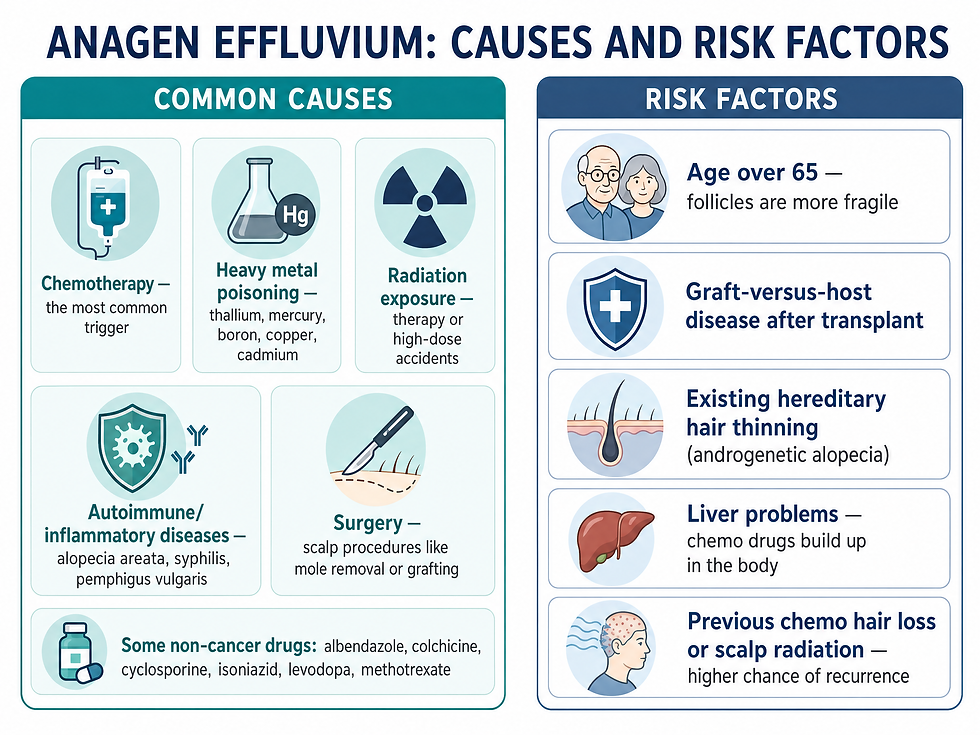
| Trigger | How It Causes Hair Loss | | --- | --- | | Chemotherapy | Chemotherapy drugs destroy cancer cells — but can also damage other fast-growing cells, including hair growth cells | | Heavy metal poisoning | Toxic metals like thallium, mercury, boron, copper, and cadmium damage hair follicles | | Radiation exposure | Radiation therapy or accidental high-dose exposure causes hair loss | | Inflammatory and autoimmune diseases | Conditions like alopecia areata, syphilis, and pemphigus vulgaris attack the hair bulb or follicle | | Surgery | Can follow scalp surgeries such as mole removal or scalp grafting |
Several non-cancer drugs can also cause anagen effluvium:
| Drug | Typical Use | | --- | --- | | Albendazole | Antiparasitic medication | | Colchicine | Gout and inflammation medication | | Cyclosporine | Immunosuppressant | | Isoniazid | Tuberculosis medication | | Levodopa | Parkinson's disease medication | | Methotrexate | Autoimmune disease and cancer medication |
What Are the Risk Factors?
Hair follicles tend to be more fragile with age, so anagen effluvium is more common after age 65. You may also be at higher risk in several specific situations:
| Risk Factor | Why It Increases Risk | | --- | --- | | Age over 65 | Hair follicles are more fragile with age | | Graft-versus-host disease after transplant | Damages hair follicles and increases the risk of hair loss during chemotherapy | | Existing androgenetic alopecia | Hereditary thinning can lead to worse hair loss | | Liver problems | When the liver doesn't break down chemotherapy drugs properly, the medicine builds up and causes more severe hair loss | | Previous chemotherapy-related hair loss | More likely to happen again | | Previous scalp radiation | More likely to lose hair again with chemotherapy |
What Are the Complications?
Losing your hair suddenly can be emotionally overwhelming. Finding clumps of hair in your brush, the shower drain, or on your pillow can be upsetting and hard to process. While anagen effluvium doesn't cause physical pain, it can deeply affect your mental and emotional well-being. Many people feel stress, anxiety, or depression, or begin to see themselves differently after hair loss.
How Is Anagen Effluvium Diagnosed?
Your healthcare provider can usually diagnose anagen effluvium after a thorough clinical history and physical exam. A key finding in the history is sudden hair loss days to weeks after a known exposure.
During the exam, your provider checks your scalp and hair for signs pointing to anagen effluvium. They look for broken hairs and make sure there is no discoloration, scarring, or scaling on your scalp.
| Diagnostic Step | Purpose | | --- | --- | | Clinical history | Identifies sudden hair loss days to weeks after a known exposure | | Physical exam | Checks for broken hairs; rules out discoloration, scarring, or scaling | | Microscope examination of hairs | Shows whether hairs are breaking during the growth phase | | Magnifying tool | Gives a close-up view of the scalp and hair roots | | Scalp biopsy | A small skin sample rules out other conditions if the diagnosis isn't clear | | Blood tests | Check for other causes of hair loss, like thyroid issues, iron deficiency, or autoimmune diseases |
In most cases, your provider can confirm anagen effluvium without many tests. But if they suspect another condition is involved, these extra steps help find the cause and guide treatment.
How Is Anagen Effluvium Treated?
Treatment for anagen effluvium focuses on helping hair grow back and supporting your emotional well-being during recovery. Here are some options your provider might discuss with you:
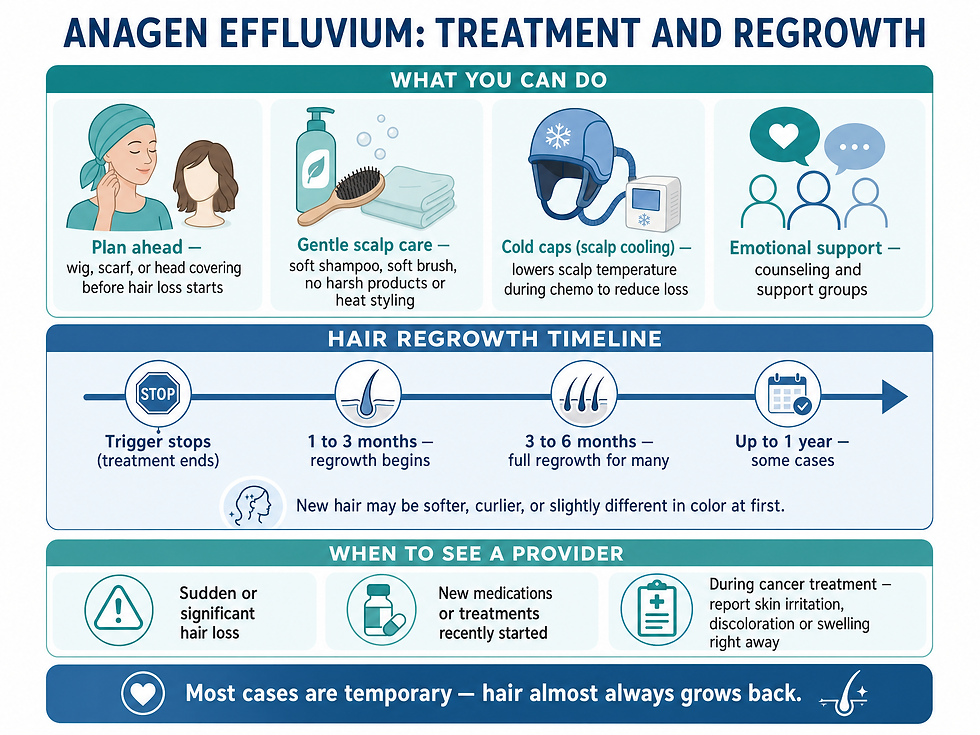
| Approach | What It Involves | | --- | --- | | Planning ahead | Getting a wig, scarf, or head covering before hair loss begins — protects the scalp, keeps you warm, and boosts confidence | | Scalp care | Gentle shampoos, soft brushes; avoiding harsh hair products or heat styling to protect new hair growth | | Scalp cooling (cold caps) | A device that gently lowers scalp temperature during chemotherapy, slowing how much medication reaches the follicles — may reduce hair loss, though it isn't right for everyone | | Mental health support | Counseling, support groups, and connecting with others who have been through similar experiences | | Medications | No medication stops hair loss completely, but minoxidil can help hair regrow; light therapy (photobiomodulation) is also being studied |
Is Anagen Effluvium Reversible?
Yes, anagen effluvium is usually temporary. Hair typically starts to grow back a few weeks after treatment ends or contact with a trigger stops. There are a few cases where hair loss is permanent — usually with high doses of chemotherapy.
| Regrowth Milestone | What Happens | | --- | --- | | Trigger stops | Treatment ends or exposure stops; regrowth can begin within a few weeks | | 1–3 months | Hair often starts to grow back | | 3–6 months | Many people see full regrowth | | Up to 1 year | Some cases take this long; new hair may initially be softer, curlier, or a slightly different color |
How Long Does Anagen Effluvium Last?
Hair often starts to grow back within one to three months after stopping the trigger that caused it. Many people see full regrowth within three to six months, but it can take up to a year.
The shedding itself may happen over just a few weeks, which can be a difficult and emotional experience. But hair loss is almost always temporary — regrowth is expected once what is causing it stops. Your hair might look or feel a little different at first: softer, curlier, or a slightly different color. Most people notice steady changes within a few months, and the outlook is positive.
When Should I See My Healthcare Provider?
Contact your healthcare provider if you notice sudden or significant hair loss. Be sure to tell them about any new medications or treatments you started — hair loss can sometimes be a medication side effect.
If you are receiving cancer treatment, let your provider know right away if you notice new or worsening symptoms like skin irritation, discoloration, or swelling. After treatment ends, continue regular follow-up visits. If your hair isn't growing back as expected, talk with your care team about ways to support your recovery.
Can Anagen Effluvium Be Prevented?
There is no way to completely prevent anagen effluvium. However, if you are receiving chemotherapy, your provider may suggest scalp cooling (cold caps). This device gently lowers the temperature of your scalp during treatment, slowing how much medication reaches your hair follicles — which may reduce hair loss.
Scalp cooling isn't right for everyone, and your provider will discuss whether it is a safe option for you.
Questions to Ask Your Healthcare Provider
If you have anagen effluvium, consider asking your provider: What are my treatment options? Are there any side effects to the treatments? When should I expect my hair to grow back? Can you recommend mental health resources?
Conclusion
Anagen effluvium strikes fast — within about two weeks of its trigger — and it strikes hard, potentially shedding hair across the scalp, eyebrows, and lashes. Because it is most closely linked to chemotherapy, it often arrives during an already difficult chapter, which makes its emotional weight real and worth acknowledging.
But the clinical message is genuinely reassuring: the hair loss is almost always temporary. The follicles are damaged, not destroyed, and once the trigger stops, regrowth typically begins within one to three months, with full regrowth for many people within three to six months. Gentle scalp care, planning ahead with coverings, and — for some chemotherapy patients — scalp cooling can help protect what remains and ease the transition.
CTA: If you notice sudden, rapid hair loss — especially after starting chemotherapy, a new medication, or a possible toxin exposure — see your healthcare provider and ask about anagen effluvium. And if you are starting chemotherapy, ask whether scalp cooling is a safe option for you before treatment begins.
FAQ
What is anagen effluvium?
Anagen effluvium is a sudden and widespread type of hair loss that happens when something disrupts the active growth (anagen) phase of the hair cycle — usually through damage to the hair follicle. It most commonly occurs after chemotherapy but can also follow radiation or toxin exposure.
What causes anagen effluvium?
It happens when something suddenly stops hair matrix cells — the fastest-growing cells at the base of each hair follicle — from dividing and growing. The most common trigger is chemotherapy, but heavy metal poisoning (thallium, mercury, boron, copper, cadmium), radiation exposure, autoimmune and inflammatory diseases, scalp surgery, and several non-cancer drugs (albendazole, colchicine, cyclosporine, isoniazid, levodopa, methotrexate) can also cause it.
How quickly does hair fall out with anagen effluvium?
Signs can start about two weeks after the trigger. The hair loss is sudden and rapid, and over time may lead to bald patches or complete hair loss in areas where hair normally grows. It can affect the scalp as well as eyebrows, eyelashes, face, and body hair.
Is anagen effluvium permanent?
No — in most cases it is temporary. Hair typically starts to grow back a few weeks after the trigger stops. Permanent hair loss is uncommon and usually linked to high doses of chemotherapy or certain chemotherapy regimens.
How long does it take for hair to grow back?
Hair often starts to regrow within one to three months after the trigger stops. Many people see full regrowth within three to six months, though some cases take up to a year. New hair may initially be softer, curlier, or slightly different in color.
Can anagen effluvium be prevented?
There is no way to completely prevent it. During chemotherapy, scalp cooling (cold caps) may reduce hair loss by lowering scalp temperature and slowing how much medication reaches the follicles — but it isn't right for everyone, so discuss it with your provider.
What should I do if I notice sudden hair loss?
Contact your healthcare provider and mention any new medications or treatments you have started, since hair loss can be a medication side effect. If you are undergoing cancer treatment, report skin irritation, discoloration, or swelling right away. Gentle scalp care — soft shampoo, soft brush, and no harsh products or heat styling — can protect new growth.
Is anagen effluvium different from other types of hair loss?
Yes. Unlike gradual thinning conditions, anagen effluvium is sudden and widespread because it knocks out hairs that are actively growing. Hair strands often break easily and remain anchored by a damaged follicle, with no scalp discoloration, scarring, or scaling — key features that help providers distinguish it from other causes of hair loss.
References
Dermnet New Zealand Trust. Anagen effluvium. Last updated 11/2019. https://dermnetnz.org/topics/anagen-effluvium
Fitzpatrick's Color Atlas and Synopsis of Clinical Dermatology, 8th Ed. Disorders of Hair Follicles and Related Disorders. In: Wolff K, Johnson R, Saavedra AP, et al., eds. McGraw Hill; 2017.
Saleh D, Nassereddin A, Saleh HM, et al. Anagen Effluvium. In: StatPearls [Internet]. Treasure Island (FL): StatPearls Publishing; 2024 Apr 30. https://www.ncbi.nlm.nih.gov/books/NBK482293/
Saraswat N, Chopra A, Sood A, et al. A Descriptive Study to Analyze Chemotherapy-Induced Hair Loss and its Psychosocial Impact in Adults: Our Experience from a Tertiary Care Hospital. Indian Dermatol Online J. 2019 Jul-Aug;10(4):426-430. https://pmc.ncbi.nlm.nih.gov/articles/PMC6615375/
Disclaimer: This article is for general educational purposes only and is not a substitute for professional medical advice, diagnosis, or treatment. Always consult a qualified healthcare provider — such as a dermatologist or your oncology care team — for guidance specific to your situation.
Comments