Breast Implant Removal: Surgery, Recovery, Risks and Results

Updated: 6 days ago
Written and medically reviewed by Dr. Baraa Alnahhal, MD · Last reviewed: October 2026 · How we review
Quick Answer: What is breast implant removal?
Breast implant removal is surgery to take out silicone or saline breast implants, sometimes along with scar tissue or leaked silicone. People choose it for complications such as capsular contracture, leaks, or BIA-ALCL, or because they no longer want implants. It is usually an outpatient procedure, and fever, chest pain or shortness of breath afterward need prompt medical care. [1]
What the research says
Most women with implant-related symptoms reported improvement after removal. A meta-analysis of 33 studies covering 6,048 women found that 81.9% reported their symptoms improved after their implants were removed. The most common complaints were fatigue (58.3%), joint pain (51%) and muscle pain (44%). The authors note the condition is still debated. (Ferreira et al., Aesthetic Plastic Surgery, 2025)
Removal combined with a breast lift showed high satisfaction. In 40 women who had implant removal with a breast lift, all but one were satisfied or very satisfied, with a mean score of 4.9 out of 5. Minor wound problems needing simple dressings occurred in 17.5%. (Macmillan et al., Plastic and Reconstructive Surgery, 2025)
Removal alone can also give results people are happy with. In 28 women who had implants removed without a lift and wore targeted compression for one month, 57.1% were satisfied and 42.9% very satisfied with the look; 17.8% said they would consider a later touch-up. (Benito-Ruiz, Aesthetic Plastic Surgery, 2025)
Key takeaways
Breast implants are not lifetime devices; the longer you have them, the more likely you are to need more surgery, but routine replacement isn't needed if you have no problems.
Hardened scar tissue around the implant (capsular contracture) is the most common medical reason for removal.
Surgery is usually outpatient, done under IV sedation or general anesthesia.
Expect 1 to 2 weeks of limited activity and soreness for up to 6 weeks.
Breasts may sag after removal; a breast lift can be done at the same time.
What is breast implant removal?
Breast implant removal is an operation that takes out breast implants and, when needed, the scar tissue around them or silicone from a leaking implant. [1]
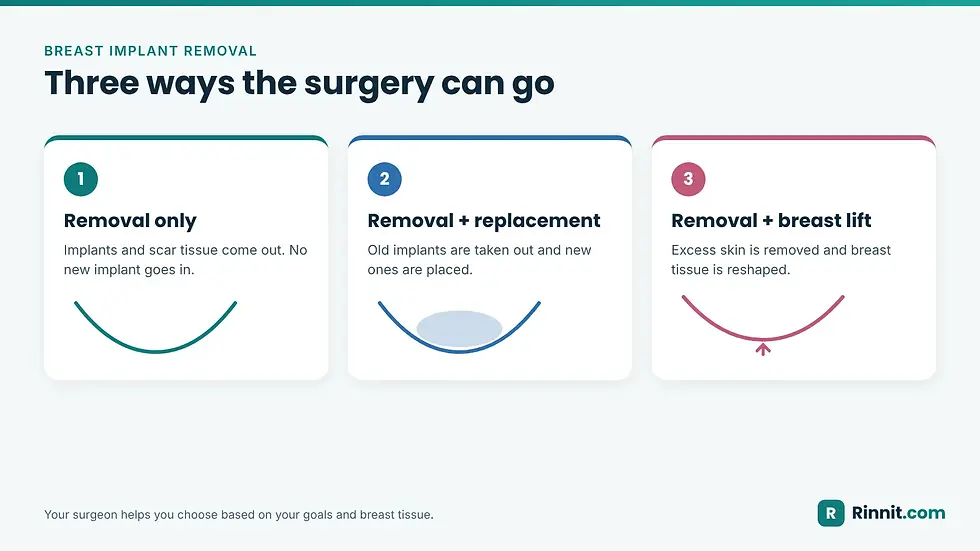
It can end in one of three ways:
Your implants come out and nothing replaces them.
Your old implants are swapped for new ones.
Your implants come out and your breasts are lifted and reshaped.
Some people need the surgery because of implant problems. Others simply no longer want implants.
Why do people have breast implants removed?
People have breast implants removed either because of a medical problem with the implant or because their goals or body have changed. [1]
Breast implants don't last a lifetime. The longer you have implants, the more likely you are to need more surgery, but routine removal or replacement isn't needed if you have had no complications. [5]
The most common medical reason is capsular contracture. This is when the scar tissue around the implant hardens. It can cause pain, discomfort or a change in how your breasts look. [1]
Medical reasons | Personal reasons |
Capsular contracture (hardened scar tissue) — most common | No longer wanting implants |
Leaking of the implant | Breast shape changed with age |
Movement or shifting of the implant | Changes after pregnancy |
Calcium buildup around the implant | Changes after breastfeeding |
BIA-ALCL, a rare cancer in scar tissue around an implant | Changes after weight gain or loss |
BIA-ALCL is linked to textured implants. If you are not sure which type you have, ask your plastic surgeon to check your records. Calcium deposits in the breast are explained in our guide to breast calcifications. [6]

What are the surgical options for breast implant removal?
The surgical options for breast implant removal are removal alone, removal with new implants, or removal combined with a breast lift. [1]
Option | What happens | Who it may suit |
Removal only | Implants and scar tissue are taken out | People who no longer want implants |
Removal + replacement | Old implants come out; new ones go in | People who want to keep implants but have old or problem implants |
Removal + breast lift (mastopexy) | Implants come out; extra skin is removed and breast tissue reshaped; nipple and areola can be moved if needed | People worried about sagging after removal |
If you want a natural option for volume instead of implants, read about fat transfer breast augmentation.
How do you prepare for breast implant removal?
You prepare for breast implant removal by following your provider's instructions on medicines, smoking and travel home. [1]
You may need to:
Adjust your current medicines or start new ones.
Avoid medicines that raise bleeding risk, such as anti-inflammatory drugs and some herbal supplements.
Stop smoking or using tobacco products. Our guide to nicotine replacement therapy can help.
Arrange a ride home, since most people leave the same day.
What happens during breast implant removal surgery?
During breast implant removal surgery, you receive anesthesia, the surgeon removes the implants through a small cut, and the cut is closed. [1]
First, an anesthesiologist gives you one of two types of anesthesia:
IV sedation to help you feel calm and relaxed.
General anesthesia to put you in a sleep-like state.
Then your surgeon:
Makes a cut around the darker skin of the nipple (areola) or in the fold under the breast (inframammary fold).
Removes the implants and scar tissue.
Places new implants, if you are having a replacement.
Closes the cut with stitches, tape or skin glue.
What happens after breast implant removal surgery?
After breast implant removal surgery, you go home with instructions on wound care, activity, medicines and follow-up visits. [1]
Support garment: You may wear a special support bra or compression garment for a few weeks to reduce swelling.
Drains: Small tubes may be placed under the skin to drain extra fluid or blood. They usually come out after a few days but can stay 10 days or more.
Follow-up: Your surgeon will tell you when to come back for a check.
How long is recovery from breast implant removal?
Recovery from breast implant removal usually means 1 to 2 weeks of limited activity, with tenderness that can last up to 6 weeks. [1]
Time after surgery | What to expect |
Surgery day | Usually home the same day |
First few days | Drains (if placed) often removed; may stay 10+ days |
Weeks 1–2 | Avoid driving and some usual activities |
Throughout recovery | Limit hard exercise and heavy lifting |
A few weeks | Wear a support bra or compression garment |
Up to 6 weeks | Tenderness or soreness common |

What are the benefits of breast implant removal?
The benefits of breast implant removal include clearer mammograms, pain relief and no future risk of implant rupture. [1]
Clearer mammograms: Implants can hide breast tissue on X-ray, so images may be clearer without them. This matters for breast cancer screening.
Pain relief: If you have capsular contracture, removal can ease pain almost right away. Taking out large implants may also reduce neck or back pain.
No rupture risk: Hardened scar tissue can lead to an implant rupture. Without implants, that risk is gone.
What are the risks of breast implant removal?
The most common risk of breast implant removal is being unhappy with how your breasts look afterward, though many people have few or no complications. [1]
Risk | What it means |
Dissatisfaction with appearance | The most common issue after removal |
Bleeding | Blood loss or a blood collection |
Seroma | Fluid collecting where the implant was |
Infection | Infection at the surgery site |
Asymmetry | Breasts look uneven |
Loose skin | Skin that was stretched by the implant |
Numbness | Changes in nipple or breast feeling |
Scarring | Visible marks at the cut site |
Will breasts sag after breast implant removal?
Breasts may sag, droop or look misshapen after breast implant removal, because the skin stretched to fit the implants. [1]
That is why many people combine removal with a breast lift (mastopexy). During a lift, your surgeon removes extra skin and reshapes your breast tissue. If needed, the nipple and areola can be moved higher. The result is firmer, higher breasts.
When should you call a doctor after breast implant removal?
You should call your healthcare provider right away after breast implant removal if you have chest pain, chills or fever, nausea or vomiting, pain that does not go away or gets worse, or shortness of breath. [1]
Chest pain
Chills or fever
Nausea or vomiting
Pain that does not go away or gets worse
Shortness of breath
For ongoing breast discomfort unrelated to surgery, see our guide to breast pain.
Conclusion
Breast implant removal is usually a same-day surgery to take out implants that are causing problems or are no longer wanted. You can have removal alone, swap to new implants, or add a breast lift to reduce sagging. Activity limits are tightest in the first one to two weeks, and soreness can last up to six weeks.
Next step: Save or print this guide and bring it to your plastic surgeon consultation. Ask which option fits your body and goals, whether your implants are textured, and what your recovery plan will look like. Explore our other breast health guides to learn more.
Frequently asked questions
How long do breast implants last?
Breast implants usually last about 10 to 15 years. Removal or replacement is often advised in that window, but your surgeon may not recommend it if you have no complications.
Is breast implant removal an outpatient surgery?
Yes. It is usually done as outpatient surgery, so you can go home the same day. You will need someone to drive you.
What anesthesia is used for breast implant removal?
You may have IV sedation to feel calm and relaxed, or general anesthesia to be in a sleep-like state.
Where are the cuts made for breast implant removal?
The surgeon usually cuts around the areola (the darker skin around the nipple) or in the fold under the breast.
How long do drains stay in after breast implant removal?
Drains usually come out after a few days but can stay in for 10 days or more.
When can I drive after breast implant removal?
Most people avoid driving for the first one to two weeks. Follow your surgeon's advice for your case.
Do I need to wear a special bra after breast implant removal?
You may wear a support bra or compression garment for a few weeks to reduce swelling.
Will my mammograms be clearer after removal?
They may be. Implants can block a clear view of breast tissue on X-ray, so images may be easier to read without them.
What is capsular contracture?
Capsular contracture is hardening of the scar tissue that forms around an implant. It can cause pain, discomfort or changes in breast shape, and it is the most common medical reason for removal.
Do textured implants need to be checked?
Textured implants are linked to BIA-ALCL, a rare cancer in the scar tissue around an implant. Ask your plastic surgeon whether you have ever had textured implants.
Related Reading
Breast Implants: Types, Surgery, Recovery and Risks explains breast implant types and risks.
References
Cleveland Clinic. Breast Implant Removal: What to Expect, Surgery & Recovery. Cleveland Clinic. Last updated September 20, 2021. https://my.clevelandclinic.org/health/treatments/21799-breast-implant-removal
Ferreira S, Barros AS, Marques M. Breast Implant Illness: Symptoms, Outcomes with Explantation and Potential Etiologies — A Systematic Review and Meta-analysis. Aesthetic Plast Surg. 2025;49(23):6600-6620. PMID: 40788544. https://doi.org/10.1007/s00266-025-05142-x
Macmillan RD, Bell K, Wilson E, Asgeirsson KS. Explantation with Lateral Pedicle Mastopexy. Plast Reconstr Surg. 2025;155(2):269-278. PMID: 39026385. https://doi.org/10.1097/PRS.0000000000011645
Benito-Ruiz J. Breast Implant Removal-Only: The Role of Targeted Compression. Aesthetic Plast Surg. 2025;49(1):224-233. PMID: 39043947. https://doi.org/10.1007/s00266-024-04256-y
American Society of Plastic Surgeons. Breast Implant Removal. PlasticSurgery.org. Accessed October 20, 2026. https://www.plasticsurgery.org/cosmetic-procedures/breast-implant-removal
U.S. Food and Drug Administration. Risks and Complications of Breast Implants. FDA. Updated December 15, 2023. Accessed October 20, 2026. https://www.fda.gov/medical-devices/breast-implants/risks-and-complications-breast-implants
Medical disclaimer
This article is for general education and does not replace advice from your doctor or plastic surgeon. Always discuss your options, risks and recovery plan with a qualified healthcare provider.



Comments