What Is Benign Breast Disease? Types, Symptoms, and Treatment

Updated: 3 days ago
Medically reviewed by Dr. Baraa Alnahhal, MD · Last reviewed: October 2026
Quick Answer
Benign breast disease is any lump, cyst or change in breast tissue that is not cancer. Up to 25% of breast lumps are fluid-filled cysts, and as many as half of people with female anatomy have fibrocystic changes at some point. Most types need no treatment, but only a provider's evaluation and testing can confirm that a change is benign. [1]
Key takeaways
Most breast lumps are benign (not cancerous), but every new lump deserves a provider visit. [1]
Eight common types range from simple fluid-filled cysts to atypical hyperplasia, which raises future breast cancer risk. [1]
As many as 50% of people with female reproductive anatomy experience fibrocystic changes during their lifetime. [1]
Most types need no treatment and resolve on their own; treatment is reserved for painful, large, or higher-risk lumps.
Certain types increase breast cancer risk, so a confirmed diagnosis guides your screening plan. [1]
Simple habits like limiting caffeine, wearing well-fitted bras, and routine self-checks can lower risk.
What the research says
The type of benign change matters: risk rises from nonproliferative lesions to atypical hyperplasia. In a Mayo Clinic cohort of 9,087 women with benign breast disease followed for a median of 15 years, 67% had nonproliferative lesions, 30% had proliferative lesions without atypia, and 4% had atypical hyperplasia. The relative risk of breast cancer was 1.27 (95% CI 1.15–1.41) for nonproliferative lesions, 1.88 (1.66–2.12) for proliferative changes without atypia, and 4.24 (3.26–5.41) for atypical hyperplasia. Family history was an independent risk factor, and women with no family history and nonproliferative findings had no increased risk. (Hartmann et al., N Engl J Med, 2005) [2]
A pooled analysis points the same way. A meta-analysis of 32 studies found summary relative risks of 1.17 (95% CI 0.94–1.47) for nonproliferative disease, 1.76 (1.58–1.95) for proliferative disease without atypia, and 3.93 (3.24–4.76) for atypical hyperplasia. The authors concluded that these data support extra screening or chemoprevention for women with proliferative benign breast disease. (Dyrstad et al., Breast Cancer Res Treat, 2015) [3]
What Is Benign Breast Disease?

Finding a lump in your breast is frightening, and the first thought is often breast cancer. Fortunately, most breast lumps are benign, meaning they are not cancerous. [1]
Benign breast disease is the umbrella term for any lump, cyst, or other change in breast tissue that is not cancer. Breasts are complex structures filled with glands, tissue, and fat, so it is relatively common to develop a breast lump, cyst, or tumor. [1]
These conditions are not cancerous or life-threatening. However, certain types of breast disease can increase your future risk of developing breast cancer. The best way to know for sure what you are dealing with is to contact a healthcare provider. [1]
It is also a good idea to become familiar with the normal look and feel of your breasts so you can notice changes more easily. [1]
What Are the Common Types?
Benign breast disease includes many different conditions. [1] They all refer to a lump, cyst, or change in breast tissue that is not cancer, but they behave very differently. The table below summarizes the eight most common types.
Type | What It Is | Cancer Risk | Treatment |
Fluid-filled sacs; up to 25% of breast lumps [1] | No increased risk [1] | Often resolves on its own [1] | |
Fibroadenomas | Most common solid tumor in ages 15–35 [1] | No increased risk [1] | Often goes away on its own [1] |
Hormone-driven lumpiness, density, tenderness [1] | No increased risk | Resolves without treatment [1] | |
Hyperplasia | Overgrowth of cells lining ducts or glands [1] | Usual type slightly increases risk; atypical type raises risk more [1] | Atypical may require surgery [1] |
Intraductal papilloma | Wart-like growths in a duct near the nipple [1] | Risk rises with 5 or more papillomas [1] | Surgery can remove growths and reduce risk [1] |
Mammary duct ectasia | Swollen, thickened, sometimes blocked milk ducts after menopause [1] | No increased risk [1] | Antibiotics if infected; otherwise none [1] |
Traumatic fat necrosis | Scar tissue replacing breast tissue damaged by injury, surgery, or radiation [1] | No increased risk [1] | No treatment needed [1] |
Adenosis | Enlarged milk-producing lobules with extra glands [1] | Not specified as increased | Not specified |
Breast cysts
Up to 25% of breast lumps are fluid-filled cysts. Breast cysts can be tender and lumpy, but they do not make you more prone to cancer. Cysts often go away without any treatment. [1]
Fibroadenomas
These are the most common non-cancerous solid breast tumors providers find in people with female reproductive anatomy between ages 15 and 35. Fibroadenomas do not increase cancer risk and often go away on their own. [1]
Fibrocystic breast changes
Fluctuating hormone levels can make breasts feel lumpy, dense, and tender, especially right before menstruation. People ages 30 to 50 are more likely to experience these changes, which go away without treatment. [1]
Hyperplasia
This condition comes from an overgrowth of the cells that line your mammary ducts or glands. Usual (typical) hyperplasia slightly increases breast cancer risk but does not require surgery. If you have atypical hyperplasia, your provider may recommend surgically removing the affected breast tissue because the condition may make you more prone to breast cancer. [1]
Intraductal papilloma
These small, wart-like growths form inside your mammary duct near your nipple. Intraductal papillomas may cause nipple discharge and most commonly affect people ages 30 to 50. Your cancer risk goes up if you have five or more papillomas at one time. Surgery can remove these growths and reduce your cancer risk. [1]
Mammary duct ectasia
People who have reached menopause are more prone to mammary duct ectasia. It causes the milk ducts to swell, thicken, and sometimes become blocked. Your nipple may turn inward or leak discharge. Also known as periductal mastitis, this condition does not increase cancer risk. You may need antibiotics if a bacterial infection causes the inflammation and blockage; otherwise, no treatment is needed. [1]
Traumatic fat necrosis
These breast lumps form when scar tissue replaces breast tissue damaged by an injury, surgery, or radiation therapy. Fat necrosis does not raise your cancer risk and does not need treatment. [1]
Adenosis
This is when the lobules — the milk-producing part of your breast — grow larger and contain more glands than usual. [1]
How Common Is Benign Breast Disease?
Benign breast lumps in people with female reproductive anatomy are common. Up to 50% will experience fibrocystic changes that cause noncancerous breast lumps at some point in their lives. Males can also develop benign breast disease, though it is less common. [1]
What Are the Symptoms?
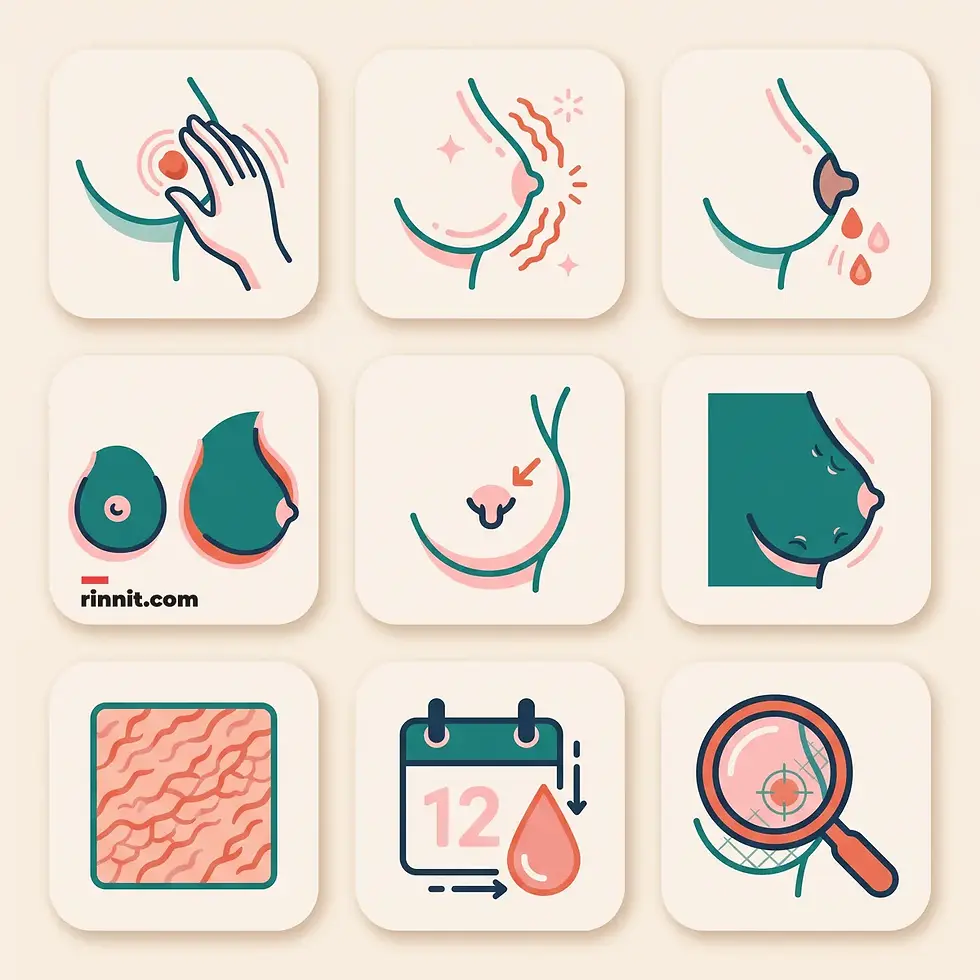
You may notice breast changes or a lump while doing a breast self-exam, showering, or getting dressed. Sometimes a provider detects these changes during a clinical breast exam or a mammogram. [1] Besides a breast lump, other signs of benign breast disease are listed below.
Symptom | What It Looks or Feels Like |
Breast lump | A new lump noticed during self-exam, showering, or dressing [1] |
Breast pain (mastalgia) | Pain in one or both breasts |
Nipple discharge | Fluid leaking from the nipple [1] |
Change in breast size, shape, or contour | Visible difference from your usual shape [1] |
Inverted, creased, or scaly nipple | Nipple pulls inward or develops creases or scaling [1] |
Dimpled, puckered, or scaly breasts | Skin texture changes on the breast surface [1] |
What Causes Benign Breast Disease?
Several everyday factors drive non-cancerous breast changes. Common causes include changes in breast tissue (fibrocystic breast changes), breast infection (mastitis), scar tissue from a breast injury, and hormone fluctuations, especially during menstruation, pregnancy, or menopause. [1]
Medication use can also play a role, such as hormonal contraceptives (birth control pills) and hormone replacement therapy. Consuming too much caffeine is another common cause. [1]
Cause | How It Leads to Benign Changes |
Changes in breast tissue | Fibrocystic breast changes create lumpiness and tenderness [1] |
Breast infection | Mastitis can produce lumps and swelling |
Scar tissue from injury | Damaged tissue is replaced by scar tissue, forming traumatic fat necrosis [1] |
Hormone fluctuations | Menstruation, pregnancy, and menopause drive lumpiness and discharge [1] |
Medications | Hormonal contraceptives and hormone replacement therapy affect breast tissue [1] |
Excess caffeine | Coffee, tea, soda, and chocolate may contribute to lumps and pain |
Males can develop enlarged, swollen breasts with lumps, a condition called gynecomastia. Gynecomastia happens due to hormone imbalance, having obesity, and certain diseases or medications. [1]
What are the risk factors?
Benign breast disease can affect anyone, but your risk increases if you have a family history of breast cancer or benign breast disease, use hormone replacement therapy, or have a hormonal imbalance. [1]
Can Benign Breast Disease Cause Complications?
Certain types of benign breast disease, such as atypical hyperplasia, make you more prone to breast cancer. Sometimes benign breast lumps hurt or become large, and your provider may recommend surgery to remove painful or large lumps. Unfortunately, some fibroadenoma lumps come back after surgery. [1]
Complication | Details |
Higher breast cancer risk | Conditions like atypical hyperplasia raise future cancer risk [1] |
Painful or large lumps | May require surgical removal [1] |
Recurrence after surgery | Some fibroadenomas return even after removal [1] |
Repeat episodes | Lumps can appear many times across your lifetime [1] |
How Is Benign Breast Disease Diagnosed?
If you feel a lump or notice breast changes, see your healthcare provider promptly. [1] Your provider may order one or more of the tests below.
Diagnostic Step | What It Involves |
Mammogram | Imaging scan of the breast tissue |
Ultrasound | Sound-wave imaging to view lumps and cysts |
MRI | Magnetic resonance imaging for detailed breast images |
Core needle breast biopsy | Image-guided tissue sample to test cells for cancer [1] |
Fine-needle aspiration biopsy | Thin-needle sample of cells or fluid |
Excisional biopsy | Surgical removal of a larger piece of tissue for testing [1] |
Imaging scans — including mammogram, ultrasound, or magnetic resonance imaging (MRI) — let providers see what is happening inside the breast. Biopsies go a step further: an image-guided core needle breast biopsy, fine-needle aspiration biopsy, or excisional biopsy tests cells for cancer. An excisional (or surgical) biopsy removes a larger piece of tissue from your breast. [1]
How Is Benign Breast Disease Treated?
Most types of benign breast disease do not require treatment. Your provider may recommend treatment if you have atypical hyperplasia or a different kind of benign breast disease that increases your future risk of breast cancer. This may include surgical excision or certain pills to decrease your risk. [1]
Treatment Option | When It Is Used |
No treatment | Most types resolve on their own |
Fine needle aspiration | Drains fluid-filled cysts [1] |
Surgery | Removes painful or large lumps [1] |
Oral antibiotics | Treats infections like mastitis [1] |
Risk-reducing medication | For conditions that raise future cancer risk [1] |
Surgical excision | For atypical hyperplasia or higher-risk types [1] |
Do benign breast tumors need to be removed?
Sometimes. It depends on the results of your diagnostic tests, your risk for cancer, and whether the tumor is painful or large. Your healthcare provider can discuss removing a benign tumor with you. [1]

Can Benign Breast Disease Come Back?
Yes. Benign breast lumps are fairly common and can occur many times throughout your life. Your breasts may feel lumpy or tender when hormone levels change due to menstruation or menopause. You should contact your healthcare provider anytime you feel a lump or notice a breast change. [1]
How Does Pregnancy Affect It?
Changes in hormone levels during pregnancy can cause breast lumps, tenderness, and nipple discharge. You are also more likely to experience benign breast changes or develop a breast infection called mastitis while breastfeeding. Breast changes during pregnancy or breastfeeding are rarely cancerous, but you should still reach out to your healthcare provider when you notice any breast changes. [1]
Can Benign Breast Disease Turn Cancerous?
Most people with benign breast disease do not develop breast cancer. Certain benign conditions increase your risk, so if your provider diagnoses one of these, it is possible for a benign condition to change to cancer in the future. [1]
If you have a disease type that increases your cancer risk, your provider may recommend more frequent cancer screenings. Your healthcare provider is the best person to discuss possible outcomes with, and they can help you decide what treatment option fits your situation. [1]
Can Benign Breast Disease Be Prevented?
You may not be able to prevent benign breast disease completely, but you can take steps to reduce your risk. [1] The table below groups the recommended steps into two categories: habits that may lower the risk of benign disease itself, and habits that lower cancer risk and help detect disease early.
Risk-Reduction Habit | Category |
Decrease caffeine (coffee, tea, soda, chocolate) | Lowers benign disease risk [1] |
Wear well-fitted bras; avoid underwire | Lowers benign disease risk [1] |
Don't smoke or quit smoking | Both categories [1] |
Avoid alcohol | Both categories [1] |
Get regular mammogram screenings | Early detection [1] |
Perform self-breast exams | Early detection [1] |
Maintain a healthy weight | Lowers cancer risk [1] |
Exercise regularly | Lowers cancer risk [1] |
Eat a nutritious diet | Lowers cancer risk [1] |
Reconsider hormone replacement therapy | Lowers cancer risk [1] |
Switch to non-hormonal birth control | Lowers cancer risk [1] |
When Should I Call My Healthcare Provider?
You should call your healthcare provider if you experience a newly discovered lump, nipple discharge, changes in the way your breast or skin looks or feels (like dimpling or other texture changes), an inverted nipple, or breast pain. [1]
If you have benign breast disease, you may also want to ask your provider:
Question to Ask | Why It Matters |
What's the best treatment for me? | Matches treatment to your specific type |
Am I at risk for more breast lumps? | Sets expectations for recurrence |
How frequently should I get a mammogram or other cancer screenings? | Personalizes your screening schedule |
How can I lower my risk of breast cancer? | Guides prevention habits |
Should I use a different birth control method? | Addresses hormonal influences |
Can I use hormone replacement therapy? | Weighs risk and benefit |
Should I look out for signs of complications? | Helps you monitor safely at home |
Conclusion
Discovering a breast lump is frightening, but the odds are strongly in your favor — most breast lumps are benign and go away without treatment. Understanding the type you have matters, because a few conditions like atypical hyperplasia raise your future breast cancer risk and change your care plan. The safest move is always the same: get every new lump or breast change evaluated by a healthcare provider, and build early-detection habits like regular mammograms and self-exams into your routine.
Take the next step in understanding your health. Turn complex health topics into content your audience can scan, share, and remember. Rinnit's infographic templates can help you bring articles like this one to life with custom visuals.
Frequently Asked Questions
Is benign breast disease the same as breast cancer?
No. Benign breast disease refers to any lump, cyst, or change in breast tissue that is not cancerous and not life-threatening. However, certain types can increase your future breast cancer risk. [1]
How common are non-cancerous breast lumps?
Very common. Benign breast lumps affect many people with female reproductive anatomy, and up to 50% will experience fibrocystic changes that cause noncancerous breast lumps at some point in their lives. [1]
What percentage of breast lumps are fluid-filled cysts?
Up to 25% of breast lumps are fluid-filled cysts. They can be tender and lumpy, but they do not raise your cancer risk and often resolve without treatment. [1]
Can a benign breast lump turn into cancer?
Most people with benign breast disease never develop breast cancer. Certain conditions, such as atypical hyperplasia, do increase risk, and a benign condition can change to cancer in the future. Talk to your provider about your specific type. [1]
Which benign breast conditions increase cancer risk?
Atypical hyperplasia is the most notable, and usual (typical) hyperplasia slightly raises risk. Your cancer risk also goes up if you have five or more intraductal papillomas at one time. [1]
Who is most likely to get fibroadenomas?
Fibroadenomas are the most common non-cancerous solid breast tumors found in people with female reproductive anatomy between the ages of 15 and 35. They often go away on their own. [1]
Can men get benign breast disease?
Yes, though it is less common. Males can develop benign breast disease, and hormone imbalance, obesity, certain diseases, or medications can cause gynecomastia — enlarged, swollen breasts with lumps. [1]
What causes benign breast changes during pregnancy?
Hormone level changes during pregnancy can cause breast lumps, tenderness, and nipple discharge. You are also more likely to experience benign breast changes or mastitis while breastfeeding, and these changes are rarely cancerous. [1]
Do all benign breast tumors need to be removed?
No. Removal depends on your diagnostic test results, your cancer risk, and whether the tumor is painful or large. Your provider can discuss the options with you. [1]
Can benign breast disease come back after treatment?
Yes. Lumps can occur many times throughout your life, and some fibroadenomas return even after surgery. Contact your provider anytime you feel a new lump or notice a breast change. [1]
What tests confirm a breast lump is benign?
Providers use imaging scans (mammogram, ultrasound, or MRI) and biopsies — including image-guided core needle, fine-needle aspiration, or excisional biopsy — to test cells for cancer and confirm a diagnosis. [1]
Does caffeine really affect breast lumps?
Consuming too much caffeine (from coffee, tea, soda, or chocolate) is listed as a common cause of non-cancerous breast changes, and decreasing caffeine intake is one of the recommended steps to lower your risk. [1]
How can I lower my risk of benign breast disease?
Helpful steps include decreasing caffeine, wearing well-fitted bras and avoiding underwire, not smoking, and avoiding alcohol. You can also lower cancer risk and catch disease early with regular mammograms, self-exams, a healthy weight, and exercise. [1]
When should I call my provider about a breast change?
Call your provider for a newly discovered lump, nipple discharge, changes in how your breast or skin looks or feels (like dimpling or texture changes), an inverted nipple, or breast pain. [1]
Related Reading
References
Cleveland Clinic. Benign Breast Disease. Cleveland Clinic Health Library. Last updated November 7, 2023. Accessed October 15, 2026. https://my.clevelandclinic.org/health/diseases/6270-benign-breast-disease
Hartmann LC, Sellers TA, Frost MH, et al. Benign breast disease and the risk of breast cancer. N Engl J Med. 2005;353(3):229-237. PMID: 16034008. https://doi.org/10.1056/NEJMoa044383
Dyrstad SW, Yan Y, Fowler AM, et al. Breast cancer risk associated with benign breast disease: systematic review and meta-analysis. Breast Cancer Res Treat. 2015;149(3):569-575. PMID: 25636589. https://doi.org/10.1007/s10549-014-3254-6
Medical disclaimer
The information provided in this article is for educational purposes only and is not intended as medical advice. Always seek the advice of your physician or other qualified health provider with any questions you may have regarding a medical condition. Contact a healthcare provider for any new breast lump, nipple discharge, skin dimpling or texture change, inverted nipple, or breast pain.



Comments