Fibrocystic Breasts: Why They Happen, What the Lumps Mean, and What Actually Helps

Updated: 3 days ago
Medically reviewed by Dr. Baraa Alnahhal, MD · Last reviewed: October 2026
Source currency note: This guide reflects medical information reviewed between April 2023 and October 2026. Always confirm current guidance with your healthcare professional.
Quick Answer
Fibrocystic breasts are breasts with tissue that feels lumpy or ropelike because of cysts and other hormone-related changes. It is not a disease, and changes that rise and fall with the menstrual cycle are common. It does not typically increase breast cancer risk. Mild cases need no treatment, while pain relievers, support bras or cyst drainage can help. [3] [4]
What the research says
Not every benign breast change carries the same risk. A systematic review and meta-analysis of observational studies found that proliferative disease without atypia was linked to a higher breast cancer risk than non-proliferative disease (pooled risk 1.58, 95% CI 1.51–1.66), and proliferative disease with atypia to a higher one still (3.49, 95% CI 3.23–3.77). This is why your clinician looks at the type of change, not just the lumpiness (Salamat et al., Iranian Journal of Medical Sciences, 2018 [1]).
Simple measures usually work best for breast pain. A systematic review of breast pain treatment concluded that when no abnormality is found, reassurance, a supportive bra, and topical NSAID gel massage are usually effective, with anti-estrogen medicines as second-line treatment, and that evening primrose oil (gamma-linolenic acid), though commonly prescribed, is not effective (Kataria et al., Indian Journal of Surgery, 2014 [2]).
What are fibrocystic breasts?
Fibrocystic breast changes lead to the development of fluid-filled round or oval sacs called cysts. These cysts can make the breasts feel tender, lumpy, or ropy, and they feel distinct from the surrounding breast tissue [3].
Doctors call this nodular or glandular breast tissue. It is common enough that medical professionals have stopped using the term “fibrocystic breast disease” and now simply say “fibrocystic breasts” or “fibrocystic breast changes,” because having fibrocystic breasts is not a disease. Breast changes that fluctuate with the menstrual cycle and have a ropelike texture are considered normal [3].
Fibrocystic breast changes do not always cause symptoms. Some people experience breast pain, tenderness, and lumpiness, especially in the upper, outer area of the breasts. Symptoms tend to be most bothersome just before menstruation and get better afterward. Simple self-care measures can usually relieve the discomfort [3].
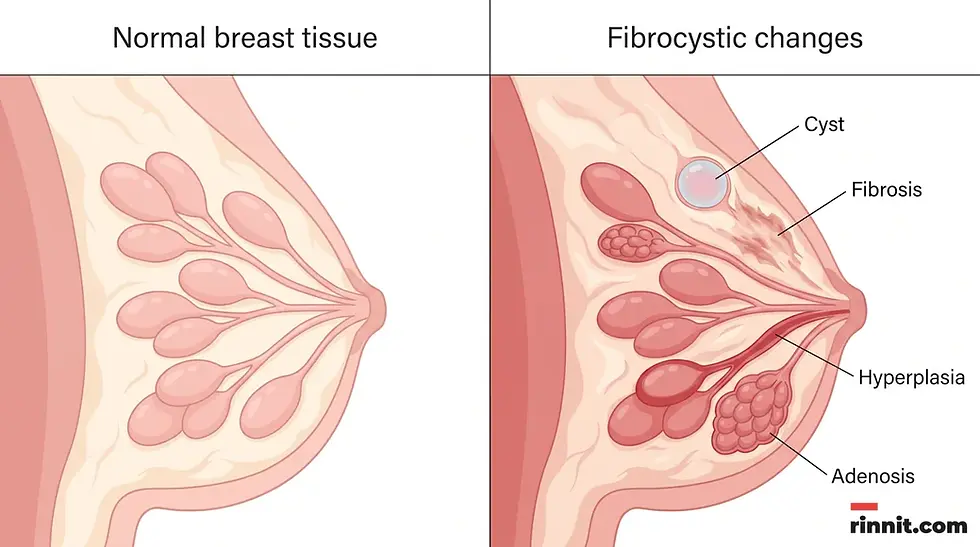
What does breast anatomy have to do with it?
Each breast contains 15 to 20 lobes of glandular tissue, arranged like the petals of a daisy. The lobes are further divided into smaller lobules that produce milk for breastfeeding. Small tubes, called ducts, conduct the milk to a reservoir that lies just beneath the nipple [3].
Under a microscope, fibrocystic breast tissue may show several kinds of change:
Microscopic change | What it is |
Cysts | Fluid-filled round or oval sacs |
Fibrosis | Areas of thicker, scar-like fibrous tissue |
Hyperplasia | Extra growth of cells that line the milk ducts or milk-producing lobules |
Adenosis | Enlarged breast lobules |
What are the symptoms of fibrocystic breasts?
Fibrocystic breasts typically cause lumpy or thickened tissue, breast pain or tenderness and changes that follow the menstrual cycle, which is the defining feature.
Symptom | Detail |
Breast lumps or thickening | Areas of thickening that tend to blend into the surrounding breast tissue |
Pain or tenderness | Breast pain, tenderness, or discomfort in the upper, outer part of the breast |
Size changes with cycle | Lumpy tissue changes with the menstrual cycle |
Nipple discharge | Green or dark brown nonbloody discharge that tends to leak without pressure or squeezing |
Both breasts affected | Breast changes that are similar in both breasts |
Monthly pattern | Breasts feel more lumpy from around ovulation to just before your period, then get better once your period starts |
That monthly rhythm is the defining feature. If breast symptoms track your cycle, that pattern points toward common fibrocystic changes rather than something more concerning.

When to see a doctor
Most fibrocystic breast changes are common and not a cause for concern. However, make an appointment with your healthcare professional if any of the following applies [3].
Warning sign | Why it matters |
A new or persistent breast lump, or an area that suddenly feels very thick or firm and lasts over 2 to 3 menstrual cycles | New findings deserve a professional exam |
Specific areas of constant or worsening breast pain that goes on throughout your cycle | Constant pain, unlike cycle-linked pain, needs evaluation |
A lump that was checked before but now seems bigger or otherwise different and does not go away | A changed lump needs re-checking, even if it is not painful |
What causes fibrocystic breasts?
The exact cause of fibrocystic breast changes is not known, but experts think that hormone changes, especially changes in estrogen during the menstrual cycle, may play a role. These hormone changes can cause breast discomfort and areas of breast tissue that feel lumpy, tender, sore, or swollen. The changes often feel worse before a period and usually get better after the period starts [3].
Who is most affected?
Factor | Detail |
Age | Changes occur most often between 30 and 50 years of age |
Menopause | Rare after menopause, unless you are using hormone medicine such as estrogen or progesterone |
Hormones | Changing reproductive hormones, especially estrogen, are the suspected driver |
Do fibrocystic breasts increase cancer risk?
Having fibrocystic breasts does not typically increase your risk of breast cancer. Simple cysts and fibrosis do not raise your risk. However, certain changes such as hyperplasia, where too many cells grow at once, could very slightly raise your breast cancer risk, so it is reasonable to talk with your healthcare professional about your breast changes and possible risks [3].
This is one of the most reassuring facts about the condition. The lumpiness and tenderness can feel alarming, but fibrocystic breasts are not cancer.
How are fibrocystic breasts diagnosed?
Your doctor will usually start with a careful exam and history before deciding whether further testing is needed. Tests used to evaluate your condition may include the following [4].
Test | What happens | When it is used |
Clinical breast exam | Your doctor feels your breasts and the lymph nodes in your lower neck and underarm, checking for unusual tissue | Always first; if the exam and history suggest normal changes, you may not need additional tests |
Follow-up exam after your period | If a new lump or suspicious tissue is found, you may return a few weeks later, after your period, for another exam | For new or uncertain findings |
Diagnostic mammogram | An X-ray exam focused on a specific area of concern, closely examined by a radiologist | When a lump or prominent thickening is detected |
Ultrasound | Sound waves produce images of the breast; better for dense breast tissue in younger women and can distinguish fluid-filled cysts from solid masses | Often with a mammogram; if you are under 30, often instead of a mammogram |
Fine-needle aspiration | A special needle draws out any fluid from the lump, sometimes guided by ultrasound; it may collapse the cyst and relieve discomfort | For a lump that feels a lot like a cyst; can be done in the office |
Breast biopsy | A small tissue sample is removed for microscopic analysis | If imaging is normal but concerns remain, or a suspicious area shows up on imaging |

One point deserves emphasis: report any new or persistent breast changes to your doctor, even if you have had a normal mammogram within the last year. You may need a diagnostic mammogram or ultrasound to evaluate the changes. [4].
What treatments are available?
If you do not have symptoms, or your symptoms are mild, no treatment is needed for fibrocystic breasts. Severe pain or large, painful cysts may warrant treatment [4].
Treatment for breast cysts
Option | How it works |
Fine-needle aspiration | Your doctor uses a hair-thin needle to drain the fluid from the cyst. Removing the fluid confirms the lump is a breast cyst and, in effect, collapses it, relieving discomfort |
Surgical excision | Rarely, surgery removes a persistent cyst-like lump that does not resolve after repeated aspiration and careful monitoring, or that has features that concern your doctor |
Treatment for breast pain
Option | How it works |
Over-the-counter pain relievers | Acetaminophen or NSAIDs such as ibuprofen, or a prescription medication |
Oral contraceptives | Lower the levels of cycle-related hormones linked to fibrocystic breast changes |
Which lifestyle and home remedies help fibrocystic breasts?
Many people find relief through simple home measures [4].
Home remedy | Detail |
Firm support bra | Wear one fitted by a professional, if possible |
Sports bra | Wear it during exercise and while sleeping, especially when your breasts are extra sensitive |
Limit or avoid caffeine | A change many people report as helpful, although medical studies of caffeine's effect on breast pain and other premenstrual symptoms have been inconclusive |
Eat less fat | May decrease breast pain or discomfort |
Review hormone therapy | Reduce or stop hormone therapy if you are postmenopausal, but talk to your doctor before changing any prescription medication |
Warmth | Use a heating pad or warm water bottle to relieve discomfort |
Alternative medicine options
Vitamins and dietary supplements may lessen breast pain symptoms and severity for some people. Ask your doctor whether one of these might help, and ask about doses and possible side effects. Evidence is mixed, as the research box above notes for evening primrose oil [4].
Supplement | What the evidence suggests |
Evening primrose oil | May change the balance of fatty acids in your cells, which may reduce breast pain; at least one systematic review found it was not effective |
Vitamin E | Early studies show a possible beneficial effect on cycle-related breast pain; one study found 200 international units (IU) twice daily for two months improved symptoms, with no additional benefit after four months. For people older than 18, including those who are pregnant or breastfeeding, the maximum dose is 1,000 milligrams daily (1,500 IU) |
Two practical rules: if you try a supplement and notice no improvement in breast pain after a few months, stop taking it. And try just one supplement at a time so you can tell clearly which one helps, or not.
How should you prepare for a fibrocystic breasts appointment?
You are likely to start by seeing your family doctor, nurse practitioner, or physician assistant. In some cases, based on a clinical breast exam or imaging findings, you may be referred to a breast-health specialist. The initial evaluation focuses on your medical history, including your symptoms and how they relate to your menstrual cycle [4].
What you can do
Preparation item | Examples |
All your symptoms | Even ones that seem unrelated to the reason for your visit |
Key personal information | Dates and results of any prior mammograms |
All medications | Including vitamins, herbs, and supplements |
Questions to ask | Listed from most important to least important, in case time runs out |
Basic questions to ask your doctor:
What is causing my symptoms?
Does my condition increase my risk of breast cancer?
What kinds of tests will I need?
What treatment is likely to work best, and what are the alternatives?
Are there any restrictions I will need to follow?
Are there printed materials or websites you recommend?
What to expect from your doctor
Your doctor may ask: What are your symptoms, and how long have you had them? Do you have breast pain, and how severe is it? Do symptoms occur in one or both breasts? When was your last mammogram? Have you ever had breast cancer or precancerous breast lesions? Do you have a family history of cancer? [4].
Conclusion: lumpy, tender, and usually completely normal
Fibrocystic breasts are one of the most common breast changes, so common that medicine no longer calls them a disease. They are hormone-linked, follow the menstrual cycle, and are most common between ages 30 and 50. They do not typically raise your risk of breast cancer, and in most cases they need no treatment at all.
The practical playbook is simple: watch the pattern, ease the pain with a supportive bra, over-the-counter pain relief, and warmth, and talk to your doctor before adjusting any hormone therapy or starting supplements. At the same time, stay alert for the warning signs, such as a new or persistent lump, pain that does not follow your cycle, or a lump that changes, and get those checked promptly.
If breast lumps, tenderness, or discharge are new, persistent, or changing, book an appointment with your doctor. A brief exam is the fastest way to peace of mind. For more guides on breast health, hormone balance, and cycle-linked symptoms, explore the rest of Rinnit.com's women's health library.
Learn more from trusted organizations
American Cancer Society: Fibrosis and simple cysts in the breast
National Cancer Institute: Understanding breast changes: a health guide for women
NIH Office of Dietary Supplements: Vitamin E fact sheet for consumers
Frequently Asked Questions
What is the difference between fibrocystic breasts and fibrocystic breast disease?
There is no disease. Medical professionals stopped using the term “fibrocystic breast disease” because having fibrocystic breasts is common and not an illness. Today the condition is simply called fibrocystic breasts or fibrocystic breast changes.
What do fibrocystic breast lumps feel like?
Fibrocystic breasts feel lumpy or ropelike, a texture doctors call nodular or glandular breast tissue. The changes come from fluid-filled sacs (cysts) that feel distinct from other breast tissue, along with scar-like fibrous tissue, extra cell growth in the milk ducts or lobules, and enlarged lobules.
Do fibrocystic breasts increase breast cancer risk?
Not typically. Simple cysts and fibrosis do not raise your risk. Certain changes such as hyperplasia could very slightly raise breast cancer risk, so it is worth discussing your breast changes with your healthcare professional.
Why do fibrocystic breast symptoms get worse before my period?
Experts think hormone changes, especially in estrogen, play a role. Hormone changes during the menstrual cycle can cause breast discomfort and lumpy tissue that feels tender, sore, and swollen. Symptoms usually build from ovulation to just before your period and ease once your period begins.
Who is most likely to get fibrocystic breast changes?
They occur most often between the ages of 30 and 50. They happen rarely after menopause, unless you are using hormone medicine such as estrogen or progesterone.
How do doctors tell a cyst from something more serious?
A clinical breast exam comes first. If it and your history suggest normal changes, no further tests may be needed. Otherwise, a diagnostic mammogram or ultrasound helps, with ultrasound often used for people under 30 and useful for telling fluid-filled cysts from solid masses. Fine-needle aspiration can confirm a cyst by drawing out its fluid.
Do fibrocystic breasts need treatment?
If you have no symptoms or only mild ones, no treatment is needed. For severe pain or large, painful cysts, options include over-the-counter pain relievers such as acetaminophen or ibuprofen, oral contraceptives, fine-needle aspiration to drain a cyst, and, rarely, surgical excision of a persistent lump.
Does caffeine cause fibrocystic breast pain?
Cutting caffeine is a change many people report as helpful, but medical studies of caffeine's effect on breast pain and other premenstrual symptoms have been inconclusive. It is a reasonable experiment, not a proven fix.
Can supplements help fibrocystic breast pain?
Evening primrose oil may change the balance of fatty acids in your cells, which may reduce breast pain, although at least one systematic review found it was not effective. Vitamin E showed possible benefit in early studies; one study found 200 IU twice daily for two months improved symptoms. Try one supplement at a time, stop it if there is no improvement after a few months, and ask your doctor about doses and side effects.
When should I see a doctor about breast lumpiness?
See a doctor if you find a new or persistent breast lump or an area that suddenly feels very thick or firm and lasts over 2 to 3 menstrual cycles, have constant or worsening pain in a specific area, or find that a previously checked lump has grown or changed. Report new or persistent changes even if you had a normal mammogram within the last year.
Related Reading
Clinical Breast Exam (CBE): What to Expect, How Often and What Results Mean explains the hands-on breast check that can find lumps and other changes.
Learn more in our guide to Mammogram: Types, How to Prepare, What Happens and Your Results.
Breast Self-Exam: How to Do It Step by Step and What to Look For shows how to check your breasts at home and which changes to report.
References
Salamat F, Niakan B, Keshtkar A, et al. Subtypes of benign breast disease as a risk factor of breast cancer: a systematic review and meta-analyses. Iranian Journal of Medical Sciences. 2018;43(4):355-364. PMID 30046203. https://pubmed.ncbi.nlm.nih.gov/30046203/
Kataria K, Dhar A, Srivastava A, et al. A systematic review of current understanding and management of mastalgia. Indian Journal of Surgery. 2014;76(3):217-222. PMID 25177120. https://doi.org/10.1007/s12262-013-0813-8
Mayo Clinic Staff. Fibrocystic breasts: symptoms and causes. Mayo Clinic. October 7, 2026. https://www.mayoclinic.org/diseases-conditions/fibrocystic-breasts/symptoms-causes/syc-20350438
Mayo Clinic Staff. Fibrocystic breasts: diagnosis and treatment. Mayo Clinic. April 4, 2023. https://www.mayoclinic.org/diseases-conditions/fibrocystic-breasts/diagnosis-treatment/drc-20350442
Medical disclaimer
This article was prepared for general information only and is not a substitute for professional medical advice.



Comments