Clinical Breast Exam (CBE): What to Expect, How Often and What Results Mean

Updated: 2 days ago
Written and medically reviewed by Dr. Baraa Alnahhal, MD · Last reviewed: November 2026 · How we review
Quick Answer: What is a clinical breast exam?
A clinical breast exam (CBE) is a physical check of the breasts done by a provider. They look at the breasts, skin and nipples for changes, then feel the breasts, underarms and collarbone area for lumps or swollen lymph nodes. Most CBEs are normal. A CBE is only one part of breast cancer screening and doesn't replace a mammogram. [1]
What the research says
A CBE adds a little to mammography, with more false alarms. In 61,688 women aged 40 or older, mammography alone found 78% of invasive cancers and mammography plus CBE found 82%, an extra 4%. The added exam also lowered specificity, especially in dense breasts. (Oestreicher et al., American Journal of Roentgenology, 2005) [2]
Where mammograms are scarce, regular CBEs help find cancer earlier. In a 20-year trial of 151,538 women in Mumbai, CBE every two years by trained health workers meant fewer cancers found at a late stage (37% vs 47%) and nearly 30% fewer breast cancer deaths in women aged 50 and older, though the drop was not significant overall. (Mittra et al., BMJ, 2021) [3]
Key takeaways
A CBE combines a visual check and a hands-on check of the breasts, underarms and collarbone area. [1]
It's often offered every 1 to 3 years from age 25 and every year from age 40. [1]
It's quick, safe and non-invasive; the main risk is a false positive. [1]
Most abnormal findings aren't cancer; common causes include cysts and fibroadenomas. [1]
Regular mammograms remain the gold standard for finding breast cancer early. [1]
Who needs a clinical breast exam?
People at average risk may be offered a CBE at regular visits with a primary care doctor or gynecologist. [1]

Age | Suggested CBE frequency |
25 to 39 | Every 1 to 3 years |
40 and older | Every year |
Sources: [1]
The National Comprehensive Cancer Network recommends starting CBEs at age 25, but your provider may suggest starting earlier or later depending on your breast cancer risk. [1]
Providers also do a CBE when you have symptoms such as breast pain, skin dimpling, fluid from the nipple, a lump, or a big change in breast size or shape. [1]
Clinical breast exam vs breast self-exam
Clinical breast exam | Breast self-exam | |
Who does it | A healthcare provider | You, at home |
How often | About once a year at appointments | Once a month, as many breast cancer organizations suggest |
Sources: [1]
One study found more breast cancers were first noticed through self-exams than through CBEs, so knowing how your breasts normally look and feel matters. [1]
How do you prepare for a clinical breast exam?
No special preparation is usually needed. Your period can affect how your breasts look and feel, so mention where you are in your cycle if you've noticed changes. [1]
What happens during a clinical breast exam?
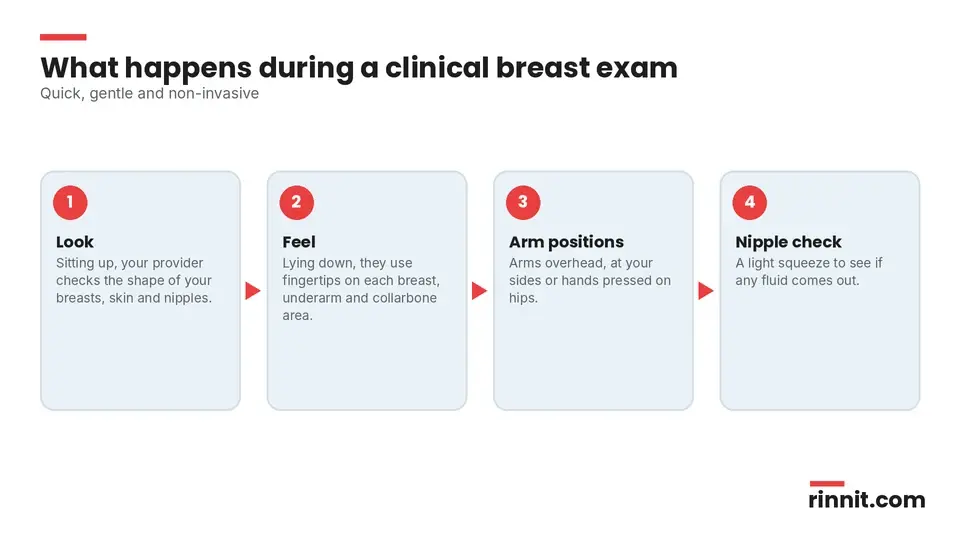
Sitting up: you sit on the exam table while your provider looks at the shape and appearance of your breasts, skin and nipples.
Lying down: your provider gently uses their fingertips to check the whole breast, the underarm and the collarbone area for lumps, and checks nearby lymph nodes.
Arm positions: you may be asked to raise your arms overhead, rest them at your sides or press your hands on your hips.
Nipple check: your provider may lightly squeeze each nipple to see if any fluid comes out.
Sources: [1]
Your provider may ask whether one breast has always been a bit larger, which is normal for most women, or whether a nipple difference, like an inverted nipple, has always been there. If so, it's usually treated as normal for you. They record any changes or areas of concern. [1]
Are there any risks?
A CBE is safe and non-invasive. The main risk is a false positive, when something looks or feels concerning but isn't cancer. That can lead to more tests and worry, but it's not a reason to skip breast exams, because the goal is to find problems early. [1] [2]
What do clinical breast exam results mean?
Your provider tells you at the end of the exam whether they saw or felt anything concerning. For most women, the results are normal. [1]
If something needs a closer look, follow-up tests may include: [1]
A mammogram
A breast ultrasound
A breast MRI
A biopsy
Most abnormal CBE findings aren't cancer. Common harmless causes include fibroadenomas and cysts. [1]
When should you see your provider?
Don't wait for your next scheduled exam if you notice: [1]
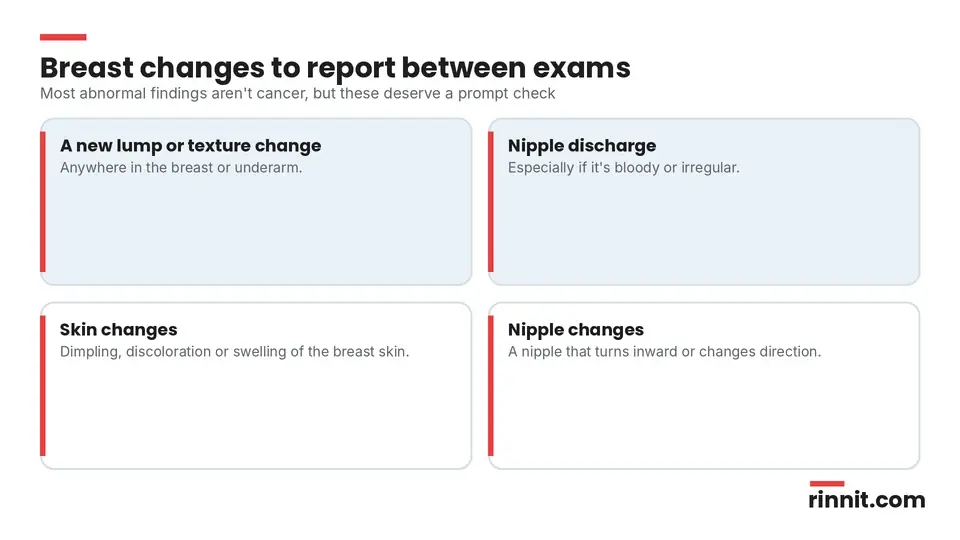
A new lump or a change in breast texture
Irregular or bloody nipple discharge
Dimpling, discoloration or swelling of the breast skin
A nipple that turns inward or changes direction
Why don't all organizations recommend CBEs?
Providers still do CBEs, but they're not the most effective screening method, and regular mammograms remain the gold standard for early detection. The American Cancer Society no longer recommends CBEs for cancer screening, while the National Comprehensive Cancer Network still does. Ask your provider how often you should have a mammogram. [1]
Conclusion
A clinical breast exam is a quick, painless check that can pick up lumps or skin and nipple changes, and most results are normal. It works best alongside regular mammograms and your own awareness of how your breasts usually feel.
At your next checkup, ask whether you need a CBE, when to start mammograms based on your risk, and what changes should prompt a call between visits.
Keep learning: Read our guide to breast cancer or learn about breast cysts, a common harmless lump. For more background, see the CDC guidance on breast cancer screening.
FAQ
What is a clinical breast exam?
It's a check by a healthcare provider who looks at and feels your breasts, underarms and collarbone area for lumps or other changes.
How often should I have a clinical breast exam?
It's often suggested every 1 to 3 years from age 25 and every year from age 40.
At what age should clinical breast exams start?
The National Comprehensive Cancer Network recommends starting at age 25, adjusted for your risk.
What happens during a clinical breast exam?
Your provider looks at your breasts while you sit, then feels the breasts, underarms and collarbone area while you lie down.
Does a clinical breast exam hurt?
No. It's a gentle, non-invasive exam with fingertip pressure.
Does a clinical breast exam replace a mammogram?
No. Mammograms and breast MRI are much better at finding breast cancer early.
What does an abnormal clinical breast exam mean?
It means something needs a closer look, often with a mammogram, ultrasound, MRI or biopsy; most findings aren't cancer.
What is a false positive on a breast exam?
It's a finding that seems concerning but turns out not to be cancer.
What is the difference between a CBE and a breast self-exam?
A provider does a CBE about once a year; you do a self-exam at home, often once a month.
Why doesn't the American Cancer Society recommend CBEs?
CBEs aren't the most effective screening tool; regular mammograms remain the gold standard.
When should I call my provider about a breast change?
Call for a new lump, bloody or unusual nipple discharge, skin dimpling or swelling, or a nipple that turns inward.
Related Reading
Breast Cancer: Symptoms, Causes, and Treatment explains the main condition a clinical breast exam screens for.
Breast Cysts: Symptoms, Causes, and Treatment covers one of the most common harmless lumps found during a CBE.
Fibrocystic Breasts: Why They Happen, What the Lumps Mean, and What Actually Helps explains lumpy breast tissue that can be felt during an exam.
Breast Pain: Symptoms, Causes, and Treatment covers a symptom that often leads to a clinical breast exam.
Mastitis: Symptoms, Causes, and Treatment explains breast inflammation that can cause swelling and redness noted on an exam.
References
Cleveland Clinic. Clinical Breast Exam (CBE): What To Expect. Cleveland Clinic. Last updated July 28, 2025. https://my.clevelandclinic.org/health/diagnostics/clinical-breast-exam
Oestreicher N, Lehman CD, Seger DJ, et al. The incremental contribution of clinical breast examination to invasive cancer detection in a mammography screening program. AJR Am J Roentgenol. 2005;184(2):428-432. PMID 15671358. https://doi.org/10.2214/ajr.184.2.01840428
Mittra I, Mishra GA, Dikshit RP, et al. Effect of screening by clinical breast examination on breast cancer incidence and mortality after 20 years: prospective, cluster randomised controlled trial in Mumbai. BMJ. 2021;372:n256. PMID 33627312. https://doi.org/10.1136/bmj.n256
Medical disclaimer
This article is for general education only and does not replace advice from a qualified healthcare professional. Talk to your doctor about your own diagnosis and treatment, and seek emergency care right away for severe or sudden symptoms.



Comments