Cellulite: What It Is, Why It Happens, and What Actually Works to Reduce It

Updated: 2 days ago
Medically reviewed by Dr. Baraa Alnahhal, MD · Last reviewed: September 2026
Editorial note (education only): This article is for general education and is not a substitute for professional medical advice. It is compiled exclusively from two peer-reviewed, medically reviewed patient-education pages, updated November 21, 2023, plus supplementary statistics from peer-reviewed dermatology and plastic-surgery literature. For any personal decision, consult a qualified dermatologist or plastic surgeon.
Quick Answer
Cellulite is a common, harmless skin condition in which fat cells push up against the skin while tough connective cords pull down, creating dimpled "orange peel" texture on the thighs, buttocks, and abdomen. It affects roughly 80–90% of postpubertal women. No treatment cures it, but ablative laser (6–12 months of improvement), surgical subcision (2–3 years), radiofrequency, massage, weight loss, muscle-toning exercise, and 0.3% retinol cream (visible after 6+ months) can reduce its appearance.
What exactly is cellulite, and is it dangerous?
Cellulite is a very common, harmless skin condition that causes lumpy, dimpled flesh on the thighs, hips, buttocks, and abdomen. It is not an infection, not a disease, and not contagious. It does not hurt and does not threaten your overall health.
The name comes from how it looks. Dimpled skin is often compared to cottage cheese or orange peel. Medically, it goes by names such as gynoid lipodystrophy, nodular liposclerosis, and edematofibrosclerotic panniculopathy — each reflecting a different theory of how it forms.
Because it is a cosmetic concern rather than a medical problem, treatment is never required. But if the appearance bothers you, dermatologists and plastic surgeons offer options.
Medical nature: harmless, painless cosmetic skin condition
Who it affects: ~80–90% of postpubertal women; under 10% of men
Typical locations: thighs, buttocks, hips; also lower abdomen, breasts, upper arms
Common look: dimpled, bumpy, "cottage cheese" or "orange peel" texture
Health risk: none — no treatment medically necessary
Typical first appearance: any age after puberty; most commonly ages 20–30

What does cellulite look like, and how severe can it get?
Cellulite looks like dimpled or bumpy skin. Mild cellulite appears only when you pinch the skin in an affected area such as the thigh. More severe cellulite makes the skin appear rumpled and bumpy with areas of peaks and valleys.
Dermatologists grade cellulite in four levels, based on how the dimpling behaves when you stand versus when you sit:
Grade 0 — no visible cellulite
Grade 1 — skin is smooth when standing; mild dimpling appears only when sitting
Grade 2 — moderate dimples visible both standing and sitting
Grade 3 — severe dimples when standing or sitting, with deep peaks and valleys
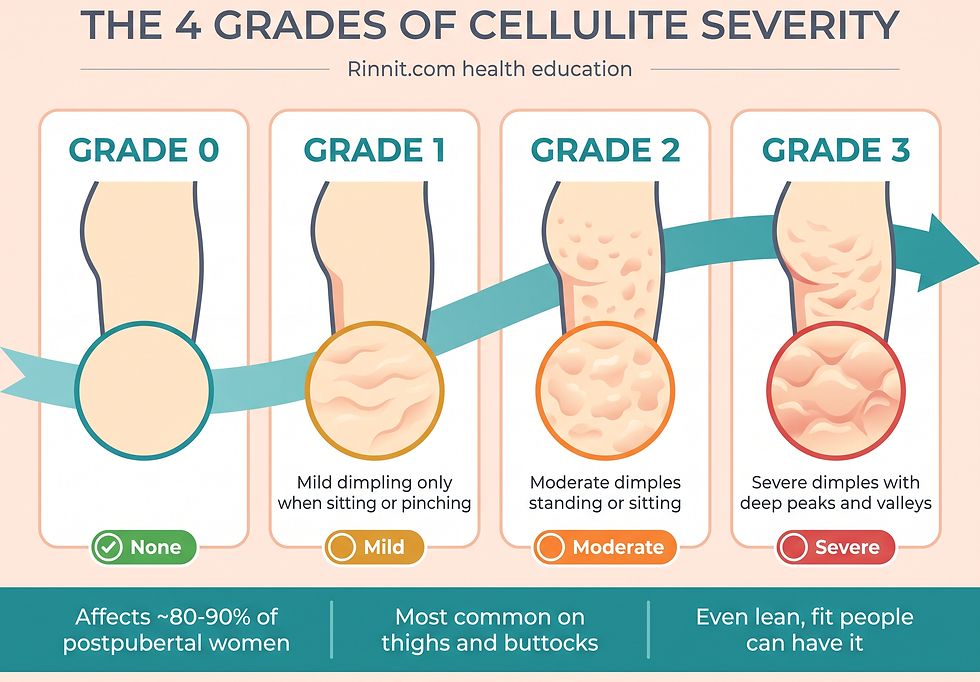
Most cellulite appears around the thighs and buttocks, but it can also show up on the breasts, lower abdomen, and upper arms. A useful distinction: the dimpling is only obvious in Grade 1 when you pinch or sit, so "I have cellulite" can depend on posture and pressure, not just body fat.
Why does cellulite form, and why is it so much more common in women?
Little is known about what causes cellulite, but the accepted mechanism is mechanical. Fibrous connective cords tether the skin to the underlying muscle, with fat lying between them. As fat cells accumulate, they push up against the skin, while the long, tough cords pull down. This creates the uneven, dimpled surface.
Gender anatomy explains the strong female predominance. In women, the fibrous bands run vertically and in parallel, so fat pushing outward shows as puckers. In men, the bands crisscross at roughly a 45-degree angle and are stronger and more stable — which is why even obese men rarely develop cellulite. In the roughly 2% of men who do have cellulite, it is usually linked to androgen deficiency from causes such as castration, hypogonadism, Klinefelter syndrome, or estrogen therapy.
Hormones also matter. Estrogen appears to play a pivotal role, and high-estrogen states — pregnancy, nursing, long-term oral contraceptive use, and postmenopausal hormone therapy — can worsen cellulite. Genetics determine your skin structure, skin texture, and body type, and cellulite tends to run in families.
What are the risk factors for developing cellulite?
Cellulite is far more common in women than men — in fact, most women develop some cellulite after puberty. This is partly because women's fat is typically distributed in the thighs, hips, and buttocks, exactly where cellulite forms.
Note the important caveat: even very fit, lean people can have cellulite, so body weight alone does not explain it.
Female sex — parallel, vertical connective bands and estrogen exposure
Post-pubertal age — most women develop some cellulite after puberty
Aging — skin loses elasticity, making dimpling more evident
Genetics — determines skin structure, texture, and fat distribution; runs in families
Weight gain — extra fat exaggerates the push against tethering cords
Pregnancy — hormonal and weight changes both contribute
Inactive lifestyle — less muscle tone reduces support under the skin
Ethnicity — reported more often in women of European descent than Asian or African descent
One practical takeaway: being lean does not make you immune, and being heavier does not guarantee worse cellulite — but losing excess weight and toning muscle can improve how it looks.
How do doctors diagnose cellulite?
Diagnosis is straightforward — a doctor simply looks at the skin to assess the dimpling and what may have caused it. No blood test, scan, or biopsy is needed. This exam also helps determine which treatment may improve the appearance, because treatments target different parts of the problem.
An important framing that patients often miss: some methods treat the fat but do not remove the dimpling, while methods that remove cellulite are not intended to remove excess fat. That is why the realistic goal is a reduction in appearance, not elimination — and why results are typically temporary.
What treatments actually reduce cellulite, and how long do results last?
A variety of approaches can improve the appearance of cellulite, at least temporarily. Some studies suggest combining treatments yields the most satisfying results.
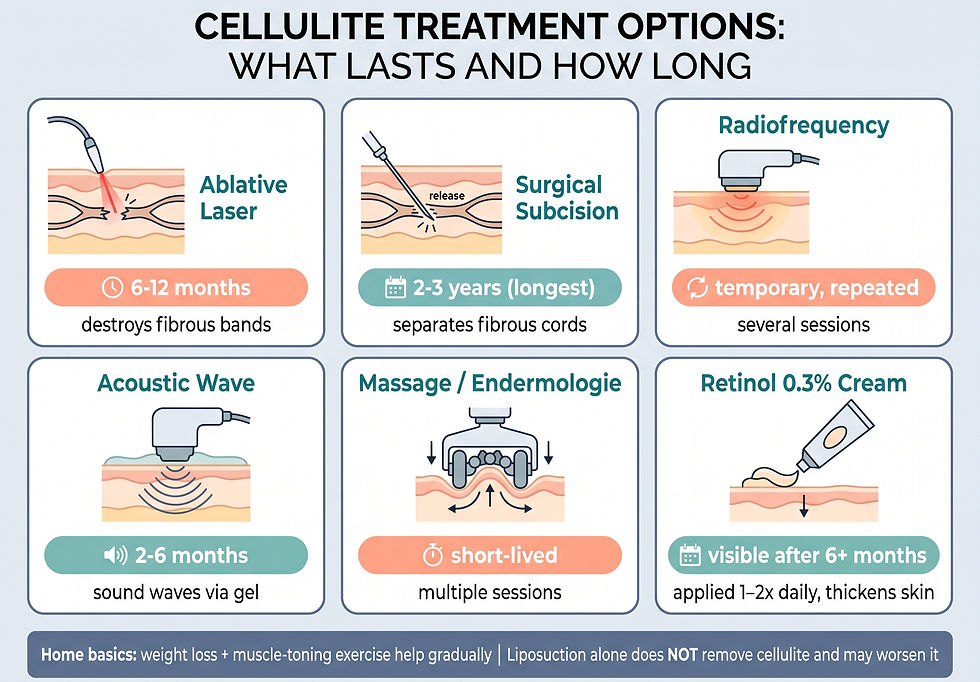
Ablative laser — a thin fiber under the skin delivers heat that destroys the fibrous bands binding fat; results last 6 months to 1 year, the longest-lasting non-surgical option
Radiofrequency (nonablative) — heat applied over the skin improves skin appearance; temporary, repeated more often than laser, requires several sessions before visible improvement
Acoustic wave therapy — a handheld transducer sends sound waves through gel into the skin; short-lived, multiple sessions needed, results may persist 2–6 months after a full course
Massage (Endermologie) — a roller machine kneads the skin to stimulate lymphatic flow; short-lived, FDA-recognized as low-harm, slight improvement after multiple sessions
Surgery (subcision) — needles, blades, or tools separate the fibrous bands, sometimes with fat grafting; results last 2 to 3 years, the longest-lasting option, with possible pain and bleeding beneath the skin
Two cautions come directly from the clinical guidance. First, cellulite treatments are usually not covered by insurance. Second, always confirm that your dermatologist or plastic surgeon is specially trained and experienced in the specific technique you are considering.
"There is no effective treatment for cellulite, although a number of different treatment modalities are available, from noninvasive to minimally invasive. The efficacy of most treatments is unpredictable and improvements in cellulite appearance are short lived." — Aesthetic Surgery Journal Open Forum, 2023
Is liposuction the answer?
No — on its own, liposuction does not remove cellulite and may actually worsen the appearance of the skin. Researchers are studying combinations of liposuction with ultrasound or laser for skin tightening, but more study is needed before such approaches can be recommended.
What can you do at home without procedures?
Self-care can genuinely improve the look of dimpled skin, though patience is required.
0.3% retinol cream — thickens the skin, reducing dimpling; applied once or twice daily; effect visible only after 6 months or longer
Weight loss — losing extra pounds and toning muscle may improve the look of dimpled skin
Physical activity — muscle-toning activities improve appearance, circulation, and lymphatic drainage — try yoga, Pilates, swimming, walking, biking, stair climbing, or dancing
The overarching message is honest but reassuring: you cannot completely get rid of cellulite, but a combination of exercise, weight management, and careful treatment selection can meaningfully reduce its appearance.
When should you see a doctor about cellulite?
Treatment is never medically necessary for cellulite. But if you are concerned about the appearance of your skin, talk with your primary care doctor, a dermatologist, or a plastic surgeon about treatment options.
Before an appointment, it helps to prepare questions such as: what is the best course of action, what are my options and their pros and cons, what will treatments cost, what results can I expect, and what follow-up is needed. Since results are temporary for every option, budgeting for repeated sessions or touch-up procedures should be part of that conversation.
What is the bottom line?
Cellulite is a normal, harmless feature of skin anatomy for the large majority of women — an architectural interplay of fat, connective cords, and skin elasticity rather than a flaw to fix. It affects an estimated 80–90% of women after puberty, and even the fittest individuals can have it.
If the appearance bothers you, realistic expectations matter most. Non-surgical energy treatments improve appearance for roughly 6–12 months, surgical subcision offers the longest effect at 2–3 years, and daily 0.3% retinol cream plus muscle-toning exercise provides a gradual, low-cost improvement. Discuss your goals with a specially trained dermatologist or plastic surgeon before choosing a procedure.
Ready to explore your options? Talk with a board-certified dermatologist or plastic surgeon about which cellulite treatment fits your skin, your grade of dimpling, and your budget — and ask specifically how long the results of each option are expected to last in someone like you.
Frequently Asked Questions
Is cellulite normal or a sign of a health problem?
Cellulite is a very common, harmless skin condition — not a health problem. It affects roughly 80–90% of women after puberty and does not hurt or require medical treatment. It only warrants a doctor's attention if you want to discuss cosmetic treatment options.
Why do women get cellulite and men rarely do?
In women, the fibrous bands under the skin run vertically and in parallel, letting fat push outward into visible puckers; in men, the bands crisscross at about 45 degrees and are stronger, which resists dimpling. Estrogen also plays a pivotal role in cellulite development.
Can you get rid of cellulite completely?
No treatment eliminates cellulite permanently. Ablative laser improves appearance for 6 months to a year, and surgical subcision may last 2–3 years — the longest available result. Home measures like 0.3% retinol cream and exercise help gradually over 6 months or more.
Does losing weight make cellulite go away?
Losing weight can make cellulite less noticeable, but it does not remove it — some lean people have cellulite while some heavier people have little. Weight loss combined with muscle toning tends to improve the skin's appearance more than weight loss alone.
What is the fastest way to reduce cellulite?
Surgical subcision produces visible results as early as one month and lasts 2–3 years, making it the longest-lasting option. Non-invasive options such as laser and radiofrequency require multiple sessions and repeat treatments to maintain results.
Do cellulite creams really work?
Only one cream has clear evidence: 0.3% retinol cream thickens the skin and reduces dimpling, but results take at least 6 months of once- or twice-daily use. Most other creams and lotions have not been shown to provide lasting improvement.
Is cellulite caused by toxins or poor circulation?
There is no good evidence that toxins cause cellulite. The accepted mechanism is structural: fat lobules push up against the skin while tough connective cords pull down, creating the dimpled surface. Hormones and genetics also play large roles.
Should I see a dermatologist or a plastic surgeon for cellulite?
Either is appropriate, as long as they are specially trained and experienced in the specific technique you are considering. A dermatologist is often the starting point for creams, energy devices, and mild subcision; plastic surgeons handle surgical subcision and fat grafting.
References
Cellulite — Symptoms & causes. Patient education page, medically reviewed and updated Nov. 21, 2023. mayoclinic.org/diseases-conditions/cellulite/symptoms-causes/syc-20354945
Cellulite — Diagnosis & treatment. Patient education page, medically reviewed and updated Nov. 21, 2023. mayoclinic.org/diseases-conditions/cellulite/diagnosis-treatment/drc-20354949
Gabriel A, Chan V, Caldarella M, Wayne T, O’Rorke E. Cellulite: Current Understanding and Treatment. Aesthet Surg J Open Forum. 2023;5(3):ojad050. pmc.ncbi.nlm.nih.gov/articles/PMC10324940/
Luebberding S, Krueger N, Sadick NS. Cellulite: An Evidence-Based Review. J Clin Aesthet Dermatol. 2015;8(6):20–26. pubmed.ncbi.nlm.nih.gov/25940753/
Cellulite: What It Is, Causes, Location & Treatment. Cleveland Clinic. Last reviewed Oct. 28, 2021. my.clevelandclinic.org/health/diseases/17694-cellulite
Young VL, Schorr MW, Farina A, et al. Comparison of Cellulite Severity Scales and Imaging Methods. Aesthetic Surg J. 2020. pmc.ncbi.nlm.nih.gov/articles/PMC8129470/
Khan MH, Victor F, Rao B, Sadick NS. Treatment of cellulite: Part I. Pathophysiology. J Am Acad Dermatol. 2010. doi.org/10.1016/j.jaad.2009.10.042
Khan MH, Victor F, Rao B, Sadick NS. Treatment of cellulite: Part II. Advances and controversies. J Am Acad Dermatol. 2010. doi.org/10.1016/j.jaad.2009.10.041
Uebel CO, Niept C, Rancan M. Cellulite: A surgical treatment approach. Aesthetic Surgery Journal. 2018. doi.org/10.1093/asj/sjy028
Callaghan DJ, et al. Updates in cellulite reduction. Adv Cosmet Surg. 2018. doi.org/10.1016/j.yacs.2018.02.006
Comments