Nonmelanoma Skin Cancer: Symptoms, Causes, and Treatment Explained

Updated: 3 days ago
Medically reviewed by Dr. Baraa Alnahhal, MD · Last reviewed: October 2026
Nonmelanoma skin cancer covers every skin cancer that is not melanoma, and almost all cases are basal cell carcinoma or squamous cell carcinoma. It usually shows up on sun-exposed skin as a new growth, a changing spot, or a sore that will not heal, and UV light from the sun and tanning beds causes most of the DNA changes behind it [1].
Quick Answer: What is nonmelanoma skin cancer?
Nonmelanoma skin cancer refers to all skin cancers that are not melanoma, almost all basal cell or squamous cell carcinoma, usually on sun-exposed skin. Warning signs include a new growth, a changing spot or a sore that will not heal. UV light causes most cases. A biopsy confirms it, and treatment ranges from the biopsy itself to surgery or radiation. [1] [2]
What the research says
Indoor tanning raises the risk of both main types. In a meta-analysis of 12 studies with 9,328 nonmelanoma skin cancer cases, people who ever used indoor tanning had a 67% higher risk of squamous cell carcinoma (RR 1.67, 95% CI 1.29 to 2.17) and a 29% higher risk of basal cell carcinoma (RR 1.29, 95% CI 1.08 to 1.53); use before age 25 was linked to a 40% higher basal cell risk (RR 1.40, 95% CI 1.29 to 1.52) (Wehner et al., BMJ, 2012).
Indoor tanning accounts for a large number of cases. A meta-analysis of 88 studies (406,696 participants) estimated that 3.0% to 21.8% of nonmelanoma skin cancers in the United States, Europe, and Australia are attributable to indoor tanning, corresponding to more than 450,000 cases a year (Wehner et al., JAMA Dermatol, 2014).
Oral nicotinamide (vitamin B3) lowered new cases in high-risk people. In a phase 3 trial of 386 people who had at least two nonmelanoma skin cancers in the previous 5 years, nicotinamide 500 mg twice daily lowered the rate of new nonmelanoma skin cancers by 23% over 12 months compared with placebo (95% CI 4% to 38%; P = 0.02), with no benefit after it was stopped; this is not a substitute for sun protection or skin checks (Chen et al., N Engl J Med, 2015).
What Is Nonmelanoma Skin Cancer?
Nonmelanoma skin cancer refers to all the types of cancer that happen in the skin that are not melanoma. Almost all nonmelanoma skin cancers are either basal cell carcinoma or squamous cell carcinoma. Other types are rare. Treatment depends on the type of cancer and usually involves surgery to remove the cancer cells [1].
Type | Notes |
Basal cell carcinoma | One of the two most common types |
Squamous cell carcinoma of the skin | The other most common type |
Angiosarcoma | Rare |
Cutaneous B-cell lymphoma | Rare |
Cutaneous T-cell lymphoma | Rare |
Dermatofibrosarcoma protuberans | Rare |
Merkel cell carcinoma | Rare |
Sebaceous carcinoma | Rare |
What are the symptoms of nonmelanoma skin cancer?
Nonmelanoma skin cancer often appears as a new growth, a changing spot or an irritated spot on sun-exposed skin, such as the scalp, face, ears, neck, chest, arms and hands. Nonmelanoma skin cancer can also happen elsewhere, including the lips, fingers, fingernails, and genital areas. It appears as a change in the skin [1]:
A new growth: a new bump or growth on the skin.
A changing spot: an existing skin spot that changes in shape or color.
An irritated spot: itching, pain, crusting, or bleeding of a skin spot.
A stubborn sore: a sore that won't heal or one that keeps coming back.
Anyone of any skin color can develop nonmelanoma skin cancer. It is not limited to fair-skinned people, even though the risk is highest in people with low levels of melanin [1].

When should you see a doctor about nonmelanoma skin cancer?
Make an appointment with a healthcare professional if you see any changes on your skin that worry you. Do not wait to see whether a changing spot or a sore improves on its own; an exam and, if needed, a biopsy will give you a clear answer [1].
What Causes Nonmelanoma Skin Cancer?
Nonmelanoma skin cancer develops when changes happen in the DNA of skin cells. A cell's DNA holds the instructions that tell the cell what to do. In healthy cells, DNA tells the cell to grow and multiply at a set rate and to die at a set time. In cancer cells, the DNA changes tell the cells to grow and multiply quickly and to keep living when healthy cells would die. This causes too many cells, which may form a new growth on the skin or change an existing spot [1].
Ultraviolet (UV) light causes most of the DNA changes in skin cells. UV light comes from sunlight, tanning lamps, and tanning beds. Sun exposure does not explain skin cancers that develop on skin that is not usually exposed to sunlight, so other factors can contribute and the exact cause is not always clear [1].
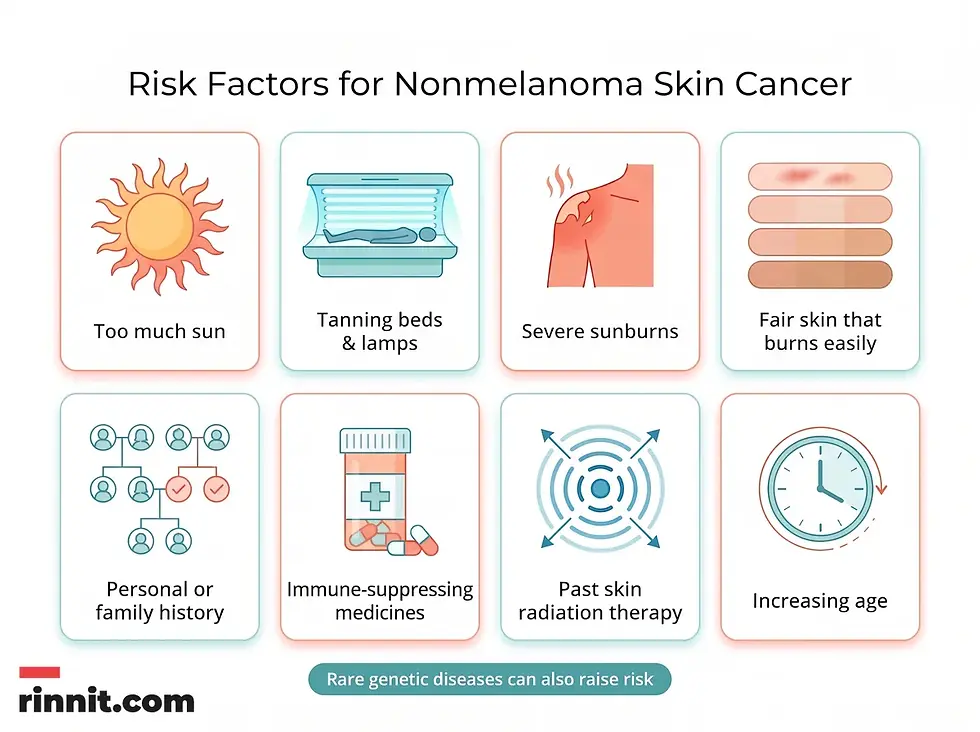
What are the risk factors for nonmelanoma skin cancer?
Low melanin is linked to a higher risk of nonmelanoma skin cancer, although the risk is not zero for any skin color.
Risk Factor | How It Raises Risk |
Too much sun | A lot of time in the sun or using tanning beds raises risk; severe sunburns raise it too. |
Skin that sunburns easily | More common in people with low melanin levels; risk is highest with blond or red hair, light-colored eyes, and skin that freckles or sunburns easily. |
Personal or family history | People who have had skin cancer have a higher risk of getting it again; a family history may also raise risk. |
Immune-suppressing medicines | Medicines that suppress the immune system, including those used after an organ transplant, raise the risk significantly. |
Past radiation therapy | Radiation to treat acne or other skin conditions may raise risk at the previously treated sites. |
Increasing age | The risk of some types goes up as people get older. |
Inherited syndromes | Some rare genetic diseases raise the risk. |
Melanin is the substance that gives skin its color and helps protect it from damaging UV light. People with Black or brown skin have more melanin than people with white skin, which is why low melanin is linked to higher risk, but the risk is not zero for any skin color [1].
How Is Nonmelanoma Skin Cancer Diagnosed?
Nonmelanoma skin cancer is diagnosed with a physical exam of your skin and a biopsy of the unusual area, which is tested in a lab for cancer and its type.
Physical exam: A member of your healthcare team asks about your health history and looks at your skin for signs of nonmelanoma skin cancer.
Biopsy: A tool is used to cut away, shave off, or punch out some or all of the area of skin that looks out of the ordinary. The sample is tested in a lab to see whether it is cancer and, if so, what type.
If a biopsy shows nonmelanoma skin cancer, other tests may be needed to check whether the cancer has spread beyond the skin [2].
What are the treatment options for nonmelanoma skin cancer?
Nonmelanoma skin cancer treatment depends on the cancer's size, type, location and depth, and small surface cancers may need nothing beyond a biopsy that removes the entire growth. Small nonmelanoma skin cancers on the surface of the skin may not require treatment beyond a skin biopsy that removes the entire growth. If other treatment is needed, the options include [2]:
Treatment | How It Works | When It Is Used |
Surgery | Removes the cancer; sometimes an area of healthy tissue around it is removed too. | Often can remove nonmelanoma skin cancer. |
Freezing (cryosurgery) | Destroys the cancer by freezing it with liquid nitrogen. | Some small, early-stage cancers. |
Radiation therapy | Uses powerful energy beams to treat the cancer. | When the cancer can't be completely removed during surgery. |
Chemotherapy | Uses strong medicines: creams or lotions for cancers limited to the top layer of skin, or whole-body treatment for cancers that have spread. | Top-layer cancers, or cancers that have spread beyond the skin. |
Photodynamic therapy | A two-stage treatment: a photosensitizer medicine is activated by light, usually from a laser, to kill cancerous and precancerous cells. | Selected cancers and precancerous cells. |
Immunotherapy | Uses the body's immune system to kill cancer cells. | Depending on the case. |
Clinical trials, which test new treatments and tests, may also be an option [2].

How should you prepare for a nonmelanoma skin cancer appointment?
If you have skin changes that worry you, start by making an appointment with a healthcare professional. If they suspect nonmelanoma skin cancer, you may be referred to a dermatologist. Because appointments can be brief, it helps to be prepared [2].
What You Can Do
Write down any symptoms you have, including any that seem unrelated to the reason for your visit.
Write down key personal information, including major stresses or recent life changes.
Make a list of all medicines, vitamins, and supplements you take.
Consider bringing a family member or friend to help you remember the information.
Write down questions to ask your healthcare professional.
Questions to Ask Your Doctor
Do I have nonmelanoma skin cancer? What kind?
How is this type different from other types of skin cancer?
Has my cancer spread?
What treatment do you recommend, and what are the possible side effects?
Will I have a scar after treatment?
Am I at risk of this coming back, or of other types of skin cancer?
How often will I need follow-up visits?
Are my family members at risk of skin cancer?
Are there printed materials or websites you recommend?
What to Expect From Your Doctor
Be ready to answer questions such as:
When did you first notice this skin change, and has it grown or changed much?
Is it painful or uncomfortable, and do you have other skin growths or sores that worry you?
Have you had skin cancer before?
How much were you in the sun as a child, and how much are you in the sun now?
Have you ever used tanning beds, and what do you do to stay safe in the sun?
Have you ever taken medicines that suppress your immune system?
Do you or did you smoke? How much?
What is the bottom line on nonmelanoma skin cancer?
Nonmelanoma skin cancer is the broad category of every skin cancer that is not melanoma, with basal cell and squamous cell carcinoma making up almost all cases. It develops when DNA changes make skin cells grow out of control, and UV light from the sun and tanning beds drives most of those changes. The warning signs are straightforward, and a biopsy confirms the diagnosis. If you notice a skin change that worries you, do not wait it out: see a healthcare professional, because early evaluation is the fastest path to a clear answer and, if needed, an effective treatment [1] [2].
Frequently Asked Questions
What is nonmelanoma skin cancer?
Nonmelanoma skin cancer refers to all types of skin cancer that are not melanoma. Almost all cases are either basal cell carcinoma or squamous cell carcinoma, and other types are rare.
What are the warning signs of nonmelanoma skin cancer?
Warning signs include a new growth on the skin, an existing spot that changes in shape or color, itching, pain, crusting, or bleeding of a spot, and a sore that won't heal or keeps coming back.
Where does nonmelanoma skin cancer usually appear?
Nonmelanoma skin cancer most often develops on sun-exposed areas such as the scalp, face, ears, neck, chest, arms, and hands. It can also occur on the lips, fingers, fingernails, and genital areas.
What causes nonmelanoma skin cancer?
Nonmelanoma skin cancer develops when changes happen in the DNA of skin cells, causing the cells to grow and multiply out of control. Ultraviolet (UV) light from sunlight, tanning lamps, and tanning beds causes most of these DNA changes.
Can people with dark skin get nonmelanoma skin cancer?
Yes. Anyone of any skin color can get it. It is more common in people with low levels of melanin, and the risk is highest in people with blond or red hair, light-colored eyes, and skin that freckles or sunburns easily.
What raises my risk of nonmelanoma skin cancer?
Risk factors include too much time in the sun or using tanning beds, severe sunburns, skin that sunburns easily, a personal or family history of skin cancer, medicines that suppress the immune system, past radiation therapy to the skin, increasing age, and rare inherited genetic diseases.
How is nonmelanoma skin cancer diagnosed?
Diagnosis starts with a physical exam of your skin and a review of your health history, followed by a biopsy. A sample of the suspicious skin is cut away, shaved off, or punched out and tested in a lab. If cancer is found, other tests may check whether it has spread beyond the skin.
Does every nonmelanoma skin cancer require treatment?
Not always. Small nonmelanoma skin cancers on the surface of the skin may not need treatment beyond a skin biopsy that removes the entire growth.
What are the treatment options?
Treatment depends on the size, type, location, and depth of the cancer. Options include surgery, freezing with liquid nitrogen (cryosurgery), radiation therapy, chemotherapy (creams or lotions for surface cancers, or whole-body treatment for cancers that have spread), photodynamic therapy, and immunotherapy.
When should I see a doctor about a skin change?
Make an appointment with a healthcare professional if you see any change on your skin that worries you.
Who treats nonmelanoma skin cancer?
You usually start with a healthcare professional, who may refer you to a specialist, often a dermatologist, a doctor who specializes in diagnosing and treating skin conditions.
Related Reading
Learn more in our guide to Skin Biopsy: Types, What to Expect, Results and Aftercare.
References
Mayo Clinic Staff. Nonmelanoma skin cancer: Symptoms and causes. Mayo Clinic. December 23, 2025. https://www.mayoclinic.org/diseases-conditions/nonmelanoma-skin-cancer/symptoms-causes/syc-20355397
Mayo Clinic Staff. Nonmelanoma skin cancer: Diagnosis and treatment. Mayo Clinic. December 23, 2025. https://www.mayoclinic.org/diseases-conditions/nonmelanoma-skin-cancer/diagnosis-treatment/drc-20579827
Wehner MR, Shive ML, Chren MM, et al. Indoor tanning and non-melanoma skin cancer: systematic review and meta-analysis. BMJ. 2012;345:e5909. PMID: 23033409. DOI: 10.1136/bmj.e5909
Wehner MR, Chren MM, Nameth D, et al. International prevalence of indoor tanning: a systematic review and meta-analysis. JAMA Dermatol. 2014;150(4):390-400. PMID: 24477278. DOI: 10.1001/jamadermatol.2013.6896
Chen AC, Martin AJ, Choy B, et al. A phase 3 randomized trial of nicotinamide for skin-cancer chemoprevention. N Engl J Med. 2015;373(17):1618-1626. PMID: 26488693. DOI: 10.1056/NEJMoa1506197
Medical disclaimer
The information provided in this article is for educational purposes only and should not be used as a substitute for professional medical advice, diagnosis, or treatment. Always seek the advice of a qualified healthcare provider with any questions you may have regarding a medical condition.



Comments