Wood's Lamp Examination: What the Blacklight Skin Test Shows

Updated: 3 days ago
Written and medically reviewed by Dr. Baraa Alnahhal, MD · Last reviewed: November 2026 · How we review
Quick Answer
A Wood's lamp examination is a quick, painless skin test that uses long-wave ultraviolet (UV) light to make certain skin, hair and scalp problems glow or change color. It helps spot fungal infections such as scalp ringworm, bacterial infections and pigment changes such as vitiligo. A glow can suggest a condition, but it doesn't always confirm it.
What the research says
Wood's lamp helps judge vitiligo activity: in 110 people with vitiligo, Wood's lamp examination had 72.3% sensitivity and 66.7% specificity for judging whether the disease was stable, and it agreed moderately with dermoscopy, another skin-imaging tool (Mohan AJ et al., Indian Dermatology Online Journal, 2025) [2]
It's a low-cost tool for scalp ringworm in children: in 50 children with hair loss, Wood's lamp examination helped identify tinea capitis caused by Microsporum canis, and fluorescence faded as treatment worked, supporting its use in primary care (Sun D et al., Photodiagnosis and Photodynamic Therapy, 2024) [3]
Key takeaways
A Wood's lamp shines UV blacklight on the skin, hair or scalp.
Different conditions glow in different colors.
The test is painless, takes a few minutes and has no recovery time.
Don't wear makeup, deodorant or creams on the area being checked.
Results are discussed right away, but other tests may be needed to confirm a diagnosis.
What is a Wood's lamp examination?
The Wood's lamp is named after physicist Robert Wood. It gives off long-wave UV light that you can't see, plus a faint violet glow that you can. When UV light hits certain bacteria, fungi, pigments or chemicals in the skin, they fluoresce, or glow. Healthy skin looks bluish under the lamp, so areas that glow differently stand out. It's also called a blacklight test, ultraviolet light test or Wood's light test. Sources: [1]
What it can help find
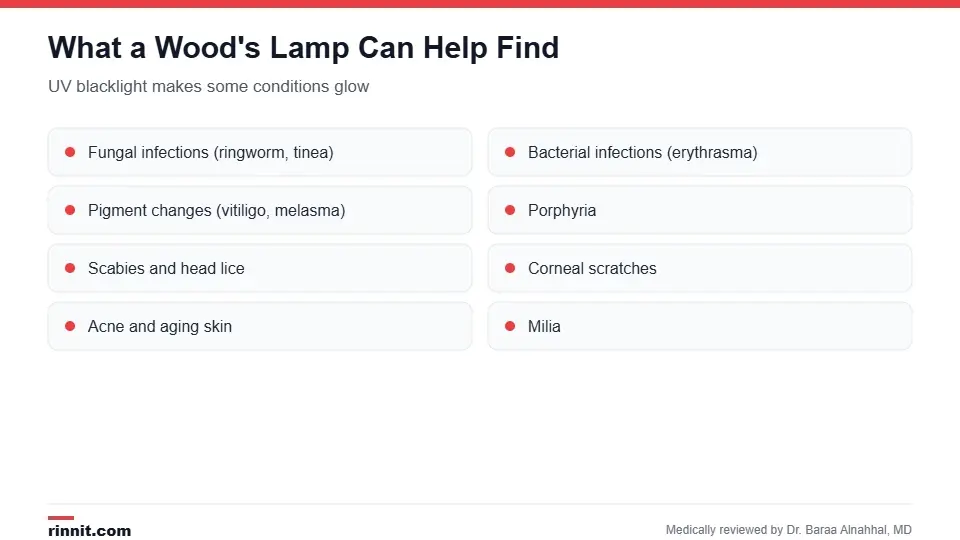
One quick test can check for many skin problems.
Fungal infections: ringworm, tinea capitis and tinea versicolor.
Bacterial infections: Pseudomonas and Corynebacterium (erythrasma).
Pigment changes: vitiligo and melasma.
Porphyria, a group of rare blood disorders (porphyria guide).
Corneal abrasions, scratches on the front of the eye.
Acne, aging skin and milia. Sources: [1]
What the colors mean

Your provider interprets the color along with your symptoms.
Color under the lamp | What it may suggest |
Bluish | Normal, healthy skin |
Bright blue-white | Loss of pigment, such as vitiligo |
Brown | Extra pigment (hyperpigmentation) |
Blue-green | Certain fungal infections |
Coral pink | Bacterial infection, such as erythrasma |
Pink-red | Porphyria |
Yellow or orange | Certain yeasts |
White or gray spots on the scalp | Head lice |
Yellow / purple / white | Oily skin / dry skin / thick skin or lint |
Sources: [1]
How to prepare
Your skin should be clean but not freshly washed.
Don't put makeup, deodorant, perfume, lotion or other products on the area. They can glow and change the results.
Tell your provider about any light sensitivity. Sources: [1]
What happens during the test
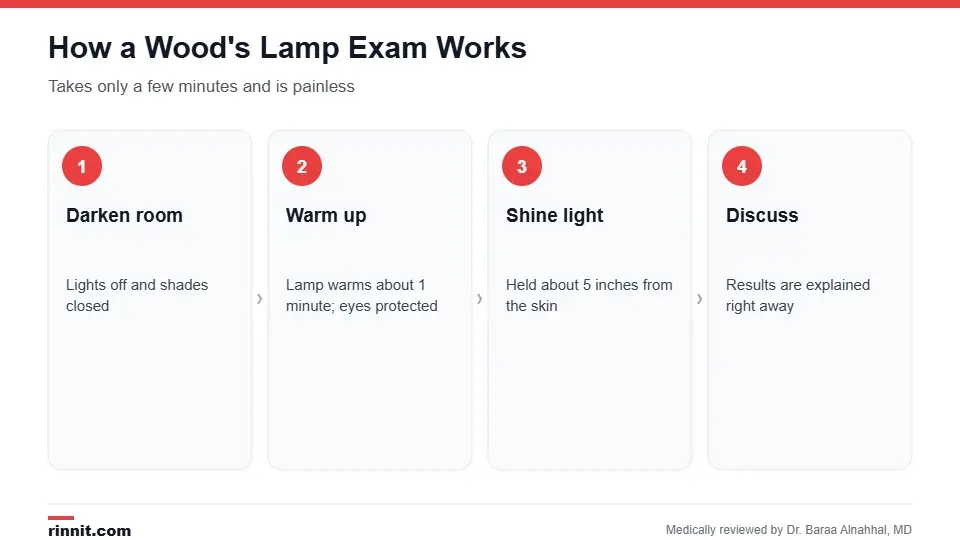
The exam takes only a few minutes.
The room is darkened by turning off the lights, closing the shades or using a drape.
The lamp is switched on and warms up for about a minute while your eyes adjust.
You wear goggles or close your eyes to protect them.
Your provider holds the lamp about 5 inches from your skin for a few seconds and looks for glowing areas.
The room lights come back on and your provider discusses what they saw. Sources: [1]
Risks and limitations
A Wood's lamp exam is considered safe and doesn't damage the skin. Rarely, people who are extremely light-sensitive get a temporary rash. Looking directly at UV light repeatedly can harm the eyes, so eye protection is used. The glow can suggest a condition rather than prove it. Some makeup products, lint and skin creams can glow too, and not every fungus fluoresces. Your provider may confirm the diagnosis with a skin scraping, culture or skin biopsy. Sources: [1, 2, 3]
Conclusion
A Wood's lamp exam is a fast, painless and inexpensive way to look for skin infections and pigment problems. It gives your provider useful clues in minutes and helps decide whether more testing or treatment is needed.
Keep learning: read about ringworm and tinea versicolor.
Frequently asked questions
What is a Wood's lamp?
A handheld device that shines UV blacklight on the skin to make certain conditions glow.
What does a Wood's lamp test for?
Fungal and bacterial infections, pigment changes, porphyria, scabies, lice and some skin problems.
Does a Wood's lamp exam hurt?
No. It's painless and gives off no heat.
How long does it take?
Only a few minutes.
What color does ringworm glow?
Certain fungal infections glow blue-green.
What color does vitiligo look under a Wood's lamp?
Bright blue-white.
Can I wear makeup to the test?
No. Makeup, deodorant and creams can affect the results.
Is UV light from the lamp safe?
Yes. It's considered safe, but your eyes are protected.
When will I get results?
Your provider usually discusses them right away.
Can a Wood's lamp confirm a diagnosis?
Not always. Other tests may be needed to confirm it.
Related Reading
Tinea Capitis: Symptoms, Causes, Treatment and Prevention a scalp infection a Wood's lamp can help find.
Tinea Versicolor: Complete Guide to Symptoms, Causes, and Treatment a yeast skin infection that can glow under UV light.
Erythrasma: Symptoms, Types, Causes, Diagnosis, Treatment and Prevention — What You Need to Know a bacterial infection that glows coral pink.
Understanding Melasma: Causes, Symptoms, and Management a pigment condition a Wood's lamp can assess.
Porphyria: Complete Guide to Symptoms, Causes, and Treatment a rare disorder that can glow pink-red.
Skin Biopsy: Types, What to Expect, Results and Aftercare the test that can confirm a skin diagnosis.
References
Cleveland Clinic. Wood's Lamp Examination: Skin Analysis Under UV Light. Cleveland Clinic. Last updated June 17, 2022. https://my.clevelandclinic.org/health/diagnostics/23292-woods-lamp-examination
Mohan AJ, Sarin A, Kidangazhiathmana A, et al. Comparison of dermoscopy and Wood's lamp in the assessment of stability of vitiligo. Indian Dermatology Online Journal. 2025;16(6):910-915. PMID 40801552. https://doi.org/10.4103/idoj.idoj_728_24
Sun D, Lu J, Liu T, et al. Wood's lamp for early detection of Microsporum canis tinea capitis in children. Photodiagnosis and Photodynamic Therapy. 2024;51:104428. PMID 39638219. https://doi.org/10.1016/j.pdpdt.2024.104428
Medical disclaimer
This article is for general education only and does not replace advice from a qualified healthcare professional. Talk to your doctor about your own diagnosis and treatment, and seek emergency care right away for severe or sudden symptoms.



Comments