What Is Ringworm? A Plain-Language Guide to the Itchy Rash That Isn't Caused by a Worm

Updated: 3 days ago
Medically reviewed by Dr. Baraa Alnahhal, MD · Last reviewed: October 17, 2026
Quick Answer
Ringworm is a rash caused by a fungal infection called tinea corporis, not a worm, named for its ring-shaped appearance [1] [3]. It causes an itchy, circular, scaly rash with clearer skin in the middle [1]. It spreads mostly through skin-to-skin contact with infected people or animals [1] [3]. Mild cases often respond to over-the-counter antifungal creams, while severe infections may need prescription pills [1] [2].
What the research says
Common antifungal creams work, and different kinds perform similarly. A Cochrane review of 129 randomized trials with 18,086 people who had tinea corporis or tinea cruris found that terbinafine produced far more clinical cures than placebo (risk ratio 4.51, 95% CI 3.10 to 6.56; number needed to treat 3), and clotrimazole 1% improved mycological cure versus placebo (risk ratio 2.87, 95% CI 2.28 to 3.62). Azoles and benzylamines showed no difference in mycological cure (risk ratio 1.01). Side effects were mainly mild irritation and burning, though the reviewers rated the quality of the evidence as low to very low. (El-Gohary et al., Cochrane Database Syst Rev, 2014) [4]
A rash that does not improve deserves a doctor's visit. A 2026 review estimates that dermatophyte infections affect roughly 20 to 25% of the global population and reports rising antifungal treatment failure over the past decade, led by Trichophyton indotineae. This species can mimic eczema or psoriasis, often fails to respond to terbinafine, and patients may be using topical steroid creams on it inappropriately. (Cox et al., Am J Clin Dermatol, 2026) [5]
What Is Ringworm, in Plain Language?
Ringworm of the body (tinea corporis) is a rash caused by a fungal infection [1]. It's usually an itchy, circular rash with clearer skin in the middle [1].
Despite the name, no worm is involved [1] [3]. Ringworm gets its name because of its appearance [1].
Ringworm often causes a ring-shaped rash that is itchy, scaly and slightly raised [1]. The rings usually start small and then expand outward [1].
Ringworm of the body is related to athlete's foot (tinea pedis), jock itch (tinea cruris) and ringworm of the scalp (tinea capitis) — the same family of mold-like fungi, just in different locations on the body [1].
The good news: mild ringworm often responds to antifungal medications applied to the skin [1]. For more-severe infections, you may need to take antifungal pills for several weeks [1].

What Does Ringworm Look Like?
The rash has a distinctive ring shape that makes it easier to spot than many other rashes. Signs and symptoms of ringworm may include a scaly ring-shaped area, typically on the buttocks, trunk, arms and legs [1]. The rash is usually itchy, with a clear or scaly area inside the ring, perhaps with a scattering of bumps [1].
The color of the bumps varies with skin tone: red on white skin, and reddish, purplish, brown or gray on black and brown skin [1]. The rings are slightly raised and expanding [1]. Some people develop a round, flat patch of itchy skin, and others develop overlapping rings [1].
Symptom | What you may see or feel |
Ring shape | A scaly ring-shaped area, typically on the buttocks, trunk, arms and legs [1] |
Itchiness | The rash is usually itchy |
Inside the ring | A clear or scaly area, perhaps with a scattering of bumps (red on white skin; reddish, purplish, brown or gray on black and brown skin) |
Edges | Slightly raised, expanding rings |
Patch form | A round, flat patch of itchy skin |
Multiple rings | Overlapping rings |
How Does Ringworm Spread?
Ringworm is a contagious fungal infection caused by common mold-like parasites that live on the cells in the outer layer of your skin [1].
A key fact to understand: the fungus that causes ringworm is common, and the condition is contagious even before symptoms appear [1]. This is why it can be difficult to prevent.
The infection spreads in four ways:
Route | How it happens |
Human to human | |
Animal to human | |
Object to human | It's possible for ringworm to spread by contact with objects or surfaces that an infected person or animal has recently touched or rubbed against, such as clothing, towels, bedding and linens, combs, and brushes [1]. |
Soil to human | In rare cases, ringworm can be spread to humans by contact with infected soil. Infection would most likely occur only from prolonged contact with highly infected soil [1]. |
Who Is at Higher Risk?
You're at higher risk of ringworm of the body if you live in a warm climate, have close contact with an infected person or animal, share clothing, bedding or towels with someone who has a fungal infection, take part in sports with skin-to-skin contact, wear tight or restrictive clothing, or have a weak immune system [1].
Risk factor | Why it matters |
Warm climate | The fungus thrives in warm, humid conditions |
Close contact with an infected person or animal | Direct contact is a common route of spread [1] |
Sharing clothing, bedding or towels | The fungus can ride on fabric and linens [1] |
Contact sports (such as wrestling) | Repeated skin-to-skin contact creates many chances to catch it |
Tight or restrictive clothing | Traps warmth and sweat that the fungus likes |
Weak immune system | The body has a harder time fighting the infection off [3] |
When Should You See a Doctor?
Talk to your doctor if you have a rash that doesn't begin to improve within two weeks of using an over-the-counter antifungal product [1]. You may need prescription medication [1].
Can Ringworm Cause Serious Problems?
The outlook is generally reassuring. A fungal infection rarely spreads below the surface of the skin to cause serious illness [1].
But people with weak immune systems, such as those with human immunodeficiency virus (HIV)/acquired immunodeficiency syndrome (AIDS), may find it difficult to get rid of the infection [1].
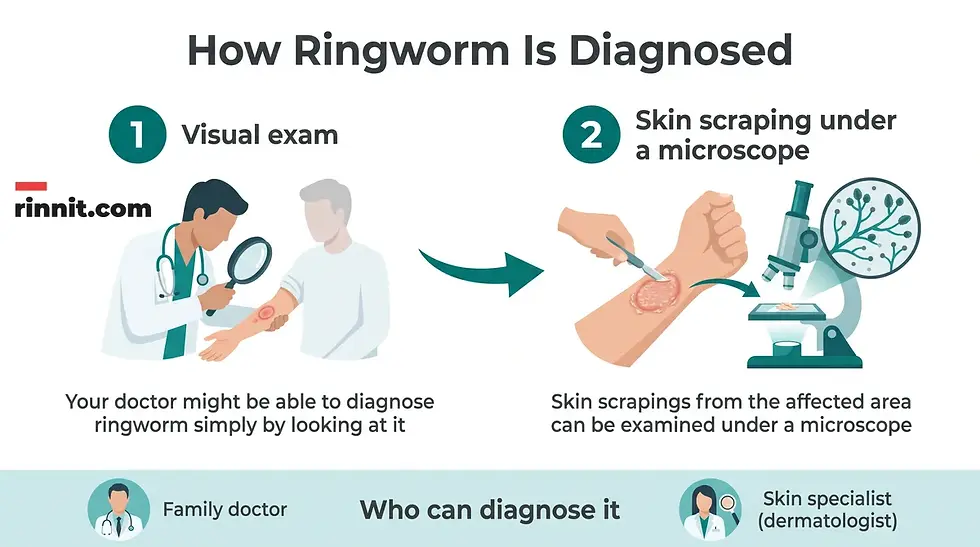
How Is Ringworm Diagnosed?
Your doctor might be able to diagnose ringworm simply by looking at it [2].
If the appearance isn't certain, your doctor may take skin scrapings from the affected area so that they can be examined under a microscope [2].
How Is Ringworm Treated?
Ringworm treatment depends on how far the fungal skin infection has spread on the body.
Treatment step | What it involves |
Over-the-counter antifungal products | Lotion, cream or ointment applied to the skin, such as clotrimazole (Lotrimin AF) or terbinafine (Lamisil AT), applied as directed on the packaging [2] |
Prescription-strength topicals | If over-the-counter treatments don't work, you may need prescription-strength antifungal medications — such as a lotion, cream or ointment that you apply to the affected skin [2] |
Antifungal pills | If your infection is particularly severe or extensive, your doctor might prescribe antifungal pills [2] (taken for several weeks) |
What Can You Do at Home?
For a mild case of ringworm, try these self-care tips:

How Can You Prevent Ringworm?
Ringworm is difficult to prevent because the fungus that causes it is common and it is contagious even before symptoms appear [1]. The fungus that causes it is common, and the condition is contagious even before symptoms appear [1]. Still, these steps can help reduce your risk:
Prevention step | How it helps |
Educate yourself and others | Be aware of the risk of ringworm from infected people or pets. Tell your children about ringworm, what to watch for and how to avoid infection [1]. |
Keep clean | |
Stay cool and dry | Don't wear thick clothing for long periods of time in warm, humid weather. Avoid excessive sweating [1]. |
Avoid infected animals | The infection often looks like a patch of skin where fur is missing. If you have pets or other animals, ask your veterinarian to check them for ringworm [1]. |
Don't share personal items | Don't let others use your clothing, towels, hairbrushes, sports gear or other personal items. And don't borrow such things [1]. |
How Should You Prepare for Your Appointment?
Your family doctor or a skin specialist (dermatologist) can diagnose ringworm of the body [2].
Your time with your doctor is limited, so preparing a list of questions helps you make the most of your appointment. List your questions from most important to least important in case time runs out [2].
What Questions Should You Ask Your Doctor?
For ringworm, some basic questions to ask your doctor include [2]:
Question | What it tells you |
What might be causing the signs and symptoms? | Confirms whether it's ringworm or something else |
Are tests needed to confirm the diagnosis? | Whether a microscope exam of skin scrapings is needed |
What is the best treatment? | The right cream, ointment or pills for your case |
Is this condition temporary or chronic? | How long to expect it to last |
Is there a generic alternative to the medicine you're prescribing? | Cost-saving options |
Can I wait to see if the condition goes away on its own? | Whether watchful waiting is safe |
What can I do to prevent the infection from spreading? | Steps to protect household members |
What skin care routines do you recommend while the condition heals? | Daily care during recovery |
What Questions Will Your Doctor Ask?
Your doctor is likely to ask you a number of questions, such as [2]:
When did you first notice your symptoms?
What did the rash look like when it first started?
Have you had this type of rash in the past?
Does a pet or family member already have ringworm?
Is the rash painful or itchy?
Have you used any medications on it already? If so, what?
What is the bottom line on ringworm?
Ringworm is one of those condition names that causes more confusion than it's worth — there's no worm, just a common mold-like fungus living on the outer layer of the skin [1]. What it does produce is hard to miss: an itchy, scaly, expanding ring with clearer skin in the middle [1]. It spreads easily through skin-to-skin contact with people or animals, shared towels and clothing, and contact sports, and it's contagious even before the first ring appears [1]. The response plan is simple and effective: clean, dry skin plus an over-the-counter antifungal cream for mild cases, and a doctor's visit with prescription-strength topicals or pills if it doesn't improve within two weeks [1] [2]. Prevention comes down to the basics — don't share personal items, shower after practice, keep pets' fur-free patches checked, and keep warm, sweaty skin aired out [1].
Take the Next Step
Got an itchy, ring-shaped rash that hasn't improved after two weeks of over-the-counter antifungal cream? See your doctor — you may need prescription medication. And if anyone in your household or a pet shows signs of ringworm, get them checked at the same time so the infection doesn't bounce back and forth between people and animals.
Frequently Asked Questions
Is ringworm actually caused by a worm?
No — no worm is involved. Ringworm of the body (tinea corporis) is a rash caused by a fungal infection [1]. It gets its name because of its appearance: an itchy, circular rash with clearer skin in the middle [1].
What does ringworm look like?
Ringworm often causes a ring-shaped rash that is itchy, scaly and slightly raised. The rings usually start small and expand outward [1]. The rash is typically found on the buttocks, trunk, arms and legs, with a clear or scaly area inside the ring — sometimes with bumps that range from red on white skin to reddish, purplish, brown or gray on black and brown skin [1].
How does ringworm spread?
Most often it spreads by direct, skin-to-skin contact with an infected person [1] [3]. It can also spread from animals — touching a dog or cat with ringworm can pass it on, and it's fairly common in cows [1]. It can spread from objects such as clothing, towels, bedding and linens, combs, and brushes, and in rare cases from prolonged contact with highly infected soil [1].
Who is at higher risk?
People who live in a warm climate, have close contact with an infected person or animal, share clothing, bedding or towels with someone who has a fungal infection, participate in contact sports such as wrestling, wear tight or restrictive clothing, or have a weak immune system [1].
How is it diagnosed?
Your doctor might be able to diagnose ringworm simply by looking at it [2]. They may also take skin scrapings from the affected area so that they can be examined under a microscope [2].
How is it treated?
Mild ringworm often responds to antifungal medications applied to the skin [1]. Keep the area clean and dry, and apply an over-the-counter antifungal lotion, cream or ointment such as clotrimazole (Lotrimin AF) or terbinafine (Lamisil AT) as directed on the packaging [2]. If over-the-counter treatments don't work, you may need prescription-strength antifungal topicals, and if the infection is particularly severe or extensive, your doctor might prescribe antifungal pills [2].
When should I see a doctor?
Talk to your doctor if you have a rash that doesn't begin to improve within two weeks of using an over-the-counter antifungal product [1]. You may need prescription medication [1].
Can ringworm cause serious illness?
A fungal infection rarely spreads below the surface of the skin to cause serious illness [1]. But people with weak immune systems, such as those with HIV/AIDS, may find it difficult to get rid of the infection [1].
How can I prevent it?
Ringworm is difficult to prevent because the fungus is common and contagious even before symptoms appear [1]. You can reduce risk by keeping shared areas clean, washing hands often, showering right after contact sports, staying cool and dry in warm weather, not sharing clothing, towels, hairbrushes or sports gear, and having pets with fur-free skin patches checked by a veterinarian [1].
Related Reading
References
Mayo Clinic Staff. Ringworm (body): Symptoms and causes. Mayo Clinic. Last updated April 26, 2022. Accessed October 14, 2026. https://www.mayoclinic.org/diseases-conditions/ringworm-body/symptoms-causes/syc-20353780
Mayo Clinic Staff. Ringworm (body): Diagnosis and treatment. Mayo Clinic. Last updated April 26, 2022. Accessed October 14, 2026. https://www.mayoclinic.org/diseases-conditions/ringworm-body/diagnosis-treatment/drc-20353786
Centers for Disease Control and Prevention. Ringworm basics. CDC. Last reviewed October 13, 2026. Accessed October 14, 2026. https://www.cdc.gov/ringworm/about/index.html
El-Gohary M, van Zuuren EJ, Fedorowicz Z, et al. Topical antifungal treatments for tinea cruris and tinea corporis. Cochrane Database Syst Rev. 2014;(8):CD009992. PMID: 25090020. https://doi.org/10.1002/14651858.CD009992.pub2
Cox VRV, Zuluaga T, Gupta AK, et al. Trichophyton indotineae: rise, diagnosis, treatment, and future directions. Am J Clin Dermatol. 2026;27(4):659-672. PMID: 42207393. https://doi.org/10.1007/s40257-026-01042-1
Disclaimer: This guide is for general information only and is not a substitute for professional medical advice, diagnosis, or treatment. Always seek the advice of a physician or other qualified health provider with any questions about a medical condition. Never disregard professional medical advice or delay seeking it because of something you have read here.



Comments