Testicles: Anatomy, Essential Functions, and Care

Updated: 2 days ago
Medically reviewed by Dr. Baraa Alnahhal, MD · Last reviewed: October 2026
Testicles are two egg-shaped organs in the scrotum. They make sperm and hormones such as testosterone. You need them for reproduction and for the body changes of puberty. To keep them healthy, learn how they normally look and feel. Protect them in contact sports, practice safe sex, and see a healthcare provider about any lump, swelling, or pain.
Quick Answer: What are testicles?
Testicles, also called testes, are the main male reproductive organs. They sit in the scrotum, outside the body. There it is about 5°F (3°C) cooler than inside, which is better for making sperm. They also make testosterone, which drives the changes of puberty. Report any lump, swelling, or pain quickly to protect your health and fertility.
What the research says
Delay is the main enemy in testicular torsion, and testicular loss is common. A meta-analysis of 12 studies of torsion in children found a mean early testicular loss rate of 39%, with late loss approaching 50% even after the testicle was initially saved; time to presentation consistently predicted worse outcomes, although the authors note that study quality was generally low (MacDonald et al., Journal of Pediatric Urology, 2018 [2]).
Removing a testicle after torsion shifts some hormones but not testosterone. A meta-analysis of 11 studies with 538 participants found higher FSH and LH after orchiectomy than after orchiopexy (standardized mean differences 1.63 and 1.31), while testosterone and inhibin-B were comparable between groups; sperm concentration was lower after orchiectomy (mean difference -18 million/mL), but sperm count, morphology, and motility did not differ significantly (Nasr et al., Journal of Pediatric Surgery, 2026 [3]).
Education raises awareness of testicular self-examination, but there is no consensus on scheduled exams in younger men. A systematic review of five studies found that most educational interventions (such as videos and presentations) increased men's awareness of testicular cancer and self-examination; the authors encourage clinicians to tell men to learn the look and feel of their own testicles and to seek timely care for any abnormality (Saab et al., HRB Open Research, 2023 [4]).
What is the anatomy of the testicles?
The testicles are two small, egg-shaped organs in a pouch of skin called the scrotum. The scrotum hangs below the penis. You can't see them directly, but you can see and feel their outline. Many people say they feel like large olives, small eggs, or walnuts [1].

Structural components
A tough layer of connective tissue covers each testis. Inside, it is split into small sections where sperm are made.
Component | Description |
Tunica | Tough connective tissue covering the testis, with an inner layer (tunica albuginea) and an outer layer (tunica vaginalis). |
Septa | Sections of connective tissue that divide the testis into about 250 lobules; each lobule holds one to four seminiferous tubules. |
Seminiferous tubules | Tightly coiled tubes where sperm are made; each testis has about 700. |
Rete testis | A group of small tubes that move sperm from the tubules to the epididymis. |
Epididymis | A tube along the back of each testis that connects to the vas deferens. |
Vas deferens | The tube that carries sperm toward the urethra before ejaculation. |
Spermatic cord | Connects each testis to the body; contains nerves, blood vessels, and the vas deferens. |
Size and development
The testes are small at birth. They usually stay about the same size until around age 8 [1]. Then they grow to adult size during puberty. An adult testis is about 1.5 to 2 inches (4 to 5 cm) long, with a volume of about 15 mL to 35 mL or more [1]. One side is often a little bigger than the other, and one may hang a little lower [1]. Both are normal.
What essential functions do the testicles perform?
The testes have two main jobs. They make sperm, and they make the hormones that shape male body development.
Sperm production: After puberty, the testes make sperm (spermatogenesis) inside tightly coiled tubes called seminiferous tubules [1]. Hormones such as testosterone and follicle-stimulating hormone (FSH) help cells grow into sperm [1]. The cooler temperature outside the body helps too.
Testosterone production: Leydig cells make testosterone. During puberty, it brings bigger muscles, body and facial hair, a deeper voice, a higher sex drive, and growth in height [1].
Developmental regulation: Other hormones, such as insulin-like factor 3, help the testes drop into the scrotum shortly before birth. They also help the testes keep developing.
Hormones made by the testes
Hormone | Role |
Testosterone | Made by Leydig cells; drives puberty changes and sex drive. |
Inhibin B | Relates to testicular volume and to the amount of sperm in the semen. |
Anti-Müllerian hormone | Important for the development of the internal reproductive organs. |
Insulin-like factor 3 | Helps the testes descend into the scrotum and keep developing. |
Estradiol | Important in sperm production. |
What common conditions and disorders affect the testicles?
No muscles or bones protect the testes, so they are easy to injure [1]. Several medical conditions can also affect how they work.
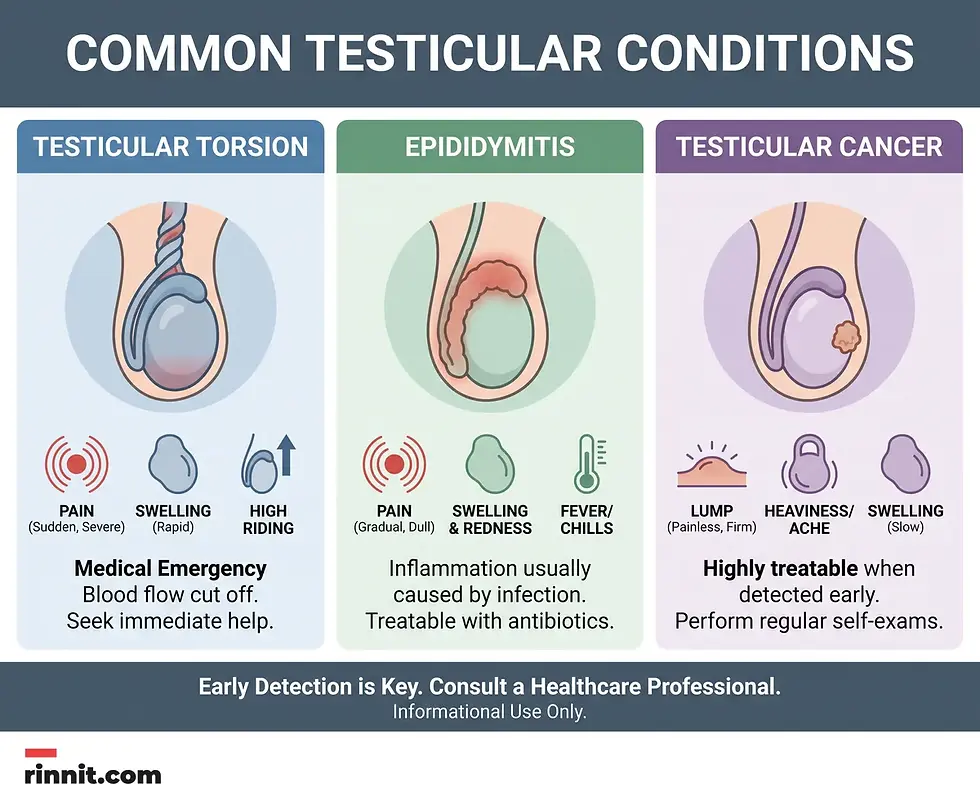
Condition | Characteristics |
Testicular torsion | The spermatic cord twists and cuts off blood supply. A medical emergency. |
Testicular cancer | The most common cancer in males between the ages of 20 and 35. |
Epididymitis | Inflammation of the epididymis, often causing pain and swelling. |
Low testosterone (hypogonadism) | The testes do not make enough of the hormones the body needs. |
Undescended testicles (cryptorchidism) | The testes do not drop into the scrotum when they should. |
Other conditions | Azoospermia (no sperm in the semen), oligospermia (low sperm count), spermatocele (a cyst above or behind a testis), and Klinefelter syndrome (an extra X chromosome). |
When to see a healthcare provider
A lump or swelling on a testicle
Testicular pain or pain in the lower abdomen
Blood in the semen (hematospermia)
Discoloration of the scrotum or an unexpected feeling of warmth in the area
Trouble getting a partner pregnant after more than a year of regular unprotected sex
Key point: testicular torsion is an emergency [1]. Sudden, severe testicular pain needs immediate medical attention.
How can you care for your testicles and prevent problems?
You can care for your testes with monthly self-exams, good hygiene, and protection during sports. These habits help you spot problems early.

Self-exams: Check your testes once a month to learn how they usually look and feel. If you notice any change, book an appointment. Also have a healthcare provider examine them once a year [1].
Avoid high temperatures: Limit time in saunas and hot tubs.
Keep the area clean: Wash your genitals often with soap and clean water. Pat dry, then put on clean underwear and clothes.
Practice safe sex: Use condoms to avoid getting or spreading sexually transmitted infections (STIs) [1].
Wear protection: Wear an athletic supporter (jock strap) for contact sports such as baseball, hockey, martial arts, lacrosse, or football [1].
Conclusion: Know What Normal Feels Like
The testicles are key parts of the male reproductive system and the hormone (endocrine) system. They make sperm and hormones. Only skin protects them, so they are easy to injure.
A few simple habits help a lot. Learn how your testes normally look and feel. Wear protection in contact sports, and practice safe sex. These steps protect them and your long-term health.
Next step: If you notice a lump, swelling, pain, or any other change, see a healthcare provider promptly.
Frequently Asked Questions
What happens to the testicles during ejaculation?
Sperm move from the testes to the epididymis. Next, they travel through the vas deferens to the prostate, where they mix with fluids to make semen. Muscles at the base of the penis then squeeze and push the semen out through the urethra.
Can I get a partner pregnant with only one testicle?
Yes. One healthy testicle can make enough sperm and testosterone to have children. If both testes must be removed because of cancer or injury, sperm banking may be an option.
What is the normal size for an adult testicle?
There is no exact normal size. An adult testis is about 15 mL (a bird egg) to 35 mL or more (a small chicken egg). One side may be slightly larger or hang lower, and that is normal.
Why are the testicles located outside the body?
The scrotum keeps the testes about 5°F (3°C) cooler than the rest of the body, which is better for making sperm.
What are the signs of a problem with the testicles?
Watch for a lump or swelling, testicular pain, or pain in the lower abdomen. Other signs are blood in the semen, a change in scrotum color, or unexpected warmth in the area. Trouble getting a partner pregnant after a year of regular unprotected sex is another sign.
How often should I do a testicular self-exam?
Cleveland Clinic suggests a self-exam once a month, so you learn how your testes normally look and feel. It also suggests a yearly exam by a healthcare provider. Report any change to a provider.
What is testicular torsion?
Testicular torsion happens when the spermatic cord twists and cuts off blood flow to the testis. Torsion is a medical emergency that needs care right away.
Does aging affect the testicles?
The testes keep working as you age. Over time, they may slowly make less testosterone, and sperm quality can change.
What hormones do the testicles make?
The testes mainly make testosterone, along with inhibin B, anti-Müllerian hormone, insulin-like factor 3, and estradiol.
What should I do if I find a lump?
See a healthcare provider promptly. Testicular cancer is the most common cancer in males ages 20 to 35. Getting checked early matters.
Related Reading
Prosthetic Testicle (Testicular Implant): Procedure and Recovery explains prosthetic testicles.
Testicular Self-Exam: How to Check Your Testicles and What's Normal explains how to check your testicles monthly and which changes need a doctor.
References
Cleveland Clinic. Testicles. Cleveland Clinic. Last updated May 6, 2026. https://my.clevelandclinic.org/health/body/23964-testicles
MacDonald C, Kronfli R, Carachi R, et al. A systematic review and meta-analysis revealing realistic outcomes following paediatric torsion of testes. Journal of Pediatric Urology. 2018;14(6):503-509. PMID 30404723. https://doi.org/10.1016/j.jpurol.2018.09.017
Nasr AM, Zamlout A, Alghzawi HM, et al. Gonadal function and fertility outcomes after orchiopexy versus orchiectomy for testicular torsion: a systematic review and meta-analysis. Journal of Pediatric Surgery. 2026;61(10):163348. PMID 42546903. https://doi.org/10.1016/j.jpedsurg.2026.163348
Saab MM, Davoren MP, Murphy A, et al. Promoting men's awareness, self-examination, and help-seeking for testicular disorders: a systematic review of interventions. HRB Open Research. 2023;1:16. PMID 32002508. https://doi.org/10.12688/hrbopenres.12837.3
Medical disclaimer
The information provided in this article is for educational purposes only and should not be used as a substitute for professional medical advice, diagnosis, or treatment. Always seek the advice of your physician or other qualified health provider with any questions you may have regarding a medical condition.



Comments