Prosthetic Testicle (Testicular Implant): Procedure and Recovery

Updated: 2 days ago
Written and medically reviewed by Dr. Baraa Alnahhal, MD · Last reviewed: November 2026 · How we review
Quick Answer
A prosthetic testicle (testicular implant) is an implant placed in an empty scrotum to restore its look and feel. It doesn't make sperm or testosterone and isn't needed for erections or sex. People get one after losing a testicle to cancer, torsion or infection. Surgery takes under an hour, and the implant can last a lifetime.
What the research says
Very few implants needed to be redone: among 427 people who received a testicular prosthesis, only one needed revision surgery, and 99.8% were free of removal or revision at 54 months (Atwater BL et al., International Journal of Impotence Research, 2025) [2]
Placing an implant during cancer surgery was safe: among 393 people with testicular cancer who got a prosthesis during orchiectomy, complications occurred in 4.3% to 6.2%, with no difference whether they later had chemotherapy, radiation or neither (Musi G et al., Andrologia, 2020) [3]
Key takeaways
A prosthetic testicle restores the look and feel of the scrotum.
It doesn't make sperm or testosterone.
Implants are made of silicone filled with gel or saline.
Surgery takes under an hour.
Complications are uncommon, and it can last a lifetime.
What is a prosthetic testicle?
Testicular implants have been used since the 1940s. Today's implants look like clear eggs with a similar weight, shape and feel to a natural testicle. Research hasn't found a link to connective tissue disease. Sources: [1]
Who may want one
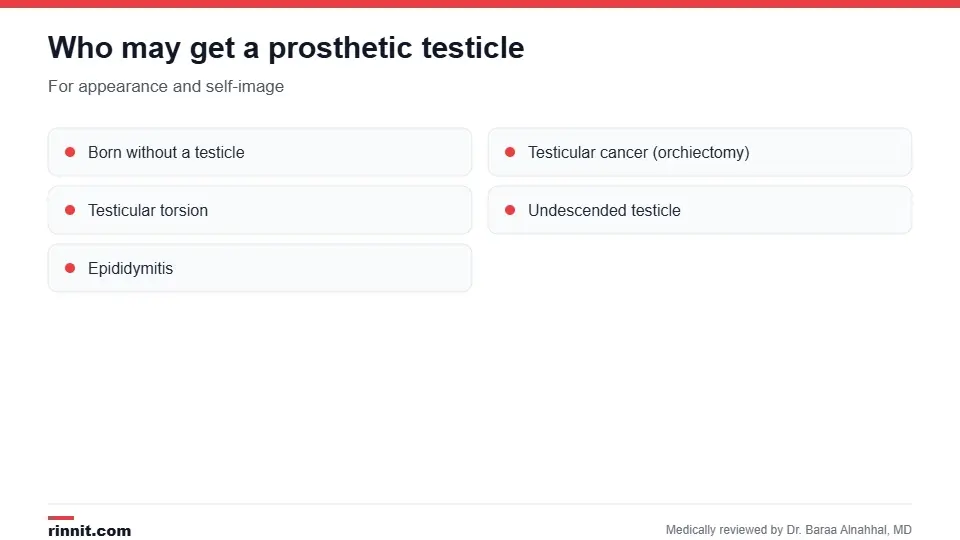
It's mainly for appearance and self-image.
Being born without a testicle or with a malformed one.
Testicular cancer requiring orchiectomy.
Untreated testicular torsion.
Epididymitis. Sources: [1]
It's mainly chosen to improve appearance and boost self-image. Sources: [1]
Types of implants
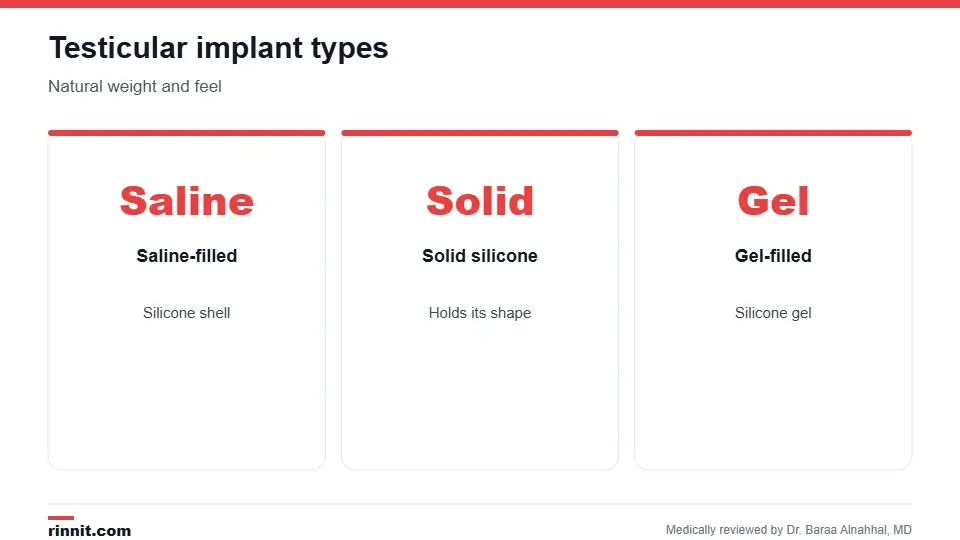
An ideal implant is sterile, holds its shape and feels comfortable.
Type | Details |
Saline-filled silicone | Common today |
Solid silicone | Common today |
Silicone gel-filled | Another option |
Metal alloy (vitallium) | Used historically, since the 1940s |
Sources: [1]
What happens during surgery

It usually takes less than an hour.
You get general or local anesthesia.
A small cut is made in the lower groin or upper scrotum.
A pouch is created in the scrotum.
The implant is placed and stitched in position.
The incision is closed. Sources: [1]
It's usually outpatient, so arrange a ride home. Children born without a testicle can have it between ages 1 and 3. Sources: [1]
Risks
Infection.
Blood pooling in the scrotum (hematoma).
Scarring.
Shifting out of position.
Rupture or leakage.
The implant pushing out, usually with infection.
Being unhappy with the look. Sources: [1, 2, 3]
Risk is higher with diabetes, a weak immune system, an active infection or past scrotal surgery. Sources: [1]
Recovery
Expect pain and tenderness for at least 24 to 48 hours.
Keep bandages on for at least a few days.
You may need supportive underwear and antibiotics.
Avoid heavy lifting, cycling and strenuous activity for about a month.
Wait a week or two before sexual activity. Sources: [1]
Outlook
A testicular implant is relatively safe, can last a lifetime and can improve self-esteem and body image. Insurance usually doesn't cover it because it doesn't restore function. Sources: [1, 2]
When to call your provider
Severe pain.
Trouble urinating.
Heavy bleeding or pus from the incision.
Loss of feeling in the scrotum.
Fever, chills or discoloration.
Problems getting or keeping an erection. Sources: [1]
Conclusion
A prosthetic testicle can restore a natural look and help you feel more like yourself after losing a testicle. A urologist experienced with implants can help you choose the right size.
Keep learning: read about orchiectomy and testicular cancer.
Frequently asked questions
What is a prosthetic testicle?
An implant placed in the scrotum to replace a missing testicle.
Does it make testosterone or sperm?
No.
Do I need one to have sex?
No. It isn't needed for erections or sex.
What is it made of?
Silicone, filled with silicone gel or saline.
How long does surgery take?
Usually less than an hour.
Is it outpatient?
Usually, yes.
When can I exercise?
After about a month.
Can children get one?
Yes, often between ages 1 and 3.
How long does it last?
It can last a lifetime.
Does insurance cover it?
Usually not.
Related Reading
Orchiectomy: A Comprehensive Guide to Testicle Removal Surgery testicle removal surgery.
Testicular Cancer: The Young Man's Cancer That's Highly Curable — Symptoms, Self-Exam Guidance, and Treatment Explained a common reason for an implant.
Testicular Torsion: Symptoms, Causes, Diagnosis and Treatment — What You Need to Know a cause of testicle loss.
What Are Undescended Testicles? Causes, Risks, and Treatment another cause.
Testicles: Anatomy, Essential Functions, and Care how the testicles work.
References
Cleveland Clinic. Prosthetic Testicle: Purpose, Procedure & Recovery. Cleveland Clinic. Last updated April 22, 2024. https://my.clevelandclinic.org/health/treatments/15993-testicular-prosthesis
Atwater BL, Kirkik D, Wilson SK, et al. Short-term revision rate of Rigicon Testi10 testicular prosthesis in adolescents and adults: a retrospective chart review. International Journal of Impotence Research. 2025;37(4):303-309. PMID 38714783. https://doi.org/10.1038/s41443-024-00893-8
Musi G, Cozzi G, Mistretta FA, et al. Insertion of a testicular prosthesis at the time of radical orchiectomy for testicular cancer is safe in patients who will subsequently undergo chemotherapy or radiotherapy. Andrologia. 2020;52(6):e13613. PMID 32352182. https://doi.org/10.1111/and.13613
Medical disclaimer
This article is for general education only and does not replace advice from a qualified healthcare professional. Talk to your doctor about your own diagnosis and treatment, and seek emergency care right away for severe or sudden symptoms.



Comments