Orchiectomy: A Comprehensive Guide to Testicle Removal Surgery

Updated: 3 days ago
Medically reviewed by Dr. Baraa Alnahhal, MD · Last reviewed: October 17, 2026
An orchiectomy is surgery to remove one or both testicles. It is used to treat and prevent testicular cancer, to treat prostate and male breast cancer, and to remove testicles that are badly injured. This guide explains the different types, what happens during surgery, what recovery looks like, and the hormonal changes to expect.
Quick Answer: What is an orchiectomy?
An orchiectomy is a surgical procedure that removes one or both testicles. It treats and prevents testicular cancer, treats prostate and male breast cancer, and removes testicles damaged by trauma. It usually takes 30 to 60 minutes under general anesthesia, with same-day discharge. Removing both testicles ends sperm production and lowers testosterone, which may need hormone treatment.
What the research says
A prosthetic testicle placed during surgery was linked to less regret. In a retrospective analysis of 142 men with localized testicular cancer (cN0M0) who had an orchiectomy, 61 (43%) had a prosthesis placed at the same operation. These men reported less decision regret than men without one, and prosthesis placement was independently linked to lower odds of regret (odds ratio 0.4, p = 0.03) (Boeri et al., Eur Urol Focus, 2025) [2].
Most men with a prosthesis were satisfied, with no clear harm to sex life. In a single-center study of 60 men who had a testicular prosthesis after orchiectomy, 48 (80%) were satisfied with it, and there was no significant impact on overall sexual performance. Dissatisfaction was mostly seen in men who also had erectile dysfunction (El Kaddouri et al., Cureus, 2025) [3].
Lowering testosterone is linked to bone problems. In a cohort of 790,916 US veterans with prostate cancer, androgen deprivation therapy with LHRH agonists (men who had a bilateral orchiectomy were excluded) was associated with a higher risk of bone fractures (hazard ratio 1.59; 95% CI 1.55-1.62) and osteoporosis (hazard ratio 2.73; 95% CI 2.65-2.80). This is a different way of lowering testosterone, so it is indirect evidence for bone risk after orchiectomy (Friedrich et al., JAMA Netw Open, 2025) [4].
Study details retrieved from PubMed.
What Is an Orchiectomy?
An orchiectomy, also called an orchidectomy, is a surgical procedure to remove one or both testicles. The testicles (testes) are two small organs that hang in a sac of skin called the scrotum, below the penis. They make sperm and male hormones such as testosterone. [1]
The surgery is usually an outpatient procedure, so you go home the same day. Which type you have depends on the condition being treated and where the surgeon makes the incision. [1]
What are the types of orchiectomy?
Type | What is removed | Incision and notes |
Unilateral | One testicle | The remaining testicle can usually still make enough sperm and hormones. |
Bilateral | Both testicles | Ends sperm production (infertility) and causes a large drop in testosterone. |
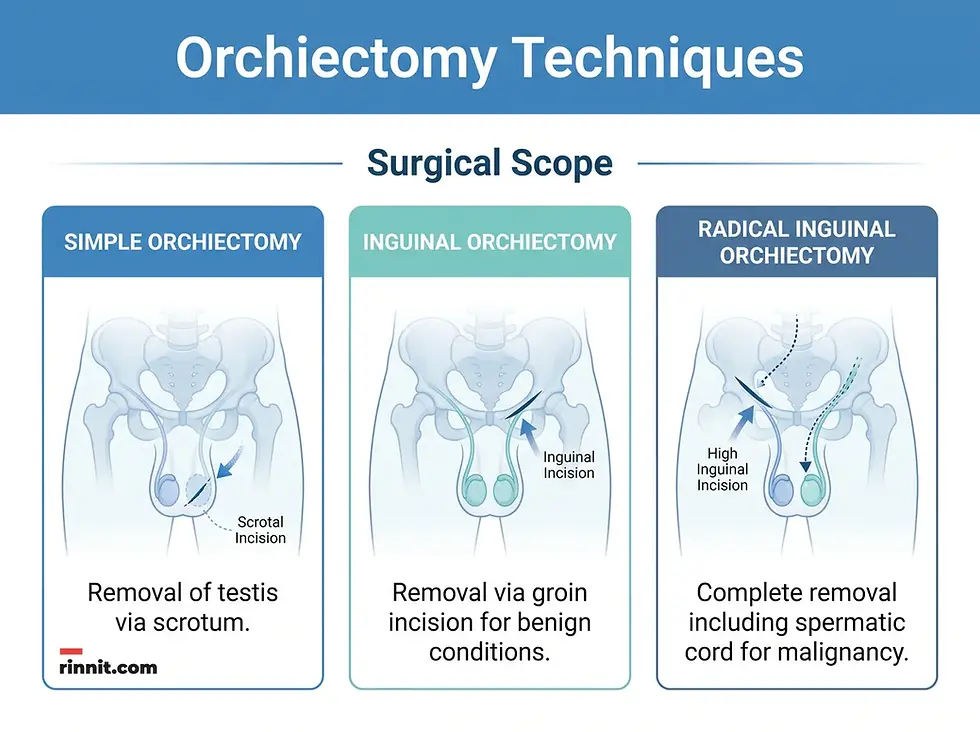
Simple | The testicle or testicles | The incision is made in the scrotum. |
Inguinal | The testicle or testicles | The incision is made in the pubic (groin) area. |
Radical inguinal | The testicle and the spermatic cord | Used when cancer is suspected. The cord holds blood vessels and nerves that cancer can use to spread. |
When Is an Orchiectomy Used?
An orchiectomy can affect some cancers hormonally, because removing the testicles lowers androgens such as testosterone, which encourage some cancer cells to grow, and some tumors shrink.
Condition | How an orchiectomy helps |
Testicular cancer | Removes the tissue that may contain cancer and lets a pathologist examine it to make an accurate diagnosis. It is both a diagnostic tool and a treatment. |
Prostate cancer | Lowers testosterone and other androgens that encourage some cancer cells to grow. It is used as part of a larger treatment strategy. |
Male breast cancer | Works the same way, by lowering the hormone levels that help some tumors grow and spread. |
Severe trauma | If a testicle damaged in a sports injury, motorcycle accident, or similar trauma cannot be repaired, it is removed and the surrounding tissue is stitched. |
Rare cases | An undescended testicle, or a testicle damaged by testicular torsion, may occasionally need to be removed. |
The effect on cancer is hormonal, so removing the testicles works as a form of hormone therapy. Androgens such as testosterone encourage some cancer cells to grow, and without the testicles, hormone levels drop and some tumors shrink. [1]
How does orchiectomy surgery work?
Orchiectomy is usually done under general anesthesia, with the surgeon removing the testicle through a scrotal or groin incision in a procedure that typically takes 30 to 60 minutes.
Preparation and Anesthesia
Orchiectomies are done at a surgical center or a hospital. Most commonly, providers use general anesthesia, so you are asleep for the procedure and feel no pain during surgery. You will need someone to drive you home afterward. [1]
What Happens During the Operation
Your surgeon cleans the area and makes an incision, in the scrotum for a simple orchiectomy or in the pubic area for an inguinal orchiectomy. The testicle is detached and removed. In a radical inguinal orchiectomy, the spermatic cord is removed too. If you choose a prosthetic testicle, your surgeon places it inside the scrotum. The prosthetic testicle is filled with salt water (saline). The incision is then closed with stitches. [1]
The whole procedure usually takes 30 to 60 minutes. After a short time in the recovery room, most people go home the same day. [1]
What is recovery and aftercare like after an orchiectomy?
The full recovery process usually takes several weeks, and you will need a follow-up visit with your healthcare provider. [1]
First 48 hours: Wear a scrotal support garment or supportive underwear to reduce swelling, and apply ice packs for 20 minutes at a time during the first day or two.
Activity: Wear loose-fitting clothes and take it easy for a few days. Avoid heavy lifting, running, strenuous exercise, and sex until the incision has healed completely, usually three to four weeks. Ask your provider when you can return to sports.
Incision care: Shower with soap and water and keep the area clean and dry. Do not swim or take a bath until your provider says it is OK, usually several weeks after surgery.
Pain: Over-the-counter acetaminophen or nonsteroidal anti-inflammatory drugs (NSAIDs) can help with pain and swelling. Ask your provider which is right for you.
Hydration and fiber: Drink plenty of water and eat fiber-rich foods to avoid constipation and straining during bowel movements.

What are the risks and side effects of an orchiectomy?
As with any surgery, the risks of testicle removal include bleeding and infection. You may also have swelling and pain, and blood can pool under the skin (a hematoma). The complications you may have depend on the type of surgery. [1]
Hormonal Changes
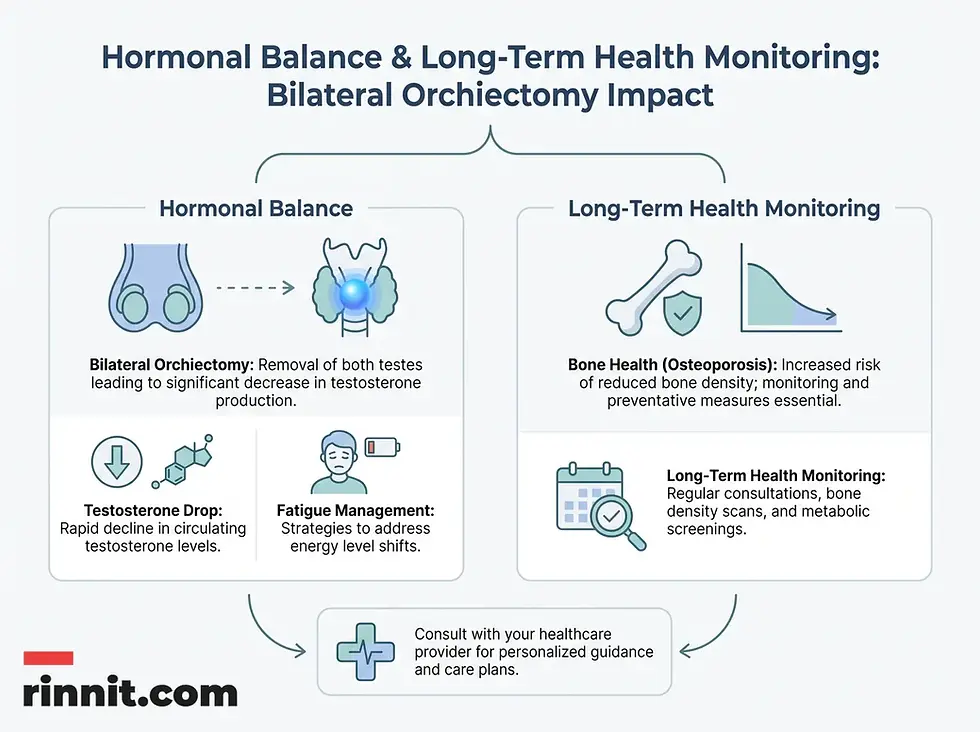
Some side effects come from lower hormone levels, mostly when both testicles are removed. A drop in testosterone levels and other male hormones can lead to: [1]
Low sex drive
Problems with sexual function, including erectile dysfunction
Fatigue
Hot flashes
Low muscle mass
Osteoporosis (weaker bones)
Depression
If you have hot flashes, fatigue, or sexual problems after surgery, talk to your healthcare provider about treatment options. Testosterone replacement is generally not used when the testicles were removed to treat prostate or breast cancer, because it can feed the cancer. Removing both testicles also stops sperm production, which causes infertility. [1]
Body Image and Emotions
This surgery can affect how you feel about yourself and about sex. It is normal to have these emotions after surgery. Your provider can recommend ways to cope, and a prosthetic testicle is an option some people choose. [1]
When should you contact your healthcare provider after an orchiectomy?
After testicle removal surgery, call your healthcare provider right away if you: [1]
Develop a fever or severe pain
Have problems urinating
Lose feeling or sensation in your scrotum
Notice redness near the incision or a purple spot on the scrotum, which could be blood pooling under the skin (a hematoma)
See blood or pus coming from the incision
What is the bottom line on orchiectomy?
An orchiectomy is a short, usually same-day surgery that plays a central role in diagnosing and treating testicular cancer and in treating prostate and male breast cancer. Most of the lasting effects come from lower testosterone after both testicles are removed, so follow-up and a conversation about hormone support matter. With good wound care and several weeks of rest from heavy activity, most people recover well. Your surgeon can explain which type of orchiectomy is right for your situation.
Frequently Asked Questions
Will I feel pain during the surgery?
No. The procedure is done under general anesthesia, so you will be asleep and will not feel pain. You may have some discomfort or tenderness during the first part of recovery at home.
Can I have a normal appearance after surgery?
Yes, in many cases. You can choose to have a saline-filled prosthetic testicle placed in the scrotum during the procedure. This helps maintain a natural appearance and can support self-image after surgery.
How long does the operation take?
The surgery is a relatively quick procedure and usually takes 30 to 60 minutes.
When can I go back to work?
Many people can return to light activities within a few days. Avoid heavy lifting and strenuous work for about three to four weeks so the incision can heal. Ask your healthcare provider what is safe for your job.
Does removing one testicle cause infertility?
Usually not. After removal of one testicle, the remaining testicle can typically produce enough sperm and hormones for normal function and fertility.
What happens if both testicles are removed?
Removing both testicles stops sperm production, which causes permanent infertility. It also causes a large drop in testosterone, which can lead to side effects such as low sex drive, fatigue, and hot flashes. Ask your healthcare provider about treatment options; testosterone replacement is generally avoided if the surgery treated prostate or breast cancer.
How do I manage swelling after surgery?
Wear supportive underwear or a special scrotal support garment for about the first 48 hours, and apply ice packs for 20 minutes at a time during the first day or two.
Can I shower after the procedure?
Yes, you can usually shower with soap and water, but keep the incision area clean and dry. Do not swim or take a bath until your healthcare provider says it is safe.
Why is the spermatic cord sometimes removed?
In a radical inguinal orchiectomy for suspected cancer, the spermatic cord is removed along with the testicle. The cord contains blood vessels and nerves and can be a pathway for cancer to spread to other parts of the body.
When should I be concerned during recovery?
Contact your healthcare provider right away if you develop a fever or severe pain, redness or a purple spot on the scrotum, blood or pus from the incision, loss of feeling in the scrotum, or trouble urinating.
How do I prepare for an orchiectomy?
Orchiectomies are done at a surgical center or a hospital, most commonly under general anesthesia, so you will need someone to drive you home afterward. Plan for a few days of taking it easy, with loose-fitting clothes and no heavy lifting, running, strenuous exercise or sex until the incision has healed, usually three to four weeks [1].
Related Reading
Prosthetic Testicle (Testicular Implant): Procedure and Recovery explains prosthetic testicles.
References
Cleveland Clinic. Orchiectomy. Cleveland Clinic. Medically reviewed; last updated January 24, 2024. https://my.clevelandclinic.org/health/procedures/orchiectomy
Boeri L, Passarelli F, Raffo M, et al. Decision regret about testicular prosthesis after radical orchiectomy: real-life data to improve preoperative patient counseling. Eur Urol Focus. 2025;11(6):1004-1011. PMID: 40545427. DOI: 10.1016/j.euf.2025.05.015
El Kaddouri H, Sideris S, Beirnaert J, et al. The impact of testicular prosthesis on cancer patients' intimacy and quality of sex life. Cureus. 2025;17(10):e93935. PMID: 41200660. DOI: 10.7759/cureus.93935
Friedrich NA, Janes JL, Parrish J, et al. Racial differences in adverse events after androgen deprivation in veterans with prostate cancer. JAMA Netw Open. 2025;8(11):e2545705. PMID: 41259022. DOI: 10.1001/jamanetworkopen.2025.45705
Medical disclaimer
This article is for general informational purposes only and is not a substitute for professional medical advice, diagnosis, or treatment. Always consult a qualified healthcare professional about your health.



Comments