Understanding the Scrotum: Anatomy, Function, and Health

Updated: 2 days ago
Medically reviewed by Dr. Baraa Alnahhal, MD · Last reviewed: October 17, 2026
Quick Answer
The scrotum is a thick-walled sac below the penis that contains the testicles, epididymis, and spermatic cords. [1] It has two functions: protecting the reproductive organs from external injury and regulating their temperature. [1] By moving the testicles closer to or further from the body, the scrotum maintains the environment for sperm development, which requires a few degrees below body temperature. [1]
What the research says
Tighter underwear raises scrotal temperature, but fertility effects look small. A 2026 narrative review found physiologic studies linking tighter underwear to higher scrotal temperatures and modest differences in semen parameters, while prospective data showed no differences in pregnancy outcomes; the authors concluded underwear choice alone is unlikely to meaningfully influence male fertility. (Zleczewski et al., Transl Androl Urol, 2026) [2]
Repairing a varicocele can improve IVF outcomes. In a meta-analysis of 9 observational studies, men who had varicocele repair before ICSI had higher fertilization (mean difference 10.9), clinical pregnancy (OR 1.38, 95% CI 1.07–1.78) and live-birth rates (OR 2.07, 95% CI 1.45–2.97), but no difference in pregnancy with intrauterine insemination (OR 1.01). (Palani et al., World J Mens Health, 2025) [3]
Torsion needs emergency care; manual detorsion is a clinician-performed first step in selected cases. Across 8 retrospective studies (670 patients), manual detorsion succeeded in a pooled 75.7% of cases, and orchiectomy rates were numerically lower than with immediate surgery (3.8% vs 29.2%), though the difference was not statistically significant (RR 1.23, 95% CI 0.82–1.84). (Kılıç, Can J Urol, 2026) [4]
The scrotum is easy to overlook until something goes wrong, yet it plays a central role in fertility and reproductive health. This guide explains what it does, how it is built, which conditions affect it, and how to look after it.
The Functional Role of the Scrotum
The scrotum is a specialized component of the male reproductive system designed for both defense and environmental regulation. Its external position between the upper thighs is a biological necessity for fertility. [1] The scrotal tissues provide a physical barrier for the testicles, while the entire structure operates as a thermal regulator. [1]
Feature | Primary function |
|---|---|
Protection | Surrounds and shields the testicles, glands, and blood vessels from trauma. |
Temperature regulation | Keeps the testicles a few degrees below body temperature to support sperm production. |
Support | Houses the epididymis and spermatic cords, which allow sperm to mature and be transported. |
Detailed Anatomy of the Scrotum
Anatomically, the scrotum is more than a simple sac. It is divided into two parts to support the paired reproductive organs. The perineal raphe, a visible crease down the center, corresponds to the internal scrotal septum that partitions the sac into two distinct compartments. [1]
Scrotal Layers and Muscles
The scrotal wall is approximately 8 mm thick and is made of skin and muscle. [1] The dartos fascia, a layer of smooth muscle, allows the skin to tighten or expand. [1] Working in tandem with the cremaster muscle, which surrounds the testicles and spermatic cord, these muscles adjust the position of the testicles in response to temperature changes. [1]
Internal Structures
Each side of the scrotum contains a highly organized network of reproductive and vascular components.
Component | Description |
|---|---|
Testicle | The primary gland that produces sperm (see how sperm are made) and secretes testosterone. |
Epididymis | A tightly coiled tube at the top of each testicle where sperm is stored until it matures. |
Spermatic cord | A bundle containing nerves, lymph vessels, blood vessels and the vas deferens. |
Vas deferens | The tube that carries mature sperm toward the urethra for ejaculation. |

Common Scrotal Conditions and Clinical Importance
While the scrotum is designed for protection, it is susceptible to various mechanical, inflammatory, and developmental issues. These range from minor fluid collections to surgical emergencies that need immediate attention. For a broader overview of lumps and swellings, see our guide to scrotal masses.
Structural and Vascular Issues
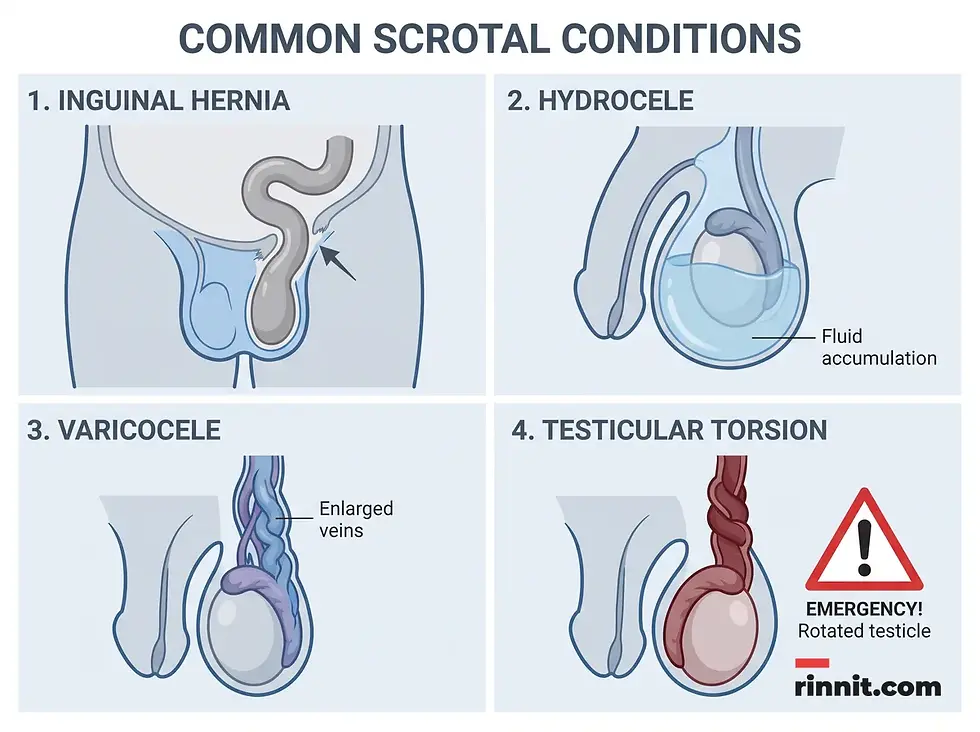
Inguinal hernia: abdominal tissues push through an opening in the abdominal wall into the scrotum [1] (see hernia repair surgery).
Hydrocele: fluid fills the scrotum, causing noticeable swelling [1] (see hydrocelectomy).
Varicocele: an enlarged vein or swollen collection of veins in the scrotum, [1] often described as feeling like a "bag of worms."
Spermatocele: a fluid-filled growth that forms on the epididymis. [1]
Inflammatory and Emergency Conditions
Testicular torsion: a critical emergency in which the testicle rotates, twisting the spermatic cord and cutting off blood supply (read more about testicular torsion).
Epididymitis and orchitis: inflammation of the epididymis or testicle, [1] often related to infection such as mumps or sexually transmitted infections.
Testicular cancer: cancerous cells develop in one or both testicles; [1] regular self-exams help you notice changes early (see testicular cancer and self-exams).
Proactive Care for Scrotal Health
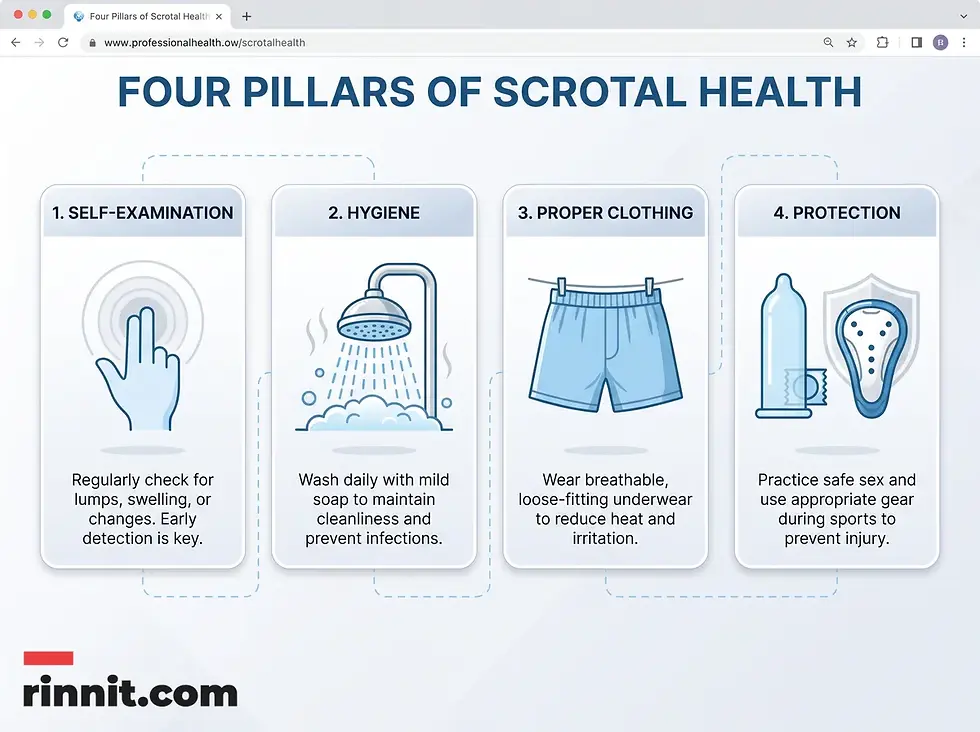
Maintaining scrotal health involves regular hygiene, self-monitoring, and lifestyle adjustments. Because the scrotum is sensitive to temperature and moisture, simple daily habits can prevent many common irritations and infections.
Safety and Maintenance Strategies
Pillar | Actionable step |
|---|---|
Self-examination | Perform monthly checks for lumps, swelling, or tenderness. |
Hygiene | Shower regularly and dry the area thoroughly to prevent fungal growth. |
Clothing | Wear loose, comfortable underwear to help keep scrotal temperature low. |
Protection | Use condoms during sexual activity and wear protective gear during sports. |
Conclusion
The scrotum is an indispensable component of the male reproductive system, providing both a physical shield and a thermal regulator for the testicles. By housing the machinery of sperm production and hormone secretion, it plays a central role in fertility and overall well-being. Recognizing the signs of common conditions and practicing consistent proactive care are the most effective ways to protect long-term health.
When to See a Healthcare Professional
If you experience sudden pain, unusual swelling, or a persistent feeling of heaviness in the scrotal area, do not delay in seeking medical advice. Sudden severe pain can be a sign of testicular torsion and needs emergency care. Early intervention for conditions like torsion or cancer is vital for successful outcomes.
Frequently Asked Questions
1. What is the main purpose of the scrotum?
The scrotum protects the testicles and keeps them a few degrees cooler than the rest of the body to support healthy sperm production.
2. Why does the scrotum hang outside the body?
The scrotum hangs externally to maintain a temperature slightly lower than the rest of the body, which helps regulate sperm production.
3. What is the perineal raphe?
The perineal raphe is the visible line or crease down the center of the scrotum that divides it into two halves.
4. How thick is the scrotal wall?
On average, the scrotum is about 8 mm thick.
5. What muscles control the scrotum?
The dartos fascia and cremaster muscles help move the testicles toward or away from the body and tighten or expand the scrotal skin.
6. Is a hydrocele dangerous?
Most hydroceles do not require treatment unless they become large or painful.
7. What is testicular torsion?
Testicular torsion is a medical emergency in which the testicle rotates, cutting off its blood supply, nerve function and sperm transport.
8. How often should I perform a self-exam?
A testicular self-exam is recommended once a month.
9. Can tight clothing affect the scrotum?
Tight clothing can raise scrotal temperature, which is why loose underwear is recommended; research suggests underwear choice alone is unlikely to have a large effect on fertility.
10. What causes a varicocele?
A varicocele is an enlarged vein or swollen collection of veins within the scrotum.
11. What is the epididymis?
The epididymis is a tightly coiled tube at the top of each testicle where sperm is stored until it matures.
12. Can infections cause scrotal swelling?
Yes. Infections can cause inflammation of the epididymis (epididymitis) or the testicle (orchitis, which is typically related to mumps).
13. What should I do if I find a lump?
Contact a healthcare provider for an evaluation.
14. Is scrotal skin different from other skin?
Yes. It is thick, highly elastic and lined with a smooth muscle (the dartos fascia) that tightens and expands the skin.
15. What is an inguinal hernia?
An inguinal hernia occurs when abdominal tissue, such as fat or a loop of intestine, pushes through a weak spot in the abdominal wall, sometimes into the scrotum.
Related Reading
Testicles: Anatomy, Essential Functions, and Care describes the organs held inside the scrotum and how to care for them.
Scrotal Masses Guide: Symptoms, Causes, Diagnosis, and Treatment explains lumps and swelling in the scrotum and how they are checked.
Testicular Torsion: Symptoms, Causes, Diagnosis and Treatment — What You Need to Know covers the twisted testicle emergency that needs care right away.
Hydrocele: A Clear Guide to Symptoms, Causes, and Treatment explains fluid buildup around the testicle and when it is treated.
References
Cleveland Clinic. Scrotum: Anatomy & Function. Cleveland Clinic. Last updated March 27, 2024. https://my.clevelandclinic.org/health/body/scrotum
Zleczewski M, et al. Garment fit, scrotal thermoregulation, and male fertility outcomes: a narrative review. Translational Andrology and Urology. 2026;15(5):184. PMID 42293842. https://doi.org/10.21037/tau-2026-1-0139
Palani A, et al. Impact of Varicocele Repair on Assisted Reproductive Technique Outcomes in Infertile Men: A Systematic Review and Meta-Analysis. The World Journal of Men's Health. 2025;43(2):344-358. PMID 39344117. https://doi.org/10.5534/wjmh.240132
Kılıç S. Effectiveness of manual detorsion in the treatment of testicular torsion: systematic review and meta-analysis. The Canadian Journal of Urology. 2026;33(3):505-514. PMID 42415571. https://doi.org/10.32604/cju.2025.072049
Medical disclaimer
The information provided in this article is for educational purposes only and is not intended as medical advice. Always seek the guidance of a qualified healthcare professional regarding any medical condition or treatment.



Comments