Scrotal Masses Guide: Symptoms, Causes, Diagnosis, and Treatment

Updated: 2 days ago
Medically reviewed by Dr. Baraa Alnahhal, MD · Last reviewed: September 2026
TL;DR: A scrotal mass is a lump or swelling in the scrotum, the pouch of skin holding the testicles. It can be caused by nine conditions — including fluid buildups, inflamed tissue, a hernia, and testicular cancer — and some masses cause pain while others cause none at all. Sudden scrotal pain is an emergency that needs care right away to prevent permanent damage. Most other masses need a medical check even if they do not hurt, because a diagnosis depends on an exam, an ultrasound, and sometimes blood and urine tests. Treatment depends entirely on the cause, and most early testicular cancers can be cured.
Quick Answer
What it is: A lump or swelling in the scrotum, caused by fluid buildup, irregular tissue growth, or swollen and inflamed tissue inside the scrotum.
Possible causes: nine conditions, including testicular cancer, spermatocele, epididymitis, orchitis, hydrocele, hematocele, varicocele, inguinal hernia, and testicular torsion.
The emergency sign: sudden pain in the scrotum — some problems must be treated right away to prevent permanent damage to a testicle.
How it's diagnosed: a physical exam, transillumination, ultrasound, and urine and blood tests; a CT scan is added if cancer is found.
Treatment in one line: it depends on the cause — antibiotics for bacterial infection, sometimes no treatment for benign masses, and surgery (with chemotherapy or radiation if cancer has spread) for testicular cancer.
What This Guide Is Based On
This guide is built entirely from specialist-reviewed clinical guidance updated in August 2023, supported by the American Family Physician review of scrotal masses (2022), UpToDate overviews of painless and painful scrotal swelling in children and of nonacute scrotal conditions in adults, the American Cancer Society's testicular cancer resources, the Urology Care Foundation's patient education materials, Grainger & Allison's Diagnostic Radiology (7th ed., 2021), and Rosen's Emergency Medicine: Concepts and Clinical Practice (10th ed., 2023). These peer-reviewed and institution-backed references are cited inline throughout, with the full list at the end of this guide.
What Is a Scrotal Mass?
A scrotal mass is a lump or swelling in the scrotum, the pouch of skin that holds the testicles. The mass might be a buildup of fluids, the growth of irregular tissue, or swollen, inflamed, or hardened parts inside the scrotum.
Here is the point that matters most: every scrotal mass should be checked by a healthcare professional, even if there is no pain or other symptoms. Some masses could be cancer, and others could be caused by a different condition that affects the health of the testicles and how well they work.

What a scrotal mass is, what causes one, and who is at higher risk: the ways a mass forms, the nine possible causes from benign cysts to testicular torsion, and the risk factors of an undescended testicle, birth conditions, and family history.
Checking your scrotum for changes once a month, and getting the area checked during regular health checkups, helps spot masses early — when many treatments work better.
What Are the Signs and Symptoms?
Symptoms of scrotal masses vary. Some causes produce pain and others do not — it depends on the underlying condition. A scrotal mass might cause an unusual lump, sudden pain, a dull ache or a feeling of heaviness in the scrotum, or pain that spreads across the groin, stomach area, or lower back. The testicle or the epididymis — the soft, comma-shaped tube above and behind the testicle that stores and transports sperm — may be tender, swollen, or hardened. Swelling in the scrotum and a change in the color of the scrotal skin can also occur, along with an upset stomach or vomiting.
If an infection is the cause, additional symptoms may include a fever, the need to urinate often, and pus or blood in the urine.
Unusual lump — The most direct sign of a scrotal mass
Sudden pain — An emergency warning — needs immediate care
Dull ache or heaviness — A common, painless-form sign that can go unnoticed
Pain spreading to groin, abdomen, or lower back — Pain is not always confined to the scrotum
Tender, swollen, or hardened testicle or epididymis — Often points to inflammation or infection
Swelling in the scrotum — Common with fluid-related causes
Change in scrotal skin color — A visible change worth reporting
Upset stomach or vomiting — Can accompany painful conditions such as torsion
Fever, frequent urination, pus or blood in urine — Suggests infection as the cause

The possible signs and symptoms of scrotal masses, when to seek emergency care versus a routine checkup, and the complications that can follow an untreated mass.
When Should You See a Doctor?
The clearest rule is this: get emergency medical care if you have sudden pain in your scrotum. Some problems need to be treated right away to prevent permanent damage to a testicle.
For anything less urgent, see a healthcare professional if you notice a lump or any other unusual change — and get the checkup even if the mass does not hurt. Some masses are more common in children, so a child with symptoms, any genital concerns, or a "missing" testicle should be seen by a pediatrician. A testicle that never moved down into the scrotum before birth is called an undescended testicle, and it may raise the risk of some scrotal masses later in life.
What Causes a Scrotal Mass?
Nine conditions can cause a scrotal mass or an unusual change in the scrotum, and they range from everyday to serious:
Testicular cancer — Cancer that starts in the testicles. Often a painless lump or swelling; some people have no symptoms at all.
Spermatocele — A fluid-filled sac, often above the testicle (also called a spermatic or epididymal cyst). Tends to be painless and usually not cancer.
Epididymitis — Inflammation of the epididymis, the coiled tube at the back of the testicle. Often bacterial — for example, chlamydia passed through sex — and less often viral.
Orchitis — Inflammation of the testicle, with pain and swelling. Usually viral, most often mumps.
Hydrocele — Extra fluid collects between the layers of the sac surrounding each testicle. Painless swelling; in adults often from injury or infection; in babies from an opening that never closed.
Hematocele — Blood builds up between the layers of the sac around the testicle. Most often caused by injury, such as a direct hit to the testicles.
Varicocele — The veins inside the scrotum enlarge. More common on the left side; can cause infertility.
Inguinal hernia — Part of the small intestine pushes through a weak spot between the abdomen and groin. Appears as a mass in the scrotum or higher in the groin.
Testicular torsion — The spermatic cord twists, cutting off blood to the testicle. Painful and an emergency; without prompt treatment the testicle can be lost.
The infection-based causes deserve one distinction. Epididymitis is most often caused by bacteria — including bacterial infections spread through sex such as chlamydia — while orchitis is usually due to a virus, most often mumps.
Who Is Most at Risk?
Three factors raise the risk of a scrotal mass:
Undescended testicle — The testicle did not move down into the scrotum before birth or in the months afterward
Conditions present at birth — Irregular changes in the testicles, penis, or kidneys at birth may raise the risk of a scrotal mass and testicular cancer later in life
History of testicular cancer — Cancer in one testicle raises the risk in the other; having a parent or sibling with testicular cancer also raises risk
What Are the Possible Complications?
Not every scrotal mass leads to a long-term medical condition. But any mass that affects the health or function of the testicle can result in delayed or poor development during puberty, and in infertility.
How Is a Scrotal Mass Diagnosed?
Diagnosis starts with a physical exam: a doctor or healthcare professional feels the scrotum, its contents, and the nearby groin area while you stand and lie down. A few simple tests then help identify what kind of mass it is.
Physical exam — The feel of the scrotum, its contents, and the nearby groin while standing and lying down
Transillumination — Shining a bright light through the scrotum reveals the size, location, and makeup of the mass
Ultrasound — Sound waves create a detailed image of the mass and the condition of the testicles; often needed to diagnose a scrotal mass
Urine test — Lab analysis may find a viral or bacterial infection and detect blood or pus in the urine
Blood test — May find an infection, or detect higher levels of certain proteins linked with testicular cancer
CT scan — If other tests show testicular cancer, a CT of the chest, abdomen, and groin checks whether the cancer has spread
How Is a Scrotal Mass Treated?
Treatment of a scrotal mass depends mainly on its cause. Three broad paths apply.
For infections, antibiotics treat a mass caused by bacteria, as is often the case with epididymitis. If a virus causes epididymitis or orchitis, the usual treatment involves rest, ice, and pain-relief medicine.
For masses that are not cancer — often called benign masses — treatment is not always necessary. When treatment is needed, the mass may be removed with surgery, repaired, or drained. The decision depends on whether the mass causes discomfort or pain, contributes to or raises the risk of infertility, or becomes infected.
For testicular cancer, you will likely see an oncologist. The main treatment choices depend on whether the cancer is confined to the testicle or has spread, along with your age and overall health.
Radical inguinal orchiectomy — Surgery to remove the affected testicle and the spermatic cord through a cut in the groin; lymph nodes in the abdomen may also be removed if cancer has spread. Used as the main treatment for testicular cancer.
Chemotherapy — Powerful chemicals, most often through a vein, kill cancer cells. Used to cure cancer that has spread beyond the testicle and to lower the chance of return after surgery; not used for cancer only in the testicle.
Radiation therapy — High-dose X-rays or other high-energy radiation kills cancer cells or slows their growth. Mainly used to destroy cancer cells that have spread to the lymph nodes, often after surgery.
There is real reason for reassurance here: most cases of early testicular cancer can be cured, and even if the disease spreads beyond the testicle, it may still be curable. Follow-up care is needed to watch for signs that the cancer has come back.
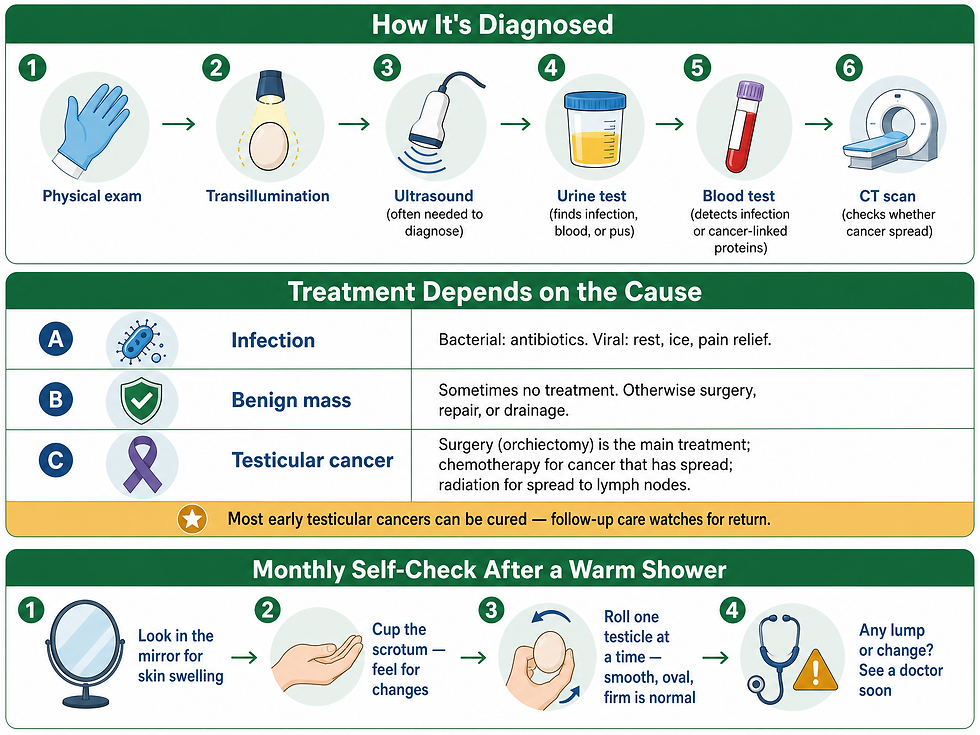
How a scrotal mass is diagnosed and treated, and the monthly self-exam routine: the diagnostic steps, the treatment paths by cause, and the self-check steps after a warm shower.
What Self-Care and Home Measures Help?
A monthly testicular self-exam can help you find a scrotal mass early. The timing matters: do the exam after a warm bath or shower, because the heat relaxes the scrotum and makes it easier to check. This monthly routine is especially important if you have had testicular cancer or if a blood relative — such as your father or brother — has had it.
The steps are simple. Stand in front of a mirror and look for swelling on the skin of the scrotum. Cup the scrotum with one hand to see whether it feels different than usual. Then check one testicle at a time using both hands: place the index and middle fingers under the testicle and the thumbs on top, and gently roll the testicle between your thumbs and fingers to feel for lumps. The testicles are usually smooth, oval shaped, and somewhat firm, and one is often slightly larger than the other. Finally, feel along the epididymis — the soft, comma-shaped structure above and behind the testicle — to check for swelling. If you find a lump or any other unusual change, seek medical care as soon as you can.
How Should You Prepare for Your Appointment?
If you find a scrotal mass, you will likely start with your doctor and may be referred to a urologist, the specialist who treats urinary tract and male genital conditions. Preparing helps you make the most of the visit.
Write down your symptoms, including any that seem unrelated to a scrotal mass. Bring your key personal information, the medicines, vitamins, and supplements you take, your family history of testicular cancer or scrotal problems, and your personal medical history — including any previous scrotal masses, an undescended testicle, or genital conditions present at birth. Prepare questions for the care team, such as what tests you will need, how long results take, what happens next if the mass is cancerous, and whether treatment is needed if it is not.
Expect questions in return. The clinician will likely ask when you found the lump, whether you have pain or fever, whether there is blood or pus in your urine, any recent groin injury, what makes symptoms better or worse, whether an undescended testicle was corrected with surgery, and whether you have had a sexually transmitted infection or have new or multiple sex partners.
Conclusion: Every Lump Deserves a Check
A scrotal mass can be many things — a harmless fluid-filled cyst, an infection, a hernia, an emergency, or, in some cases, cancer. The signs range from a painless lump and a dull heaviness to sudden, severe pain that demands emergency care. Because the cause cannot be judged by feel alone, the path forward is straightforward: get any lump checked, let an exam, an ultrasound, and simple lab tests do the diagnosing, and follow the treatment that matches the cause. Most early testicular cancers can be cured, and the same early attention protects fertility and the health of the testicles. A monthly self-check after a warm shower takes only a minute — and it is the habit that catches problems early, when treatments work best.
If you notice a new lump, sudden pain, or any unusual change, talk to a healthcare professional right away. For more evidence-based guidance, explore our guides on men's health, sexual health, and cancer.
This guide is for general education only and is not a substitute for professional medical advice, diagnosis, or treatment. Always seek the advice of a qualified healthcare provider with any questions about a medical condition.
Frequently Asked Questions
What is a scrotal mass, in simple terms?
A scrotal mass is a lump or swelling in the scrotum, the pouch of skin holding the testicles. It may be a buildup of fluids, a growth of irregular tissue, or swollen, inflamed, or hardened tissue inside the scrotum.
Is a scrotal mass always cancer?
No. Nine different conditions can cause a scrotal mass — including painless fluid-filled cysts (spermatocele), extra fluid around the testicle (hydrocele), inflamed tissue from infection, enlarged veins, and hernias — and many are not cancer. But because some masses can be cancer, every new lump should be checked.
When is a scrotal mass an emergency?
When it causes sudden pain. Sudden scrotal pain can signal a problem such as testicular torsion, which cuts off blood to the testicle and must be treated right away to prevent permanent damage.
Can a scrotal mass be painless?
Yes, and that is precisely why painless lumps still need a checkup. Testicular cancer often causes a painless lump or swelling, and some people with it have no symptoms at all.
How will a doctor find out what my lump is?
With a physical exam, transillumination (shining a bright light through the scrotum), and usually an ultrasound, plus urine and blood tests to check for infection or cancer-linked proteins. If cancer is found, a CT scan checks whether it has spread.
Do all scrotal masses need treatment?
No. Benign masses sometimes need no treatment at all. Treatment — surgery, repair, or drainage — is considered when a mass causes discomfort, contributes to or raises the risk of infertility, or becomes infected.
How is a bacterial infection treated compared to a viral one?
A bacterial cause, as with most epididymitis, is treated with antibiotics. A viral cause, as with orchitis, is usually managed with rest, ice, and pain-relief medicine.
How do I check my testicles at home?
Once a month, after a warm bath or shower, stand in front of a mirror and look for skin swelling, cup the scrotum to feel for changes, then gently roll one testicle at a time between your thumbs and fingers. Testicles are normally smooth, oval, and somewhat firm. Any lump or unusual change should be checked by a healthcare professional as soon as possible.
References
[1] Scrotal masses — Symptoms & causes (updated August 4, 2023)
[2] Scrotal masses — Diagnosis & treatment (updated August 4, 2023)
Additional references consulted
Langan R, et al. Scrotal masses. American Family Physician. 2022.
Brenner JS, et al. Causes of painless scrotal swelling in children and adolescents. UpToDate. Accessed Jan. 18, 2023.
Brenner JS, et al. Causes of scrotal pain in children and adolescents. UpToDate. Accessed Jan. 18, 2023.
Eyre RC. Nonacute scrotal conditions in adults. UpToDate. Accessed Jan. 18, 2023.
American Cancer Society: Signs and symptoms of testicular cancer; Risk factors for testicular cancer; Surgery, chemotherapy, and radiation therapy for testicular cancer
Urology Care Foundation: What is testicular cancer? and What is testicular self-examination?
Andreas A, et al., eds. The male reproductive structures. In: Grainger & Allison's Diagnostic Radiology. 7th ed. Elsevier; 2021.
Walls RM, et al., eds. Urologic disorders. In: Rosen's Emergency Medicine: Concepts and Clinical Practice. 10th ed. Elsevier; 2023.
Comments