Gadolinium Contrast for MRI: How It Works, Side Effects and Kidney Safety

Updated: 2 days ago
Written and medically reviewed by Dr. Baraa Alnahhal, MD · Last reviewed: November 2026 · How we review
Quick Answer
Gadolinium contrast is a dye given through an IV during an MRI to make blood vessels, inflammation, abnormal tissues and tumors show up more clearly. Healthy kidneys remove it within 24 hours. Most people have no or mild side effects, and serious allergic reactions are rare. If you have severe kidney disease, tell your care team beforehand.
What the research says
The kidney risk with modern agents is very low: a meta-analysis of 16 studies with 4,931 people with stage 4 or 5 chronic kidney disease who received a group II gadolinium agent found no cases of nephrogenic systemic fibrosis, putting the risk at likely less than 0.07% (Woolen SA et al., JAMA Internal Medicine, 2020) [2]
Reactions in children are rare: across 32 studies covering 112,760 contrast MRI exams in children, acute allergic-like reactions occurred in 0.13% and physiologic reactions such as nausea in 0.25%, with delayed reactions in 0.04% and no cases of nephrogenic systemic fibrosis (Yu OJ et al., Radiology, 2025) [3]
Key takeaways
A contrast dye injected into a vein during an MRI to highlight blood vessels, inflammation and tumors.
The injection takes under 20 seconds; healthy kidneys clear it within about 24 hours.
Common mild effects: metallic taste, warmth, tiredness, headache, nausea or IV-site soreness.
Allergic-like reactions are rare (about 1 in 1,000 or fewer).
Tell your care team about kidney disease, pregnancy, breastfeeding and past contrast reactions.
What is gadolinium contrast?
An MRI uses a magnet and radio waves to create detailed pictures. Gadolinium is a metal with magnetic properties that change how nearby tissues appear on MRI, making them brighter. On its own, gadolinium would be toxic, so it's tightly bound to a carrier molecule called a chelating agent. Different brands use different chelators, and newer "group II" agents are more stable and safer. Sources: [1, 2]
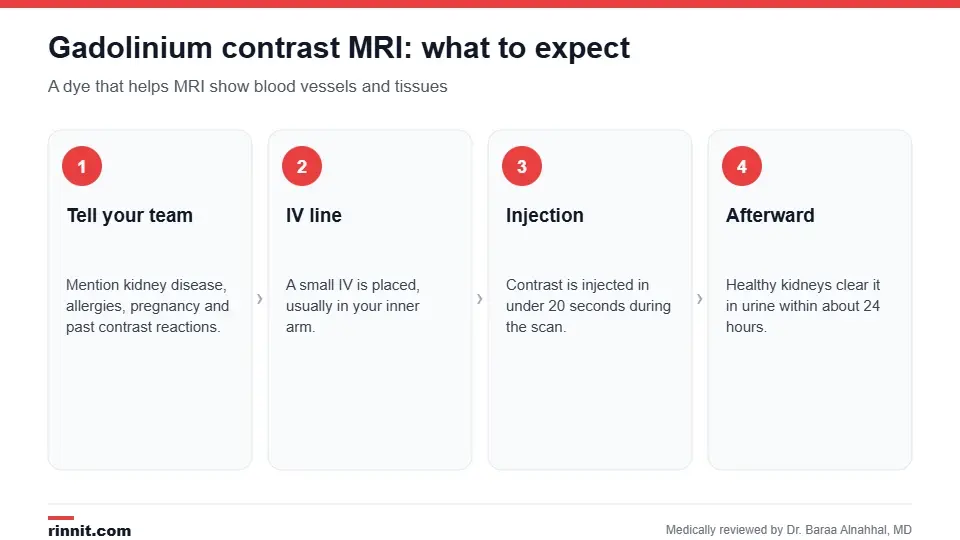
Gadolinium contrast is given during the MRI.
Why is it used?
Contrast helps the radiologist see details that a standard MRI may miss, such as: Sources: [1]
Blood vessels and blood supply to tissues.
Inflammation and infection.
Tumors and other abnormal tissues, such as on a brain MRI or breast MRI.
Scarring and blood flow in the heart on a cardiac MRI.
How do I prepare?
Tell your provider about kidney disease, past reactions to contrast, allergies and asthma.
Tell them if you are or might be pregnant, or are breastfeeding.
Your provider may check your kidney function with a blood test such as eGFR if you have kidney disease or risk factors.
Remove metal objects and follow the usual MRI safety screening. Sources: [1]
What happens during the scan?
A small IV line is placed in a vein, usually in your inner arm.
The MRI begins with images taken without contrast.
The contrast is injected, taking less than 20 seconds; you may feel cool or warm.
More images are taken as the contrast circulates. Sources: [1]
Afterward, drink plenty of water to help your kidneys flush out the contrast. Your urine may look brighter for a short time. Results usually come from your provider within three to four days. Sources: [1]
Side effects
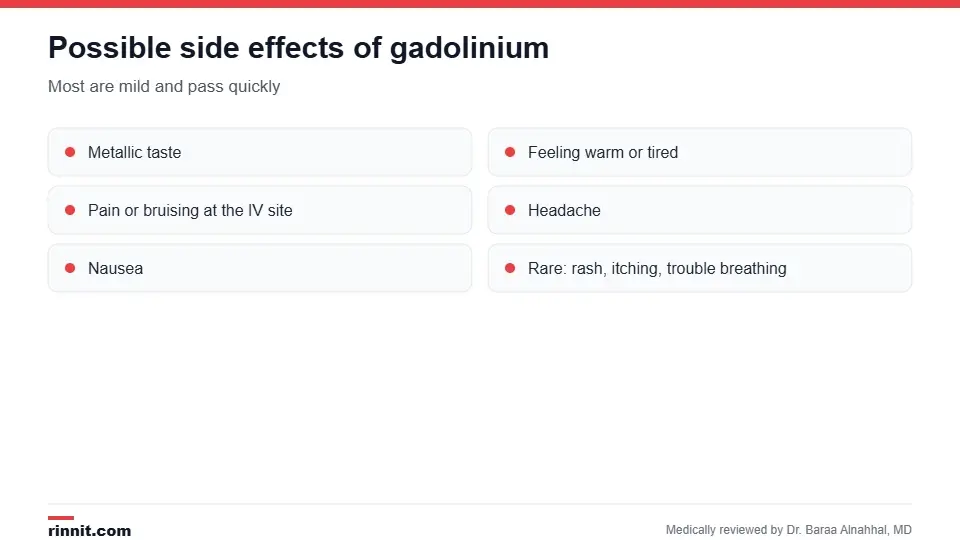
Most side effects are mild and short-lived.
Common and mild: metallic taste, feeling warm or tired, pain or bruising at the injection site, headache and nausea.
Rare but serious: trouble breathing or swallowing, rash, hives, itching or other skin reactions. Call your provider or get emergency help right away if these occur. Sources: [1, 3]
Kidney disease and NSF

Gadolinium contrast has a strong safety record.
If your kidneys don't work well, gadolinium clears more slowly and can build up in the brain, bones and skin. In people with severe kidney disease, older agents were linked to nephrogenic systemic fibrosis (NSF), a rare condition that makes skin, muscles and organs thick and stiff. With modern group II agents, the risk appears extremely low, less than 0.07% even in severe chronic kidney disease. Your care team weighs these risks against the value of the scan. Sources: [1, 2]
Conclusion
Gadolinium contrast makes MRI scans clearer and more useful, with a strong safety record. Mild, brief side effects are common; serious reactions are rare. Tell your care team about kidney disease, allergies and pregnancy, drink water afterward and report any rash or breathing trouble right away.
Keep learning: read about MRI scans and contrast-associated kidney injury.
Frequently asked questions
What is gadolinium contrast used for?
To make blood vessels, inflammation and tumors easier to see on an MRI.
How is it given?
Through an IV in your arm, in less than 20 seconds during the scan.
How long does gadolinium stay in the body?
Healthy kidneys remove it within about 24 hours.
What are the common side effects?
Metallic taste, warmth, tiredness, headache, nausea or IV-site soreness.
How common are allergic reactions?
Rare; about 0.13% of contrast MRI exams in children had allergic-like reactions.
Is gadolinium safe with kidney disease?
Modern agents carry a very low risk, but tell your provider so they can weigh the benefits.
What is NSF?
Nephrogenic systemic fibrosis, a rare condition causing thick, stiff tissues, seen mainly with older agents in severe kidney disease.
Can I have gadolinium if I'm pregnant?
It's usually avoided unless essential; tell your provider if you are or might be pregnant.
Is it the same as CT contrast?
No. CT contrast is iodine-based; MRI contrast uses gadolinium.
Should I drink water afterward?
Yes. It helps your kidneys clear the contrast.
Related Reading
Intraoperative MRI (iMRI): MRI Scans During Brain Surgery explains MRI scanning during surgery to check tumor removal.
Contrast-Enhanced Ultrasound (CEUS): Uses, Safety and What to Expect explains the microbubble ultrasound that shows blood flow without radiation.
MRI (Magnetic Resonance Imaging): Uses, What to Expect, Safety and Results the scan that uses gadolinium contrast.
Brain MRI: Why It's Done, How to Prepare and What to Expect a common MRI that often uses contrast.
Breast MRI: Why It's Done, What to Expect and How It Compares to a Mammogram a contrast MRI used for breast cancer.
Contrast-Associated Acute Kidney Injury (CA-AKI): Symptoms, Causes, Diagnosis and Treatment — What You Need to Know kidney injury linked to contrast agents.
Chronic Kidney Disease: What It Is, Its 5 Stages, Causes, and How It's Treated the condition that affects how contrast is cleared.
References
Cleveland Clinic. Gadolinium Contrast MRI Agent. Cleveland Clinic. Last updated December 22, 2025. https://my.clevelandclinic.org/health/diagnostics/gadolinium-contrast
Woolen SA, Shankar PR, Gagnier JJ, et al. Risk of nephrogenic systemic fibrosis in patients with stage 4 or 5 chronic kidney disease receiving a group II gadolinium-based contrast agent: a systematic review and meta-analysis. JAMA Intern Med. 2020;180(2):223-230. PMID 31816007. https://doi.org/10.1001/jamainternmed.2019.5284
Yu OJ, Kim PH, Yoon HM, et al. Safety of gadolinium-based contrast agents in children: a systematic review and meta-analysis. Radiology. 2025;316(1):e241224. PMID 40728401. https://doi.org/10.1148/radiol.241224
Medical disclaimer
This article is for general education only and does not replace advice from a qualified healthcare professional. Talk to your doctor about your own diagnosis and treatment, and seek emergency care right away for severe or sudden symptoms.



Comments