Contrast-Associated Acute Kidney Injury (CA-AKI): Symptoms, Causes, Diagnosis and Treatment — What You Need to Know

Updated: 2 days ago
Medically reviewed by Dr. Baraa Alnahhal, MD · Last reviewed: September 2026
Quick Answer: Contrast-associated acute kidney injury (CA-AKI) is sudden kidney damage that occurs within two days of receiving a contrast dye — the special fluid injected into a vein to make blood vessels and organs easier to see on imaging tests such as CT scans. It is rare, and for most people the damage is not permanent. The people at greatest risk are those with severe chronic kidney disease (stages 4 and 5), diabetes along with kidney disease, congestive heart failure, high blood pressure, low body fluid levels, or NSAID use on top of one of these. If you are at risk, your provider may check a blood marker called eGFR, offer IV fluids, limit the dye, or suggest imaging tests that do not use contrast.
What Is Contrast-Associated Acute Kidney Injury?
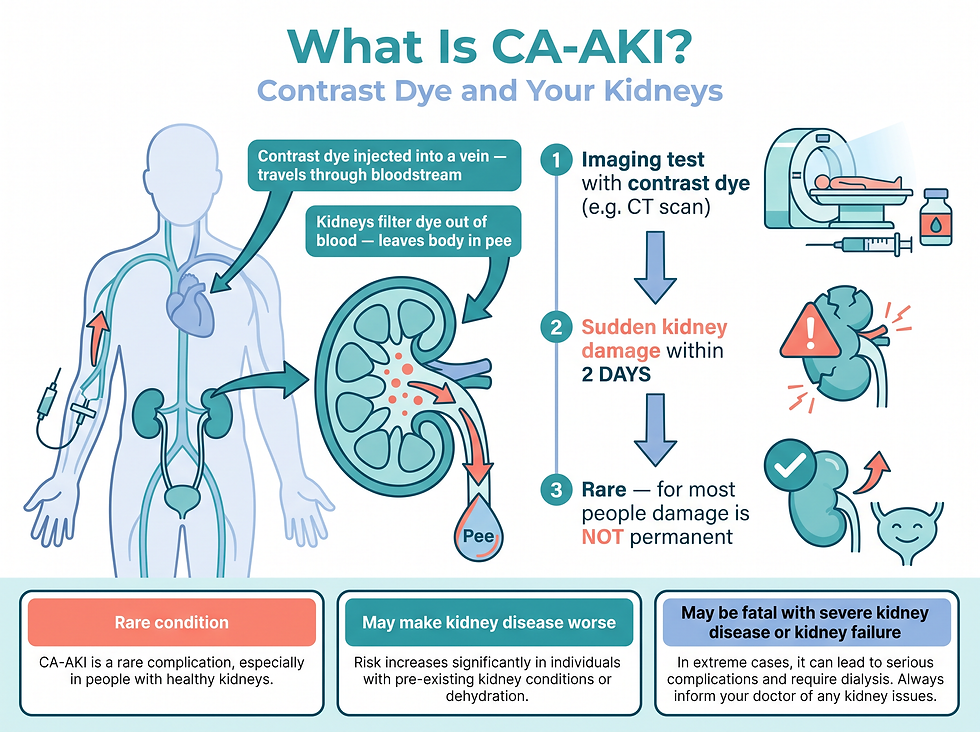
Contrast-associated acute kidney injury is when sudden kidney damage occurs within two days of receiving a contrast dye.
Contrast dye (iodinated contrast or iodine contrast medium) is a special fluid healthcare providers use. It helps make parts of your body — like blood vessels and organs — easier to see on imaging tests like CT scans. Contrast dye also makes it easier and safer for providers to perform certain procedures, including heart surgeries. Providers use a needle to inject it into a vein, and it travels through your bloodstream. Your kidneys eventually filter it out of your blood. It leaves your body in your pee.
For most people, contrast dye is safe. But some experts have concerns that it may cause contrast-associated acute kidney injury (CA-AKI). CA-AKI is a rare but serious condition that may cause chronic kidney disease (CKD) or make CKD worse. It may be fatal if you have severe CKD or kidney failure.
Contrast-associated acute kidney injury is a rare condition in which the contrast dyes in some imaging tests damage your kidneys. In most people, the damage isn't permanent. But if you have kidney problems, it can permanently affect how well your kidneys work. If you're at risk, your providers may suggest other types of imaging tests. To learn more about sudden kidney damage in general, see our guide to acute kidney injury.
You may also see CA-AKI referred to by older names. These generally describe the same condition.
Older name | What it stands for |
Contrast-induced nephropathy (CIN) | "Nephropathy" means kidney damage |
Contrast-induced acute kidney injury (CI-AKI) | Same condition, older phrasing |
Contrast-associated nephropathy | Same condition, older phrasing |
Post-contrast acute kidney injury (PC-AKI) | Emphasizes that it follows contrast exposure |
TL;DR — The Short Version
Contrast dye is a fluid injected into a vein to improve the visibility of blood vessels and organs on imaging tests like CT scans. For most people it is safe, and the kidneys filter it out of the blood naturally. In rare cases, the dye triggers sudden kidney damage within two days — a condition called CA-AKI. The risk is concentrated in people who already have kidney problems, especially severe chronic kidney disease, diabetes with kidney disease, heart failure, high blood pressure, or low body fluid levels. Most people who develop CA-AKI recover within about two weeks. Prevention is the main strategy: a blood test (eGFR) before the test, IV fluids, lower dye doses, alternative dyes, or imaging that does not use contrast.
"No matter how small the risk, it can be scary to learn that an imaging test may affect your kidneys. Your healthcare providers will do everything they can to reduce the odds of contrast-associated kidney injury. If you have a greater risk, they may pre-treat you. They may also suggest other types of imaging tests." — the reviewed medical source on CA-AKI
When Should You Talk to Your Provider About Contrast Dye and Your Kidneys?
This is a prevention-focused conversation, best held before your imaging test — not after a problem appears. Speak with your healthcare team in these situations.
Situation | What to discuss |
You have been told you need a CT scan or procedure using contrast dye | Ask whether the test is necessary and whether contrast-free alternatives exist |
You have chronic kidney disease, especially stages 4 and 5 | Ask for an eGFR blood test beforehand and about pre-treatment options such as IV fluids |
You have diabetes plus kidney disease, congestive heart failure, or high blood pressure | These raise your CA-AKI risk — make sure your team knows your full history |
You regularly use NSAIDs (ibuprofen, naproxen) and have one of the conditions above | NSAID use increases risk; ask whether to stop any medications before or after the test |
You recently received contrast dye | Schedule follow-up blood tests to confirm your kidneys are functioning as expected |
You develop CKD symptoms after a contrast study | Reduced urination, swelling, fatigue, confusion, flank pain, or chest pain deserve prompt evaluation |
How Does Contrast Dye Affect the Kidneys?
Contrast dye travels through your bloodstream after being injected into a vein. Your kidneys eventually filter it out of your blood, and it leaves your body in your pee.
What Are the Early Symptoms of CA-AKI?
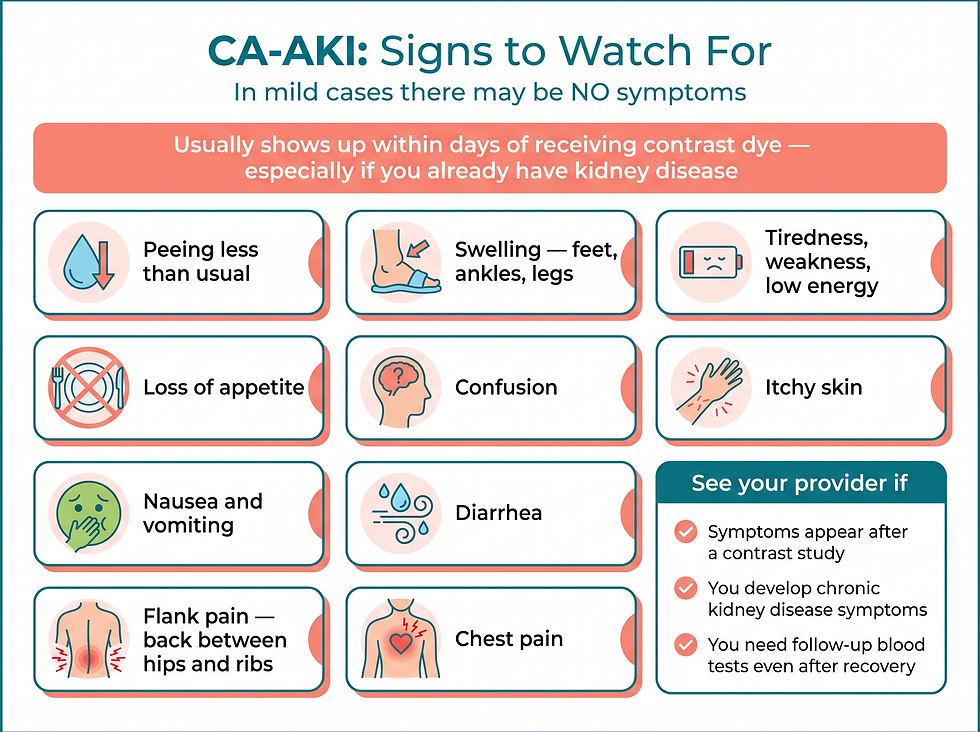
It depends on how bad the kidney damage is. In mild cases, you may not have any symptoms at all. But if you have chronic kidney disease, CA-AKI may cause or make the following symptoms worse.
Symptom | What to watch for |
Peeing less than usual | A noticeable drop in urine output |
Swelling | Especially in your feet, ankles, and legs |
Tiredness, weakness, or low energy | Unusual fatigue |
Confusion | Changes in alertness or thinking |
Itchy skin | New or worsening itching |
Loss of appetite | Food seems unappealing |
Nausea and vomiting | Stomach upset |
Diarrhea | Loose or watery stools |
Flank pain | Pain on one or both sides of your back, between your hips and ribs |
Chest pain | Any chest discomfort |
What Causes CA-AKI?
Experts aren't exactly sure why contrast dye causes CA-AKI in some people. Some suggested factors include the following.
Suggested factor | Explanation |
Vasoconstriction | Narrow or tight blood vessels reduce blood flow to the kidneys |
Excess dye | Too much contrast dye damages the tiny tubes (renal tubules) in your kidneys — a pattern also seen in acute tubular necrosis |
Cell membrane problems | Difficulties with contrast dye and other fluids passing through kidney cell membranes |
Overdosing | Higher doses of contrast dye than recommended |
Dye type | Certain types of contrast dyes, including gadolinium-based dyes |
What Increases Your Risk of CA-AKI?
You're at a greater risk of getting CA-AKI if you have any of the following conditions.
Risk factor | Why it matters |
Severe chronic kidney disease (stages 4 and 5) | Your kidneys are already working with limited capacity |
Diabetes mellitus along with CKD | The combination raises risk significantly |
Congestive heart failure | Reduced circulation affects kidney perfusion |
High blood pressure | Damages kidneys and blood vessels over time |
Low body fluid levels (hypovolemia) | Dehydration stresses the kidneys during filtering |
NSAID use plus one of the above | NSAIDs add further stress to at-risk kidneys |
How to lower your risk
Before giving you a contrast dye, providers may conduct blood tests to check your estimated glomerular filtration rate (eGFR). Your eGFR helps providers understand how healthy your kidneys are. If it indicates kidney damage, your provider may recommend tests that don't use contrast dyes.
Providers may also give you IV fluids before or after giving you a contrast dye. This may help lower your risk.

How Is CA-AKI Diagnosed?
Blood tests help healthcare providers diagnose it. They'll look for an increase in your serum creatinine levels. When your muscle tissue breaks down, it creates the waste product creatinine.
Diagnostic marker | What providers look for |
Creatinine rise within one week | Serum creatinine about 50% higher than usual within one week after receiving contrast dye |
Creatinine rise within two days | An overall serum creatinine increase of 0.3 milligrams per deciliter within two days of receiving contrast dye |
How Is CA-AKI Treated?
There's no specific treatment after a contrast-associated acute kidney injury. Prevention is the best intervention.
If you're at a higher risk for CA-AKI and your provider recommends contrast dye as part of your care plan, they may give you IV fluids. This helps balance your fluids, support your kidney function and lower your risk. They may also use a noniodinated contrast dye and limit how much dye they use.
In severe cases of CA-AKI, you may need dialysis. But this is rare. Dialysis filters wastes and extra fluids from your body when your kidneys don't work as well as they should.
Prevention and treatment measure | How it helps |
eGFR blood test before contrast | Reveals whether your kidneys are healthy enough for contrast dye |
Contrast-free imaging alternatives | Avoids exposure entirely when test results allow |
IV fluids before or after contrast | Balances fluids, supports kidney function, lowers risk |
Noniodinated contrast dye | May be gentler on the kidneys for some patients |
Limiting dye dose | Using only the amount needed reduces stress on kidney tubules |
Dialysis (severe cases only) | Filters wastes and extra fluids when kidneys underperform — rarely needed |
How Long Does It Take to Recover?
If you have healthy kidneys and experience mild damage, your kidney function will usually return to normal within two weeks.
Most people who experience a CA-AKI, even with severe chronic kidney disease, will recover from CA-AKI. But your recovery depends on other factors. These include your overall health, the type of procedure you need and any other conditions you might have. Your healthcare provider will give you a better idea of what to expect.
What Is the Prognosis for CA-AKI?
It depends on your overall kidney health. In general, your outlook is better if you have mild CA-AKI and good kidney function before getting contrast dye. Most people recover kidney function in about two weeks.
Outlook statistic (from the reviewed medical source) | What it means |
2 to 3 out of 10 | People with chronic kidney disease, diabetes, or high blood pressure will develop a CA-AKI |
Less than 1 out of 100 | People without diabetes will need dialysis |
Around 10 to 15 out of 100 | People with diabetes and CA-AKI need dialysis |
Around 2 out of 10 | People who need dialysis after CA-AKI need it for the rest of their lives |
What Should You Do After a Contrast Study?
You should schedule follow-up appointments with your provider, even if you make a full recovery after contrast-associated acute kidney injury. They'll do blood tests to make sure your kidneys are still functioning as expected.
You should also see your provider if you have symptoms of severe chronic kidney disease after CA-AKI.
Questions to ask at your appointment
Question | Why it helps |
What's my risk of developing contrast-associated acute kidney injury? | Gives you your personal risk picture |
Do I need contrast dye, or are there other imaging test options? | Contrast-free alternatives may exist |
Should I schedule a blood test before the imaging tests? | An eGFR test shows how your kidneys are doing |
Should I stop taking any medications before or after the imaging test? | Some medications, including NSAIDs, affect risk |
The Bottom Line
Contrast dye makes important imaging tests like CT scans clearer and some procedures safer — and for most people, it passes through the kidneys without a problem. CA-AKI, the rare form of sudden kidney damage that can follow contrast exposure within two days, is a real but manageable risk, concentrated in people who already have kidney disease, diabetes with kidney disease, heart failure, high blood pressure, or low body fluid levels. The most powerful protection happens before the test: tell your healthcare team your complete health history, ask about an eGFR blood test, discuss whether contrast is truly needed, and find out whether IV fluids, a gentler dye, or a smaller dose is right for you. If you have already had contrast and notice reduced urination, swelling, fatigue, flank pain, or chest discomfort afterward, contact your provider for follow-up blood tests — early monitoring, and in most cases early recovery, are the norm.
Take action today: before your next imaging test with contrast dye, bring up your kidney health history with your healthcare team, ask whether an eGFR blood test is appropriate beforehand, and discuss whether contrast-free alternatives exist for your situation.
Frequently Asked Questions
What is contrast-associated acute kidney injury?
CA-AKI is sudden kidney damage that occurs within two days of receiving a contrast dye — the fluid injected into a vein to make blood vessels and organs easier to see on imaging tests like CT scans.
Is contrast dye the same thing as the dye used in CT scans?
Yes. Contrast dye, also called iodinated contrast or iodine contrast medium, is a special fluid injected into a vein that travels through your bloodstream and makes structures like blood vessels and organs easier to see on imaging tests. It also helps providers perform certain procedures, including heart surgeries.
How common is CA-AKI?
It is described as a rare condition. Among people with chronic kidney disease, diabetes, or high blood pressure, 2 to 3 out of 10 will develop a CA-AKI. For most people, the damage is not permanent.
How do the kidneys handle contrast dye?
Your kidneys eventually filter contrast dye out of your blood, and it leaves your body in your pee.
Can contrast dye cause chronic kidney disease?
CA-AKI may cause chronic kidney disease (CKD) or make CKD worse. It may be fatal if you have severe CKD or kidney failure. In most people the damage is not permanent, but if you have kidney problems it can permanently affect how well your kidneys work.
What are the older names for CA-AKI?
Contrast-induced nephropathy (CIN), contrast-induced acute kidney injury (CI-AKI), contrast-associated nephropathy, and post-contrast acute kidney injury (PC-AKI). These generally refer to the same condition.
What are the early symptoms of CA-AKI?
In mild cases you may not have any symptoms. If you have CKD, it may cause or worsen: peeing less than usual, swelling in the feet, ankles and legs, tiredness or weakness, confusion, itchy skin, loss of appetite, nausea and vomiting, diarrhea, flank pain, and chest pain.
Why do some people develop CA-AKI and others don't?
Experts aren't exactly sure. Suggested factors include narrowed blood vessels (vasoconstriction), too much dye damaging the kidney's tiny tubes (renal tubules), problems with fluids passing through kidney cell membranes, doses higher than recommended, and certain dye types including gadolinium-based dyes.
Who is at highest risk of CA-AKI?
People with severe chronic kidney disease (stages 4 and 5), diabetes along with CKD, congestive heart failure, high blood pressure, or low body fluid levels. NSAID use plus one of these conditions also increases risk.
What is eGFR and why does it matter before a CT scan?
Estimated glomerular filtration rate (eGFR) is measured with a blood test and helps providers understand how healthy your kidneys are. If it indicates kidney damage, your provider may recommend tests that don't use contrast dyes.
How can I lower my risk before a contrast study?
Providers may check your eGFR beforehand, give you IV fluids before or after the contrast dye, use a noniodinated dye, and limit how much dye is used. Tell your team about all your conditions and medications.
Is there a treatment for CA-AKI once it happens?
There's no specific treatment after a CA-AKI. Prevention is the best intervention. In severe cases you may need dialysis, but this is rare — dialysis filters wastes and extra fluids from your body when your kidneys don't work as well as they should.
How long does recovery take?
If you have healthy kidneys and mild damage, kidney function usually returns to normal within two weeks. Most people who experience CA-AKI, even with severe CKD, will recover — though recovery depends on your overall health, the type of procedure, and any other conditions.
Will I need dialysis?
Less than 1 out of 100 people without diabetes will need dialysis. Around 10 to 15 out of 100 people with diabetes and CA-AKI need dialysis. Of those who need dialysis after CA-AKI, around 2 out of 10 need it for the rest of their lives.
What should I do after I recover?
Schedule follow-up appointments even after a full recovery. Your provider will do blood tests to make sure your kidneys are still functioning as expected. Also see your provider if you develop symptoms of severe CKD after CA-AKI.
Should I stop my medications before a contrast test?
Ask your provider. NSAID use increases risk if you also have a kidney-related condition, and some medications may need adjustment before or after the imaging test.
What questions should I ask before my CT scan?
Ask about your personal CA-AKI risk, whether contrast dye is truly needed or other imaging options exist, whether you should have a blood test beforehand, and whether any medications should be stopped before or after the test.
Does CA-AKI have to be permanent?
No. In most people the damage isn't permanent, and most people recover kidney function in about two weeks. But if you have existing kidney problems, the condition can permanently affect how well your kidneys work.
Related Reading
External References
For deeper reading, consult authoritative references including the ACR Manual on Contrast Media, National Kidney Foundation — Contrast Dye and Your Kidneys, and StatPearls — Contrast-Induced Nephropathy.
Sources
Medical review source on contrast-associated acute kidney injury — overview, symptoms, causes, risk factors, diagnosis, treatment, recovery, and prognosis page (medically reviewed; last updated March 6, 2026). Cleveland Clinic — Contrast-Associated Acute Kidney Injury
Medical disclaimer: This article is for general informational purposes only and does not constitute medical advice. It is not a substitute for professional medical diagnosis or treatment. Always seek the advice of your physician or other qualified healthcare provider with any questions regarding a medical condition. Never disregard professional medical advice or delay seeking care because of information read here. If you think you may have a medical emergency, call your doctor or emergency services immediately.
Comments