Core Needle Breast Biopsy: Procedure, Recovery and Results

Updated: 3 days ago
Written and medically reviewed by Dr. Baraa Alnahhal, MD · Last reviewed: November 2026 · How we review
Quick Answer
A core needle breast biopsy is a minimally invasive procedure that uses a hollow needle to remove several small cylinders of breast tissue so a pathologist can check for breast cancer. It's done when a lump is felt or imaging shows something abnormal. The biopsy takes about 15 to 20 minutes. Results usually take 7 to 10 days.
What the research says
Core needle biopsy is nearly as accurate as surgery, with fewer complications: a systematic review found stereotactic and ultrasound-guided core needle biopsies were almost as accurate as open surgical biopsy, with severe complications in under 1% compared with 2%–10% for surgery (Bruening W et al., Ann Intern Med, 2010) [2]
Follow-up matters when results and imaging disagree: in a study of breast lesions where core biopsy results didn't match the imaging, a repeat vacuum-assisted biopsy identified almost half of the cancers the first core biopsy had missed (Vatteroni G et al., Radiol Med, 2024) [3]
Key takeaways
Removes small cores of breast tissue with a hollow needle.
Guided by ultrasound, stereotactic mammography or MRI.
Done with local numbing; you feel pressure, not pain.
A small clip marks the biopsy site.
Results in about 7–10 days, including tumor type, grade and receptor status if cancer is found.
Why is it done?
A core needle biopsy is ordered when there's a breast lump or when mammogram, breast ultrasound or breast MRI shows an area that needs a closer look. Most breast biopsies turn out to be benign. Sources: [1, 2]
Compared with fine-needle aspiration, which collects loose cells and fluid, a core biopsy removes intact tissue, giving the pathologist a larger sample. Learn about other breast biopsy types. Sources: [1]
Types of imaging guidance

Imaging guides the needle to the exact spot.
Guidance | How it works |
Ultrasound-guided | Breast ultrasound shows the needle in real time |
A special mammography machine; you lie face down with the breast through an opening | |
MRI-guided | Breast MRI guides the needle to areas seen only on MRI |
Sources: [1]
How do I prepare?
Tell your care team about all your medicines; you may need to stop aspirin or blood thinners a few days before.
Wear comfortable clothes and a soft bra.
Plan to take it easy for about a day afterward. Sources: [1]
What happens during the biopsy?
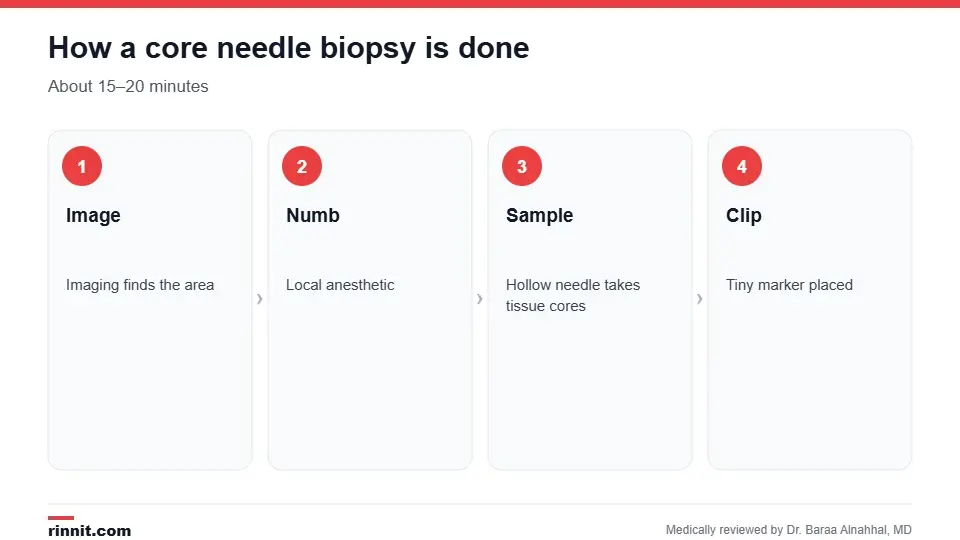
The biopsy itself takes about 15 to 20 minutes.
You're positioned for the imaging method being used.
Imaging finds the area, and the skin is cleaned and numbed.
A tiny cut is made and a needle about 2 mm wide is inserted.
Several samples are taken; you may feel pressure and hear a click with each one. Some devices use suction (vacuum-assisted biopsy).
A tiny metal clip is placed to mark the site, pressure is applied and a bandage is put on. Sources: [1]
The biopsy takes about 15–20 minutes, though you may be in the room for up to an hour. Tell the team if you feel pain, and they'll give more numbing medicine. Sources: [1]
Recovery and risks
Most people return to work and daily activities soon after. Avoid strenuous activity such as running for at least 48 hours. Bruising is common. Complications are very rare but include bleeding that forms a hematoma, infection and, rarely, a collapsed lung. Call your provider for a fever over 101°F (38.3°C), redness, tenderness or spreading bruising. Sources: [1, 2]
Understanding your results
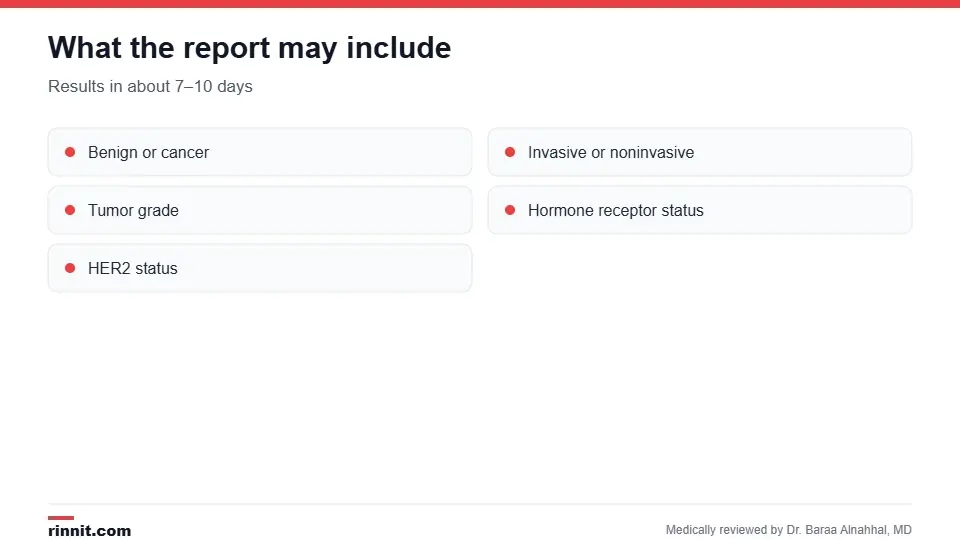
Results usually take 7 to 10 days.
Results usually come back in 7–10 days in a pathology report. If cancer is found, the report describes: Sources: [1]
Tumor type: invasive or noninvasive.
Grade: how abnormal the cells look and how fast they divide; see cancer staging and grading.
Hormone receptor status: whether the cancer grows in response to hormones; see hormone receptor-positive breast cancer.
HER2 status: whether cells make the HER2 protein. Sources: [1]
A false-negative result, where the needle misses the tumor, is possible but rare. If results don't match the imaging, a repeat biopsy may be recommended. Sources: [1, 3]
Conclusion
A core needle breast biopsy is a quick, safe way to find out whether a breast change is cancer. It avoids surgery for most people, and when cancer is found, it gives the detailed information needed to plan treatment.
Keep learning: read about breast cancer and breast biopsy.
Frequently asked questions
What is a core needle breast biopsy?
A procedure that removes small cores of breast tissue with a hollow needle.
Does it hurt?
The area is numbed; you should feel pressure, not pain.
How long does it take?
About 15–20 minutes, up to an hour in the room.
Why is a clip placed?
To mark exactly where the samples came from.
Can I go back to work?
Usually yes; avoid strenuous activity for 48 hours.
What are the risks?
Bruising is common; bleeding, infection or a collapsed lung are rare.
When will I get results?
Usually in 7–10 days.
Does a biopsy mean I have cancer?
No. Most breast biopsies are benign.
Should I stop blood thinners?
Ask your provider; you may need to stop them a few days before.
Can a biopsy miss cancer?
Rarely. A repeat biopsy may be needed if results don't match imaging.
Related Reading
Digital Breast Tomosynthesis (3D Mammogram): Benefits, Prep and Results explains 3D mammography and how it compares with a standard mammogram.
Breast Biopsy: Types, What to Expect, Recovery and Results an overview of breast biopsy types.
Stereotactic Breast Biopsy: Why It's Done, What to Expect, Recovery and Results mammogram-guided needle biopsy.
Breast Ultrasound: Why It's Done, What to Expect and Results often used to guide core biopsy.
Breast MRI: Why It's Done, What to Expect and How It Compares to a Mammogram imaging that can guide biopsy.
Mammogram: Types, How to Prepare, What Happens and Your Results the screening test that often leads to biopsy.
References
Cleveland Clinic. Core Needle Biopsy of the Breast: Procedure, Recovery & Results. Cleveland Clinic. Last updated January 16, 2025. https://my.clevelandclinic.org/health/diagnostics/core-needle-breast-biopsy
Bruening W, Fontanarosa J, Tipton K, et al. Systematic review: comparative effectiveness of core-needle and open surgical biopsy to diagnose breast lesions. Ann Intern Med. 2010;152(4):238-246. PMID 20008742. https://doi.org/10.7326/0003-4819-152-1-201001050-00190
Vatteroni G, Pinna G, Trimboli RM, et al. Role of ultrasound-guided vacuum-assisted breast biopsy in the management of radiologic-pathologic discordance: a retrospective single-centre study. Radiol Med. 2024;129(10):1454-1462. PMID 39102107. https://doi.org/10.1007/s11547-024-01864-1
Medical disclaimer
This article is for general education only and does not replace advice from a qualified healthcare professional. Talk to your doctor about your own diagnosis and treatment, and seek emergency care right away for severe or sudden symptoms.



Comments