Breast Ultrasound: Why It's Done, What to Expect and Results

Updated: 2 days ago
Written and medically reviewed by Dr. Baraa Alnahhal, MD · Last reviewed: November 2026 · How we review
Quick Answer: What is a breast ultrasound?
A breast ultrasound is an imaging test that uses sound waves to take pictures of the inside of the breast. It can show whether a lump is a fluid-filled cyst, which is usually not cancer, or a solid mass that may need more testing. It takes about half an hour, uses no radiation and has no known risks. [1]
What the research says
Adding ultrasound to mammography finds more breast cancers. In a randomized trial of 72,998 women aged 40 to 49, adding ultrasound to mammography raised the share of cancers detected from 77.0% to 91.1% and found more cancers overall (0.50% vs 0.32% of women). It also led to more false alarms, with specificity falling from 91.4% to 87.7%. (Ohuchi et al., The Lancet, 2016) [2]
Ultrasound helps women with dense breasts and higher risk, at the cost of more false positives. In 2,637 women at elevated risk with dense breast tissue, a single screening ultrasound added to mammography found 4.2 more cancers per 1,000 women. But only 8.9% of biopsies recommended from ultrasound found cancer, compared with 22.6% from mammography. (Berg et al., JAMA, 2008) [3]
Key takeaways
A breast ultrasound uses sound waves to take pictures of the inside of your breast. [1]
It can show whether a breast lump is a fluid-filled cyst or a solid mass. [1]
It's often used after an unclear mammogram, to check a lump or breast pain, or for screening with dense breasts. [1]
Don't wear deodorant, lotion or powder on or near your breasts on the day of the test. [1]
It takes about half an hour, uses no radiation and has no known risks. [1]
Mammography is still the best tool for looking at your whole breast; ultrasound focuses on a specific area. [1]
What is a breast ultrasound?
A breast ultrasound is an imaging test that healthcare providers use to take pictures of the inside of your breast. It lets your provider focus on a small area they need to see more closely. You might have one after a mammogram to get a detailed look at changes your provider sees, or in addition to a mammogram to screen for breast cancer. [1]
What does a breast ultrasound show?
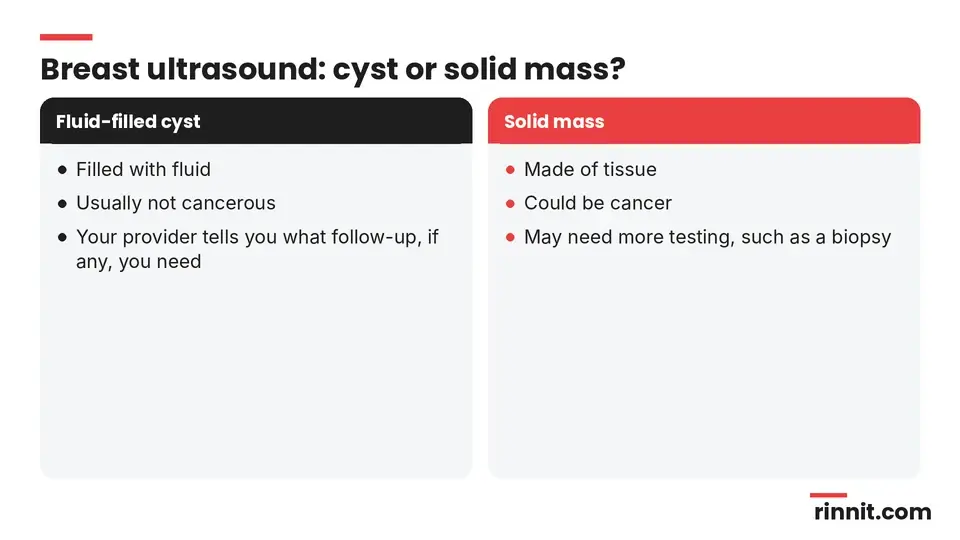
A breast ultrasound can show whether a breast lump is: [1]
Finding | What it usually means |
Fluid-filled breast cyst | Usually not cancerous |
Solid mass | Could be cancer and may need further testing, such as a biopsy |
Sources: [1]
When do you need a breast ultrasound?

Your healthcare provider might order a breast ultrasound if: [1]
They want another look at an area of your breast that was abnormal, unclear or looked different on a mammogram
You or your provider can feel a lump in your breast
You have pain in a specific area of your breast
You have dense breast tissue, and your provider recommends ultrasound along with a mammogram for routine cancer screening
You're younger than the recommended age for routine mammograms
Providers also use breast ultrasound during a biopsy to make sure they take tissue from the right spot. A pathologist then examines the tissue under a microscope to diagnose or rule out breast cancer. [1]
How does a breast ultrasound work?
An ultrasound technician moves a handheld device called a transducer over your breast and the tissue around it. The transducer uses high-frequency sound waves to take pictures of the tissues and structures inside, and the technician watches the images on a computer monitor. [1]
How do you prepare for a breast ultrasound?
On the day of your ultrasound, don't wear deodorant or use lotions or powders on or around your breasts, because they can make it hard to get clear images. Wearing comfortable clothing can make it easier to change. [1]
What happens during a breast ultrasound?
During a breast ultrasound: [1]
You undress from the waist up and remove any jewelry.
You change into a gown or robe that opens in the front.
You lie on an exam table, and the technician helps you into the best position, usually with your arm resting over your head.
The technician puts a clear, water-based gel on your breast and on the transducer.
They place the transducer on your breast and move it to get the images they need.
They save the best images. They might step out to talk with your provider, which doesn't necessarily mean they found anything concerning.
Your provider may also come in and scan your breast to see the pictures in real time.
A breast ultrasound takes about half an hour. [1]
What happens after a breast ultrasound?
When the test is done, you or the technician wipe the gel off your skin. A radiologist looks at and interprets the images, and your provider tells you whether you need any follow-up tests or procedures. If your provider recommends a biopsy based on the images, they'll schedule it before you leave. [1]
Breast ultrasound vs. mammogram

Feature | Breast ultrasound | Mammogram |
How it makes images | High-frequency sound waves | Low-dose X-rays |
Radiation | None | Yes |
What it covers | Usually one specific area of the breast | The entire breast |
Main use | Checking a lump, pain or an unclear mammogram finding; extra screening for dense breasts | Routine breast cancer screening |
Sources: [1]
Does a breast ultrasound have risks or limits?
Breast ultrasound uses sound waves, so there's no radiation, and there are no known risks of ultrasound technology. Its limit is that providers usually use it to look at one specific area of your breast. That's why mammography is still the best tool for looking at the entire breast. If you're at higher risk of breast cancer, your provider may recommend ultrasound together with a mammogram for screening. [1]
When do you get your results?
You should know the results by the end of your appointment. Your provider will tell you whether what they see looks noncancerous (benign), like a cyst, or possibly cancerous (malignant), and they'll schedule or perform any follow-up procedures right away. [1]
When should you call your provider?
Call your healthcare provider if you: [1]
Feel a new or changing lump, dimpling or other changes in your breast or armpit
Have nipple discharge, a nipple that has newly turned inward (or outward), or skin changes on your nipples
Think a breast implant has ruptured
Questions to ask your provider
Why do I need a breast ultrasound instead of, or as well as, a mammogram?
Does the area look like a cyst or a solid mass?
Do I need a biopsy, and when?
Do I have dense breasts, and should I have extra screening?
When should I have my next breast imaging?
Conclusion
A breast ultrasound is a safe, painless way to take a closer look at one area of your breast. It's especially useful for telling a fluid-filled cyst from a solid lump, checking an unclear mammogram finding and adding extra screening for dense breasts.
Feeling anxious before the test is normal, but many lumps aren't cancer, and you'll usually hear your results before you leave. Whatever they show, your healthcare team will guide you through the next steps.
Keep learning: Read our guides to the mammogram, breast MRI, the clinical breast exam and the breast self-exam.
FAQ
What is a breast ultrasound?
A breast ultrasound is an imaging test that uses sound waves to take pictures of the inside of your breast. [1]
What does a breast ultrasound show?
It can show whether a breast lump is a fluid-filled cyst, usually not cancer, or a solid mass that may need more testing. [1]
Why would I need a breast ultrasound after a mammogram?
Your provider may want a closer look at an area that was abnormal, unclear or looked different on the mammogram. [1]
How long does a breast ultrasound take?
A breast ultrasound takes about half an hour. [1]
How do I prepare for a breast ultrasound?
Don't wear deodorant or use lotions or powders on or around your breasts, and wear comfortable clothes. [1]
Is a breast ultrasound better than a mammogram?
No. Ultrasound looks closely at one area, while mammography is still the best tool for looking at the whole breast. [1]
Does a breast ultrasound use radiation?
No. It uses sound waves, and there are no known risks of ultrasound technology. [1]
When will I get my breast ultrasound results?
You should know your results by the end of your appointment. [1]
What happens if my breast ultrasound is abnormal?
Your provider may recommend a biopsy and will often schedule it before you leave. [1]
Can a breast ultrasound be used for screening?
Yes. If you have dense breasts or a higher risk of breast cancer, your provider may recommend it along with a mammogram. [1]
Related Reading
Learn more in our guide to Breast Cysts: Symptoms, Causes, and Treatment.
Learn more in our guide to Breast Cancer: Symptoms, Causes, and Treatment.
Learn more in our guide to Breast Cancer in Young Women: Early-Onset Diagnosis, Risk Factors, and What to Do Next.
Core Needle Breast Biopsy: Procedure, Recovery and Results explains the needle biopsy used to check breast changes for cancer.
References
Cleveland Clinic. Breast Ultrasound: What It Is, Purpose, Procedure & Results. Cleveland Clinic. Last updated April 3, 2024. https://my.clevelandclinic.org/health/diagnostics/21496-breast-ultrasound
Ohuchi N, Suzuki A, Sobue T, et al. Sensitivity and specificity of mammography and adjunctive ultrasonography to screen for breast cancer in the Japan Strategic Anti-cancer Randomized Trial (J-START): a randomised controlled trial. Lancet. 2016;387(10016):341-348. PMID 26547101. https://doi.org/10.1016/S0140-6736(15)00774-6
Berg WA, Blume JD, Cormack JB, et al. Combined screening with ultrasound and mammography vs mammography alone in women at elevated risk of breast cancer. JAMA. 2008;299(18):2151-2163. PMID 18477782. https://doi.org/10.1001/jama.299.18.2151
Medical disclaimer
This article is for general education only and does not replace advice from a qualified healthcare professional. Talk to your doctor about your own diagnosis and treatment, and seek emergency care right away for severe or sudden symptoms.



Comments