Estrogen Receptor-Positive (ER+) Breast Cancer: What It Means, Symptoms, and How It's Treated

Updated: 3 days ago
Medically reviewed by Dr. Baraa Alnahhal, MD · Last reviewed: November 9, 2026
Quick Answer
Estrogen receptor-positive (ER+) breast cancer is the most common breast cancer subtype, accounting for about 70% of breast cancer cases in the United States [4]. Its cancer cells use estrogen to grow and spread [4]. It is treated mainly with surgery and hormone therapy [4], and more than 90% of females were alive five years after diagnosis [4].
What the research says
Hormone therapy lowers the risk of recurrence and death in ER-positive disease. A collaborative meta-analysis of 20 trials (21,457 women) found that about 5 years of adjuvant tamoxifen substantially reduced recurrence in ER-positive disease (10,645 women; rate ratio 0.53 in years 0–4 and 0.68 in years 5–9) and reduced breast cancer mortality by about a third throughout the first 15 years, with little or no effect in ER-negative disease (PubMed: EBCTCG, Lancet, 2011 [1]).
For postmenopausal women, aromatase inhibitors edge out tamoxifen. A patient-level meta-analysis of 31,920 postmenopausal women with ER-positive early breast cancer found that aromatase inhibitors reduced recurrence rates by about 30% compared with tamoxifen while the treatments differed; 10-year breast cancer mortality was 12.1% with aromatase inhibitors versus 14.2% with tamoxifen, with fewer endometrial cancers (0.4% vs 1.2%) but more bone fractures (8.2% vs 5.5%) (PubMed: EBCTCG, Lancet, 2015 [2]).
ER-positive breast cancer can return years later. In a meta-analysis of 88 trials with 62,923 women with ER-positive breast cancer who were disease-free after 5 years of endocrine therapy, recurrences continued at a steady rate from year 5 to year 20; the risk of distant recurrence ranged from 13% for stage T1 disease with no nodal involvement to 41% for stage T2 disease with four to nine nodes involved (PubMed: Pan et al., N Engl J Med, 2017 [3]).
What Is ER-Positive Breast Cancer? An Overview
Estrogen receptor-positive breast cancer (ER+) is a breast cancer subtype. If tests show ER+ breast cancer, it means the cancer cells have receptors that let estrogen help them grow [4]. Checking estrogen receptor levels helps healthcare providers plan breast cancer treatment [4]. Healthcare providers treat this condition with surgery and hormone therapy [4].
This breast cancer subtype is also known as estrogen-positive breast cancer and estrogen receptor-positive breast cancer [4].
Key points about ER+ breast cancer
Key Point | What It Means |
How estrogen affects it | Estrogen attaches to receptors on the cancer cells and helps the cancer grow and spread [4] |
How common it is | About 70% of all breast cancer cases in the U.S. are ER-positive |
Who it affects | All breast cancers in the U.S. — including those in males — can be ER-positive |
How it's identified | A biopsy tests tumor tissue for estrogen and progesterone receptors [4] |
How it's treated | Surgery and hormone therapy are the most common treatments |
Five-year survival | More than 90% of females were alive five years after diagnosis, overall [4] |
ER-positive breast cancer is a breast cancer subtype in which the cancer cells have estrogen receptors, so estrogen helps the cancer grow and spread [4]. It accounts for about 70% of all breast cancer cases in the United States, including cases in males [4].

Symptoms of ER+ Breast Cancer
People with ER-positive breast cancer typically have common breast cancer symptoms [4]. The same warning signs apply whether or not the cancer is hormone receptor-positive.
Symptom | What It Might Look or Feel Like |
Change in the breast | A change in the size, shape, or contour of the breast [4] |
Mass or lump | A mass or lump, which may feel as small as a pea [4] |
Persistent lump or thickening | A lump or thickening in or near the breast, or in the underarm, that persists through the menstrual cycle [4] |
Skin or nipple changes | The skin may look dimpled, puckered, scaly, or inflamed. It may look red or darker than other parts of the breast [4] |
Hardened area | A marble-like hardened area under the skin [4] |
Nipple discharge | A blood-stained or clear fluid discharge from the nipple [4] |
The symptoms of ER-positive breast cancer are typical breast cancer symptoms. They include a new mass or lump that may feel as small as a pea, a lump or thickening that persists through the menstrual cycle, a change in the size, shape, or contour of the breast, skin changes such as dimpling, puckering, or redness, a marble-like hardened area, and a blood-stained or clear nipple discharge [4].
What Causes ER-Positive Breast Cancer?
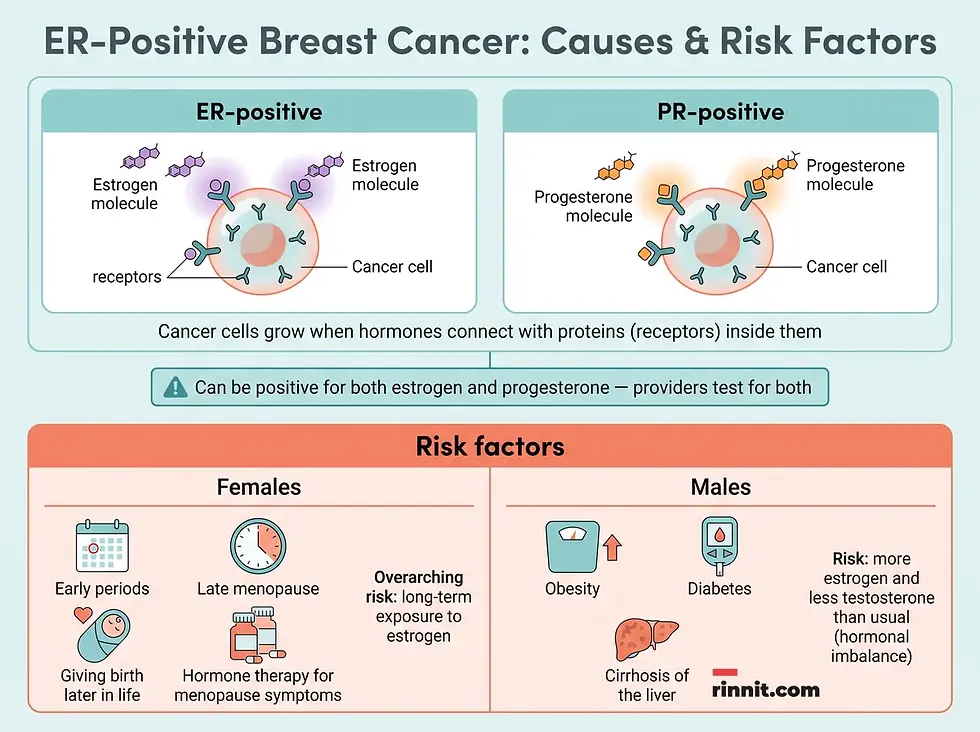
Cells in the body have hormone receptors. The hormone receptors are a type of protein [4]. Estrogen in the bloodstream can attach to the receptors [4]. This hormone-receptor process is part of typical body function. In healthy cells, estrogen aids normal cell function and growth [4].
ER-positive breast cancer occurs when estrogen connects with proteins inside cancer cells, causing the cells to grow [4]. It may also happen when estrogen and another hormone, progesterone, connect with proteins inside cancer cells. Breast cancer whose cells have progesterone receptors is PR-positive breast cancer [4].
What are the risk factors?
The overarching risk for females is long-term exposure to estrogen [4]. Risks for males are linked to situations where they have more estrogen and less testosterone than usual, which is a hormonal imbalance [4].
ER-positive breast cancer is caused when estrogen connects with proteins inside cancer cells, causing the cells to grow [4]. It may also happen when estrogen and progesterone both connect with proteins inside cancer cells [4]. In healthy cells, estrogen aids normal cell function and growth [4].
How Is ER-Positive Breast Cancer Diagnosed?
A healthcare provider does a breast biopsy to obtain samples of cancer tumor tissue [4]. They send the samples to a lab. There, a medical pathologist tests tissue for signs of hormone receptors [4].
A hormone receptor-positive (HR+) result means estrogen, progesterone, or both hormones are fueling cancer growth [4]. If tests don't find estrogen receptors on the cancer cells, the breast cancer is considered estrogen receptor-negative (ER-negative) [4].
Test Step | What It Involves |
Breast biopsy | The provider obtains samples of cancer tumor tissue from the breast [4] |
Lab analysis | A medical pathologist tests the tissue for signs of hormone receptors [4] |
HR+ result | Means estrogen, progesterone, or both hormones are fueling cancer growth [4] |
ER-negative result | The tests did not find estrogen receptors on the cancer cells [4] |
ER-positive breast cancer is diagnosed with a breast biopsy [4]. The provider obtains samples of tumor tissue and sends them to a lab, where a pathologist tests the tissue for hormone receptors [4]. An HR+ result means estrogen, progesterone, or both are fueling the cancer's growth [4]. If estrogen receptors are not found, the cancer is ER-negative [4].
Treatment for ER-Positive Breast Cancer
Healthcare providers may treat ER-positive breast cancer with surgery, radiation, chemotherapy, and hormone therapies [4]. Finding out whether cancerous cells have estrogen or progesterone receptors helps providers plan breast cancer treatment [4].
Treatment | How It Works |
Breast cancer surgery | Surgery removes the tumors [4] |
Radiation therapy | Uses targeted radiation to treat remaining cancer cells |
Chemotherapy | Uses drugs to kill cancer cells throughout the body |
Aromatase inhibitors | A hormone therapy that reduces the amount of estrogen in the body [4] |
Selective estrogen receptor modulators (SERMs) |
Treatment side effects
Common chemotherapy and radiation therapy side effects include fatigue, nausea, and vomiting [4]. Common hormone therapy side effects may include joint pain or stiffness, fatigue, weight gain, less or loss of interest in sex, hot flashes, and tender or swollen breasts [4].
If you're receiving ER-positive breast cancer treatment, ask your healthcare provider about palliative care. This care may help you manage breast cancer symptoms and treatment side effects [4].
ER-positive breast cancer is treated with breast cancer surgery to remove tumors, radiation therapy, chemotherapy, and hormone therapies [4]. Hormone therapies include aromatase inhibitors, which reduce the amount of estrogen in the body [4], and selective estrogen receptor modulators (SERMs), which reduce the risk that breast cancer will come back [1] [4].

Outlook: Survival Rates and Recurrence
What are ER-positive breast cancer survival rates?
Data from the National Cancer Institute (NCI) show that overall, more than 90% of females were alive five years after diagnosis [4]. NCI data doesn't break out ER-positive survival rates for males [4].
When you think about survival rates, it's important to remember these rates are based on the experiences of large groups of people with the same condition [4]. These are estimates based on what was going on during a specific time that may be years in the past [4]. If you have questions about survival rates, ask your healthcare provider what you can expect.
Can ER-positive breast cancer come back after treatment?
While this breast cancer type is considered to be less aggressive [4], there's a risk of recurrence after treatment, including treatment for early-stage, low-risk ER-positive breast cancer [3] [4]. If you're concerned that breast cancer will come back, ask your oncologist about your individual risk and what you can do to reduce your risk.
Where does ER-positive breast cancer spread?
Breast cancer may spread to the lungs, brains, bones, and livers [4]. ER-positive breast cancer accounts for about 70% of all breast cancer cases [4].
Living With ER+ Breast Cancer
How do I take care of myself?
If you have ER-positive breast cancer, the following suggestions may be helpful:
Self-Care Step | Why It Helps |
Get enough rest | Breast cancer and treatment can be exhausting. Rest when you need to, not just when you think you have time [4] |
Eat well | Treatment may affect your appetite. A diet of fruit, vegetables, lean protein, and healthy grains can help you stay strong during treatment [4] |
Manage your stress | Cancer is stressful. Exercise can help, from regular walks to exercise programs [4] |
Find support | You're a breast cancer survivor, starting the day you were diagnosed. Ask your provider about cancer survivorship programs that may help you manage the challenges of living with breast cancer [4] |
When should I see my healthcare provider?
Contact your provider if your symptoms seem to be getting worse or if you have new symptoms, like pain or weakness in a different part of your body [4].
What questions should I ask my healthcare provider?
You may want to ask the following questions:
Question | Why It Matters |
What treatment do you recommend? | Helps you understand the planned approach for your specific cancer |
Will I need to have chemotherapy and radiation or just hormone therapy? | Clarifies how intensive the treatment plan is |
Will I need hormone therapy for the rest of my life? | Helps plan for long-term treatment and follow-up |
Conclusion: What to Do With an ER+ Diagnosis
ER-positive breast cancer is the most common breast cancer subtype, and its hormone-driven nature is what makes treatment so targeted. Knowing the cancer cells depend on estrogen — and sometimes progesterone — helps your care team choose surgery, radiation, chemotherapy, or hormone therapies that reduce estrogen's impact on cancerous cells. The overall five-year survival rate is encouraging: more than 90% of females were alive five years after diagnosis [4].
Important: If you notice a new lump, a change in the size, shape, or contour of the breast, a skin or nipple change, or unusual discharge, see a healthcare provider promptly. Ask for a breast biopsy so hormone receptors can be tested. If you have been diagnosed, ask your oncologist about your individual risk of recurrence and the role of hormone therapy. Support programs can help you manage life during and after treatment.
Further reading: American Cancer Society — Breast Cancer · National Cancer Institute — Breast Cancer · CDC — Breast Cancer
Frequently Asked Questions
1. What is estrogen receptor-positive breast cancer?
ER-positive breast cancer is a breast cancer subtype in which the cancer cells have estrogen receptors, so estrogen helps the cancer grow and spread. About 70% of all breast cancer cases in the U.S. are ER-positive. It is commonly treated with surgery and hormone therapy.
2. What are the symptoms of ER-positive breast cancer?
The main symptoms are typical breast cancer symptoms: a new lump or mass that may feel as small as a pea, a lump or thickening that persists through the menstrual cycle, changes in the breast's size, shape, or contour, skin changes such as dimpling or redness, a marble-like hardened area, and blood-stained or clear nipple discharge.
3. What causes ER-positive breast cancer?
ER-positive breast cancer is caused by estrogen connecting with proteins (hormone receptors) inside cancer cells, causing the cells to grow. It may also happen when estrogen and progesterone connect with proteins inside cancer cells. In healthy cells, estrogen aids normal cell function and growth.
4. What is the difference between ER-positive and PR-positive breast cancer?
ER-positive means the cancer cells have estrogen receptors and estrogen fuels their growth. PR-positive means the cells have progesterone receptors. The cancer may be positive for both hormones, which is why providers test for both estrogen and progesterone receptors.
5. How is ER-positive breast cancer diagnosed?
ER-positive breast cancer is diagnosed through a breast biopsy. The provider obtains tumor tissue samples and sends them to a lab, where a pathologist tests for hormone receptors. An HR+ result means estrogen, progesterone, or both are fueling the cancer. If no estrogen receptors are found, the cancer is ER-negative.
6. What are the treatments for ER-positive breast cancer?
Treatments include breast cancer surgery to remove tumors, radiation therapy, chemotherapy, and hormone therapies. Hormone therapies include aromatase inhibitors, which reduce the amount of estrogen in the body, and SERMs, which reduce the risk of recurrence.
7. What are the side effects of hormone therapy for ER+ breast cancer?
Common hormone therapy side effects include joint pain or stiffness, fatigue, weight gain, less or loss of interest in sex, hot flashes, and tender or swollen breasts. Chemotherapy and radiation commonly cause fatigue, nausea, and vomiting.
8. What is the survival rate for ER-positive breast cancer?
Overall, more than 90% of females were alive five years after diagnosis, based on National Cancer Institute data. These are estimates based on large groups and past time periods. NCI data does not break out ER-positive survival rates for males.
9. Can ER-positive breast cancer come back after treatment?
Yes. While ER+ breast cancer is considered less aggressive, there is a risk of recurrence after treatment, including after treatment for early-stage, low-risk ER+ breast cancer. Ask your oncologist about your individual risk and how to reduce it.
10. Where does ER-positive breast cancer spread?
Breast cancer may spread to the lungs, brains, bones, and livers. ER-positive breast cancer accounts for about 70% of all breast cancer cases in the U.S.
11. What are the risk factors for ER-positive breast cancer?
For females, risk factors include early periods, late menopause, giving birth later in life, and taking hormone therapy for menopause symptoms — all tied to long-term estrogen exposure. For males, risks include obesity, diabetes, and cirrhosis of the liver, which create more estrogen and less testosterone.
Related Reading
Breast Biopsy: Types, What to Expect, Recovery and Results explains the procedure used to confirm or rule out breast cancer.
References
Early Breast Cancer Trialists' Collaborative Group (EBCTCG), Davies C, Godwin J, et al. Relevance of breast cancer hormone receptors and other factors to the efficacy of adjuvant tamoxifen: patient-level meta-analysis of randomised trials. Lancet. 2011;378(9793):771-784. doi:10.1016/S0140-6736(11)60993-8. PMID: 21802721.
Early Breast Cancer Trialists' Collaborative Group (EBCTCG). Aromatase inhibitors versus tamoxifen in early breast cancer: patient-level meta-analysis of the randomised trials. Lancet. 2015;386(10001):1341-1352. doi:10.1016/S0140-6736(15)61074-1. PMID: 26211827.
Pan H, Gray R, Braybrooke J, et al. 20-year risks of breast-cancer recurrence after stopping endocrine therapy at 5 years. N Engl J Med. 2017;377(19):1836-1846. doi:10.1056/NEJMoa1701830. PMID: 29117498.
Cleveland Clinic. Estrogen receptor-positive breast cancer (ER+). Cleveland Clinic Health Library. Medically reviewed; last updated February 2, 2024. https://my.clevelandclinic.org/health/diseases/er-positive-breast-cancer
American Cancer Society. Breast cancer. American Cancer Society. Last revised June 24, 2026. https://www.cancer.org/cancer/types/breast-cancer.html
National Cancer Institute. Breast cancer. National Cancer Institute, National Institutes of Health. Accessed October 30, 2026. https://www.cancer.gov/types/breast
Centers for Disease Control and Prevention. Breast cancer. CDC. Last updated September 11, 2024. https://www.cdc.gov/breast-cancer/index.html
Medical Disclaimer
This article is for informational purposes only and does not constitute medical advice. Always seek the advice of your physician or other qualified health provider with any questions you may have regarding a medical condition. Never disregard professional medical advice or delay in seeking it because of something you have read here.



Comments