What Is Metastatic Breast Cancer? A Plain-Language Guide to Stage 4 Breast Cancer

Updated: 3 days ago
Medically reviewed by Dr. Baraa Alnahhal, MD · Last reviewed: October 2026
Quick Answer: Key Facts About Metastatic Breast Cancer
Metastatic breast cancer is breast cancer that has spread to other parts of the body, most often the bones, brain, liver and lungs; for most people it is a recurrence of a previously treated cancer. It may cause pain, deep tiredness and weight loss. Treatment usually starts with medicines chosen by the cancer's hormone receptor and HER2 status. [1] [2]
Feature | Details |
What it is | Breast cancer that has broken away from the breast and spread to other parts of the body, most often the bones, brain, liver, and lungs. |
What it feels like | Often nothing at first; later, pain, deep tiredness, shortness of breath, swollen lymph nodes, loss of appetite, and weight loss without trying — plus site-specific signs like bone pain, new headaches, belly swelling, or cough. |
What makes it unique | It's the same disease that started in the breast — the cells just learned to travel through the blood or lymphatic system and grow in a new place. For most, it's a recurrence of a cancer treated before. |
Who gets it | The same people at risk for breast cancer in general — mainly women, with risk rising with age, family or personal history, BRCA1/BRCA2 DNA changes, dense breasts, alcohol use, and obesity. |
How it is treated | Treatment usually starts with medicines — estrogen blocker therapy, targeted therapy, chemotherapy, antibody-drug conjugates, or immunotherapy — chosen by the cancer's hormone receptor (HR) and HER2 status, with radiation, surgery, bone-building medicines, and palliative care added as needed. |
What the research says
Survival depends heavily on the cancer's subtype. In a French cohort of 16,702 people newly diagnosed with metastatic breast cancer, median overall survival was 37.2 months overall: 42.1 months for HR-positive/HER2-negative, 44.9 months for HER2-positive, and 14.5 months for triple-negative disease. Survival improved over the study years only in the HER2-positive group. (Gobbini et al., Eur J Cancer, 2018) [6]
Adding a CDK4/6 inhibitor to estrogen blocker therapy improves outcomes. A network meta-analysis of 41 randomized trials in postmenopausal women with HR-positive, HER2-negative advanced breast cancer found that adding CDK4/6 inhibitors to endocrine therapy as first-line treatment significantly improved both progression-free and overall survival. (Shao et al., BMC Med, 2024) [7]
More women are living with metastatic disease. U.S. registry modeling estimated 154,794 women living with metastatic breast cancer by January 1, 2017, about three in four of whom were first diagnosed with stage I–III disease. Five-year relative survival for women diagnosed at ages 15–49 roughly doubled, from 18% (1992–1994) to 36% (2005–2012). (Mariotto et al., Cancer Epidemiol Biomarkers Prev, 2017) [5]
What is metastatic breast cancer?
Metastatic breast cancer is cancer that starts in the breast and spreads to other parts of the body. It also is called stage 4 breast cancer, stage IV breast cancer and secondary breast cancer. [1]
Breast cancer begins when cells in the breast grow out of control. Sometimes these cancer cells break away and travel through the lymphatic system or the blood. Common sites where breast cancer spreads include the bones, brain, lungs and liver. [1]
Breast cancers can spread at different speeds. Some grow and spread quickly, while others grow slowly and are less likely to spread. The type of breast cancer and other features of the cancer help determine how quickly it spreads. [1]
Some people have metastatic cancer when they're first diagnosed. But cancer that has spread is more often discovered when cancer comes back after treatment for a previous breast cancer diagnosis. For most, a metastatic breast cancer also is a breast cancer recurrence. [1]
Treatment for metastatic breast cancer usually starts with medicines that can help slow the growth of the cancer. Other treatments may depend on where the cancer spreads and what symptoms it causes. [1]
When the cancer is advanced and has spread to other organs, it typically can't be cured. But treatment can help control the cancer effectively. Treatments may extend your life and help you to live as well as possible, for as long as possible. As treatments improve, people are surviving longer with metastatic breast cancer. [1]
Where does metastatic breast cancer spread?
Breast cancer cells break away from the area where they formed and may spread through the lymphatic system or enter the bloodstream. This lets the cells travel to other parts of the body. [1]

After the cancer cells reach a new place, they face many challenges. They must avoid the body's immune defenses and adapt to conditions in the new environment. Some parts of the body are better able to support the survival and growth of metastatic breast cancer cells. These places include the bones, brain, liver and lungs. [1]
Where it spreads | Other details |
Bones | Most often the spine; also the ribs, pelvis, skull, thigh bone and upper arm bone [1] |
Brain | May form one or more growths in brain tissue, or spread to the leptomeninges (the thin layers of tissue around the brain and spinal cord) [1] |
Liver | Can cause bloating or swelling of the belly [1] |
Lungs | May spread to the lungs or the pleura (the thin tissue that surrounds the lungs) and can cause a pleural effusion (fluid buildup around a lung) [1] |
What are the symptoms of metastatic breast cancer?
Metastatic breast cancer may not cause symptoms at first. When they happen, symptoms may depend on where the cancer spreads. [1]
Signs and symptoms of metastatic breast cancer include pain, feeling very tired, shortness of breath, swollen lymph nodes, loss of appetite, and weight loss without trying. [1]
What does it feel like when it spreads to the bones?
Breast cancer that spreads to the bones most often goes to the spine. Other common sites include the ribs, pelvis, skull, thigh bone and upper arm bone. Symptoms may include: [1]
Symptom | What it involves |
Pain in or around a bone | Soreness in a specific bone area [1] |
Weakness in one part of the body | Reduced strength on one side or in one area [1] |
Changes in feeling | Numbness or tingling in one part of the body [1] |
Bones that break without a clear cause | Breaks without an accident or fall [1] |
Loss of bladder and bowel control | Trouble controlling the bladder or bowels [1] |
What does it feel like when it spreads to the brain?
Symptoms of cancer that spreads to the brain may include new headaches or changes in existing headaches (becoming more frequent or more severe), weakness in one part of the body, changes in vision, changes in balance and coordination, nausea and vomiting, and seizures. [1]
What does it feel like when it spreads to the liver?
Breast cancer that spreads to the liver may cause bloating or swelling of the belly, yellowing of the skin and the whites of the eyes, and pain in the upper right side of the belly. [1]
What does it feel like when it spreads to the lungs?
Breast cancer may spread to the lungs or the thin tissue that surrounds the lungs, called the pleura. Metastatic breast cancer also can cause fluid to build up around a lung — this fluid buildup is called pleural effusion. Symptoms of cancer that spreads to the lungs may include shortness of breath, cough and chest pain. [1]
When should you see a doctor?
Make an appointment with a doctor or other healthcare professional if you have any symptoms that worry you. Get emergency care right away if you have new back or neck pain with leg weakness, numbness, or loss of bladder or bowel control, or a seizure, because these can be signs of cancer pressing on the spinal cord or brain. If you were treated for breast cancer in the past, tell your healthcare team about your previous diagnosis and treatment. [1]
What causes metastatic breast cancer?
Metastatic breast cancer has no clear cause, but it develops when breast cancer cells break away and travel through the lymphatic system or bloodstream. It happens when cancer cells in the breast break away from the area where they formed. The cancer cells may spread through the lymphatic system or enter the bloodstream. This lets the cells travel to other parts of the body. [1]
What increases the risk?
Metastatic breast cancer has the same risk factors as breast cancer in general. [1]
How do family and personal history affect risk?
Risk factors related to your personal medical history and your family's medical history include:
Risk factor | What it means |
A family history of breast cancer | If a parent, sibling or child had breast cancer, your risk is increased — higher if breast cancer ran in the family at a young age or in multiple family members. Still, most people diagnosed with breast cancer don't have a family history. [1] |
A personal history of breast cancer | If you've had cancer in one breast, you have an increased risk of getting cancer in the other breast. [1] |
A personal history of breast conditions | Lobular carcinoma in situ (LCIS) and atypical hyperplasia of the breast are markers for a higher risk. [1] |
Increasing age | The risk of breast cancer goes up as you get older. [1] |
Inherited DNA changes | Changes such as BRCA1 and BRCA2 can be passed from parents to children and can greatly increase your risk — but not everyone with these changes gets cancer. [1] |
Radiation exposure | Radiation treatments to the chest as a child or young adult raise the risk. [1] |
How do reproductive history and hormones affect risk?
Risk factor | What it means |
Beginning your period at a younger age | Beginning your period before age 12 increases the risk. [1] |
Beginning menopause at an older age | Beginning menopause after age 55 increases the risk. [1] |
Being female | Women are much more likely than men to get breast cancer, but anyone with breast tissue can get it — including men. [1] |
Having your first child at an older age | Giving birth after age 35 may increase the risk. [1] |
Having never been pregnant | Pregnancy lowers the risk; never having been pregnant increases it. [1] |
What other factors affect risk?
Risk factor | What it means |
Dense breast tissue | Dense tissue (milk glands, ducts and fibrous tissue) outweighs fatty tissue. Dense breasts raise the risk and make cancer harder to spot on a mammogram — ask your team about extra tests. [1] |
Alcohol use | Drinking alcohol increases the risk. There is no safe amount; the more you drink, the greater your risk. [1] |
Obesity | Obesity increases the risk of breast cancer. [1] |
How is metastatic breast cancer diagnosed?
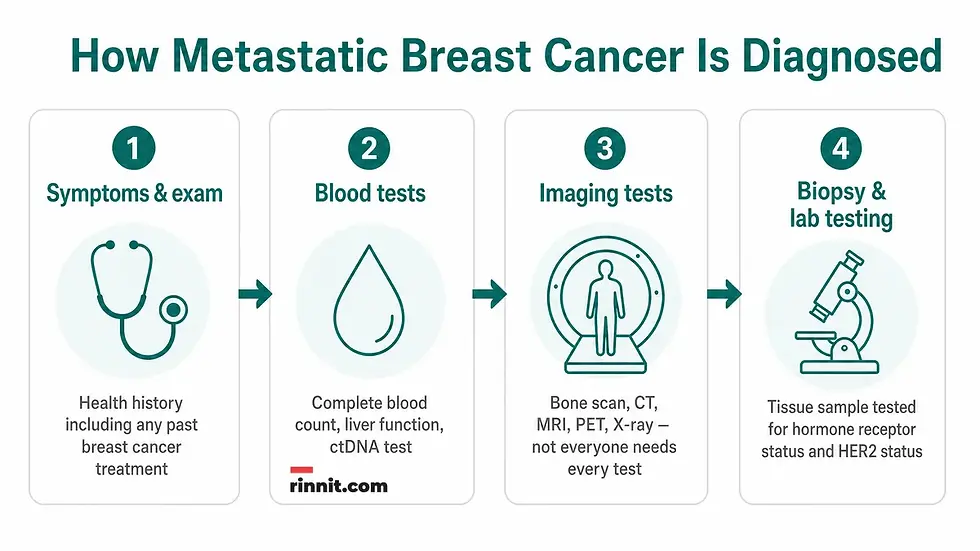
To diagnose metastatic breast cancer, a healthcare professional might start by asking about your symptoms and doing an exam. Most people with this cancer were treated for breast cancer in the past, so the professional might ask about a previous cancer diagnosis and any treatments you had. [2]
The tests you need may depend on your symptoms and your situation. Tests may include blood tests, imaging tests and a biopsy procedure to remove a sample of tissue. [2]
What blood tests are used?
Blood tests alone usually can't confirm a metastatic breast cancer diagnosis, but they give the team clues about your overall health. Blood tests may include: [2]
Blood test | What it measures |
Complete blood count | The number of blood cells in a sample; clues about overall health [2] |
Liver function tests | How well the liver is working; whether cancer may be affecting the liver [2] |
Circulating tumor DNA (ctDNA) test | Tiny pieces of DNA from cancer cells in the blood; results help choose a treatment [2] |
What imaging tests are used?
Imaging tests make pictures of the body that healthcare teams use to look for signs of cancer. What imaging tests you'll have depends on your specific situation. Not everyone needs every test. Imaging tests may include bone scans, computerized tomography (CT) scans, magnetic resonance imaging (MRI), positron emission tomography (PET) scans and X-rays. [2]
What is a biopsy?
A biopsy is a procedure to remove a sample of tissue for testing in a lab. How the healthcare team does the biopsy may depend on where the cancer spreads. A healthcare professional may put a needle through the skin and into the cancer to get the sample. Sometimes surgery is needed to get the sample. In some situations, a blood test might find pieces of the cancer cells. [2]
What does lab testing reveal?
The biopsy sample goes to a lab for testing done by pathologists — doctors who look for disease in cells, fluids and tissue removed from the body. Lab tests might look for: [2]
Lab test | What it shows |
Hormone receptor (HR) status | Whether cancer cells have receptors that catch estrogen and progesterone. Most breast cancer cells use these hormones to grow. Receptors found for one or both hormones = HR positive; none found = HR negative. [2] |
HER2 status | Whether cancer cells make extra copies of the HER2 protein (human epidermal growth factor receptor 2), which some cells use to grow. Extra HER2 gene copies or high HER2 protein = HER2 positive; otherwise HER2 negative. [2] |
DNA changes in cancer cells | Certain DNA changes may make some targeted therapy and immunotherapy medicines work better; testing helps guide treatment choices. [2] |
If you've had breast cancer before, your cancer may have been tested for HR status and HER2 status at that time. When the cancer comes back, these tests are often repeated. Sometimes the cancer changes between the first diagnosis and the recurrence. [2]
Why is genetic testing done?
Some cancer medicines work better in people who are born with certain DNA changes. Your healthcare team may recommend genetic testing to see if your DNA has these changes. This testing uses a sample of blood or saliva to look for changes in your DNA. Unlike tests that look at changes in the DNA inside cancer cells, this genetic testing looks at DNA that's in all the cells in the body. The results also may provide information about cancer risk that can be helpful for your blood relatives. [2]
What is the treatment for metastatic breast cancer?
Metastatic breast cancer treatment usually starts with medicines. This may include estrogen blocker therapy, targeted therapy, chemotherapy or other medicines. Other treatments, such as surgery and radiation therapy, are used in certain situations. [2]
Metastatic breast cancer typically can't be cured. Treatments may help slow the growth of the cancer. The treatments may extend your life and help you live as well as possible, for as long as possible. [2]
Your treatment plan may depend on the cancer's characteristics, where and how far it has spread, and whether it is causing symptoms. If you've had breast cancer in the past, your plan also may depend on which treatments you have already received. [2]
Your goals and priorities also help guide treatment decisions. Some people want treatment that may help them live as long as possible, even if it causes more side effects. Others place greater importance on maintaining quality of life and limiting treatment side effects. Talk openly with your cancer care team and the people close to you about what matters most to you. [2]
How is treatment chosen by cancer type?
Your team uses the results of tests on your cancer cells — the hormone receptor (HR) status and the HER2 status — to identify the type of breast cancer you have. The type guides the treatment options your care team may recommend. [2]
Cancer type | Treatment may start with |
HR-positive, HER2-negative | Estrogen blocker therapy combined with targeted therapy, such as CDK4/6 inhibitor medicines [2] |
HR-positive, HER2-positive (including triple-positive) | Estrogen blocker therapy or chemotherapy combined with targeted therapy, such as anti-HER2 medicines [2] |
HR-negative, HER2-positive | Chemotherapy combined with targeted therapy, such as anti-HER2 medicines [2] |
HR-negative, HER2-negative (triple-negative) | Chemotherapy; immunotherapy or antibody-drug conjugates also may be options for some [2] |
If the first treatment stops working, your care team may adjust your medicines or try new medicines. There are many treatments for metastatic breast cancer, and more are being tested in clinical trials. [2]
How does treatment depend on where it spreads?
Treatments also may depend on where the cancer has spread. Breast cancer most often goes to the bones, brain, liver and lungs. [1] [2]
Where it spread | Treatment options |
Bones (bone metastasis) | Bone-building medicines can lower the risk of broken bones; radiation therapy or surgery may treat cancer that causes symptoms or complications [2] |
Brain (brain metastasis) | Radiation therapy or surgery [2] |
Liver (liver metastasis) | Chemotherapy, surgery or radiation therapy for cancer that causes symptoms or complications [2] |
Lungs (lung metastasis) | Chemotherapy or surgery for cancer that causes symptoms or complications [2] |

What is estrogen blocker therapy?
Estrogen blocker therapy treats breast cancer that is sensitive to hormones. This means the cancer cells have proteins called receptors. The receptors bind to the hormones estrogen and progesterone. The cancer grows in response to these hormones. Healthcare professionals call these cancers hormone receptor positive. Most breast cancers are sensitive to hormones. [2]
Estrogen blocker therapy also is called endocrine therapy and hormone therapy for breast cancer. [2]
Estrogen blocker therapy treatments can include medicines that lower hormone production (called aromatase inhibitors), surgery or medicines to stop the ovaries from making hormones, and medicines that block hormone receptors (called selective estrogen receptor modulators) or destroy them (called selective estrogen receptor degraders). [2]
For metastatic breast cancer that is hormone receptor positive, estrogen blocker therapy often starts with an aromatase inhibitor medicine. If you haven't been through menopause, you also may need treatment to stop the ovaries from making hormones. Estrogen blocker therapy often is combined with targeted therapy. [2]
What is chemotherapy?
Chemotherapy treats cancer with strong medicines. Many chemotherapy medicines exist. Chemotherapy for breast cancer often involves giving the medicine through a vein. Some medicines are available in pill form. [2]
For metastatic breast cancer, chemotherapy may be used when estrogen blocker therapy isn't an option or is no longer working. Chemotherapy also may be used if the cancer is causing serious complications, such as if it's hurting the liver or lungs. Chemotherapy may help shrink the cancer more quickly than other treatments. [2]
What is targeted therapy?
Targeted therapy uses medicines that attack specific chemicals in the cancer cells. By blocking these chemicals, targeted treatments can cause cancer cells to die. [2]
Many targeted therapy medicines exist for metastatic breast cancer. Your cancer cells may be tested to see which medicines are most likely to work against the cancer. Examples include: [2]
Medicine type | What it targets | Who it treats |
Anti-HER2 medicines | Cancer cells making extra HER2 protein [2] | HER2-positive cancers |
CDK4/6 inhibitors | Proteins called cyclin-dependent kinases (CDK) 4 and 6 on cancer cells; help make estrogen blocker therapy more effective [2] | Hormone receptor positive cancer |
PARP inhibitors | Enzymes in cancer cells that repair breaks in DNA; blocked, the cells may die [2] | Cancer in people with certain DNA changes, such as BRCA1 and BRCA2 |
Targeted therapy may be used alone or with other cancer treatments. [2]
What are antibody-drug conjugates?
Antibody-drug conjugates are medicines that combine targeted therapy with chemotherapy. These medicines use targeted therapy to identify the cancer cells and deliver chemotherapy directly to those cells. [2]
Antibody-drug conjugates are often used to treat metastatic breast cancer that is triple negative or HER2 positive. These medicines also may treat other types of breast cancer when other treatments don't help. [2]
What is immunotherapy?
Immunotherapy is a treatment with medicine that helps the body's immune system kill cancer cells. The immune system fights off diseases by attacking germs and other cells that shouldn't be in the body. Cancer cells survive by hiding from the immune system. Immunotherapy helps the immune system cells find and kill the cancer cells. [2]
Immunotherapy may help treat triple-negative breast cancer. Immunotherapy is typically used with chemotherapy or antibody-drug conjugates. Other types of breast cancer are sometimes treated with immunotherapy if tests on the cancer cells show this medicine might help. [2]
What are bone-building medicines?
If cancer has spread to your bones, your healthcare professional may recommend a bone-building medicine to lower your risk of broken bones or reduce bone pain. These medicines don't treat the cancer. They may be used along with other treatments, such as estrogen blocker therapy and chemotherapy. [2]
What is radiation therapy?
Radiation therapy treats cancer with powerful energy beams. The energy can come from X-rays, protons or other sources. [2]
Radiation therapy for breast cancer often uses external beam radiation. During this type of radiation therapy, you lie on a table while a machine moves around you. The machine directs radiation to precise points on your body. [2]
Radiation therapy might help relieve symptoms such as pain for people with metastatic breast cancer. Radiation also may be used to treat cancer that spreads to the brain. [2]
Is surgery an option?
Surgery isn't a common treatment for metastatic breast cancer. It might be used to remove an area of cancer that's causing symptoms or complications. It may be an option when other treatments haven't helped. [2]
If your cancer is metastatic when it's first diagnosed, it's not clear whether removing the cancer in the breast may help. Studies have found different results. If surgery is part of your care plan, treatment usually starts with medicines. Then surgeons may remove the cancer in the breast with a mastectomy or lumpectomy procedure. [2]
What are clinical trials?
Clinical trials are studies of new treatments. These studies provide a chance to try the latest treatments. The risk of side effects might not be known. Ask your healthcare team if you might be able to be in a clinical trial. [2]
What role does palliative care play?
Palliative care is a special type of healthcare that helps you feel better when you have a serious illness. If you have cancer, palliative care can help relieve pain and other symptoms. A team of healthcare professionals gives palliative care. This team can include doctors, nurses and other specially trained health professionals. Their goal is to improve the quality of life for you and the people who care about you. [2]
Palliative care specialists work with you, your family and your healthcare team to help you feel better. They provide added support while you have cancer treatment. You can have palliative care at the same time as treatment for cancer, such as surgery, chemotherapy or radiation therapy. [2]
When palliative care is used with all of the other appropriate treatments, people with cancer may feel better and live longer. [2]
What is the outlook for metastatic breast cancer?
The prognosis for metastatic breast cancer is improving. But the cancer usually can't be cured. Most people with this diagnosis will die from their cancer. [2]
One study that tracked metastatic breast cancer survival over time found that it has improved greatly as more medicines have become available. In that study, the most recent median survival time was more than three years. This means half of the people studied lived longer than three years, and half lived less than three years. [2]
If you want to know more about your personal outlook, talk about it with your healthcare team. Your care team knows the details of your cancer and treatment. Care team members can give you a sense of your prognosis and help you make sense of what it means for you. [2]
Your healthcare team can't know exactly how long you will live. But they may be able to give you a general range based on what is known about people in similar situations. This range is only an estimate, but it may help you plan for the future. [2]
When thinking about your prognosis, your healthcare team might consider:
Factor considered | Why it matters |
Time since first diagnosis | How long the cancer has been present [2] |
Previous treatments | Which treatments you had before [2] |
Where the cancer has spread | The places involved [2] |
Symptoms | What the cancer is causing [2] |
Hormone receptor status | Whether cells use estrogen or progesterone to grow [2] |
HER2 status | Whether cells use extra HER2 protein to grow [2] |
DNA changes in the cancer cells | Changes that affect how medicines work [2] |
Overall health | Your general condition [2] |
Some people want to know as much as possible about prognosis and life expectancy, while others choose to focus on treatment and day-to-day life. The amount of information that feels helpful is different for everyone. [2]
There may come a time when you and your care team decide treatment has little chance of prolonging your life or that the side effects are more than you're willing to accept. The focus of your treatment may switch to comfort and helping you achieve the highest possible quality of life. Choosing to stop cancer-directed treatment doesn't mean giving up. It may allow you to spend more time and energy on the people, activities and experiences that matter most to you. [2]
How can you cope with this diagnosis?
A diagnosis of metastatic breast cancer can bring shock, fear, anger, sadness and many other emotions. You may feel overwhelmed, want to withdraw or find that your feelings change from one day to the next. There's no right way to react. Over time, many people find ways to adjust to the uncertainty and may continue living meaningful, fulfilling lives. Here are some strategies that may help you cope. [2]
Give yourself time to adjust
Once the initial emotions settle, many people reach a point of acceptance. Accepting a diagnosis of metastatic breast cancer doesn't mean that you're OK with it or that difficult feelings go away. You may still have days when you feel angry, afraid or sad. Acceptance can simply mean beginning to understand your circumstances and finding ways to live with this new reality. [2]
As you adjust, you may gain a clearer sense of what matters most to you. You may find it easier to make decisions about the future, spend more time with people you care about or let go of things that feel less important. This process takes time, and it may not follow a straight path. [2]
Connect with family and friends
Choosing to tell family and friends that the breast cancer has spread can be one of the hardest parts of the diagnosis. There's no single right way to have these conversations. It may help to choose a time when you won't be interrupted and to tell one trusted person first. Someone who listens, cares and is there for you can help you feel supported as you talk with others. [2]
People may react in different ways or need time to understand what metastatic breast cancer means. When you feel ready, let people know what kind of support would help most — examples include listening, driving you to treatment, or helping with meals, children or household tasks. [2]
Talking with a spouse, partner or children may take more than one conversation. Be as open as you can. For young children, use words they can understand. Honest conversations can ease fear, help the people close to you prepare, and create opportunities for closeness and support. [2]
Reach out for support resources
Find a good listener you can talk to about your hopes and fears. This may be a friend or family member. You also may find it helpful to talk with a counselor, medical social worker or clergy member. Or join a cancer support group for understanding and guidance. [2]
Ask your healthcare team about local support groups, or contact a national cancer organization in your area to find resources. Find support online through communities where you can connect with others for support, practical information and answers to everyday questions. [2]
Find sources of meaning and connection
A diagnosis of metastatic breast cancer may lead you to look for meaning, comfort or a connection to something beyond yourself. For some people, that connection comes through faith or religion. For others, it may come through nature, relationships, service, music, meditation or art. [2]
You also may find meaning in thinking about the mark you want to leave. This could mean sharing stories, writing letters, creating a scrapbook, recording memories, volunteering or supporting a cause that matters to you. Reflecting on your life, relationships and contributions can bring a sense of purpose, pride and connection. [2]
Seek financial assistance
Cancer care can be costly. Along with medical bills, you may have other expenses, such as travel, lodging, childcare or time away from work. These costs can affect more than your budget. They also can add to the mental health burden that may come with having cancer. [2]
If you're facing financial difficulties because of your cancer care, tell someone on your cancer care team as soon as possible. Most cancer clinics have staff who can talk with you about finances — social workers, case managers, financial counselors and patient navigators. These professionals may guide you through billing questions (including payment plans and reduced rates), assist in finding alternative financial resources from government, nonprofit and charitable institutions, help assess your insurance and eligibility for programs such as Medicare and Medicaid, and help you save on medicines. [2]
How should you prepare for appointments?
If you have any signs or symptoms that worry you, make an appointment with your healthcare professional. Your healthcare professional can recommend the necessary tests and procedures to confirm a diagnosis of metastatic breast cancer. Then you'll likely be referred to an oncologist — a doctor who specializes in diagnosing and treating cancer. [2]
What you can do
Preparation step | Why it helps |
Be prepared to discuss your new symptoms | Includes any other health concerns that seem relevant [2] |
Request your medical records | Get records from your previous healthcare professional, or bring imaging tests and sign a release form [2] |
Make a list of all medicines, vitamins or supplements | Includes any alternative treatments you've tried [2] |
Consider asking a family member or friend to come | Someone with you may remember something you missed or forgot [2] |
Write down questions to ask | Makes the most of the appointment [2] |
Some basic questions to ask your healthcare professional include: Has my cancer spread? Are there other possible causes for my symptoms? What kinds of tests do I need, and do these tests require any special preparation? What are the hormone receptor status and the HER2 status of the cancer? What treatments are available to me, and which do you recommend? What types of side effects can I expect from treatment? Are there any alternatives to the approach you're suggesting? Are there any clinical trials open to me? What's my outlook? [2]
Your healthcare professional is likely to ask you several questions too. They may ask: When did you first notice symptoms again? Has there been a change in the symptoms over time? How do you feel overall? Have you had any unexpected weight loss or lost your appetite? Are you having any pain? [2]
Conclusion and next steps
Metastatic breast cancer is breast cancer that has traveled from the breast to other parts of the body — most often the bones, brain, liver and lungs. For most people it's a cancer that came back after earlier treatment. While it typically can't be cured, treatment has improved greatly as more medicines have become available. Care usually starts with medicines chosen by the cancer's hormone receptor and HER2 status — estrogen blocker therapy, targeted therapy, chemotherapy, antibody-drug conjugates and immunotherapy — with radiation, surgery, bone-building medicines and palliative care added as needed. People are surviving longer with metastatic breast cancer, and a strong support system, clear goals, and honest conversations with your care team can help you live as well as possible, for as long as possible. [1] [2]
Talk with a healthcare professional. If you have symptoms that worry you, or if you were treated for breast cancer in the past and develop new symptoms, make an appointment with a doctor or other healthcare professional. Tell them about your previous diagnosis and treatment. For more plain-language guides to breast cancer and advanced cancer topics, explore the related articles on Rinnit.com.
Frequently Asked Questions
What does "metastatic" mean?
The term "metastatic" means the cancer has spread from the breast to other parts of the body. Breast cancer cells break away and travel through the lymphatic system or the bloodstream. Breast cancer most often spreads to the bones, brain, liver and lungs. [1]
What is stage 4 breast cancer?
Stage 4 breast cancer is another name for metastatic breast cancer. It's also called stage IV breast cancer and secondary breast cancer. [1]
Does metastatic breast cancer cause symptoms?
Not at first. When symptoms happen, they depend on where the cancer spreads. General symptoms include pain, deep tiredness, shortness of breath, swollen lymph nodes, loss of appetite and weight loss without trying. Cancer in the bones can cause bone pain and breaks; in the brain, headaches, vision changes and seizures; in the liver, belly swelling and yellowing skin; in the lungs, cough and chest pain. [1]
Is metastatic breast cancer a new cancer or a recurrence?
For most people, it's a breast cancer recurrence — cancer that comes back after treatment for a previous breast cancer diagnosis. But some people have metastatic cancer when they're first diagnosed. [1]
Can it be cured?
When the cancer is advanced and has spread to other organs, it typically can't be cured. But treatment can help control the cancer effectively, may extend your life, and helps you live as well as possible. [1]
How is it diagnosed?
Through an exam plus blood tests (including a complete blood count, liver function tests and a circulating tumor DNA test), imaging tests (bone scan, CT, MRI, PET, X-ray), a biopsy, and lab testing that checks hormone receptor status, HER2 status and DNA changes. Genetic testing with a blood or saliva sample may also be recommended. [2]
How is it treated?
Treatment usually starts with medicines — estrogen blocker therapy, targeted therapy (anti-HER2, CDK4/6 inhibitors, PARP inhibitors), chemotherapy, antibody-drug conjugates, or immunotherapy — chosen by the cancer's HR and HER2 status. Radiation, surgery, bone-building medicines, clinical trials and palliative care may also be part of care. [2]
What is the outlook?
The prognosis is improving. One study found the most recent median survival time was more than three years — half of people lived longer than three years, half lived less. [2] The outlook varies from person to person, so it's best to discuss your own situation with your healthcare team.
Is cancer in the bones or liver still breast cancer?
Yes. Even when it grows in another organ, the cancer is made of breast cancer cells. That is why it is treated with breast cancer medicines, not as bone or liver cancer.
Is palliative care the same as hospice?
No. Palliative care eases pain, other symptoms, and stress, and it can be given at any stage alongside cancer treatment. Hospice care is for when treatment aimed at controlling the cancer has stopped.
Related Reading
Read next on Rinnit.com:
What Is Mantle Cell Lymphoma? A Plain-Language Guide to This Rare Blood Cancer
What Is a Malignant Peripheral Nerve Sheath Tumor? A Plain-Language Guide to This Rare Cancer
What Is Mammary Duct Ectasia? A Plain-Language Guide to Clogged Milk Ducts
Median Arcuate Ligament Syndrome (MALS): Symptoms, Causes, and What Treatment Really Involves
References
Mayo Clinic Staff. Metastatic (stage 4) breast cancer - Symptoms and causes. Mayo Clinic. August 13, 2026. https://www.mayoclinic.org/diseases-conditions/metastatic-breast-cancer/symptoms-causes/syc-20605550
Mayo Clinic Staff. Metastatic (stage 4) breast cancer - Diagnosis and treatment. Mayo Clinic. August 13, 2026. https://www.mayoclinic.org/diseases-conditions/metastatic-breast-cancer/diagnosis-treatment/drc-20605563
National Cancer Institute, SEER Program. Cancer Stat Facts: Female Breast Cancer. SEER. Accessed October 15, 2026. https://seer.cancer.gov/statfacts/html/breast.html
Breast Cancer Research Foundation. Breast Cancer Statistics and Resources. Breast Cancer Research Foundation. Accessed October 15, 2026. https://www.bcrf.org/breast-cancer-statistics-and-resources/
Mariotto AB, et al. Estimation of the number of women living with metastatic breast cancer in the United States. Cancer Epidemiol Biomarkers Prev. 2017;26(6):809-815. PMID 28522448. https://doi.org/10.1158/1055-9965.EPI-16-0889
Gobbini E, et al. Time trends of overall survival among metastatic breast cancer patients in the real-life ESME cohort. Eur J Cancer. 2018;96:17-24. PMID 29660596. https://doi.org/10.1016/j.ejca.2018.03.015
Shao H, et al. A network meta-analysis of efficacy and safety for first-line and second/further-line therapies in postmenopausal women with hormone receptor-positive, HER2-negative, advanced breast cancer. BMC Med. 2024;22(1):13. PMID 38212842. https://doi.org/10.1186/s12916-023-03238-2
Medical disclaimer
This article is for informational purposes only and is not medical advice. Always consult a qualified healthcare professional for diagnosis and treatment decisions.



Comments