Median Arcuate Ligament Syndrome (MALS): Symptoms, Causes, and What Treatment Really Involves

Updated: 2 days ago
Medically reviewed by Dr. Baraa Alnahhal, MD · Last reviewed: October 2026
Median arcuate ligament syndrome (MALS) is a rare condition in which a band of tissue in the upper belly presses on the celiac artery and the nerves around it. It mainly causes stomach pain after eating or exercising, fear of eating, and unintended weight loss. Surgery to release the pressure is the only treatment, and it can improve or reduce symptoms in most people [1][2].
Quick Answer: What is median arcuate ligament syndrome?
Median arcuate ligament syndrome (MALS) is a condition in which a band of tissue in the upper belly presses on the celiac artery and the surrounding celiac plexus nerves. It mainly causes stomach pain after eating or exercising, often with weight loss and nausea. Surgery to release the ligament is the only treatment and improves symptoms in most people. [1] [2]
What the research says
Most studies report lasting symptom relief after treatment, but the evidence is imperfect. A systematic review of 38 studies of 880 adults (plus 6 studies of 195 children) found that most adult studies reported more than 70% symptom relief from 3 to 228 months after treatment. However, 35 of the 38 adult studies had a high or unclear risk of bias, a formal meta-analysis could not be done, and the meaning of celiac plexus resection or blockage could not be substantiated (Metz et al., Eur J Vasc Endovasc Surg, 2022 [3]).
Open surgery gave more pain relief, but laparoscopic surgery meant fewer complications. In a retrospective study of 271 patients at one center (120 open, 151 laparoscopic), pain improved in 84.2% after open release versus 71.5% after laparoscopic release. Open surgery also had more postoperative ileus (17.5% vs 2.0%) and longer hospital stays (4.6 vs 1.7 days) (Alsabbagh et al., J Vasc Surg, 2026 [4]).
Laparoscopic and robotic-assisted release performed similarly. A meta-analysis of 5 retrospective studies with 158 patients found no differences in conversion to open surgery, pain resolution, complications, or hospital stay. Symptoms took longer to return after robotic surgery (9.04 months longer; 95% CI 4.18 to 13.89), but prospective studies are still needed (Arabi et al., J Robot Surg, 2026 [5]).
What Is Median Arcuate Ligament Syndrome?
MALS happens when the band of tissue in the upper belly area presses on the artery that sends blood to the stomach, spleen, and liver. This tissue is called the median arcuate ligament, and the artery is called the celiac artery [1]. To learn more about this artery, read our guide to the celiac trunk.
The median arcuate ligament creates a pathway between the chest and belly area for the body's main blood vessel, the aorta. Typically, the ligament goes across the aorta, and the celiac artery sits just below the arch. But sometimes the ligament or arteries are out of place. The ligament may then put pressure on the celiac artery and on the network of surrounding nerves, called the celiac plexus. This pressure causes the symptoms of MALS and can cause serious stomach pain in some people [1].
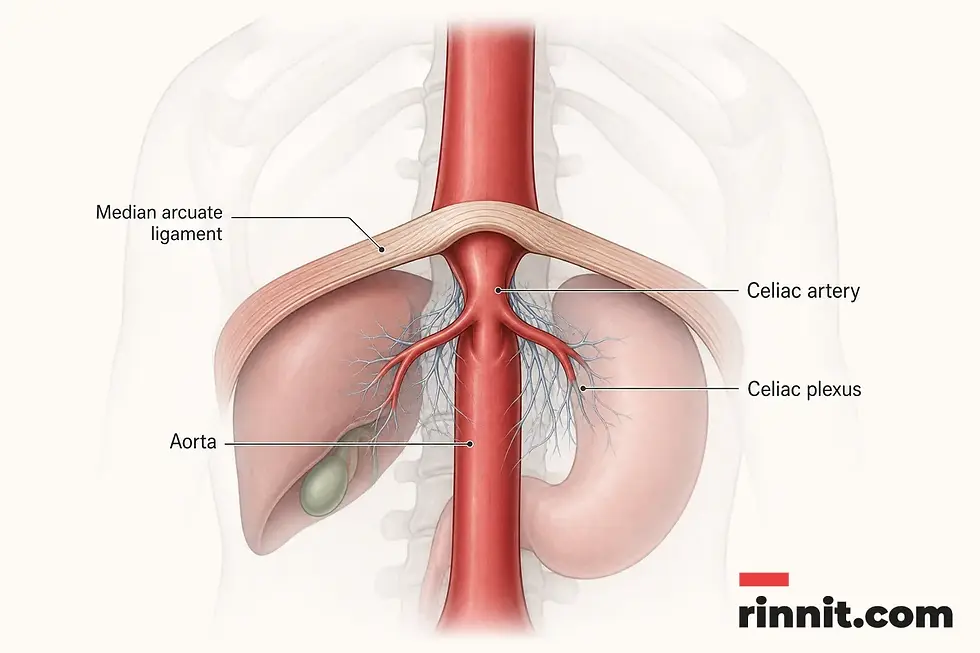
The median arcuate ligament can press on the celiac artery and the celiac plexus nerves.
MALS can occur in anyone, even children. Other names for it are celiac artery compression syndrome, celiac axis syndrome, and Dunbar syndrome [1].
What are the symptoms of median arcuate ligament syndrome (MALS)?
Pressure on the celiac artery in MALS does not always cause symptoms, but when it does, pain after meals can lead to a fear of eating and unintended weight loss. MALS symptoms are mainly caused by pressure on the nerves [1]:
Symptom | What it looks like in daily life |
|---|---|
Stomach pain after eating or exercising | Pain that arrives after meals or physical activity |
Positional relief | The pain gets better by leaning forward or backward, or by standing while eating |
Fear of eating | Avoiding food because eating causes pain |
Unintended weight loss | Losing weight without trying to |
Bloating | A swollen, uncomfortable feeling in the belly |
Diarrhea | Loose or frequent stools |
Nausea and vomiting | Queasiness, sometimes with throwing up |

Pain after meals can lead to a fear of eating and unintended weight loss.
When to See a Doctor
There are many different causes of stomach pain. If your stomach pain continues despite home care, call your healthcare professional. You need a complete physical exam and tests to find the specific cause [1].
If your stomach pain is bad and activity or movement makes it worse, call your healthcare professional immediately. Get medical help right away if your stomach pain occurs with [1]:
Bloody stools
Fever
Nausea and vomiting that doesn't go away
Severe tenderness when you touch your belly
Swelling of the belly
Yellowing of the skin or whites of the eyes (jaundice)
Upper stomach pain can sometimes be confused with chest pain, and chest pain can be due to a heart attack. Call 911 or emergency medical help if you have chest or upper stomach pain with or without any of the following [1]:
Pressure, fullness, or tightness in your chest
Crushing or searing pain that spreads to your jaw, neck, shoulders, and one or both arms
Pain that lasts more than a few minutes or gets worse with activity
Shortness of breath
Cold sweats
Dizziness or weakness
Nausea or vomiting
To learn more, read our guides on chest pain and on acute abdomen, when severe belly pain becomes an emergency.
What Causes MALS?
The exact cause of median arcuate ligament syndrome is not known. What is known is the mechanism: the ligament presses on the artery and the nerves around it. Why that pressure develops in some people and not in others remains unclear [1].
Who Is Most at Risk?
Because the cause of MALS is poorly understood, the risk factors are unclear. What has been observed [1]:
Risk factor | What's known |
|---|---|
Age | More common in adults than in children |
Sex | More common among women than among men |
Genetics | MALS has been seen in identical twins, so genetics may play a role |
Prior surgery or injury | Some people have developed MALS after pancreatic surgery or blunt injury to the upper stomach area |
Can MALS Cause Real Problems?
A complication of MALS is long-term pain, especially after meals. The pain can lead to a fear of eating and significant weight loss. The pain, along with related depression or anxiety, can greatly affect quality of life [1].
MALS symptoms may be vague and similar to those of other conditions, so it may take some time to get an accurate diagnosis [1].
How is median arcuate ligament syndrome (MALS) diagnosed?
MALS is diagnosed with a physical exam, a review of symptoms and usually many tests, because many other conditions can also cause stomach pain. The professional may hear a whooshing sound, called a bruit, when listening to your stomach with a stethoscope. The sound may occur when a blood vessel is narrowed. Because many conditions can cause stomach pain, you usually have many tests to find the cause and rule out other possible conditions [2]:
Test | What it looks for |
|---|---|
Blood tests | Checks for conditions of the liver, pancreas, kidneys, and other parts of the body. A complete blood count shows white and red blood cell levels, and a high white blood cell count can mean infection |
Ultrasound of the abdomen | Uses sound waves to see how blood is flowing. It can show if the celiac artery is compressed, especially when breathing in and out deeply |
Upper endoscopy (EGD) | A camera on a flexible tube examines the esophagus, stomach, and upper small intestine, and tissue samples (biopsies) can be taken |
Gastric emptying studies | Show how fast the stomach empties. Pressure on the celiac artery can slow it, but other conditions can too |
MRI or MRA | Magnets and radio waves make detailed images, and IV dye (contrast) shows how blood moves through the arteries |
Abdominal CT or CT angiogram | X-ray cross-sections can show whether the celiac artery is narrowed or blocked, and contrast dye makes vessels clearer |
Celiac plexus block | Numbing medicine is injected into the nerves on each side of the celiac artery for several hours, mimicking what happens during surgery. It is often used to learn who may do well with MALS surgery |
A celiac plexus block is one kind of nerve block. For readers who want to know how nerve blocks work in general, see our guide to nerve blocks.
What does surgery for MALS really involve?
Surgery is the only treatment for MALS, and it can improve or reduce symptoms in most people [2].
The Ligament Release (Decompression)
The most common surgical treatment is median arcuate ligament release, also called decompression. It is usually done as an open surgery through a cut in the belly area. Sometimes it is done using a camera and small instruments passed through several smaller openings, which is called laparoscopic surgery [2].
During the operation, the surgeon cuts away parts of the median arcuate ligament to reduce pressure on the celiac artery and nerves. The surgeon removes the nerves around the celiac artery and its branches, and bundles of nerves on each side of the artery may also be removed. Some people with MALS may also need surgery to repair or replace a blocked celiac artery and restore blood flow [2].
What Recovery Looks Like
If you have MALS release surgery, you usually stay in the hospital for 2 to 3 days. You may have an ultrasound or CT scan about a month after surgery to make sure blood flow is fully restored. You may also see a nutritionist to help you return to a healthy diet, which is particularly helpful if you haven't been eating or have lost a lot of weight [2].
How can people with MALS manage pain and stress?
Pain and stress often occur in a cycle. Pain can make you feel stressed, and stress can make pain worse. MALS pain may also make it difficult to eat, exercise, sleep, and do everyday tasks. Relaxation techniques, such as deep breathing and meditation, may reduce pain and improve mental health [2].
Coping and Support
Living with MALS may make you feel sad, anxious, or depressed, and the challenge of getting an accurate diagnosis may feel overwhelming. Sharing your thoughts and feelings with others who have similar experiences may help, and a support group can provide emotional support and help you learn new coping skills. The National MALS Foundation provides information and connections for people with MALS, and your healthcare team can recommend a support group in your area [2].
How should you prepare for a MALS appointment?
Preparing for a MALS appointment means writing down symptoms, personal information, medicines and questions, and checking whether you need to fast before any tests. Before you go [2]:
Find out if you need to do anything beforehand, such as not eating or drinking for a few hours before some blood or imaging tests.
Write down all your symptoms, including any that may not seem related to MALS.
Write down important personal information, including any family history of heart disease, stroke, high blood pressure, or blood clots, and any major stresses or recent life changes.
List all medicines, vitamins, and supplements you take, with dosages.
Bring a family member or friend if possible.
Write down your questions, from most to least important.

Come prepared with your symptoms, medicines, and questions.
Your healthcare team will likely ask when your symptoms started, whether they come and go, how bad the pain is, what makes it better or worse, whether you avoid eating or exercising because of pain, and whether you've lost weight [2].
What is the bottom line on median arcuate ligament syndrome?
MALS is a rare condition with a big effect on daily life: meals become something to fear, weight drops, and getting an answer can take time. The path forward is well defined, with a thorough round of tests to confirm the diagnosis, followed by surgical release of the ligament, which can improve or reduce symptoms in most people [1][2].
Your next step: if you have had stomach pain after eating or exercising for months, especially with weight loss and relief when you lean forward or backward, ask your healthcare professional whether MALS could be the cause [1][2].
Frequently Asked Questions
Is MALS a rare condition?
Yes. MALS is considered a rare condition. Its symptoms are vague and similar to those of other conditions, so it may take some time to get an accurate diagnosis.
Why does MALS cause pain?
Pressure on the celiac artery doesn't always cause symptoms. The symptoms are mainly caused by pressure on the nerves around the artery, called the celiac plexus.
Why does leaning forward or backward help?
Many people with MALS find that the stomach pain gets better by leaning forward or backward or by standing while eating, although the exact reason isn't established.
What tests help diagnose MALS?
Because many conditions cause stomach pain, you usually have many tests, which may include blood tests, abdominal ultrasound, upper endoscopy, gastric emptying studies, MRI or MRA, abdominal CT, and sometimes a celiac plexus block.
Is surgery the only treatment for MALS?
Yes. Surgery is the only treatment. The most common procedure is median arcuate ligament release (decompression), done as open or laparoscopic surgery, and it can improve or reduce symptoms in most people.
How long is the hospital stay after MALS surgery?
You usually stay in the hospital for 2 to 3 days, and you may have an ultrasound or CT scan about a month later to make sure blood flow is fully restored.
Can stress make MALS pain worse?
Pain and stress often occur in a cycle: pain can make you feel stressed, and stress can make pain worse. Relaxation techniques such as deep breathing and meditation may reduce pain and improve mental health.
When is stomach pain an emergency?
Get medical help right away if stomach pain comes with bloody stools, fever, nausea and vomiting that doesn't go away, severe tenderness, belly swelling, or jaundice. Call 911 for chest or upper stomach pain with chest pressure, pain spreading to the jaw, neck, shoulders, or arms, shortness of breath, cold sweats, or dizziness.
References
Mayo Clinic Staff. Median arcuate ligament syndrome (MALS) - Symptoms and causes. Mayo Clinic. Dec. 13, 2024. https://www.mayoclinic.org/diseases-conditions/median-arcuate-ligament-syndrome-mals/symptoms-causes/syc-20505001
Mayo Clinic Staff. Median arcuate ligament syndrome (MALS) - Diagnosis and treatment. Mayo Clinic. Dec. 13, 2024. https://www.mayoclinic.org/diseases-conditions/median-arcuate-ligament-syndrome-mals/diagnosis-treatment/drc-20505007
Metz FM, Blauw JTM, Brusse-Keizer M, et al. Systematic review of the efficacy of treatment for median arcuate ligament syndrome. Eur J Vasc Endovasc Surg. 2022;64(6):720-732. PMID 36075541. https://doi.org/10.1016/j.ejvs.2022.08.033
Alsabbagh Y, Erben Y, Lanka SP, et al. Balancing operative risk and symptom relief: outcomes of open versus laparoscopic release for median arcuate ligament syndrome: a retrospective study. J Vasc Surg. 2026;83(4):1100-1108.e4. PMID 41380920. https://doi.org/10.1016/j.jvs.2025.12.004
Arabi Z, Geropoulos G, Jayawardena P, et al. Outcomes in laparoscopic versus robotic-assisted surgery for median arcuate ligament syndrome: a systematic review and meta-analysis. J Robot Surg. 2026;20(1):615. PMID 42319707. https://doi.org/10.1007/s11701-026-03551-x
Medical disclaimer
This article is for informational purposes only and is not a substitute for professional medical advice, diagnosis, or treatment. The clinical information in this guide reflects source material last reviewed in December 2024.



Comments