
Simple Mastectomy: Procedure, Recovery, and Outcomes

Updated: 3 days ago
Medically reviewed by Dr. Baraa Alnahhal, MD · Last reviewed: October 2026
Quick Answer: What is a simple mastectomy?
A simple mastectomy is surgery that removes the entire breast, including tissue, skin, nipple and areola, to treat or prevent breast cancer, generally without removing all underarm lymph nodes. [1] It takes one to three hours under general anesthesia, and many people go home the same day. [1] Recovery focuses on wound healing and a gradual return to activity over several weeks.
When to call your care team
Call your surgeon for a fever of 100.4°F (38°C) or higher, spreading redness, pus or unusual drainage, or fast-growing swelling at the surgical site. [1] Get emergency help for chest pain or trouble breathing.
What the research says
Survival was similar for mastectomy and lumpectomy plus radiation. In a 20-year follow-up of 1,851 women with invasive breast cancer, there were no significant differences in disease-free or overall survival among total mastectomy, lumpectomy alone, and lumpectomy with radiation (hazard ratio for death 0.97; 95% CI 0.83 to 1.14 for lumpectomy plus radiation versus mastectomy). Cancer returned in the same breast in 14.3% of women who had lumpectomy plus radiation and 39.2% of those who had lumpectomy alone (Fisher et al., N Engl J Med, 2002 [2]).
Exercise after breast cancer surgery lowers pain and swelling risk. A meta-analysis of 22 randomized trials (2,305 patients) found that exercise reduced pain after surgery (mean difference −0.49; 95% CI −0.71 to −0.27), lowered the chance of lymphedema (odds ratio 0.34; 95% CI 0.19 to 0.61), and improved shoulder movement (Xue et al., Medicine (Baltimore), 2025 [3]).
Exercise is the best-supported option for long-lasting pain after mastectomy. In a meta-analysis of 18 trials of physical therapy for post-mastectomy pain syndrome, pooled exercise trials improved overall quality of life (standardized mean difference 0.87; 95% CI 0.36 to 1.37) and pain severity, while the benefit of acupuncture, myofascial release, and compression remained unclear (Kannan et al., Qual Life Res, 2022 [4]).
What is a simple mastectomy?
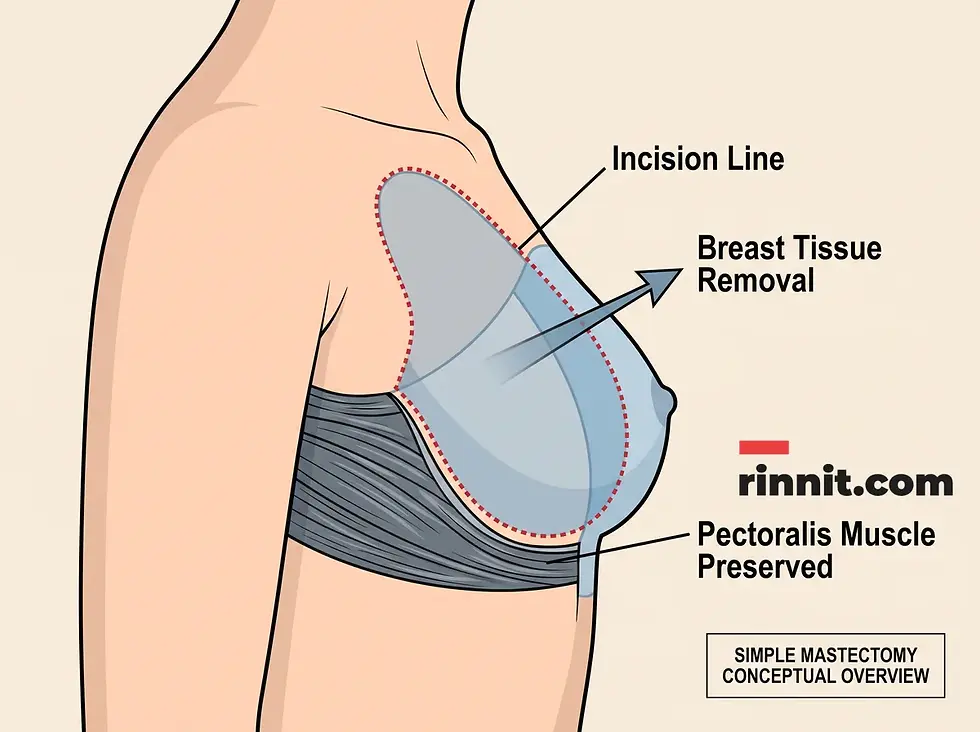
Simple mastectomy, often called total mastectomy, is a cornerstone of breast cancer treatment. It removes the whole breast while keeping the chest muscles underneath and most of the lymph nodes in the armpit. [1] Removing the main source of cancerous or high-risk tissue lets surgeons treat local disease and lower the chance of future cancer.
The decision to have a simple mastectomy is usually made with a multidisciplinary care team. It is often recommended for early-stage cancer that is confined to the milk ducts or for cancer that has returned. [1] People with a strong genetic risk may also choose it as a preventive step. [1] To compare it with related operations, see our guides to modified radical mastectomy and nipple-sparing mastectomy.

What conditions are treated with a simple (total) mastectomy?
Healthcare providers use simple mastectomy for several conditions. [1] The choice depends on how far the disease has spread and on the goals of your treatment plan.
Condition | Description |
Ductal carcinoma in situ (DCIS) | Non-invasive cancer confined to the milk ducts |
Invasive ductal carcinoma (IDC) | Cancer that has spread from the ducts into nearby breast tissue |
Invasive lobular carcinoma (ILC) | Cancer that begins in the milk-producing glands (lobules) |
Paget’s disease of the breast | A rare form of cancer affecting the skin of the nipple and areola |
Recurrent cancer | Breast cancer that has returned after earlier treatment |
High risk of breast cancer | Preventive surgery for people with a strong family history or a high-risk gene change |
What happens during a simple mastectomy?
A simple mastectomy is a standardized operation, usually done under general anesthesia. The goal is to remove the breast tissue completely and prepare the area for healing or later reconstruction.
Anesthesia and access: You are given general anesthesia, and a thin tube (IV) is placed in a vein for fluids and medicines. [1]
Tissue removal: The surgeon makes an elliptical incision around the breast and removes the breast tissue, skin, nipple, areola, and the lining (fascia) of the main chest muscle. [1]
Lymph node check: This is not a full lymph node removal, but a few “sentinel” nodes may be removed and tested to see whether the cancer has spread beyond the breast. [1]
Drainage and closure: A surgical drain is often placed to prevent fluid buildup (seroma), and the incision is closed with stitches and covered with sterile dressings. [1]
The operation usually takes one to three hours. It takes longer if breast reconstruction is done at the same time. [1]
What are the risks and complications of a simple mastectomy?
Simple mastectomy is common and generally safe, but like any major surgery it carries risks.
Risk category | Possible complication | What it means |
Fluid | Seroma | Fluid collects under the skin at the surgical site |
Infection | Wound infection | Redness, warmth, or drainage that may need antibiotics |
Nerves | Nerve injury | Numbness or tingling in the chest wall or underarm |
Long-term pain | Post-mastectomy pain syndrome | Chronic discomfort after surgery |
Lymph system | Lymphedema | Arm or hand swelling, especially if lymph nodes are removed or treated with radiation |
Some people also have shoulder or chest-wall stiffness, and emotional effects such as low mood or phantom breast sensations. [1] These deserve support and follow-up like any other part of recovery.
What is recovery and the outlook after a simple mastectomy?
Many people go home on the day of surgery, though some stay overnight for monitoring. [1] Early recovery focuses on wound and drain care, and most surgical wounds heal within a few weeks. [1] Light activity such as walking is encouraged almost right away to support circulation and healing.
For the first two weeks or so, avoid strenuous exercise and heavy lifting (usually anything heavier than a gallon of milk). [1] Physical therapy may be prescribed to restore full movement of the arm and shoulder. [1] [3] Long-term follow-up includes reviewing the pathology results and deciding whether more treatment is needed, such as radiation therapy, immunotherapy, or chemotherapy. [1]

Conclusion
A simple mastectomy is an important surgical option in the treatment and prevention of breast cancer. The physical and emotional challenges are real, but with good surgical care, a clear recovery plan, and supportive follow-up, most people recover well and can move forward with their treatment plan.
What are the next steps if you need a simple mastectomy?
If you are facing a breast cancer diagnosis or have a high risk, schedule a consultation with a breast surgical oncologist. Ask how simple mastectomy fits your treatment plan, what your reconstruction options are, and what recovery will look like for you.
Trusted resources: Cleveland Clinic: Simple Mastectomy (Total Mastectomy).
Frequently Asked Questions
What is the difference between a simple and a radical mastectomy?
A simple mastectomy removes the breast tissue, skin, nipple, and areola but leaves the chest muscles and most lymph nodes in place. A radical mastectomy is more extensive and removes the chest muscles and the underarm lymph nodes.
How long will I be in the hospital?
Most simple mastectomies are done as outpatient surgery, so you can go home the same day. Some people stay one night for observation, especially if they have other health conditions or have reconstruction.
Will I have a surgical drain?
Most people have one or two drains to remove extra fluid from the surgical area. They are usually removed at a follow-up visit within about one to two weeks.
When can I return to work?
Most people can return to non-strenuous work within about two to four weeks. If your job involves heavy lifting, you may need more time.
Can I have breast reconstruction at the same time?
Often yes. Immediate reconstruction can be done during the same surgery, so talk with your surgeon and a plastic surgeon before the operation.
What is phantom breast syndrome?
Phantom breast syndrome is the feeling that the breast is still there, sometimes with itching, pressure, or discomfort. It is a recognized nerve response after surgery.
How do I care for my incision at home?
Your care team will give specific instructions. In general, keep the area clean and dry, watch for signs of infection, and care for the drain as directed.
Will I need chemotherapy after a simple mastectomy?
That depends on the pathology results from the removed tissue and lymph nodes. Your oncologist will discuss next steps once the results are ready.
What are the signs of a surgical site infection?
Call your provider for a fever over 100.4°F (38°C), increased redness, warmth, swelling, or unusual drainage from the incision.
How soon can I exercise after surgery?
You can start gentle walking right away. Avoid strenuous activity and heavy lifting for at least two to four weeks, or until your surgeon clears you.
Is lymphedema common after a simple mastectomy?
Lymphedema is less common than after procedures that remove many lymph nodes, but it can still happen, especially if sentinel nodes are removed or radiation is needed.
What should I wear after surgery?
Many people find soft, front-opening tops or special post-mastectomy bras most comfortable while they heal.
Will I lose sensation in my chest?
Numbness in the chest wall and underarm is common because nerves are cut during surgery. Some feeling may return over time, but some numbness can be permanent.
How long does the surgery take?
A simple mastectomy usually takes one to three hours. If reconstruction is done at the same time, the total operating time is longer.
Are there support groups for people who have had a mastectomy?
Yes. Many hospitals and cancer organizations offer support groups, counseling, and other resources for the physical and emotional parts of recovery.
How do I prepare for a simple mastectomy?
Your provider examines you, reviews your medical history, and asks about your prescriptions, over-the-counter drugs, supplements, allergies and any bleeding problems; pre-operative tests may include lab work, a mammogram or a biopsy [1]. If you want breast reconstruction, discuss the options with your provider beforehand [1]. Your provider will tell you whether to fast for a set period before surgery, and you should arrange a ride home and help during your recovery [1].
Does a simple mastectomy hurt, and what anesthesia is used?
A simple mastectomy is usually done under general anesthesia, so you are asleep and feel no pain during the surgery, while an IV line delivers fluids and medication [1]. After surgery you receive pain medication as needed, and chest wall pain is a possible complication [1]. Chronic nerve-related pain in the breast, chest wall, armpit or inner arm that persists at least six months after surgery, known as post-mastectomy pain syndrome, affects 20 to 68 percent of patients [4].
When should I call my doctor after a simple mastectomy?
Call your provider for a fever of 100.4 F (38 C) or higher or chills, redness or skin discoloration around the incision, bleeding, drainage or swelling from the incision, or nausea or vomiting [1]. Also call for warmth, swelling or stiffness in your arm or hand, if the surgical drain clogs or its stitches are loose or missing, or if you feel depressed [1].
Related Reading
References
Cleveland Clinic. Simple Mastectomy (Total Mastectomy). Cleveland Clinic. December 4, 2025. https://my.clevelandclinic.org/health/procedures/simple-mastectomy
Fisher B, Anderson S, Bryant J, et al. Twenty-year follow-up of a randomized trial comparing total mastectomy, lumpectomy, and lumpectomy plus irradiation for the treatment of invasive breast cancer. N Engl J Med. 2002;347(16):1233-1241. PMID 12393820. https://doi.org/10.1056/NEJMoa022152
Xue T, Zhang L, Zhang D. Exercise-based interventions for postoperative rehabilitation in breast cancer patients: a systematic review and meta-analysis of randomized controlled trials. Medicine (Baltimore). 2025;104(34):e43705. PMID 40859515. https://doi.org/10.1097/MD.0000000000043705
Kannan P, Lam HY, Ma TK, et al. Efficacy of physical therapy interventions on quality of life and upper quadrant pain severity in women with post-mastectomy pain syndrome: a systematic review and meta-analysis. Qual Life Res. 2022;31(4):951-973. PMID 34185226. https://doi.org/10.1007/s11136-021-02926-x
Medical Disclaimer
This article is for informational purposes only and does not constitute medical advice. Always seek the advice of your physician or other qualified health provider with any questions you may have regarding a medical condition. Never disregard professional medical advice or delay in seeking it because of something you have read in this article.



Comments