Chemotherapy for Breast Cancer: Types, Timing and Side Effects

Updated: 2 days ago
Written and medically reviewed by Dr. Baraa Alnahhal, MD · Last reviewed: November 2026 · How we review
Quick Answer
Chemotherapy for breast cancer uses drugs to kill cancer cells in the breast or cells that have spread elsewhere in the body. It can be given before surgery to shrink a tumor, after surgery to lower the chance the cancer comes back, or as the main treatment for metastatic breast cancer. Most side effects go away after treatment.
What the research says
Modern chemo cut breast cancer deaths by a third: a meta-analysis of about 100,000 women in 123 trials found modern taxane-plus-anthracycline or higher-dose anthracycline chemotherapy reduced breast cancer deaths by about one-third, regardless of age (up to 70) or tumor features (EBCTCG et al., Lancet, 2012) [2]
More frequent dosing improved results: in a meta-analysis of 37,298 women in 26 trials, giving chemotherapy every 2 weeks or in sequence lowered 10-year recurrence from 31.4% to 28.0% and breast cancer death from 21.3% to 18.9% (EBCTCG, Lancet, 2019) [3]
Key takeaways
Chemo kills breast cancer cells throughout the body.
It can be given before surgery, after surgery or for metastatic cancer.
Treatment usually lasts three to six months, given in cycles.
Fatigue, nausea, hair loss and brain fog are common.
Call your care team for a fever above 100.4°F (38°C).
What is chemotherapy for breast cancer?
Chemotherapy is a common treatment for breast cancer. Your oncologist and pharmacist choose the drugs and dose based on your cancer type and stage, test results and body size. Sources: [1]
When chemo is used

Chemo is often combined with other treatments.
Timing | Goal |
Before surgery (neoadjuvant) | Shrink the tumor and see early how well the drugs work |
After surgery (adjuvant) | Kill tiny leftover cells and lower the chance of recurrence |
Metastatic cancer | Main treatment to ease symptoms and extend life |
Chemo is often the first treatment for inflammatory breast cancer. It may be combined with immunotherapy for triple-negative breast cancer and with targeted therapy for HER2-positive cancer likely to come back. Sources: [1]
Common chemotherapy drugs
Drug group | Examples |
Anthracyclines | Doxorubicin (Adriamycin), epirubicin (Ellence), liposomal doxorubicin (Doxil) |
Taxanes | Paclitaxel (Taxol), docetaxel (Taxotere), albumin-bound paclitaxel (Abraxane) |
Others for early-stage cancer | 5-FU, capecitabine (Xeloda), cyclophosphamide (Cytoxan), carboplatin (Paraplatin) |
Others for metastatic cancer | Eribulin (Halaven), ixabepilone (Ixempra), vinorelbine (Navelbine), gemcitabine (Gemzar), cisplatin |
Antibody-drug conjugates | Ado-trastuzumab emtansine (Kadcyla), fam-trastuzumab deruxtecan (Enhertu), sacituzumab govitecan (Trodelvy) |
Sources: [1, 2]
How chemo is given

Treatment days may take a few hours.
Chemo is given as pills, injections or IV infusions.
Many people get a chemo port or PICC line.
Treatments come in cycles, usually two to three treatments per cycle, given weekly, every two weeks or every three to four weeks.
Rest periods let your body recover.
You'll stay about 30 minutes after each infusion so your team can check for reactions. Sources: [1, 3]
How to prepare
Arrange help at home for a day or so after treatment.
Plan transportation and bring a companion.
Wear comfortable clothes and bring a pillow, blanket and entertainment.
Drink extra water the day before.
Ask about palliative care for symptom support. Sources: [1]
Side effects
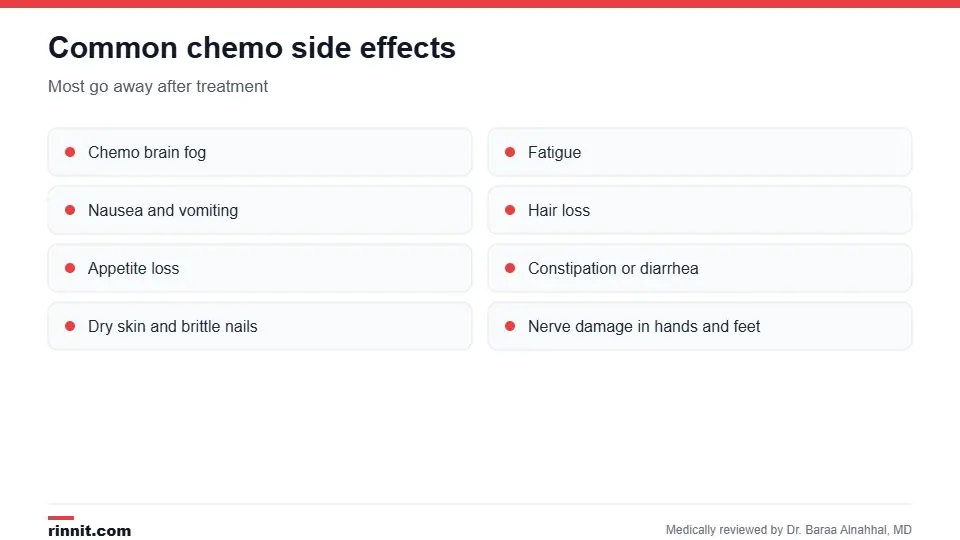
Most side effects go away after treatment ends.
Side effect | How long it may last |
Six months to a year after treatment | |
Fatigue | During and three to six months after |
Nausea and vomiting | Up to two to three weeks after |
Hair may regrow a different color | |
Other effects | Constipation, diarrhea, appetite loss, dry skin, brittle nails, peripheral neuropathy |
Some drugs may cause other cancers years later, such as acute myeloid leukemia. Sources: [1]
Coping during treatment
Eat several small meals a day, with protein to help with fatigue.
Try light exercise, such as walking or yoga.
Join a support group.
Tell your team about side effects; drugs may be changed if they're severe. Sources: [1]
Outlook
Along with surgery, chemo helps people live longer than surgery alone. In metastatic cancer, it can ease symptoms and extend life. After treatment, you'll have CT or MRI scans and regular follow-up. Sources: [1, 2, 3]
When to call your care team
A fever above 100.4°F (38°C).
Chills.
Chest pain or shortness of breath.
Sudden confusion.
Go to the ER for a severe headache with a stiff neck. Sources: [1]
Conclusion
Chemotherapy is a key treatment for many breast cancers, lowering the chance of recurrence and extending life. Knowing what to expect and reporting side effects early helps you get through treatment more comfortably.
Keep learning: read about breast cancer surgery and hormone therapy for breast cancer.
Frequently asked questions
What is chemotherapy for breast cancer?
Drugs that kill breast cancer cells in the breast or elsewhere in the body.
When is chemo given before surgery?
To shrink the tumor and see early how well the drugs work.
Why is chemo given after surgery?
To kill leftover cancer cells and lower the chance of recurrence.
How long does chemo for breast cancer last?
Usually three to six months, sometimes up to a year.
How is chemo given?
As pills, injections or IV infusions, often through a port.
Will I lose my hair?
Hair loss is common, and hair may regrow a different color.
What is chemo brain?
Brain fog that can last six months to a year after treatment.
How long does fatigue last?
During treatment and three to six months after.
Does chemo help people live longer?
Yes. With surgery, it helps people live longer than surgery alone.
When should I call my care team?
For a fever above 100.4°F (38°C), chills, chest pain or confusion.
Related Reading
Breast Cancer: Symptoms, Causes, and Treatment an overview of breast cancer.
Chemotherapy: How It Works, Side Effects, and What to Expect how chemotherapy works.
Chemo Port: What It Is, How It's Placed, Risks and Recovery a device for giving chemo.
Chemo Brain: Complete Guide to Symptoms, Causes, and Coping Strategies brain fog after cancer treatment.
Hormone Therapy for Breast Cancer: Types, How It Works, and Side Effects another breast cancer treatment.
References
Cleveland Clinic. Chemotherapy for Breast Cancer: Types & Side Effects. Cleveland Clinic. Last updated September 18, 2023. https://my.clevelandclinic.org/health/treatments/8340-chemotherapy-for-breast-cancer
Early Breast Cancer Trialists' Collaborative Group (EBCTCG), Peto R, Davies C, et al. Comparisons between different polychemotherapy regimens for early breast cancer: meta-analyses of long-term outcome among 100,000 women in 123 randomised trials. Lancet. 2012;379(9814):432-444. PMID 22152853. https://doi.org/10.1016/S0140-6736(11)61625-5
Early Breast Cancer Trialists' Collaborative Group (EBCTCG). Increasing the dose intensity of chemotherapy by more frequent administration or sequential scheduling: a patient-level meta-analysis of 37 298 women with early breast cancer in 26 randomised trials. Lancet. 2019;393(10179):1440-1452. PMID 30739743. https://doi.org/10.1016/S0140-6736(18)33137-4
Medical disclaimer
This article is for general education only and does not replace advice from a qualified healthcare professional. Talk to your doctor about your own diagnosis and treatment, and seek emergency care right away for severe or sudden symptoms.



Comments