Triple-Negative Breast Cancer (TNBC): Symptoms, Causes, Diagnosis and Treatment — What You Need to Know

Updated: 3 days ago
Medically reviewed by Dr. Baraa Alnahhal, MD | Last reviewed: October 17, 2026
Quick Answer
Triple-negative breast cancer (TNBC) is a fast-growing breast cancer whose cells lack estrogen receptors, progesterone receptors and the HER2 protein, so it won't respond to hormone or HER2-targeted therapy [1]. It is more common in women under 40 and Black women [1]. Treatment usually combines chemotherapy and sometimes immunotherapy before surgery, possibly followed by radiation or other therapies [2].
What the research says
Adding immunotherapy to chemotherapy before surgery improved outcomes in early TNBC. In the phase 3 KEYNOTE-522 trial of 1,174 patients with previously untreated stage II or III triple-negative breast cancer (784 given pembrolizumab plus chemotherapy, 390 given placebo plus chemotherapy), estimated event-free survival at 36 months was 84.5% with pembrolizumab versus 76.8% with placebo (hazard ratio for event or death 0.63; 95% CI 0.48–0.82; P<0.001) (Schmid et al., New England Journal of Medicine, 2022) [3].
For people with inherited BRCA1/BRCA2 variants, a year of olaparib after treatment lowered the risk of recurrence. In the phase 3 OlympiA trial of 1,836 patients with HER2-negative, high-risk early breast cancer and germline BRCA1 or BRCA2 variants, 3-year invasive disease-free survival was 85.9% with olaparib versus 77.1% with placebo (difference 8.8 percentage points; hazard ratio 0.58; 99.5% CI 0.41–0.82; P<0.001) (Tutt et al., New England Journal of Medicine, 2021) [4].
When should you see a doctor about triple-negative breast cancer?
TNBC is often a fast-growing cancer, and it may appear between routine mammograms more often than other breast cancer types. If you find a change in your breasts, report it even if a recent mammogram showed no breast cancer [1]. A healthcare professional may recommend additional imaging even when a recent mammogram was clear [1].
Breast change to watch for | Recommended action |
A lump or thickened area that feels different from surrounding tissue | Make an appointment; don’t wait for the next mammogram |
Puckered, dimpled or otherwise unusual skin on the breast | Make an appointment |
A thickened region under the skin | Make an appointment |
Nipple discharge, or a nipple that flattens or turns inward | Make an appointment |
Skin color change (pink or red on white skin; darker, red or purple on brown or black skin) | Make an appointment |
Change in breast size, shape or appearance; skin that peels, scales, crusts or flakes | Make an appointment |
What Is Triple-Negative Breast Cancer?
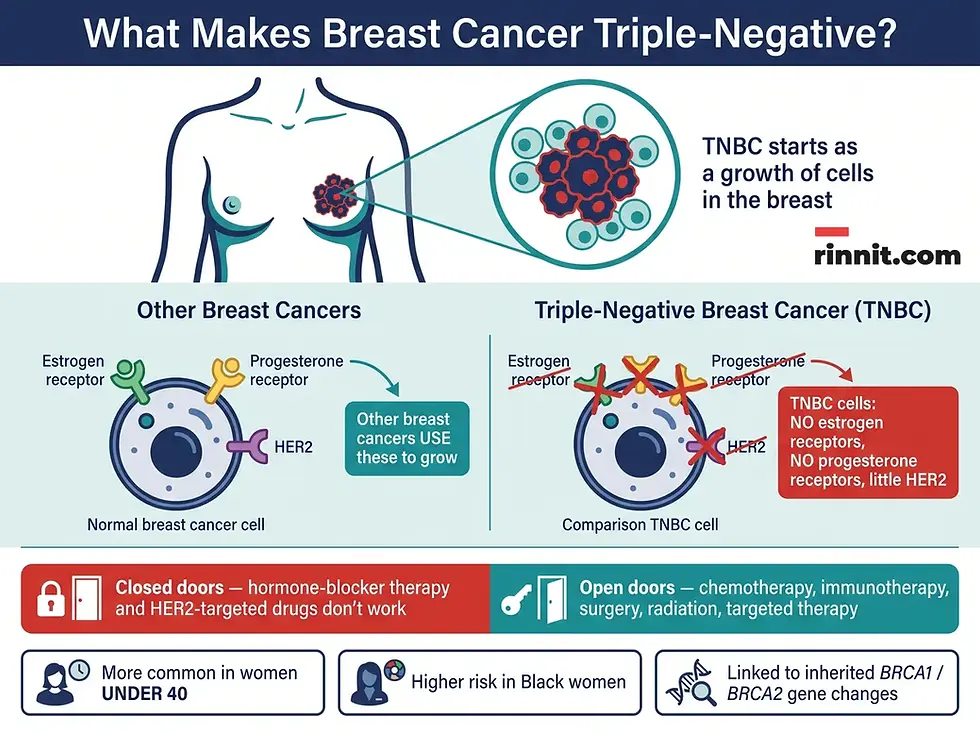
Triple-negative breast cancer (TNBC) is a fast-growing type of breast cancer. Like other types, it starts as a growth of cells in the breast. The difference lies in the cells’ receptors: TNBC cells don’t use the hormones estrogen and progesterone to help them grow, and they don’t make much of a protein called HER2 [1].
TNBC is called “triple negative” because the cells test negative for three things: estrogen receptors, progesterone receptors and the HER2 protein. Healthcare professionals use these test results to make treatment decisions.
The practical consequence: having TNBC limits some treatment options. The cancer won’t respond to estrogen-blocker therapy that lowers hormone levels, or to treatments that target the HER2 protein [1]. But it opens the door to a different set of tools: chemotherapy, immunotherapy, surgery, radiation and targeted therapies.
TNBC also tends to differ demographically. It happens at a younger age, is more common in Black women [1], and is more common in people with inherited DNA changes that increase breast cancer risk. And compared with other breast cancer types, it is more likely to be diagnosed at a later stage, often already large or spread to lymph nodes by the time it is found [1].
Question | Answer |
What is it? | A fast-growing breast cancer whose cells test negative for estrogen receptors, progesterone receptors and HER2 |
Why “triple negative”? | The three negative test results drive treatment decisions |
Why does it matter? | Limits hormone-blocker and HER2-targeted options; points to chemotherapy, immunotherapy, surgery, radiation and targeted therapy |
Who gets it? | More often younger women (under 40), Black women, and people with BRCA1 or BRCA2 DNA changes |
How is it found? | Often at a later stage, large or already spread to lymph nodes |
What Are the Subtypes of TNBC?
TNBC is not a single condition. It is a broad term for breast cancers that test negative for estrogen receptors, progesterone receptors and HER2, and it includes several subtypes [1]. This helps explain why two people with TNBC may have cancers that grow, spread or respond to treatment differently.
Subtype | What to know |
Basal-like 1 and basal-like 2 | Most, but not all, TNBC falls into the basal-like group. Named because lab testing shows features shared with healthy basal cells of the breast ducts and lobules. Often grows quickly [1] |
Mesenchymal and mesenchymal stemlike | Features linked to cell movement; the stemlike subtype also shows features linked to stemlike cells and blood vessel growth [1] |
Immunomodulatory | Shows signs of immune cells inside and around the cancer cells or tumor [1] |
Luminal androgen receptor | May use androgen hormone instructions to help cancer cells grow [1] |
Metaplastic | A rare subtype whose cancer cells don’t look like usual breast cancer cells under a microscope [1] |
What Are the Symptoms of Triple-Negative Breast Cancer?
TNBC may not cause signs or symptoms at first [1]. As it grows, its symptoms are usually the same as most other common breast cancer symptoms. Skin changes present differently on different skin tones:
Symptom | What to look for |
Breast lump or thickened area | Feels different from the surrounding tissue |
Nipple changes | A nipple that looks flattened or turns inward [1] |
Breast skin color changes | On white skin, may look pink or red; on brown or black skin, may look darker than the other chest skin, or red or purple [1] |
Size, shape or appearance change | Change in the size, shape or appearance of a breast |
Skin texture changes | Skin that looks dimpled or like an orange peel [1] |
Skin surface changes | Peeling, scaling, crusting or flaking of breast skin [1] |
What Causes Triple-Negative Breast Cancer?
The exact cause of TNBC often isn’t known [1]. The condition is more likely in people who inherit DNA changes that increase the risk of breast cancer, such as BRCA1 and BRCA2 [1]. These DNA changes run in families and raise breast cancer risk. However, not all people with TNBC have these DNA changes, and more research is needed to understand what causes this type of breast cancer.
What Are the Risk Factors?
Risk factor | What to know |
Age | Compared with other breast cancers, TNBC tends to happen at a younger age; more common in women under 40 [1] (other types occur more often in older women) |
Race and ethnicity | Black women have a higher risk of TNBC [1] |
Inherited DNA changes | A family history of BRCA1 or BRCA2 gene changes can increase TNBC risk; not everyone with these changes gets cancer |
Dense breast tissue | More dense tissue (milk glands, ducts, fibrous tissue) than fatty tissue; harder to find cancer on mammograms [1]; increases breast cancer risk; discuss additional tests beyond mammograms with your team |
Oral contraceptive use | Use for 10 years or more is linked with a higher risk of TNBC [1] |
First child at a younger age | Having a first child after age 30 may lower TNBC risk [1], the opposite of other breast cancers, where having a child before 30 lowers risk |
Early menstruation | Beginning your period before age 11 increases the risk of TNBC [1] and other breast cancers |
What Are the Complications?
Complication | What to know |
Cancer that comes back | TNBC can come back after treatment (recurrent cancer) and may spread to the lungs, liver, brain or bones; the risk is highest in the first few years after treatment [1] |
Infertility | Chemotherapy can affect the ability to get pregnant after treatment. Discuss with your team; a referral to a fertility specialist may follow, with options such as freezing eggs or embryos [1] and other fertility-preservation methods |
Ovarian cancer link (clarification) | TNBC itself does not cause ovarian cancer; both conditions are linked to BRCA gene changes [1] |
Can TNBC Be Prevented?
There’s no sure way to prevent TNBC [1]. But daily-life changes may help lower breast cancer risk in general. There is also currently no vaccine for TNBC [1].
Prevention step | What to know |
Ask about screening | Breast density and family history are linked to TNBC; discuss when to begin screening, its benefits and risks, and the right tests for you |
Breast self-exam for awareness | Can’t prevent cancer, but may help you notice changes [1]; report any new lump or atypical change right away |
Limit alcohol | Drink in moderation, if at all; for breast cancer prevention there is no safe amount [1] |
Exercise | At least 30 minutes on most days of the week [1] |
Maintain a healthy weight | No specific diet is linked to preventing TNBC [1] |
Breastfeed if you want to and can | May play a role in preventing breast cancer; longer breastfeeding, greater protective effect [1] |
How Is Triple-Negative Breast Cancer Diagnosed?
TNBC is usually diagnosed in steps, not with a single test. If symptoms or a screening mammogram suggest breast cancer, the workup begins with a physical exam [2] and then moves through imaging, biopsy, lab cell testing and biomarker testing.

Step | What happens |
Breast exam | The professional looks for anything not typical (skin or nipple changes), feels the breasts for lumps, and feels along the collarbones and around the armpits for lumps [2] |
Mammogram | An X-ray of breast tissue used to screen. A concerning finding triggers a diagnostic mammogram for a closer look at both breasts [2] |
Breast ultrasound | Sound waves make pictures; can show whether a lump is a solid mass or a fluid-filled cyst [2], guiding next tests |
Breast MRI | Magnetic field and radio waves create detailed pictures; may search the affected breast and the other breast for additional cancer areas; usually preceded by a dye injection [2] |
Biopsy | A needle passes through the skin into breast tissue, guided by imaging; tissue is drawn out, and a small metal marker is often placed in the spot [2] to help monitor the area |
Lab testing | Pathologists test the sample; results arrive as a pathology report covering cell type, cell grade, hormone receptor status, PD-L1 status, TILs, HER2 status and a Ki-67 score |
The pathology report gives the care team the details that define and direct TNBC care:
Lab finding | What it tells the healthcare team |
Cell type | Whether cancer cells are ductal, lobular or other kinds |
Cell grade | How cells look under a microscope; whether the cancer is likely to grow slowly or quickly |
Hormone receptor status | Whether cells use hormones to grow; TNBC is hormone receptor negative [2] |
PD-L1 status | Some cancer cells make this protein to hide from the immune system; testing shows whether immunotherapy is likely to work (used for TNBC that spreads or returns after treatment) [2] |
TILs (tumor infiltrating lymphocytes) | Immune cells around the cancer; may signal the immune system is actively fighting it; helps understand prognosis [2] |
HER2 status | Whether cells make extra HER2 protein or gene copies; TNBC is HER2 negative [2] |
Ki-67 score | A protein marking how fast cells divide (proliferation rate), scored from 0% to 100% [2]; higher means faster growth |
How Is Triple-Negative Breast Cancer Treated?
Treatment often involves several steps and typically includes surgery plus medicines such as chemotherapy and immunotherapy [2]. Radiation therapy, targeted therapy and antibody-drug conjugates may also be part of care [2].
If the cancer is small enough in stages 1 through 3, treatment may start with a lumpectomy or mastectomy. Sometimes treatment starts with medicine instead: chemotherapy and sometimes immunotherapy given before surgery. This pre-surgery approach, called neoadjuvant therapy [2], shrinks the cancer for easier removal and shows how well the treatment works, which guides decisions about post-surgery care. After surgery, some people receive more chemotherapy, more immunotherapy or radiation therapy [2].

Surgery Options
Procedure | What to know |
Lumpectomy | Removes the cancer and some healthy tissue around it [2]; the rest of the breast tissue stays |
Mastectomy (total/simple) | Removes all breast tissue (lobules, ducts, fatty tissue and some skin including the nipple and areola); the most common mastectomy |
Skin-sparing mastectomy | A newer type that leaves some skin; not for everyone [2] |
Nipple-sparing mastectomy | A newer type that leaves the nipple and areola; not for everyone [2] |
Sentinel node biopsy | Removes a few nearby lymph nodes for testing [2]; cancer spreads to nearby nodes first; if they’re clear, no other nodes need removal |
Axillary lymph node dissection | Removes many lymph nodes from the armpit [2]; used when imaging shows nodal spread or a sentinel node biopsy finds cancer |
Contralateral prophylactic mastectomy | Removal of the unaffected breast [2]; an option with high risk of future cancer in that breast (strong family history or DNA changes) |
Breast reconstruction | Restores breast shape after mastectomy, using an implant or your own tissue; consider a plastic surgeon referral before breast cancer surgery [2] |
Chemotherapy
Chemotherapy uses strong medicines that kill cancer cells. It can shrink TNBC to make surgical removal easier [2]. Many chemotherapy types damage cancer cells in different ways; most are given through a vein, though some come in pill form [2].
Immunotherapy
Immunotherapy is medicine that helps the body’s own immune system fight cancer cells. Cancer cells survive by hiding from the immune system; immunotherapy helps immune cells recognize and kill them. For TNBC it may be used before surgery (to shrink the cancer), after surgery, or when surgery isn’t an option [2]. For TNBC that has spread or come back, the team tests for the PD-L1 protein to see whether immunotherapy is likely to help; before surgery, immunotherapy is used whether or not the cancer has PD-L1 [2].
Radiation Therapy
Radiation therapy uses powerful energy beams, from X-rays, protons or other sources [2], directed at precise points while a machine moves around the table. For TNBC, it is sometimes used after surgery to kill any cancer cells that might remain [2].
Targeted Therapy
Targeted therapy uses medicines that attack specific chemicals in cancer cells; blocking those chemicals causes the cells to die. One example is PARP inhibitors, which target cells with BRCA1 or BRCA2 gene variations [2]. Testing can show whether these medicines might help. Many other targeted medicines exist, some used only when cancer comes back or spreads [2].
Antibody-Drug Conjugates
Antibody-drug conjugates combine targeted therapy with chemotherapy: the targeted component finds the cancer cells and delivers chemotherapy directly to them [2]. They are typically used alone or with other medicines to treat breast cancer that spreads [2].
How Do You Cope With and Prepare for Treatment?
No alternative medicine has been found to cure breast cancer [2], but complementary approaches may help you cope with side effects, especially fatigue [2], which can continue for years. Options include expressing your feelings (journaling, support groups, counseling), gentle exercise with your team’s approval (walking, swimming, yoga, tai chi), and stress management (muscle relaxation, visualization, time with loved ones).
For emotional support, talking with breast cancer survivors through support groups can be encouraging. The American Cancer Society or your healthcare team can help you find one, and online communities exist. A counselor, clergy member or medical social worker can also help you find someone to talk with [2]. Keeping friends and family close provides a crucial support network; think ahead about the help you may want, from meal preparation to pet care.
When preparing for appointments, write down your symptoms, key personal information (stresses, life changes), your family cancer history (relative, cancer type, age at diagnosis, survival), and all medicines and supplements with doses. Keep your records organized and bring a family member or friend. Specialists involved may include breast health specialists, breast surgeons, radiologists, oncologists, radiation oncologists, genetic counselors and plastic surgeons.
Conclusion
Triple-negative breast cancer is a different kind of breast cancer, defined not by what the cancer cells have but by what they lack: estrogen receptors, progesterone receptors and the HER2 protein. That “negative” profile closes some doors (hormone therapy and HER2-targeted drugs) but opens others: modern chemotherapy, immunotherapy, precise surgery, radiation and an expanding toolkit of targeted and conjugate medicines.
What matters most is speed and vigilance. TNBC is fast-growing and often appears between routine mammograms, which is why any breast change (a lump, puckered skin, a nipple that flattens, a color change that looks different on your skin tone) deserves a prompt appointment, not a wait for the next screening round.
TNBC is serious and demands prompt action, but it is also treatable through a coordinated, multi-step plan. Ask your healthcare team to explain your subtype, stage and pathology results; discuss fertility and support resources early; and lean on the specialists and support networks that exist for exactly this situation.
What is your next step if you are worried about triple-negative breast cancer?
If you or someone you love has noticed a breast change, book an appointment now. And if TNBC has been diagnosed, come to your first oncology visit with the questions in this article ready to ask.
Frequently Asked Questions
What is triple-negative breast cancer?
A fast-growing type of breast cancer whose cells test negative for estrogen receptors, progesterone receptors and the HER2 protein.
Why is it called “triple negative”?
Because the cells test negative for three markers: estrogen receptors, progesterone receptors and HER2. These test results drive treatment decisions.
What makes TNBC different from other breast cancers?
Its cells don’t use estrogen and progesterone to grow and don’t make much HER2 protein. So hormone-blocker therapy and HER2-targeted treatments don’t work, and treatment relies on chemotherapy, immunotherapy, surgery, radiation and targeted options instead.
Who is at higher risk?
Women under 40 (TNBC happens younger than other breast cancers), Black women, people with BRCA1 or BRCA2 gene changes, people with dense breasts, oral contraceptive users of 10 or more years, and those who began menstruation before age 11.
What causes TNBC?
The exact cause often isn’t known. Inherited BRCA1 or BRCA2 DNA changes increase risk, but not everyone with TNBC has them, and not everyone with these changes gets cancer.
What does “basal-like” mean?
A TNBC subtype. Most (not all) TNBC is basal-like, named for lab features shared with healthy basal cells of the breast ducts and lobules. Basal-like TNBC often grows quickly.
Can TNBC be prevented?
There is no sure way. General risk-lowering steps include breast awareness and self-exam, discussing screening based on your density and family history, limiting alcohol, exercising 30 minutes most days, maintaining a healthy weight, and breastfeeding if you want to and can. There is no vaccine for TNBC.
Why shouldn’t I wait for my next mammogram?
TNBC is fast-growing and may appear between routine mammograms. Report any breast change right away, even if a recent mammogram was clear. Additional imaging may be recommended.
How is TNBC diagnosed?
In steps: clinical breast exam, screening then diagnostic mammogram, ultrasound, breast MRI (with dye), needle biopsy (often with a marker placed), and lab testing that produces a pathology report with receptor status, cell grade, PD-L1, TILs and Ki-67.
What is a pathology report?
The lab’s written results describing cell type, cell grade (how fast the cancer is likely to grow), hormone receptor status (negative in TNBC), PD-L1 status (predicts immunotherapy response), TILs, HER2 status (negative in TNBC) and the Ki-67 score (0% to 100% cell division rate).
What is neoadjuvant therapy?
Chemotherapy, and sometimes immunotherapy, given before surgery to shrink the cancer for easier removal and to show how well the medicines work, which guides treatment after surgery.
What surgeries are used?
Lumpectomy (cancer plus surrounding tissue, breast kept), total mastectomy (all breast tissue removed), newer skin-sparing or nipple-sparing mastectomies, sentinel node biopsy (a few nodes tested), axillary lymph node dissection (many nodes removed if spread is found), and sometimes contralateral prophylactic mastectomy (removing the unaffected breast when future risk is high). Breast reconstruction with an implant or your own tissue is an option.
Will I need radiation?
Sometimes. It’s used after surgery to kill any remaining cancer cells, using precise energy beams from X-rays, protons or other sources.
What is immunotherapy and when does it work for TNBC?
Medicines that help your immune system recognize and kill cancer cells. It may be used before surgery, after surgery, or when surgery isn’t an option. For cancer that has spread, PD-L1 testing helps show whether it is likely to work; before surgery, it is used whether or not the cancer has PD-L1.
What are PARP inhibitors?
A targeted therapy that attacks cells with BRCA1 or BRCA2 gene variations. Testing can show whether these medicines might help your cancer.
What are antibody-drug conjugates?
Medicines combining targeted therapy with chemotherapy. The targeted part finds cancer cells and delivers chemotherapy directly to them. They are typically used for breast cancer that spreads.
Can TNBC come back?
Yes. It can recur after treatment and may spread to the lungs, liver, brain or bones. The recurrence risk is highest in the first few years after treatment.
Does chemotherapy affect fertility?
It can. If you want children in the future, discuss this with your healthcare team. A fertility specialist referral and options like freezing eggs or embryos are available.
Does TNBC cause ovarian cancer?
No. TNBC itself does not cause ovarian cancer. Both conditions are linked to BRCA gene changes.
Does TNBC look different on different skin tones?
Yes. Skin changes may look pink or red on white skin, while on brown or black skin they may look darker than the surrounding chest skin, or red or purple.
What should I ask at my first appointment?
Your TNBC type and stage, an explanation of your pathology report (ask for a copy), whether more tests are needed, treatment options and their benefits and side effects, fertility and menopause effects, daily-life impact, how quickly you need to decide, costs and insurance coverage, and whether clinical trials apply to you.
Where can I find support?
Support groups through the American Cancer Society or your healthcare team, online communities, counselors, clergy, medical social workers, and by keeping friends and family close during treatment.
Related Reading
Mastectomy: Types, Surgery, Recovery and Reconstruction explains the main types of mastectomy, how lymph nodes are checked and what to expect during recovery.
Breast Cancer Screening: When to Start, How Often and Which Tests Are Used explains when to start screening and which tests find breast cancer early.
Sources
Mayo Clinic Staff. Triple-negative breast cancer (TNBC) - Symptoms & causes. Mayo Clinic. July 31, 2026. https://www.mayoclinic.org/diseases-conditions/triple-negative-breast-cancer/symptoms-causes/syc-20604281
Mayo Clinic Staff. Triple-negative breast cancer (TNBC) - Diagnosis & treatment. Mayo Clinic. July 31, 2026. https://www.mayoclinic.org/diseases-conditions/triple-negative-breast-cancer/diagnosis-treatment/drc-20604299
Schmid P, Cortes J, Dent R, et al. Event-free survival with pembrolizumab in early triple-negative breast cancer. N Engl J Med. 2022;386(6):556-567. PMID 35139274. https://doi.org/10.1056/NEJMoa2112651
Tutt ANJ, Garber JE, Kaufman B, et al. Adjuvant olaparib for patients with BRCA1- or BRCA2-mutated breast cancer. N Engl J Med. 2021;384(25):2394-2405. PMID 34081848. https://doi.org/10.1056/NEJMoa2105215
Medical disclaimer
This article is for education only and is not a substitute for professional medical advice, diagnosis or treatment. Because TNBC is fast-growing, any new breast change should be evaluated by a healthcare professional promptly. Do not wait for a scheduled mammogram. Treatment decisions depend on your specific pathology, stage and health profile; always consult a qualified healthcare professional about your individual situation.



Comments