Serum Protein Electrophoresis (SPEP): What It Tests, How It Works and What Results Mean

Updated: 2 days ago
Written and medically reviewed by Dr. Baraa Alnahhal, MD · Last reviewed: November 2026 · How we review
Quick Answer: What is serum protein electrophoresis?
Serum protein electrophoresis (SPEP) is a blood test that separates the proteins in your blood by size, shape and electrical charge, then measures how much is in each group. Unusually high or low levels can point to conditions such as infection, inflammation, liver or kidney disease, autoimmune disease, malnutrition, MGUS or multiple myeloma. No preparation is needed. [1]
What the research says
SPEP works best as part of a panel. In 1,877 people with plasma cell disorders, a simplified screening panel of serum protein electrophoresis plus a serum free light chain test detected multiple myeloma, macroglobulinemia and light chain deposition disease as well as the full panel did. Compared with a panel that also used immunofixation, it was 8% less sensitive for MGUS. (Katzmann et al., Clinical Chemistry, 2009) [2]
Experts pair SPEP with other blood tests for screening. International Myeloma Working Group guidelines state that combining the serum free light chain test with serum protein electrophoresis and immunofixation gives high screening sensitivity and avoids the need for 24-hour urine collections, except when light chain amyloidosis is suspected. (Dispenzieri et al., Leukemia, 2009) [3]
Key takeaways
SPEP uses a blood sample and an electrical current to sort proteins into groups. [1]
Your two main blood proteins are albumin and immunoglobulins. [1]
High levels in certain groups can mean inflammation, cancer or immune system disorders. [1]
Low levels can mean malnutrition, kidney disease or liver disease. [1]
Results are a starting point; more tests are usually needed for a diagnosis. [1]
What is protein electrophoresis?
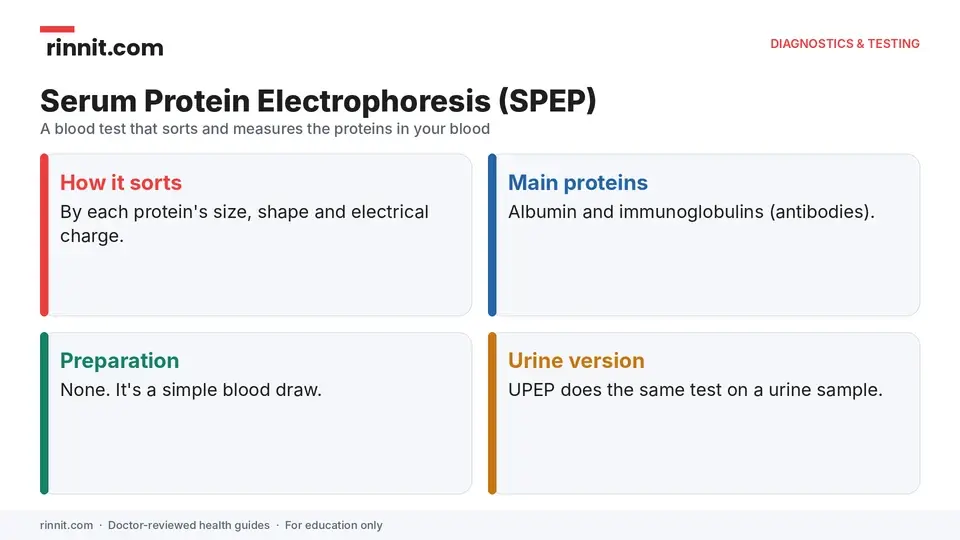
Protein electrophoresis is a test that separates and measures proteins. It's most often done on a blood sample, when it's called serum protein electrophoresis or SPEP. Proteins are important parts of your blood that help your body work. [1]
The test uses electrical current to group your blood proteins by their size, shape and electrical charge. Your provider then looks at how much protein is in each group. The results can help find health problems that change protein levels. [1]
Providers can also test your urine this way. That version is called urine protein electrophoresis, or UPEP. [1]
Why would you need an SPEP test?
Your healthcare provider may order serum protein electrophoresis if you have: [1]
Symptoms of a disease that causes abnormal protein levels
Unusual results from another blood test
SPEP can help detect or diagnose conditions such as: [1]
Autoimmune diseases
Inflammation and infection
Kidney disease
Liver disease
Malnutrition
How does serum protein electrophoresis work?
Your blood has many types of proteins. The two main ones are albumin and immunoglobulins, and each plays its own role in keeping your body working. Levels that are too high or too low can point to certain health problems. [1]
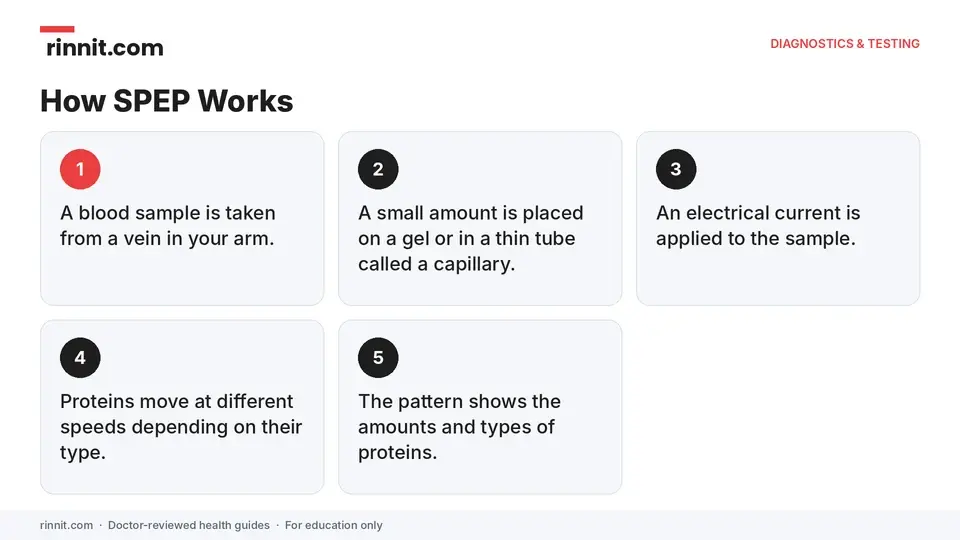
Here's how the test is done: [1]
A healthcare provider collects a blood sample from a vein in your arm.
A small amount of your blood is placed on a gel or in a thin tube called a capillary.
An electrical current is applied to the sample.
The proteins move through the gel or tube. How fast and how they move depends on the type of protein.
The pattern this creates shows the amounts and types of proteins in your blood and whether they're normal.
How do you prepare for SPEP?
You don't need to do anything to prepare for a serum protein electrophoresis test. [1]
Are there any risks?
There's little risk. The test is very safe and only involves giving a blood sample. You may have a bruise on your arm where the blood was taken. [1]
How do you read SPEP results?
You should get your results within a few days. The report shows the amount and pattern of the different proteins in your blood, and it may have two parts: [1]
Part of the report | What it shows |
Pattern (graph) | Abnormal highs and lows within each protein group, which form shapes that stand out to your provider |
Measurement | The amount or range of each protein as a number, showing whether it's higher or lower than normal |
Sources: [1]
What does an abnormal SPEP result mean?
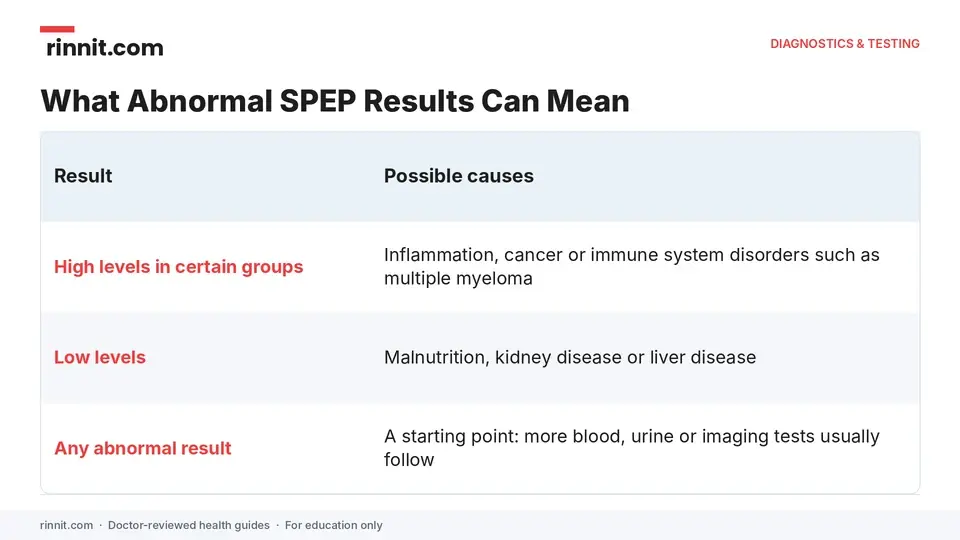
An abnormal result may point to a health condition: [1]
Result | Possible causes |
High levels in certain protein groups | Inflammation, cancer or immune system disorders |
Low levels | Malnutrition, kidney disease or liver disease |
Sources: [1]
Test results are only a starting point. Your provider will usually need more blood tests, urine tests or imaging tests to narrow down the cause or make a diagnosis. [1]
Conclusion
Serum protein electrophoresis is a safe blood test that sorts and measures the proteins in your blood. Its pattern and numbers give your provider important clues about infection, inflammation, organ problems, nutrition and blood disorders such as MGUS and multiple myeloma.
It's normal to feel nervous about the result. Lab tests like SPEP bring you closer to answers, and your care team can explain what yours means and what comes next.
Keep learning: Read our guide to multiple myeloma or our explainer on the albumin blood test. For more trusted, doctor-reviewed health guides, visit Rinnit.com.
FAQ
What is serum protein electrophoresis?
It is a blood test that separates proteins by size, shape and charge and measures each group.
What does SPEP stand for?
Serum protein electrophoresis.
Why would a doctor order SPEP?
To look for conditions that change protein levels, or after an unusual result on another blood test.
What conditions can SPEP detect?
Autoimmune disease, infection, inflammation, kidney or liver disease, malnutrition, MGUS and multiple myeloma.
Do I need to fast for SPEP?
No. You don't need to do anything to prepare.
What are the main proteins measured?
Albumin and immunoglobulins are the two main proteins in your blood.
What do high SPEP results mean?
High levels in certain groups can point to inflammation, cancer or immune system disorders.
What do low SPEP results mean?
Low levels can point to malnutrition, kidney disease or liver disease.
How long do SPEP results take?
You should get results within a few days.
What is UPEP?
Urine protein electrophoresis, the same kind of test done on a urine sample.
Related Reading
What Is Multiple Myeloma? A Plain-Language Guide to Symptoms, Causes, and Treatment explains the blood cancer that serum protein electrophoresis helps detect and monitor.
What Is MGUS? A Plain-Language Guide to This Common, Usually Quiet Blood Condition covers the common, usually quiet condition often first found on an SPEP test.
Smoldering Multiple Myeloma (SMM): What It Is, How It's Diagnosed, and What Comes Next — Complete Guide describes the early, symptom-free stage of myeloma and how it's tracked.
Waldenström Macroglobulinemia: Symptoms, Causes, Diagnosis and Treatment Options explains a blood cancer that makes too much of one antibody protein.
Amyloidosis: Symptoms, Causes, Treatment & Complete Guide covers the protein buildup disease that protein tests help diagnose.
Nephrotic Syndrome: Symptoms, Causes, and Treatment Guide explains a kidney condition that can lower blood protein levels.
Kappa Free Light Chain Test: Normal Ranges, Kappa/Lambda Ratio and What Results Mean explains the blood test that measures kappa and lambda light chains.
References
Cleveland Clinic. Serum Protein Electrophoresis. Cleveland Clinic. Last updated December 17, 2025. https://my.clevelandclinic.org/health/diagnostics/serum-protein-electrophoresis
Katzmann JA, Kyle RA, Benson J, et al. Screening panels for detection of monoclonal gammopathies. Clin Chem. 2009;55(8):1517-1522. PMID 19520758. https://doi.org/10.1373/clinchem.2009.126664
Dispenzieri A, Kyle R, Merlini G, et al. International Myeloma Working Group guidelines for serum-free light chain analysis in multiple myeloma and related disorders. Leukemia. 2009;23(2):215-224. PMID 19020545. https://doi.org/10.1038/leu.2008.307
Medical disclaimer
This article is for general education only and does not replace advice from a qualified healthcare professional. Talk to your doctor about your own diagnosis and treatment, and seek emergency care right away for severe or sudden symptoms.



Comments