Waldenström Macroglobulinemia: Symptoms, Causes, Diagnosis and Treatment Options

Updated: 2 days ago
Medically reviewed by Dr. Baraa Alnahhal, MD · Last reviewed: October 2026
TL;DR: Waldenström macroglobulinemia is a rare, slow-growing blood cancer (a type of non-Hodgkin lymphoma) in which cancerous white blood cells build up in the bone marrow and pour an excess IgM protein into the blood. That thick protein can slow blood flow, damage organs, and trigger an emergency condition called hyperviscosity syndrome. It cannot be cured, but many people live for years with treatments such as watchful waiting, plasma exchange, targeted therapy, chemotherapy, immunotherapy and, for some, stem cell transplantation.
Quick Answer: What Is Waldenström Macroglobulinemia?
Waldenström macroglobulinemia is a rare cancer that begins in white blood cells and is classified as a non-Hodgkin lymphoma. Cancer cells build up in the bone marrow, crowding out healthy blood cells, and produce IgM protein, which slows blood flow and can damage organs. [1] It cannot be cured, but treatment eases symptoms, and many people live for years. [2]
What the research says
Adding a targeted drug to rituximab delays progression. In a randomized trial of 150 symptomatic patients, 30-month progression-free survival was 82% with ibrutinib-rituximab versus 28% with placebo-rituximab (HR 0.20; P<0.001), and major responses were 72% versus 32%; grade 3 or higher atrial fibrillation (12% vs 1%) and hypertension (13% vs 4%) were more frequent with ibrutinib (According to PubMed, Dimopoulos et al., N Engl J Med, 2018) [3].
The benefit held up over time. In the final analysis (median follow-up 50 months), median progression-free survival was not reached with ibrutinib-rituximab versus 20.3 months with placebo-rituximab (HR 0.250), and responses of partial or better were seen in 76% versus 31% (According to PubMed, Buske et al., J Clin Oncol, 2022) [4].
Newer targeted drugs aim for fewer side effects. In a head-to-head trial (cohort 1: 201 patients with MYD88-mutant disease), very good partial response or better was 36.3% with zanubrutinib versus 25.3% with ibrutinib; atrial fibrillation/flutter (7.9% vs 23.5%) and hypertension (14.9% vs 25.5%) were less common with zanubrutinib, while neutropenia was more common (34.7% vs 20.4%) (According to PubMed, Dimopoulos et al., J Clin Oncol, 2023) [5].
What Is Waldenström Macroglobulinemia?
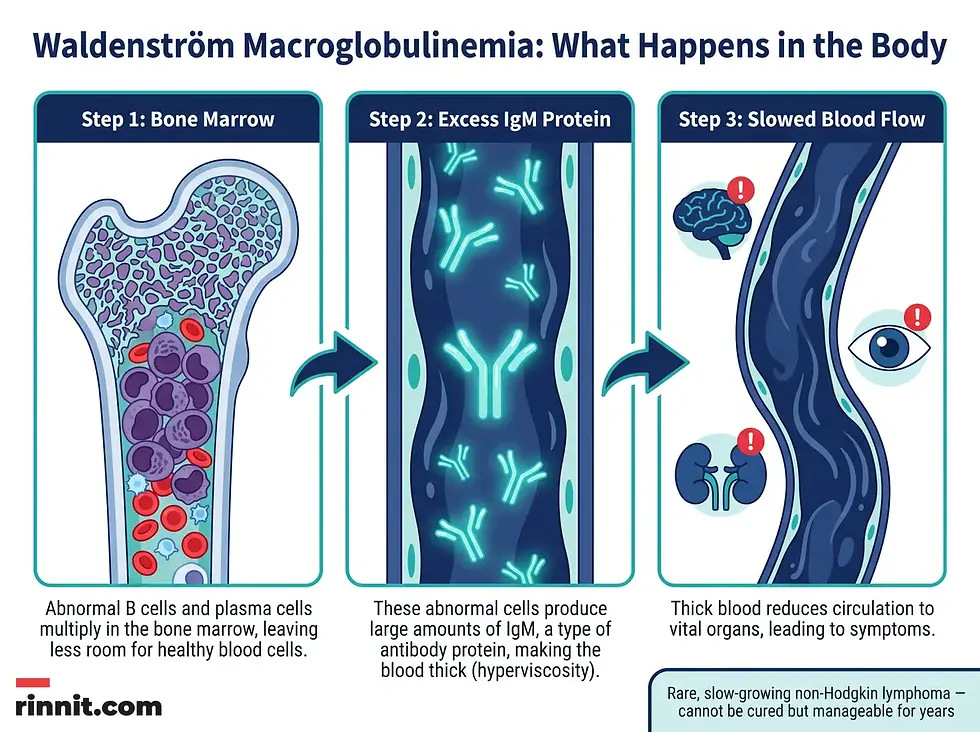
Waldenström macroglobulinemia is a type of blood cancer that starts in white blood cells. In this disease, white blood cells undergo DNA changes that turn them into cancer cells. These cells multiply and collect mainly in the bone marrow, where they push healthy blood cells out of their space. Over time, the cancer cells can also spread into the lymph nodes and the spleen. [1]
What makes this cancer unusual is what its cells produce. The cancer cells manufacture immunoglobulin M, or IgM — a protein the body cannot use. [1] IgM pours into the bloodstream and thickens the blood, much like adding syrup to water. This thickening reduces blood flow to organs and tissues and causes many of the disease's most serious problems. [1]
Key Fact | What It Means |
|---|---|
Cancer type | Non-Hodgkin lymphoma (lymphoplasmacytic lymphoma) |
Where it starts | White blood cells in the bone marrow |
Hallmark feature | Excess IgM protein thickening the blood |
Growth pattern | Slow-growing; may cause no symptoms for years |
Curable? | No — treatments focus on symptoms and organ protection |
Symptoms of Waldenström Macroglobulinemia
Because this cancer grows slowly, it may not cause any symptoms for years. [1] Many people learn they have it only after routine blood work or tests done for another reason.
When symptoms do appear, they often reflect the two main problems the disease creates: crowding out of healthy blood cells in the bone marrow, and thickening of the blood by excess IgM.
Symptom | Why It Happens |
|---|---|
Fatigue | Fewer healthy red blood cells (anemia) |
Fever | Body reacting to the cancer |
Drenching night sweats | Common lymphoma symptom |
Unintended weight loss | Metabolic effect of the disease |
Numbness or weakness in arms or legs | Nerve involvement |
Swollen lymph nodes | Cancer cells collecting in nodes (neck, armpits, groin) |
Pain or fullness under the ribs on the left side | Enlarged spleen |
Easy bruising | Fewer platelets for clotting |
Hyperviscosity Syndrome: A Blood-Flow Emergency
When IgM levels rise very high, the blood becomes thick and flows slowly. This is called hyperviscosity syndrome, and its symptoms are a medical emergency. [1]
Emergency Symptom | Description |
|---|---|
Vision changes | Blurry or double vision, vision loss |
Headache | Often persistent and severe |
Dizziness | Feeling unsteady or lightheaded |
Ringing in the ears | Tinnitus |
Sudden hearing loss | Abrupt loss of hearing |
Bleeding | Nosebleeds or bleeding gums |
Shortness of breath | Difficulty breathing |
Confusion and memory loss | Mental changes |
Fainting | Loss of consciousness |
Get emergency medical attention right away if you experience symptoms of hyperviscosity syndrome. [1] Do not wait for a scheduled appointment.
When to See a Doctor
Make an appointment with a healthcare provider if you have any symptoms that worry you, such as ongoing fatigue, unexplained weight loss, swollen lymph nodes, or drenching night sweats.
Seek emergency care immediately for signs of hyperviscosity syndrome — vision changes, sudden hearing loss, severe bleeding, confusion, or fainting — because thickened blood flow can cause life-threatening complications quickly.
Causes: How Waldenström Macroglobulinemia Starts
The exact cause of Waldenström macroglobulinemia is not clear. [1] What is known is that the disease starts with changes in the DNA of white blood cells. These genetic changes transform normal cells into cancer cells. [1]
The cancer cells then build up in the bone marrow and crowd healthy blood cells out of their space. They may also collect in the lymph nodes and spleen. [1] As they multiply, they produce IgM protein that the body cannot use. The IgM builds up in the blood, reduces blood flow, and creates the cascade of problems described above. [1]
Risk Factors
Several factors raise the odds of developing Waldenström macroglobulinemia.
Risk Factor | Details |
|---|---|
Older age | Most common in adults 70 and older, though it can occur at any age |
Race and ethnicity | White people are more likely to develop it than other races |
Family history of lymphoma | A blood relative (parent or sibling) with WM increases risk |
Autoimmune disease history | A history of autoimmune diseases increases risk |
Most people with these risk factors will never develop Waldenström macroglobulinemia, and some people with the disease have none of them.

Complications
Waldenström macroglobulinemia can lead to several serious complications as the disease progresses.
Complication | What It Involves |
|---|---|
Hyperviscosity syndrome | Thickened blood slows flow and can cause life-threatening complications |
Bing-Neel syndrome | The cancer involves the central nervous system (brain and spinal cord), causing headaches, seizures, weakness or numbness in limbs, and unusual nerve pain or tingling |
Transformation | The disease switches to a more aggressive form of cancer in some people |
Secondary cancers | Higher risk of thyroid cancer, kidney cancer, and melanoma |
About Bing-Neel syndrome. This complication means the Waldenström macroglobulinemia has reached the brain or spinal cord. It can develop during a period of remission or, less commonly, at the start of the cancer. When it develops later in the disease course, the outlook is usually worse. [1]
How Waldenström Macroglobulinemia Is Diagnosed
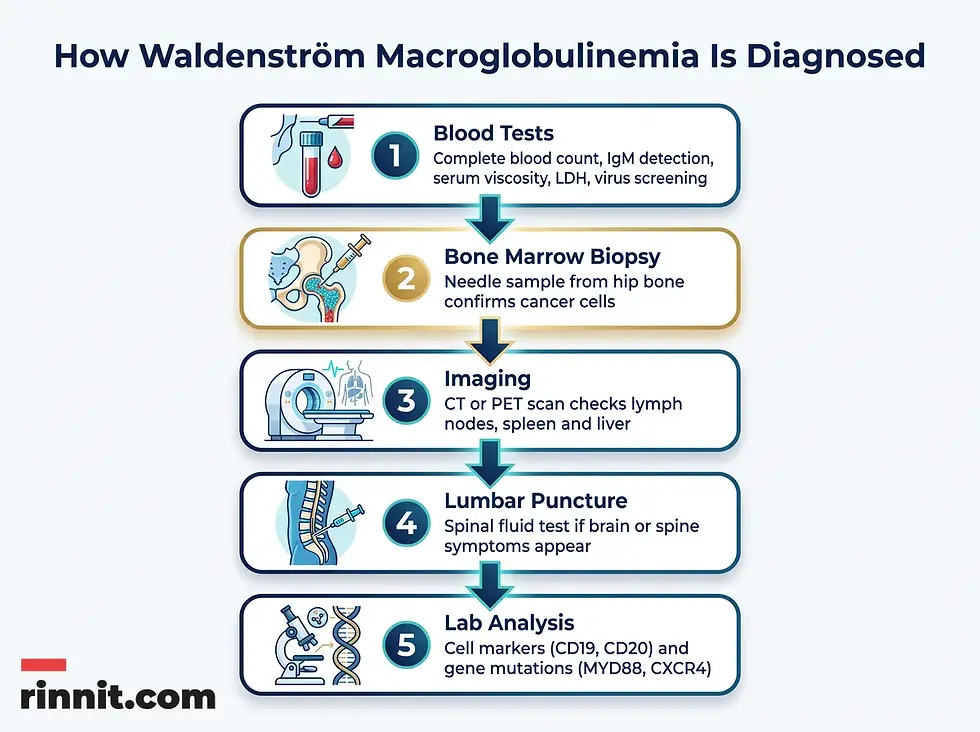
Diagnosis begins with a physical exam. The provider checks for swollen lymph nodes in the neck, underarms, and groin, and for an enlarged spleen or liver. [2] A series of specialized tests then confirms the diagnosis and measures how the body is affected.
Blood Tests
Blood testing is central to diagnosis because this is a disease of the blood.
Blood Test | What It Reveals |
|---|---|
Complete blood count (CBC) | Whether too few healthy blood cells are present |
IgM protein detection | The cancer-made protein, showing an "M spike" when increased |
Organ function tests | Whether excess IgM is harming the kidneys or liver |
Serum viscosity test | The blood's resistance to flow; high IgM thickens blood |
LDH level | Lactate dehydrogenase, often higher in lymphoma |
Virus screening | HIV, hepatitis B, and hepatitis C, which may affect treatment choices |
Bone Marrow Biopsy and Aspiration
A needle draws bone marrow fluid (aspiration), and another needle collects a small solid tissue sample (biopsy). Samples are most often taken from the hip bone. [2] The lab tests them for cancer cells. If cancer cells are found, additional tests provide more detail about the disease.
Imaging Tests
CT scans and PET scans look for enlarged lymph nodes, spleen, or liver. If Bing-Neel syndrome is suspected, an MRI of the brain and spinal cord is performed. [2]
Lumbar Puncture and Tissue Biopsy
If Bing-Neel symptoms appear — headaches, seizures, limb weakness or numbness, unusual nerve pain or tingling — a lumbar puncture (spinal tap) draws cerebrospinal fluid from around the brain and spinal cord for lab testing. A biopsy of central nervous system tissue may also be done. [2]
Testing the Cells in the Lab
Lab analysis of the cancer cells identifies proteins and markers on their surface — commonly CD19, CD20, and CD22 — and tests for the IgM protein. Genetic testing looks for DNA changes in the MYD88 and CXCR4 genes, which may help predict how quickly the cancer is likely to grow. [2]
Understanding Your Risk Group (WM Has No Stages)
Waldenström macroglobulinemia does not have traditional stages (1 through 4). [2] Because it affects the blood and bone marrow and is often found throughout the body, a different system is used instead.
Doctors assign a risk group using the Modified Staging System for Waldenström macroglobulinemia. There are four groups — low risk, low-intermediate risk, intermediate risk, and high risk — based on your age and blood test results. [2]
Factor | Effect on Risk Group |
|---|---|
Age over 65 | Increases risk group |
Age over 75 | Increases risk group even more |
LDH higher than usual | Increases risk group |
Albumin (a specific protein) low [2] | Increases risk group |
People in lower risk groups tend to live longer and need less frequent monitoring. [2] Higher risk groups face a higher chance of dying from the disease [2] and may receive closer follow-up or earlier treatment.
Importantly, risk groups do not determine when treatment should start. [2] They help you and your doctor discuss the outlook, guide follow-up scheduling, and plan long-term care. Many people with Waldenström macroglobulinemia live for years with treatment, and new therapies continue to improve survival. [2]
Treatment Options for Waldenström Macroglobulinemia
Your treatment plan depends on your symptoms, blood test and biopsy results, how quickly the cancer is growing, your overall health, and your preferences. [2]
Treatment | How It Works | When It's Used |
|---|---|---|
Watch and wait | No treatment yet; blood tests every few months | IgM present but no symptoms |
Plasma exchange | Removes IgM from blood, replaces with healthy plasma | Hyperviscosity syndrome suspected |
Targeted therapy | Medicines attack specific chemicals in cancer cells, causing them to die | Refractory or relapsed cancer; may combine with immunotherapy |
Chemotherapy | Strong medicines given through a vein or as pills | Usually combined with immunotherapy; also for relapsed/refractory |
Immunotherapy | Helps the immune system find and kill cancer cells | Combined with chemo or targeted therapy; relapsed/refractory |
Bone marrow transplant | Healthy stem cells replace cells damaged by treatment | Some relapsed/refractory cases |
Watch and Wait
If IgM is in your blood but you have no symptoms, you may not need treatment right away. Your blood is tested every few months to monitor the disease. This approach is sometimes called watchful waiting, and treatment may not be needed for years. [2]
Plasma Exchange (Plasmapheresis)
Plasma exchange physically removes the excess IgM proteins from the blood and replaces them with healthy plasma. [2] It is used when hyperviscosity syndrome is suspected or developing, and it eases the symptoms caused by too much IgM.
Targeted Therapy, Chemotherapy, and Immunotherapy
Targeted therapy medicines attack specific chemicals inside cancer cells. Blocking those chemicals causes the cancer cells to die. [2] Targeted therapy may be combined with immunotherapy and is used when other treatments have not worked (refractory disease) or when the cancer returns (relapse). [2]
Chemotherapy uses strong medicines, most given through a vein and some available as pills. It is usually combined with immunotherapy and is also used for relapsed or refractory disease. [2]
Immunotherapy helps your body's own immune system kill cancer cells. Cancer cells survive partly by hiding from immune defenses; immunotherapy helps immune cells find and destroy them. [2] It is combined with chemotherapy or targeted therapy and used for relapsed or refractory disease.
Bone Marrow Transplant (Stem Cell Transplant)
A bone marrow transplant puts healthy stem cells into the body to replace the cells damaged by chemotherapy and other treatments. When the cells come from your own body, it is called an autologous transplant; when they come from a donor, it is an allogeneic transplant. [2]
This is an option for some people with relapsed or refractory disease. Chemotherapy is typically given before the transplant to suppress the immune system and bone marrow. [2]
Monitoring After Treatment
Frequent follow-up appointments check for relapse. [2] Blood tests are repeated regularly to watch IgM levels and blood counts.
Coping and Support
A cancer diagnosis brings uncertainty and worry. With time, most people find what helps them cope. Learning enough about the disease to make informed care decisions builds confidence. Keeping friends and family close provides both practical help and emotional support. Finding someone to talk with — a counselor, social worker, clergy member, or a support group — helps carry the emotional weight.
Organizations that offer information and community support include the International Waldenström's Macroglobulinemia Foundation, the National Cancer Institute, the American Cancer Society, Blood Cancer United, and the Lymphoma Research Foundation. [2] Online communities such as patient discussion groups also connect people living with the disease.
Preparing for Your Appointment
If you have symptoms that worry you, make an appointment. If Waldenström macroglobulinemia is suspected, you will likely be referred to a hematologist — a doctor who specializes in diseases of the blood and bone marrow. [2]
Because appointments can be brief, prepare in advance. Ask whether you need to do anything ahead of time, such as restrict your diet. Write down all symptoms, important personal information (stresses or life changes), and every medicine, vitamin, and supplement with its dose. Take a family member or friend along, and write down your questions.
Questions to Ask Your Doctor | Questions Your Doctor Will Ask You |
|---|---|
Do I have Waldenström macroglobulinemia? | When did your symptoms begin? |
What is my risk group? | Do symptoms occur all the time or off and on? |
Will I need more tests? | How bad are your symptoms? |
What treatment options are available? | What makes symptoms better or worse? |
How much does each treatment prolong life? | Have you had fevers, night sweats, or weight loss? |
What are the side effects of each option? | Any lumps, swelling, or pain? |
How will treatment affect my daily life? | Do you have other medical conditions? |
Which options have shown the best results? | Has anyone in your family had lymphoma? |
What would you recommend for someone in my situation? | What are your biggest worries? |
Should I see a specialist? | — |
Are there brochures or recommended websites? | — |
What determines my follow-up plan? | — |
Don't hesitate to ask other questions. You can also ask about clinical trials testing new treatments and tests for this disease.
Living with Waldenström Macroglobulinemia: The Bottom Line
Waldenström macroglobulinemia is a rare, slow-growing blood cancer that thickens the blood with excess IgM protein. It cannot be cured, but many people manage it for years — sometimes without any treatment at all.
The key steps are knowing the warning signs (especially hyperviscosity syndrome, which is an emergency), getting an accurate diagnosis with blood tests and bone marrow analysis, understanding your risk group, and building a treatment plan with a hematologist that fits your symptoms, health, and priorities.
If you have unexplained fatigue, swollen lymph nodes, night sweats, or any sign of thickened blood — vision changes, bleeding, confusion — talk to a healthcare provider. Early evaluation gives you the full range of options and the best chance of protecting your organs and your quality of life.
Related reading: Non-Hodgkin's lymphoma
Frequently Asked Questions
What is Waldenström macroglobulinemia in simple terms?
Waldenström macroglobulinemia is a rare, slow-growing blood cancer — a type of non-Hodgkin lymphoma — in which cancerous white blood cells build up in the bone marrow and produce too much IgM protein. The excess protein thickens the blood, slows blood flow, and can damage organs.
Is Waldenström macroglobulinemia curable?
No. Waldenström macroglobulinemia cannot be cured. Treatments aim to ease symptoms, reduce organ damage, and control the disease. Many people live for years with the condition under medical care.
What causes Waldenström macroglobulinemia?
The exact cause is not clear. It begins when changes in the DNA of white blood cells turn them into cancer cells. These cells collect in the bone marrow, crowd out healthy blood cells, and produce IgM protein that the body cannot use, which builds up and thickens the blood.
What are the first signs of Waldenström macroglobulinemia?
The disease grows slowly and may cause no symptoms for years. Early signs include fatigue, fever, drenching night sweats, unintended weight loss, numbness or weakness in the arms or legs, swollen lymph nodes, left-sided rib-area fullness from an enlarged spleen, and easy bruising.
What is hyperviscosity syndrome?
Hyperviscosity syndrome occurs when too much IgM protein thickens the blood and slows its flow. Symptoms include blurry or double vision, headache, dizziness, ringing in the ears, sudden hearing loss, nose or gum bleeding, shortness of breath, confusion, memory loss, and fainting. It is a medical emergency.
Does Waldenström macroglobulinemia have stages?
No. It does not have stages 1 through 4 because it affects the blood and bone marrow and is often widespread. Instead, doctors use the Modified Staging System to assign one of four risk groups (low to high) based on age, LDH, and albumin levels.
Who is at risk for Waldenström macroglobulinemia?
Risk rises with older age — it is most common in adults 70 and older. White people are more likely to develop it than other races. Having a blood relative with the disease or a history of autoimmune diseases also increases risk.
How is Waldenström macroglobulinemia diagnosed?
Diagnosis starts with a physical exam and blood tests (complete blood count, IgM detection, organ function, serum viscosity, LDH, and virus screening). A bone marrow biopsy from the hip bone confirms cancer cells. Imaging, lumbar puncture, and lab testing of cell markers and gene mutations complete the workup.
What treatments are available?
Options include watchful waiting with regular blood tests, plasma exchange to remove excess IgM, targeted therapy, chemotherapy, immunotherapy, and bone marrow (stem cell) transplant. The plan depends on symptoms, test results, disease growth, overall health, and patient preference.
What is watchful waiting for Waldenström macroglobulinemia?
If IgM is present in the blood but there are no symptoms, treatment may not be needed right away. Blood tests are repeated every few months to monitor the disease. This is called watchful waiting or watch-and-wait, and treatment may not be required for years.
What complications can Waldenström macroglobulinemia cause?
Complications include hyperviscosity syndrome, Bing-Neel syndrome (cancer in the brain or spinal cord), transformation to a more aggressive cancer, and a higher risk of secondary cancers such as thyroid cancer, kidney cancer, and melanoma.
Related Reading
Globulin Blood Test: What It Measures, Normal Range and What High or Low Levels Mean explains the blood test that checks protein levels linked to this condition.
Serum Protein Electrophoresis (SPEP): What It Tests, How It Works and What Results Mean explains the blood test that sorts and measures blood proteins to help detect conditions like MGUS and multiple myeloma.
References
Mayo Clinic Staff. Waldenstrom macroglobulinemia - Symptoms and causes. Mayo Clinic. Oct. 17, 2026. https://www.mayoclinic.org/diseases-conditions/waldenstrom-macroglobulinemia/symptoms-causes/syc-20359967
Mayo Clinic Staff. Waldenstrom macroglobulinemia - Diagnosis and treatment. Mayo Clinic. Dec. 20, 2025. https://www.mayoclinic.org/diseases-conditions/waldenstrom-macroglobulinemia/diagnosis-treatment/drc-20359986
Dimopoulos MA, Tedeschi A, Trotman J, et al. Phase 3 trial of ibrutinib plus rituximab in Waldenström's macroglobulinemia. N Engl J Med. 2018;378(25):2399-2410. PMID 29856685. https://doi.org/10.1056/NEJMoa1802917
Buske C, Tedeschi A, Trotman J, et al. Ibrutinib plus rituximab versus placebo plus rituximab for Waldenström's macroglobulinemia: final analysis from the randomized phase III iNNOVATE study. J Clin Oncol. 2022;40(1):52-62. PMID 34606378. https://doi.org/10.1200/JCO.21.00838
Dimopoulos MA, Opat S, D'Sa S, et al. Zanubrutinib versus ibrutinib in symptomatic Waldenström macroglobulinemia: final analysis from the randomized phase III ASPEN study. J Clin Oncol. 2023;41(33):5099-5106. PMID 37478390. https://doi.org/10.1200/JCO.22.02830
Medical disclaimer
This article is for educational purposes only and is not a substitute for professional medical advice, diagnosis, or treatment. Always seek the advice of your physician or other qualified health provider with any questions about a medical condition.



Comments