Globulin Blood Test: What It Measures, Normal Range and What High or Low Levels Mean

Updated: 5 days ago
Written and medically reviewed by Dr. Baraa Alnahhal, MD · Last reviewed: November 2026 · How we review
Quick Answer: What is a globulin blood test?
A globulin blood test measures globulins, a group of proteins your liver and immune system make. A normal globulin level is about 2.0 to 3.5 g/dL. High levels can point to autoimmune disease, infection, inflammation or cancers such as multiple myeloma, while low levels can be a sign of liver or kidney disease. [1]
What the research says
A low albumin-to-globulin (A/G) ratio is linked with poorer survival in kidney cancer. In a meta-analysis of 8 studies and 5,732 people with renal cell carcinoma, a low A/G ratio was tied to shorter overall survival (adjusted hazard ratio 1.84). (Tobing et al., Arab Journal of Urology, 2024) [2]
A higher A/G ratio is linked with lower death rates in diabetes. Among 8,508 U.S. adults with diabetes followed for about 9.6 years, those in the highest A/G ratio group had a 49% lower risk of death from any cause (hazard ratio 0.51). (Wen et al., The Journal of Clinical Endocrinology & Metabolism, 2025) [3]
Key takeaways
Globulins make up about 40% of the proteins in your blood; albumin is the other main protein. [1]
A normal globulin level is 2.0 to 3.5 g/dL, but ranges vary from lab to lab. [1]
High globulin can point to autoimmune disease, infection, inflammation or certain blood cancers. [1]
Low globulin can be a sign of liver or kidney disease. [1]
You may need to fast for 12 hours, and some medicines can change your results. [1]
What is a globulin blood test?
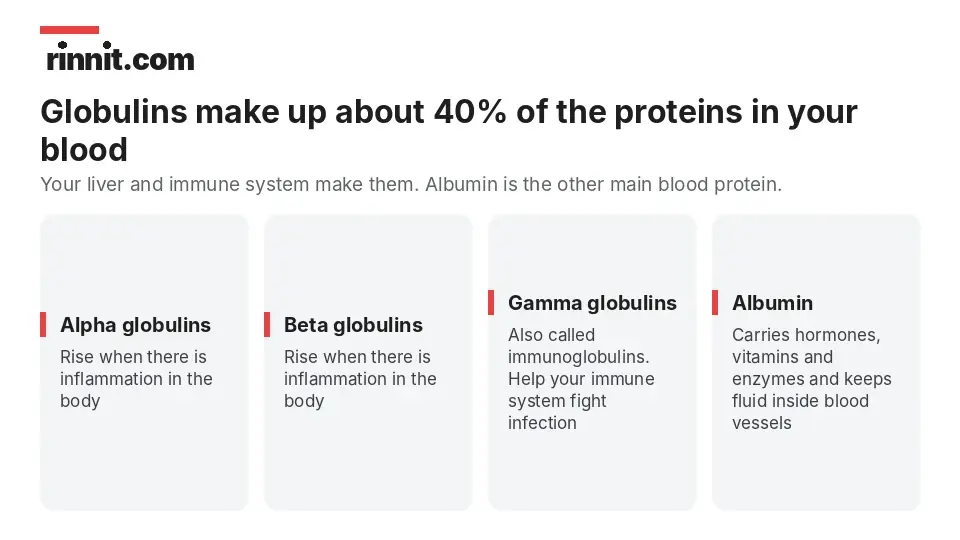
Globulins and albumin are the main proteins in your blood.
A globulin blood test measures the levels of a group of proteins called globulins in your blood serum, the liquid part of your blood. The medical term for this test is globulin electrophoresis. [1]
Your immune system and liver make globulins. About 40% of the proteins in your blood are alpha, beta and gamma globulins. Albumin is the other common blood protein. [1]
What do globulins do?
Your body needs globulins to: [1]
Fight off viruses and infections
Form blood clots
Keep your liver and kidneys working
Why is a globulin blood test done?
Providers use the test for three main reasons: [1]
Purpose | What it means |
Screening | Part of a routine physical exam to spot problems such as liver disease |
Diagnosis | Helps diagnose a liver or kidney problem |
Monitoring | Shows whether a disease is improving or getting worse |
Sources: [1]
What are the types of globulin blood tests?
Your provider chooses the test based on your symptoms or condition. The two main types are a total protein test and serum protein electrophoresis. [1]
Total protein test
This test measures alpha and beta globulins, which rise when there's inflammation. It also measures albumin, a protein your liver makes that carries hormones, vitamins and enzymes through your body and keeps fluid in your blood from leaking into tissues. [1]
A total protein test is often part of liver function tests or a comprehensive metabolic panel. You may get it if you have, or are at risk for, liver damage or liver disease, or if you have symptoms such as: [1]
Edema (fluid buildup) in your belly or lower limbs
Itchy skin (pruritus)
Jaundice
Loss of appetite or malnutrition
Nausea and vomiting
Fatigue
Serum protein electrophoresis
This test measures gamma globulins (also called immunoglobulins) and other trace proteins in your blood serum. Gamma globulins help your immune system fight off infections and foreign substances. [1]
Providers use it to diagnose conditions that affect the immune system, such as: [1]
Allergies
Autoimmune diseases like lupus and rheumatoid arthritis
Multiple myeloma
Waldenström macroglobulinemia
How do you prepare for a globulin blood test?
You may need to fast (not eat or drink) for at least 12 hours before the test. Follow your provider's directions. [1]
Give your provider a list of the medicines and supplements you take. Corticosteroids, birth control pills and insulin for diabetes can affect globulin levels. Your provider will tell you if you need to stop any medicine before the test. [1]
What happens during the test?
A nurse or phlebotomist draws your blood at a provider's office, lab or hospital. The process should take less than five minutes. [1]
They tie an elastic band (tourniquet) around your upper arm so your vein is easier to reach.
They clean your skin with an antiseptic.
They insert a thin, hollow needle into a vein on the inside of your elbow. You may feel a slight pinch.
They collect the blood into small tubes.
They remove the band and needle, press gauze on the site to stop bleeding and cover it with a bandage.
The blood samples then go to a lab for analysis. [1]
What are normal globulin levels?
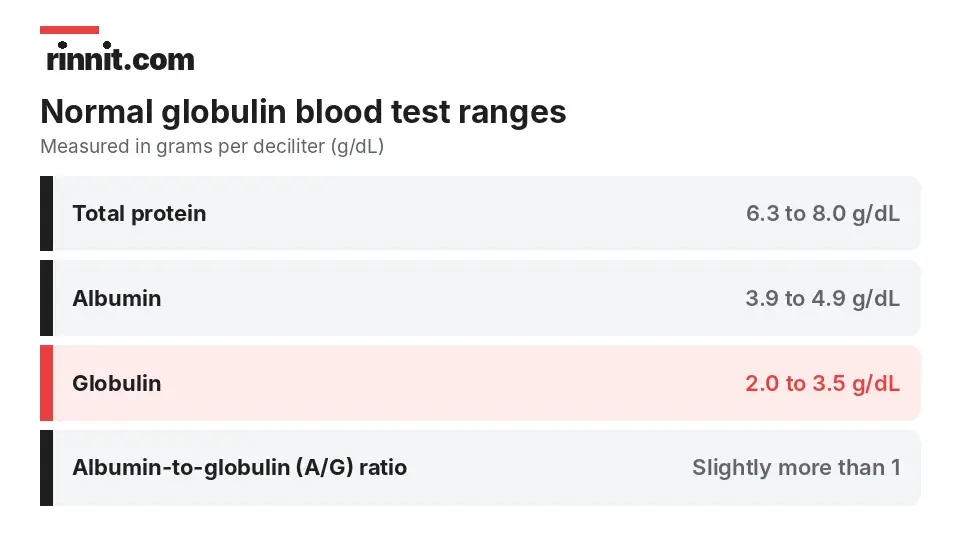
Normal ranges vary slightly from lab to lab.
Blood tests measure globulin in grams per deciliter (g/dL). Labs use different techniques, so results can vary from lab to lab, and your provider will want to use the same lab to track your levels. [1]
Measurement | Normal range |
Total protein | 6.3 to 8.0 g/dL |
Albumin | 3.9 to 4.9 g/dL |
Globulin | 2.0 to 3.5 g/dL |
A/G ratio | Slightly more than 1 |
Sources: [1]
What is the A/G ratio?
A total protein test also shows the albumin-to-globulin (A/G) ratio. It compares the amount of albumin in your blood with the amount of globulins. Your body usually has slightly more albumin than globulins, so a normal A/G ratio is slightly more than 1. [1]
What do high or low globulin levels mean?
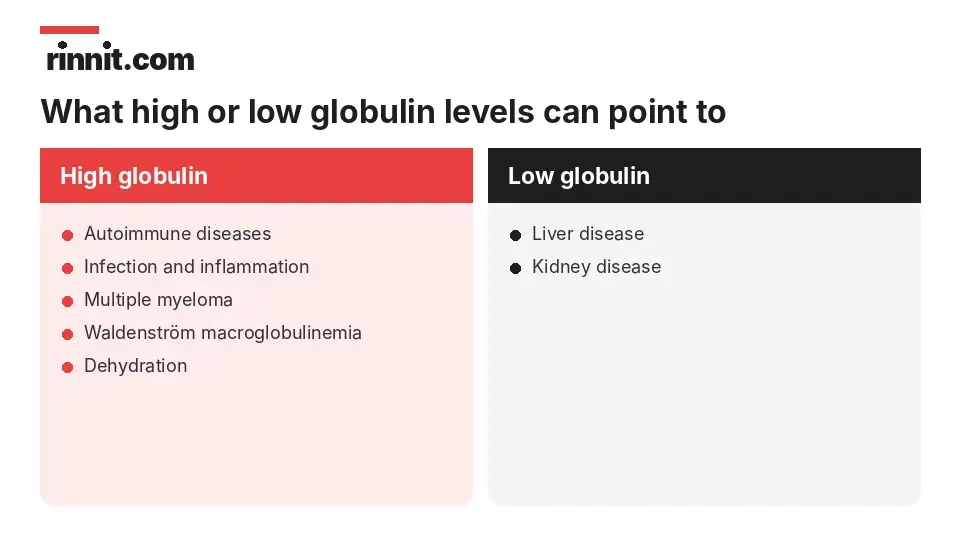
An abnormal result always needs more testing to find the cause.
Results outside the normal range can point to problems that need more testing. [1]
Result | Possible causes |
High globulin (hyperproteinemia) | Autoimmune diseases; cancers such as multiple myeloma or Waldenström macroglobulinemia; infections and inflammation |
Low globulin | Kidney disease; liver disease |
Sources: [1]
Dehydration can also raise globulin levels. Globulin and total protein levels tend to rise during pregnancy and return to normal after childbirth, which usually isn't a cause for concern. [1]
One abnormal result doesn't make a diagnosis. Your provider will order more tests to find the cause. [1]
When will you get your results?
Labs usually take several days to analyze the samples and send the results to your provider, who will review them with you. [1]
Conclusion
A globulin blood test is a simple blood draw that checks a key group of proteins made by your liver and immune system. Levels that are too high or too low aren't a diagnosis on their own, but they help your provider decide what to check next. [1]
If your provider orders this test, ask what they're looking for and whether you need to fast or pause any medicines.
Keep learning: Read our guide to liver function tests or our comprehensive metabolic panel guide. For more background, see the MedlinePlus page on the globulin test.
FAQ
What is a globulin blood test?
It is a blood test that measures globulins, a group of proteins made by your liver and immune system.
What is a normal globulin level?
About 2.0 to 3.5 g/dL, though ranges vary by lab.
What does high globulin mean?
It can point to autoimmune disease, infection, inflammation or cancers such as multiple myeloma, and it needs more testing.
What does low globulin mean?
It can be a sign of liver or kidney disease.
What is a normal A/G ratio?
Slightly more than 1, because your blood usually has a bit more albumin than globulin.
Do I need to fast before a globulin test?
You may need to fast for at least 12 hours; follow your provider's instructions.
Can medicines affect globulin levels?
Yes. Corticosteroids, birth control pills and insulin can change the results.
Can dehydration cause high globulin?
Yes. Globulin levels are higher when you're dehydrated.
Does pregnancy raise globulin levels?
Yes. Levels tend to rise during pregnancy and return to normal after childbirth.
How long do globulin test results take?
Usually several days.
Related Reading
What Is Multiple Myeloma? A Plain-Language Guide to Symptoms, Causes, and Treatment explains a blood cancer that can raise globulin levels.
Waldenström Macroglobulinemia: Symptoms, Causes, Diagnosis and Treatment Options covers a rare cancer that makes too much antibody protein.
Lupus: Symptoms, Causes & Treatment Guide describes an autoimmune disease linked with high globulin.
Rheumatoid Arthritis: Symptoms, Causes, Diagnosis, Treatment & Complete Guide covers another autoimmune condition this test can help assess.
Cirrhosis of the Liver: What It Is and What Treatment Involves explains liver damage that can lower blood protein levels.
Nephrotic Syndrome: Symptoms, Causes, and Treatment Guide covers a kidney condition that causes protein loss.
References
Cleveland Clinic. Globulin Blood Test: What It Is, Procedure, Results. Cleveland Clinic. Last updated February 7, 2022. https://my.clevelandclinic.org/health/diagnostics/22365-globulin-blood-test
Tobing E, Tansol C, Tania C. Albumin-globulin ratio (AGR) as independent predictor of poor survival in renal cell carcinoma: A systematic review and meta-analysis. Arab J Urol. 2024;22(4):219-226. PMID 39534609. https://doi.org/10.1080/20905998.2024.2352954
Wen H, Niu X, Yu R, et al. Association of Serum AGR With All-Cause and Cause-Specific Mortality Among Individuals With Diabetes. J Clin Endocrinol Metab. 2025;110(2):e266-e275. PMID 38571296. https://doi.org/10.1210/clinem/dgae215
Medical disclaimer
This article is for general education only and does not replace advice from a qualified healthcare professional. Talk to your doctor about your own diagnosis and treatment, and seek emergency care right away for severe or sudden symptoms.



Comments