Amyloidosis: Symptoms, Causes, Treatment & Complete Guide

Updated: 3 days ago
Medically reviewed by Dr. Baraa Alnahhal, MD · Last reviewed: October 2026
Amyloidosis is a rare disease in which a protein called amyloid builds up in organs and impairs how they work. There are several types, and the right treatment depends on which one you have.
Quick Answer
Amyloidosis is a rare disease in which a protein called amyloid builds up in organs such as the heart, kidneys, liver and nervous system, affecting how they work. There are many types, and symptoms such as fatigue, shortness of breath, numbness and leg swelling may appear late. There is no cure, but treatment can slow amyloid production and improve symptoms.
What the research says
Starting tafamidis earlier appears to help most. Using long-term extension data from the ATTR-ACT trial, survival gains with early versus delayed tafamidis were 15.7 months in National Amyloidosis Centre (NAC) stage I, 13.1 months in stage II, and only 1.2 months in stage III (Nagata et al., Circulation Journal, 2026) [3].
Tafamidis helps, with limits. A review of transthyretin amyloid cardiomyopathy found tafamidis reduces all-cause mortality and slows decline in function and quality of life, but its limitations include high cost and reduced effectiveness in advanced disease (Yang et al., Indian Pacing and Electrophysiology Journal, 2026) [4].
Trials under-represent the people most affected. Among 16 completed US ATTR trials reviewed, the enrollment fraction for Black participants fell from 0.291 before 2017 to 0.125 afterward, far below the 0.75 adequacy threshold (Ford et al., Reviews in Cardiovascular Medicine, 2026) [5].
Amyloidosis at a Glance
Aspect | Summary |
What it is | Rare disease caused by amyloid protein buildup in organs |
Organs affected | Heart, kidneys, liver, spleen, nervous system, soft tissue, muscle, digestive tract |
Number of types | Many — six main categories |
Most common type | AL amyloidosis (in developed countries) |
Typical patient | Adults over 50; more common in men |
Signature clues | Fatigue, shortness of breath, numbness in hands/feet, leg swelling, purpura around eyes, enlarged tongue |
Is it curable? | No — but treatment can slow it, improve symptoms, and extend life |
Specialists involved | Hematologist (blood disorder specialist), plus cardiology, nephrology, neurology as needed |

What Is Amyloidosis?
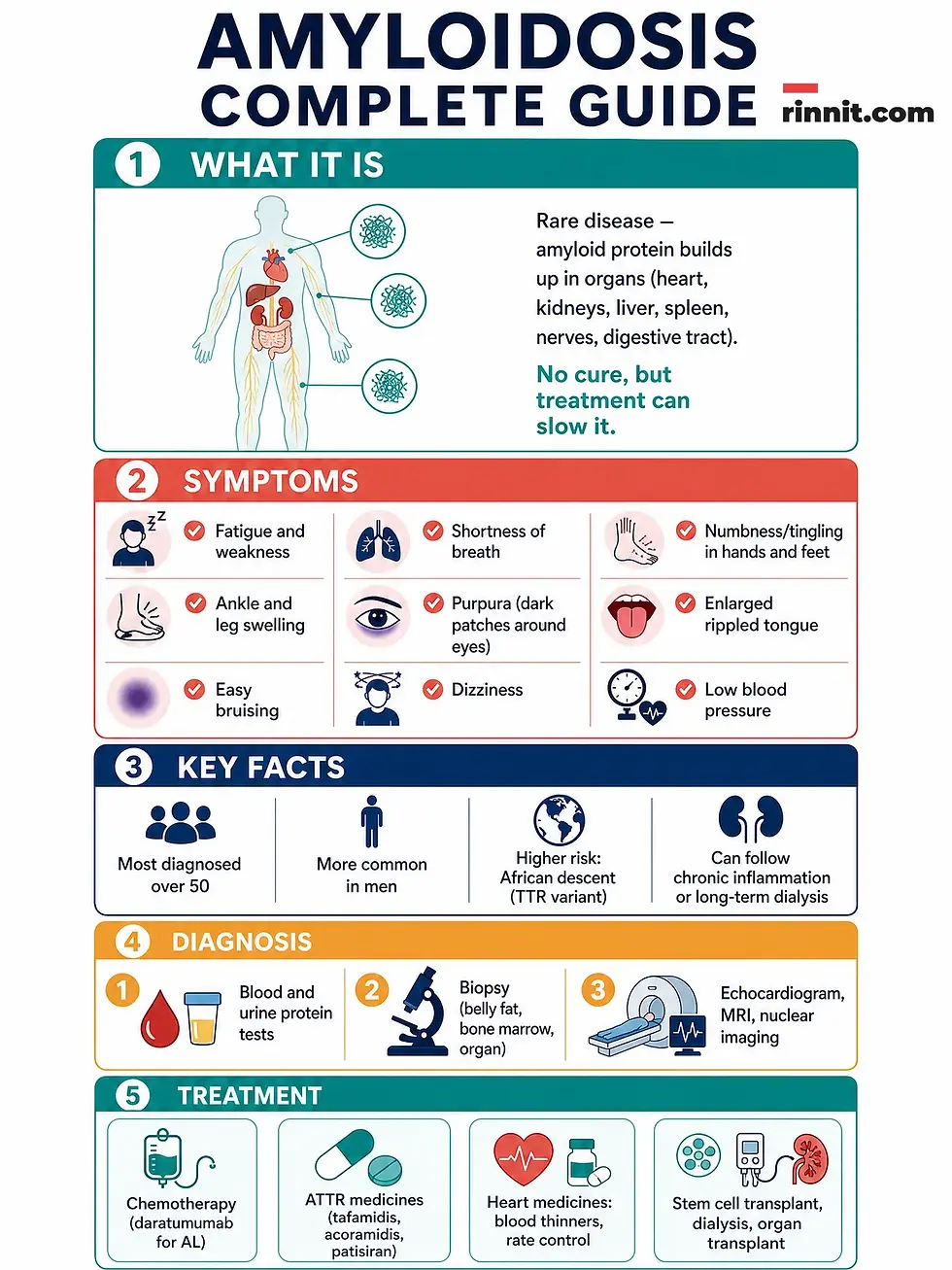
Amyloidosis (am-uh-loi-DO-sis) is a rare disease that occurs when a protein called amyloid builds up in organs. This buildup can affect the way organs work, and the condition can involve the heart, kidneys, liver, spleen, nervous system, soft tissue, muscle, and digestive tract [1].
There are many different types. Some occur with other diseases and improve with treatment, while others may lead to life-threatening organ failure [1]. Treatments may include chemotherapy medicines used to treat cancer, other medicines that reduce amyloid production and manage symptoms, and, for some people, organ or blood stem cell transplants [1].
What are the symptoms of amyloidosis?
Amyloidosis symptoms vary with the organs affected and may not appear until later in the disease [1], ranging from fatigue and shortness of breath to swelling and numbness. Common symptoms include:
Serious fatigue and weakness
Shortness of breath
Numbness, tingling, or pain in the hands or feet
Swelling of the ankles and legs
Additional symptoms may include:
Dizziness and low blood pressure
Diarrhea (possibly with blood) or constipation
Nausea, loss of appetite, and weight loss
An enlarged tongue, which sometimes looks rippled around its edge
Skin changes, such as thickening or easy bruising, and dark or purple patches around the eyes
Two Distinctive Clues
Clue | What it is |
Purpura around the eyes | Small blood vessels leak blood into the skin. This most commonly occurs around the eyes but can also affect other parts of the body. |
Enlarged tongue (macroglossia) | An enlarged tongue can be a sign of amyloidosis. It can sometimes also appear rippled along its edge. |
When to See a Doctor
See your healthcare professional if you regularly experience any of the symptoms associated with amyloidosis [1].
What causes amyloidosis and what are its types?
Amyloidosis comes in many different types, which differ in their causes and in how many organs they affect. Some are hereditary; others are caused by outside factors such as inflammatory diseases or long-term dialysis [1]. Many types affect multiple organs, while others affect only one part of the body.
Type | Also called | What causes it | Typical targets |
AL amyloidosis | Immunoglobulin light chain amyloidosis (formerly primary amyloidosis) | One of the most common types in developed countries; can be associated with multiple myeloma or other blood conditions | Heart, kidneys, liver, nerves |
Wild-type ATTR amyloidosis | Transthyretin amyloidosis; formerly senile systemic amyloidosis | The TTR protein made by the liver produces amyloid for unknown reasons; tends to affect men over age 60 | Heart; can cause carpal tunnel syndrome |
Hereditary ATTR amyloidosis | Familial transthyretin amyloidosis | Altered TTR protein passed down through families | Nerves, heart, kidneys |
Other hereditary forms | — | Rarer inherited protein changes | Different organs, depending on the type and how proteins are affected |
AA amyloidosis | Secondary amyloidosis | Often triggered by a chronic inflammatory disease, such as rheumatoid arthritis | Kidneys, liver, spleen |
Localized amyloidosis | — | Amyloid confined to one area; not common | Bladder, skin, throat, or lungs — with a better prognosis than multi-organ varieties |
The other hereditary forms include apolipoprotein A-1 amyloidosis, gelsolin amyloidosis, and fibrinogen amyloidosis [1]. Correct diagnosis of the type matters: localized amyloidosis has a better prognosis than varieties that affect multiple organ systems, and identifying it correctly means treatments that affect the entire body can be avoided [1].
What are the risk factors for amyloidosis?
Risk factor | Detail |
Age | Most people diagnosed with amyloidosis are over the age of 50 |
Sex | Amyloidosis occurs more commonly in men |
Other diseases | A chronic infectious or inflammatory disease increases the risk of AA amyloidosis |
Family history | Some types of amyloidosis are hereditary |
Dialysis | Dialysis can't always remove large proteins from the blood, so certain proteins can build up and be deposited in tissue — less common with modern dialysis techniques |
Race | People of African descent appear at higher risk of carrying a version of the TTR protein associated with a type of amyloidosis that can harm the heart |
What complications can amyloidosis cause?
System | How amyloidosis causes damage |
Heart | Amyloid reduces the heart's ability to fill with blood between heartbeats, so less blood is pumped with each beat — causing shortness of breath. If it affects the heart's electrical system, it can cause heart rhythm problems. Amyloid-related heart problems can become life-threatening. |
Kidneys | Amyloid can harm the kidneys' filtering system, affecting their ability to remove waste products from the body. It can eventually cause kidney failure. |
Nervous system | Nerve damage can cause pain, numbness, or tingling of the fingers and feet. If amyloid affects nerves controlling bowel function, it can cause alternating constipation and diarrhea. Damage to blood-pressure nerves can make people feel faint when standing up too quickly. |
How is amyloidosis diagnosed?
Amyloidosis is often overlooked because the symptoms can mimic those of more-common diseases [2]. Early diagnosis can help prevent further organ damage, and precise diagnosis of the type is important because treatment varies greatly depending on your specific condition [2].
Laboratory Tests
Blood and urine may be analyzed for proteins that can indicate amyloidosis. People with certain symptoms also may need thyroid and kidney function tests [2].
Biopsy
A tissue sample can be checked for signs of amyloidosis. It may be taken from:
Fat under the skin on the belly
Bone marrow
An affected organ, such as the liver or kidney (some people may need this)
The tissue is tested to see what type of amyloid is involved [2], which directly shapes the treatment plan.
Imaging Tests
Imaging test | What it does |
Echocardiogram | Uses sound waves to create moving images that show how well the heart is working, and can reveal heart damage specific to amyloidosis |
MRI | Uses radio waves and a strong magnetic field to create detailed images of organs and tissues; useful in diagnosing whether amyloidosis is affecting the heart |
Nuclear imaging | Tiny amounts of radioactive material (tracers) are injected into a vein; can reveal early heart damage caused by certain types of amyloidosis and help distinguish between types — guiding treatment decisions |
How is amyloidosis treated?
There's no cure for amyloidosis. But treatment can help slow or stop the production of amyloid protein, improve symptoms, and potentially extend life expectancy [2]. If the amyloidosis has been triggered by another condition, such as rheumatoid arthritis or tuberculosis, treating the underlying condition can be helpful [2].
Medicines
Medicine type | How it works |
Chemotherapy | Some cancer medicines are used for AL amyloidosis to stop the growth of cells that produce the protein that forms amyloid. Most people start therapy that contains daratumumab (Darzalex), a monoclonal antibody used to treat multiple myeloma. |
ATTR therapies | Tafamidis (Vyndamax; Vyndaqel) and acoramidis (Attruby) are approved to treat ATTR amyloidosis — shown to slow amyloid buildup in the heart, improve symptoms, and prolong life expectancy. Patisiran (Onpattro), eplontersen (Wainua), and vutrisiran (Amvuttra) are approved for nerve damage from hereditary ATTR amyloidosis, and vutrisiran is also approved for ATTR heart disease; they interfere with production of the TTR protein in the liver, helping prevent amyloid buildup. |
Heart medicines | If your heart is affected, you may need blood thinners to reduce the risk of clots and medicines to control heart rate. Some medicines increase urination, which can reduce the strain on your heart and kidneys. |
Surgical and Other Procedures
Procedure | When it's used |
Autologous blood stem cell transplant | Your own stem cells are collected from your blood, stored while you have high-dose chemotherapy, then returned through a vein. Most appropriate for people with AL amyloidosis whose disease isn't advanced and whose heart isn't greatly affected; used for people who didn't respond well to other AL treatments. |
Dialysis | If your kidneys have been damaged by amyloidosis, a machine regularly filters wastes, salts, and fluid from your blood. |
Organ transplant | If amyloid deposits have severely damaged your heart or kidneys, surgery to replace those organs may be needed. Because some types of amyloid are formed in the liver, a liver transplant could stop that production. |
How can people cope with amyloidosis?
Coping with amyloidosis is helped by learning about your specific type, keeping a symptom diary and leaning on your support network. People living with amyloidosis can connect with others in patient communities and support groups focused on blood cancers and disorders, where members share practical answers about treatments, side effects, and daily life. Three steps help most people:
Learn about your specific type. Because treatment varies greatly by type — from chemotherapy for AL to ATTR medicines for familial forms — understanding your diagnosis helps you make confident care decisions.
Keep a symptom diary. Track fatigue, swelling, breathing, and nerve symptoms between visits so your team can see how the disease and treatments are progressing.
Lean on your support network. Family and friends provide practical help during treatment and emotional support through the hardest stretches.
How should you prepare for an amyloidosis appointment?
Preparing for an amyloidosis appointment means expecting a possible referral to a hematologist [2] and writing down your symptoms, medications and questions in advance. Because appointments can be brief, prepare in advance:
Ask about pre-appointment requirements when you schedule.
Write down your symptoms, including any that may seem unrelated.
List all medications, vitamins, and supplements, with doses.
Write down key medical information, including other conditions.
Write down key personal information, including recent changes or stressors.
Write down questions to ask your healthcare team.
Ask a relative or friend to go with you to help remember what the care team says.
Questions to ask your healthcare professional:
What's the most likely cause of my symptoms?
What type of amyloidosis do I have, what organs are affected, and what stage is my disease?
What kinds of tests and treatments do I need?
Am I at risk of long-term complications, and what side effects can I expect from treatment?
Do I need to follow any dietary or activity restrictions?
I have another health condition — how can I best manage them together?
What to expect from your doctor: Be prepared to answer when your symptoms began, how severe they are, and whether they're continuous or occasional; what makes them better or worse; how your appetite is and whether you've lost weight without trying; whether you've had leg swelling or shortness of breath; whether you're able to work and perform daily tasks; whether you bruise easily; and whether anyone in your family has been diagnosed with amyloidosis.
Conclusion
It's a protein problem, not one organ. Amyloidosis starts when amyloid protein accumulates in organs — heart, kidneys, liver, spleen, nerves, and beyond — and the symptoms follow whichever organs are hit.
The type determines everything. With six main types, precise diagnosis is the foundation of the right treatment.
No cure, but real progress. Chemotherapy with daratumumab, the newer ATTR medicines, stem cell transplant, dialysis, and organ transplant can slow the disease, improve symptoms, and extend life.
Frequently Asked Questions
What is amyloidosis?
Amyloidosis is a rare disease that occurs when a protein called amyloid builds up in organs, which can affect the way those organs work. It may affect the heart, kidneys, liver, spleen, nervous system, soft tissue, muscle, and digestive tract.
What are the most common symptoms of amyloidosis?
Serious fatigue and weakness, shortness of breath, numbness, tingling, or pain in the hands or feet, and swelling of the ankles and legs. Distinctive clues include dark or purple patches around the eyes (purpura) and an enlarged tongue.
Is amyloidosis hereditary?
Some types are. Hereditary ATTR amyloidosis passes an altered TTR protein down through families, and there are other rarer inherited forms such as apolipoprotein A-1, gelsolin, and fibrinogen amyloidosis. AL amyloidosis and wild-type ATTR are generally not inherited.
What is the difference between AL and ATTR amyloidosis?
AL amyloidosis involves immunoglobulin light chains produced by abnormal cells and often affects the heart, kidneys, liver, and nerves. ATTR amyloidosis involves the TTR protein made by the liver and comes in two forms — wild-type (affects mostly men over 60, targets the heart) and hereditary (passed down through families, often affecting nerves, heart, and kidneys).
Is there a cure for amyloidosis?
There is no cure. But treatment can slow or stop amyloid protein production, improve symptoms, and potentially extend life expectancy. Options include chemotherapy, ATTR medicines, heart medicines, stem cell transplant, dialysis, and organ transplant.
Why does amyloidosis affect the heart so seriously?
Amyloid reduces the heart's ability to fill with blood between heartbeats, so less blood is pumped with each beat, causing shortness of breath. It can also affect the heart's electrical system, causing rhythm problems, and amyloid-related heart problems can become life-threatening.
Who is at highest risk for amyloidosis?
Adults over age 50, men, people with a family history, people with chronic infectious or inflammatory diseases, people on long-term dialysis, and people of African descent who may carry a heart-harming TTR protein variant.
How is amyloidosis diagnosed?
Diagnosis usually needs a tissue sample, called a biopsy, often taken from belly fat, bone marrow or an affected organ. Blood tests, urine tests and heart imaging help find the type and which organs are involved.
What is the outlook for amyloidosis?
Outlook depends on the type of amyloidosis and which organs are affected, especially the heart. Newer treatments have improved results for many people, and early diagnosis helps.
Can diet or lifestyle changes treat amyloidosis?
Diet cannot remove amyloid, but it can help manage symptoms. For example, your provider may suggest less salt if amyloidosis affects your heart or kidneys.
Related Reading
Serum Protein Electrophoresis (SPEP): What It Tests, How It Works and What Results Mean explains the blood test that sorts and measures blood proteins to help detect conditions like MGUS and multiple myeloma.
References
Mayo Clinic Staff. Amyloidosis - Symptoms and causes. Mayo Clinic. Aug. 27, 2025. https://www.mayoclinic.org/diseases-conditions/amyloidosis/symptoms-causes/syc-20353178
Mayo Clinic Staff. Amyloidosis - Diagnosis and treatment. Mayo Clinic. Aug. 27, 2025. https://www.mayoclinic.org/diseases-conditions/amyloidosis/diagnosis-treatment/drc-20353183
Nagata Y, Nabeshima Y, Kitano T, et al. Stage-specific cost-effectiveness of early vs. delayed tafamidis for transthyretin amyloid cardiomyopathy in Japan. Circ J. 2026;90(11):1620-1628. PMID: 42816364. https://doi.org/10.1253/circj.CJ-26-0576
Yang S, Hyun J, Aras MA. Tafamidis: is it truly a game changer for transthyretin amyloid cardiomyopathy? Indian Pacing Electrophysiol J. 2026. PMID: 42838364. https://doi.org/10.1016/j.ipej.2026.10.002
Ford D, Amadi C, Chandora A, et al. Demographic representation in clinical trials for transthyretin-associated cardiac amyloidosis: a systematic review. Rev Cardiovasc Med. 2026;27(9):53698. PMID: 42859727. https://doi.org/10.31083/RCM53698
Medical disclaimer
This article is for general informational purposes only and is not a substitute for professional medical advice, diagnosis, or treatment. Always seek the advice of a qualified healthcare provider with any questions about a medical condition.



Comments