Kappa Free Light Chain Test: Normal Ranges, Kappa/Lambda Ratio and What Results Mean

Updated: 2 days ago
Written and medically reviewed by Dr. Baraa Alnahhal, MD · Last reviewed: November 2026 · How we review
Quick Answer
A kappa free light chain test (serum free light chain test) is a blood test that measures two small antibody proteins, kappa and lambda light chains, in the blood. The normal kappa-to-lambda ratio is about 0.26–1.65. The test helps diagnose and monitor multiple myeloma, MGUS, AL amyloidosis and related conditions. Results take a few days to a week.
What the research says
The ratio is a strong screening tool for AL amyloidosis: a meta-analysis of 44 studies and 18,071 people found the free light chain ratio alone detected the plasma cell disorder behind AL amyloidosis with 82% sensitivity, and combining it with serum and urine immunofixation raised sensitivity to 99% (Azzam M et al., Blood Advances, 2026) [2]
Updated reference ranges reduce overdiagnosis: in 6,993 people with MGUS, revised free light chain ranges that account for age and kidney function reclassified 32% of "abnormal" ratios as normal; those reclassified had no higher risk of progression, while a truly abnormal ratio still doubled progression risk (hazard ratio 2.23) (Maeng CV et al., Blood Cancer Journal, 2025) [3]
Key takeaways
Measures kappa and lambda free light chains and their ratio in blood.
Typical ranges: kappa 3.3–19.4 mg/L, lambda 5.71–26.3 mg/L, ratio 0.26–1.65 (labs vary).
An abnormal ratio suggests a single clone of plasma cells; both chains rising together often reflects kidney disease or inflammation.
Used with serum protein electrophoresis and immunofixation, not alone.
Kidney function and age affect results, and newer reference ranges account for this.
What are free light chains?
Antibodies (immunoglobulins) are built from two heavy chains and two light chains. Plasma cells make slightly more light chains than they need, so small amounts circulate "free." There are two types, kappa and lambda. In plasma cell disorders, one abnormal clone multiplies and produces large amounts of a single light chain type, which tips the kappa-to-lambda ratio. Sources: [1]
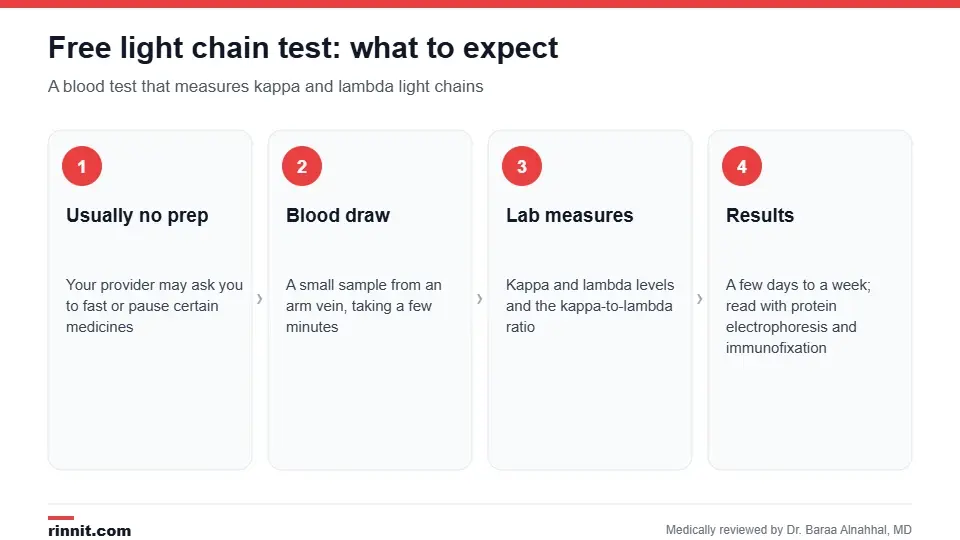
The free light chain test is a routine blood draw.
Why is the test done?
Your provider may order it if you have symptoms or findings that suggest a plasma cell disorder, or to monitor a known one: Sources: [1]
Anemia, unusual bruising or bleeding, fatigue.
Bone pain or bone lesions on imaging.
Kidney problems or protein in the urine.
High blood calcium (hypercalcemia).
Numbness or tingling in the hands and feet, a swollen tongue, skin rash or purple spots.
Follow-up of MGUS, myeloma or amyloidosis.

Free light chains rise when plasma cells multiply abnormally.
Conditions it helps diagnose or monitor include multiple myeloma (including light-chain-only myeloma), AL amyloidosis, monoclonal gammopathy of undetermined significance (MGUS), solitary plasmacytoma, lymphoproliferative disorders and Waldenström macroglobulinemia. Sources: [1]
How do I prepare?
Usually no preparation is needed. Your provider may ask you to fast for about 8 hours or pause certain medicines if other tests are drawn at the same time. Sources: [1]
What happens during the test?
A phlebotomist draws blood from a vein in your arm, which takes a few minutes.
A bandage is applied; you can remove it after a few hours.
The lab measures kappa and lambda levels and calculates the ratio. Sources: [1]
Understanding your results

Reference ranges vary by laboratory and method.
Measure | Typical reference range |
Kappa free light chains | 3.3–19.4 mg/L |
Lambda free light chains | 5.71–26.3 mg/L |
Kappa/lambda ratio | 0.26–1.65 |
Sources: [1]
Pattern | What it may mean |
Normal levels and ratio | No sign of a light-chain-producing clone |
High kappa with high ratio | Possible kappa-type plasma cell disorder |
High lambda with low ratio | Possible lambda-type plasma cell disorder |
Both chains high, normal ratio | Often kidney disease, chronic inflammation or immune activation |
Mildly abnormal ratio with reduced kidney function | May be normal for kidney function; age- and kidney-adjusted ranges help |
Results usually take a few days to a week. An abnormal ratio is not a diagnosis by itself; it is read with serum protein electrophoresis, immunofixation, blood counts, calcium, kidney function and sometimes a bone marrow biopsy. Using kidney- and age-adjusted ranges reclassified about a third of "abnormal" results as normal in one large MGUS cohort. Sources: [1, 3]
Risks
The test carries no serious risks. You may have brief stinging, soreness, a bruise or light bleeding at the needle site. Sources: [1]
Conclusion
The free light chain test is a sensitive way to spot an abnormal plasma cell clone and to follow conditions like MGUS, myeloma and AL amyloidosis over time. Ask which reference range your lab uses, especially if your kidney function is reduced, and what other tests will be done alongside it.
Keep learning: read about smoldering multiple myeloma and amyloidosis.
Frequently asked questions
What is a normal kappa/lambda ratio?
Typically 0.26 to 1.65, although ranges vary by laboratory and method.
What does a high kappa free light chain level mean?
With a high ratio, it may suggest a kappa-type plasma cell disorder. With a normal ratio, kidney disease or inflammation is a more common cause.
Do I need to fast?
Usually not, unless other tests that need fasting are drawn at the same time.
Can kidney disease affect the result?
Yes. The kidneys clear light chains, so reduced function raises both and can shift the ratio slightly. Kidney-adjusted ranges help.
Does an abnormal ratio mean I have myeloma?
No. It means further tests are needed. Many people with an abnormal ratio have MGUS, which often stays stable.
How accurate is the test for AL amyloidosis?
The ratio alone is about 82% sensitive; combined with serum and urine immunofixation, sensitivity reaches 99%.
Is a urine test the same?
No. Urine tests detect light chains (Bence Jones protein) that have passed into the urine; the serum test measures them in blood and is more sensitive.
How often is the test repeated?
In MGUS or treated myeloma, it is usually repeated at regular intervals set by your hematologist.
How long do results take?
Usually a few days to a week.
Are there risks?
No serious risks; only minor bruising or soreness from the blood draw.
Related Reading
What Is Multiple Myeloma? A Plain-Language Guide to Symptoms, Causes, and Treatment the blood cancer most often monitored with this test.
What Is MGUS? A Plain-Language Guide to This Common, Usually Quiet Blood Condition the precursor condition where the ratio guides risk.
AL Amyloidosis: The Rare Disease Where Mutated Light Chain Proteins Clog Your Heart, Kidneys, and Other Organs the disease caused by misfolded light chains.
Serum Protein Electrophoresis (SPEP): What It Tests, How It Works and What Results Mean the companion test used alongside free light chains.
Smoldering Multiple Myeloma (SMM): What It Is, How It's Diagnosed, and What Comes Next — Complete Guide where free light chain levels help predict progression.
References
Cleveland Clinic. Kappa Free Light Chain: What It Is, Purpose, Procedure & Results. Cleveland Clinic. Last updated February 2, 2022. https://my.clevelandclinic.org/health/diagnostics/22369-kappa-free-light-chain-test
Azzam M, Hamarsha Q, Kawtharany H, et al. Diagnostic utility of immunofixation and free light chain assay in AL amyloidosis: a systematic review and meta-analysis. Blood Advances. 2026;10(15):5293-5307. PMID 41979328. https://doi.org/10.1182/bloodadvances.2025019530
Maeng CV, Rögnvaldsson S, Einarsson Long T, et al. Revised free light chain reference intervals enhance risk stratification in monoclonal gammopathy of undetermined significance and reduce overdiagnosis. Blood Cancer Journal. 2025;15(1):80. PMID 40295472. https://doi.org/10.1038/s41408-025-01289-7
Medical disclaimer
This article is for general education only and does not replace advice from a qualified healthcare professional. Talk to your doctor about your own diagnosis and treatment, and seek emergency care right away for severe or sudden symptoms.



Comments