Calcium Blood Test: Normal Range and What High or Low Calcium Means

Updated: 2 days ago
Written and medically reviewed by Dr. Baraa Alnahhal, MD · Last reviewed: November 2026 · How we review
Quick Answer: What is a calcium blood test?
A calcium blood test measures the calcium in the blood. The normal range for adults is 8.5 to 10.2 mg/dL, though labs can use slightly different ranges. A high result can point to hyperparathyroidism or certain cancers, and a low result to hypoparathyroidism or vitamin D deficiency. An abnormal result does not always mean you have a medical condition. [1]
What the research says
Unadjusted total calcium may be as good as or better than "corrected" calcium. In 22,658 adults tested for total and ionized calcium at the same time, unadjusted total calcium agreed with ionized calcium in 74.5% of cases, better than the common albumin-adjustment formulas (63.0% and 58.7%), which misclassified more people, especially those with low albumin. (Desgagnés et al., JAMA Network Open, 2025) [2]
Corrected calcium can miss low calcium in older adults. In 876 older hospital patients, albumin-adjusted calcium disagreed with ionized calcium in about one-third of measurements and failed to identify 28% of cases of low calcium, with the worst agreement in people 85 and older and those with severe kidney disease. (Suryapranata et al., Age and Ageing, 2024) [3]
Key takeaways
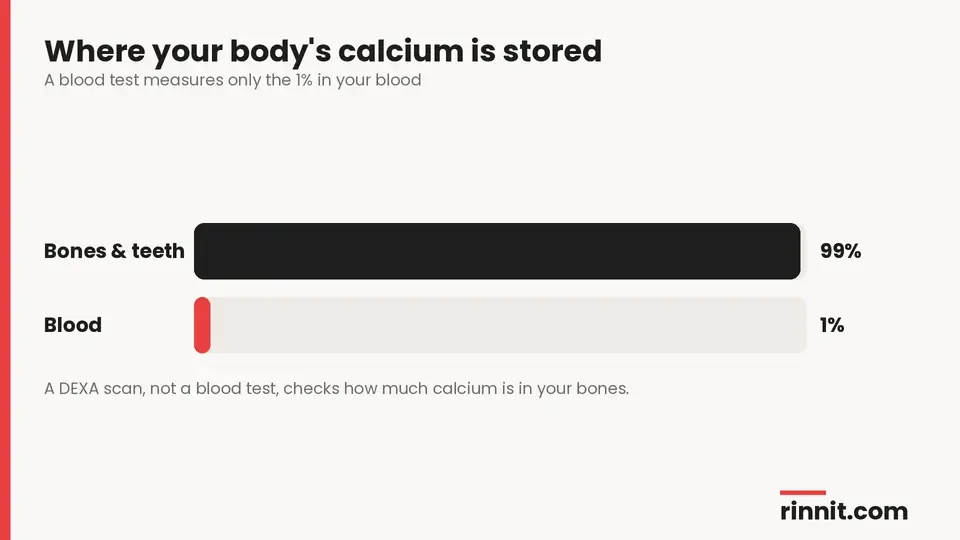
About 99% of your body's calcium is in your bones and teeth; only 1% is in your blood. [1]
Total calcium measures calcium bound to proteins plus free calcium; ionized calcium measures only free calcium. [1]
The normal adult range is 8.5 to 10.2 mg/dL (2.15 to 2.55 mmol/L). [1]
A calcium blood test cannot show how much calcium is in your bones; a DEXA scan checks bone health. [1]
High or low results often lead to follow-up tests such as vitamin D or parathyroid hormone. [1]
What is a calcium blood test?
A calcium blood test measures the amount of calcium in your blood. About 99% of your body's calcium is stored in your bones and teeth, and the remaining 1% is in your blood. [1]
There are two types of calcium blood tests: [1]
Test | What it measures |
Total calcium | Calcium bound to certain blood proteins plus free (unbound) calcium |
Ionized calcium | Only the free, unbound calcium |
Sources: [1]
A calcium blood test cannot show how much calcium is in your bones. A bone density test (DEXA scan) is used to check bone health. [1]
Why is a calcium blood test done?
Your provider may order it: [1]
As part of routine blood work, such as a basic metabolic panel (BMP) or comprehensive metabolic panel (CMP), which both measure calcium
If you have symptoms of high calcium (hypercalcemia) or low calcium (hypocalcemia)
To check whether treatment for a condition that affects calcium is working
To monitor you if you take a medicine that affects calcium levels
How do you prepare for a calcium blood test?
No special preparation is needed if calcium is the only test. If it is part of a BMP or CMP, you may need to fast for several hours beforehand. Your provider will give you specific instructions. [1]
What happens during a calcium blood test?
You sit in a chair while a phlebotomist finds a vein, usually on the inside of your arm across from your elbow. They clean the area and use a small needle to draw blood, which may feel like a small pinch. They then remove the needle, apply pressure and put on a bandage. The whole process usually takes less than five minutes. [1]
What is a normal calcium level?
Results usually come back within one or two days, though they can take longer. Your report shows the test name, your result, the lab's normal range and whether the result is flagged as normal, high or low. [1]
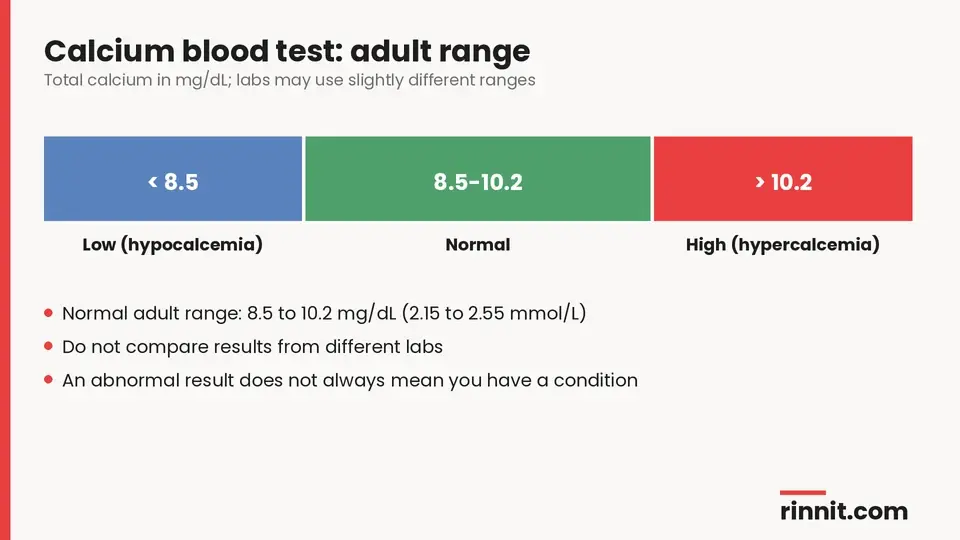
The normal range for adults is 8.5 to 10.2 mg/dL (2.15 to 2.55 mmol/L). Labs may use different reference ranges, so do not compare results from different labs. [1]
What do high and low calcium levels mean?
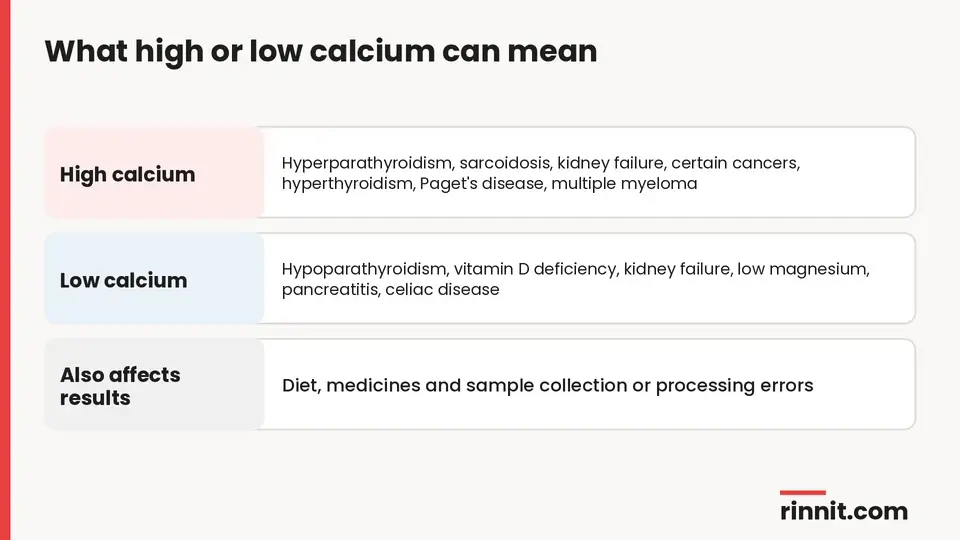
Result | Possible causes |
High calcium (hypercalcemia) | Hyperparathyroidism, sarcoidosis, tuberculosis, kidney failure, lung cancer, breast cancer, certain blood cancers, hyperthyroidism, Paget's disease of the bone, multiple myeloma, certain medicines |
Low calcium (hypocalcemia) | Hypoparathyroidism, vitamin D deficiency, kidney failure, low magnesium (hypomagnesemia), pancreatitis, celiac disease or other absorption problems, certain medicines and eating patterns |
Sources: [1]
What else can affect calcium results?
Your diet
Medicines you take
Errors when the sample is collected, transported or processed
Sources: [1]
What happens if your calcium level is abnormal?
An abnormal result does not always mean you have a medical condition or need treatment. Your provider may order follow-up tests to find the cause, such as: [1]
Ionized calcium
Urine calcium
Phosphorus
Magnesium
Vitamin D
Parathyroid hormone
Thyroid hormones
Calcitonin
Contact your provider as soon as possible if you have worrying symptoms of high or low calcium. [1]
Conclusion
A calcium blood test is a routine check, often part of a metabolic panel, that shows whether the small amount of calcium in your blood is in a healthy range. Results outside the range can point to problems with your parathyroid glands, vitamin D, kidneys or other conditions.
If your result is high or low, ask your provider which follow-up tests you need to find the cause.
Keep learning: Read our guides to the basic metabolic panel (BMP), the comprehensive metabolic panel (CMP) and the DEXA scan. For more background, see the MedlinePlus page on the calcium blood test.
FAQ
What is a calcium blood test?
A blood test that checks whether the calcium in your blood is at a healthy level. [1]
What is a normal calcium level?
For adults, 8.5 to 10.2 mg/dL (2.15 to 2.55 mmol/L), though ranges vary by lab. [1]
What is the difference between total and ionized calcium?
Total calcium includes protein-bound and free calcium; ionized calcium measures only free calcium. [1]
What causes high calcium in the blood?
Hyperparathyroidism, sarcoidosis, kidney failure, certain cancers, hyperthyroidism, Paget's disease and some medicines. [1]
What causes low calcium in the blood?
Hypoparathyroidism, vitamin D deficiency, kidney failure, low magnesium, pancreatitis and celiac disease. [1]
Do I need to fast for a calcium blood test?
Not for calcium alone, but you may need to fast if it is part of a BMP or CMP. [1]
Does a calcium blood test show bone health?
No; it measures blood calcium only, and a DEXA scan checks bone health. [1]
How long do calcium test results take?
Usually one or two days, though it can take longer. [1]
What can affect calcium test results?
Diet, medicines, and errors in collecting, transporting or processing the sample. [1]
What tests come after an abnormal calcium result?
Your provider may check ionized or urine calcium, phosphorus, magnesium, vitamin D, parathyroid hormone or thyroid hormones. [1]
Related Reading
Hypercalcemia: Symptoms, Causes & Treatment — A Complete Guide explains what a high calcium result means.
Hypocalcemia: Understanding Low Blood Calcium Levels explains what a low calcium result means.
Hyperparathyroidism and High Calcium: What Overactive Parathyroid Glands Do to Your Bones and Kidneys covers the most common cause of high calcium.
Hypoparathyroidism: Symptoms, Causes & Treatment Guide covers a common cause of low calcium.
Hypomagnesemia: Symptoms, Causes, and Management explains how low magnesium can lower calcium.
What Is Multiple Myeloma? A Plain-Language Guide to Symptoms, Causes, and Treatment covers a blood cancer that can raise calcium.
Paget's Disease of Bone: Symptoms, Causes, and Treatment — A Guide for Adults Over 50 explains a bone condition linked to high calcium.
Sarcoidosis: Complete Guide to the Condition That Forms Granulomas Throughout the Body covers a lung condition that can raise calcium.
References
Cleveland Clinic. Calcium Blood Test: What It Is & Results. Cleveland Clinic. Last updated December 10, 2024. https://my.clevelandclinic.org/health/diagnostics/22021-calcium-blood-test
Desgagnés N, King JA, Kline GA, et al. Use of Albumin-Adjusted Calcium Measurements in Clinical Practice. JAMA Netw Open. 2025;8(1):e2455251. PMID 39836424. https://doi.org/10.1001/jamanetworkopen.2024.55251
Suryapranata APSP, Keijsers CJPW, Kurstjens S, et al. Discrepancies in corrected calcium versus ionised calcium in a geriatric population: an observational study. Age Ageing. 2024;53(4):afae072. PMID 38610061. https://doi.org/10.1093/ageing/afae072
Medical disclaimer
This article is for general education only and does not replace advice from a qualified healthcare professional. Talk to your doctor about your own diagnosis and treatment, and seek emergency care right away for severe or sudden symptoms.



Comments