Debulking Surgery: A Guide to Cytoreduction for Cancer Treatment

Updated: 3 days ago
Medically reviewed by Dr. Baraa Alnahhal, MD · Last reviewed: November 2026
Quick Answer: What is debulking surgery?
Debulking surgery is a surgical intervention that removes the majority of a cancerous mass when surgery alone cannot cure it. It is most commonly performed for epithelial ovarian cancer and peritoneal mesothelioma [1], ideally aiming to leave no visible tumor at all, or at least none larger than one centimeter [1] [3]. It is typically combined with chemotherapy to target remaining cancer cells [1].
What the research says
Chemotherapy first made complete tumor removal more likely and surgery safer, with the same survival. In the SCORPION randomized trial of 171 women with advanced ovarian cancer and a high tumor load, complete resection (no visible tumor) was achieved in 47.6% of those who had primary debulking surgery versus 77.0% of those who had neoadjuvant chemotherapy followed by interval debulking (p=0.001). Major postoperative complications were 25.9% versus 7.6% (p=0.0001), while median progression-free survival (15 vs 14 months) and overall survival (41 vs 43 months) were similar (PubMed: Fagotti et al., Int J Gynecol Cancer, 2020 [2]).
Removing all visible tumor was the strongest predictor of survival. In a large randomized trial of 632 patients with stage IIIC or IV ovarian cancer who started treatment, the largest residual tumor was 1 cm or less in 41.6% after primary debulking versus 80.6% after interval debulking. Neoadjuvant chemotherapy followed by interval debulking was not inferior to primary surgery for survival (hazard ratio for death 0.98, 90% CI 0.84 to 1.13), and complete resection of all macroscopic disease was the strongest independent predictor of overall survival (PubMed: Vergote et al., N Engl J Med, 2010 [3]).
Conditions Treated with Debulking Surgery
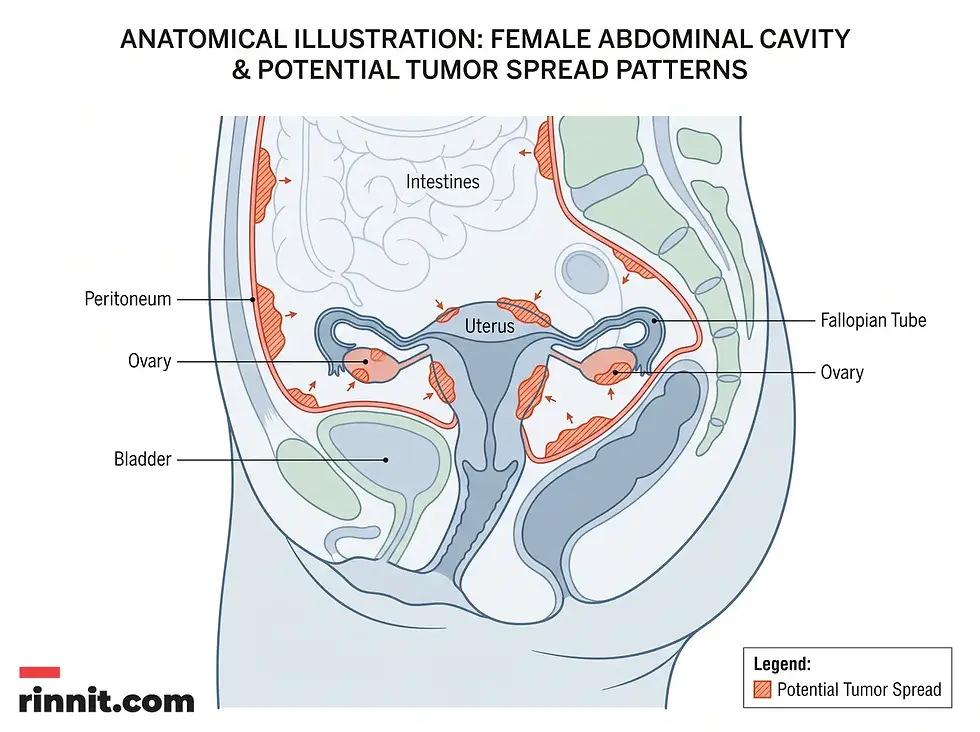
While debulking is most famously associated with ovarian cancer, it is also utilized for several other rare and aggressive cancers that affect the abdominal lining and organs. The procedure is particularly effective for cancers that spread widely but remain on the surface of organs, making them accessible for surgical removal.
Cancer Type | Description |
Epithelial Ovarian Cancer | The most common type of ovarian cancer that often spreads to the belly or pelvis. [1] |
Primary Peritoneal Cancer | A rare cancer forming in the membrane wrapping around abdominal organs. [1] |
Peritoneal Mesothelioma | A disease often linked to asbestos exposure that affects the peritoneum. [1] |
Pseudomyxoma Peritonei | A rare cancer starting in the appendix that spreads mucin throughout the abdomen. [1] |
The Surgical Process
Debulking surgery is a complex and often lengthy procedure that can take several hours depending on the extent of the cancer spread [1]. Surgeons may use either a laparotomy, which involves a large open incision, or a laparoscopic approach, which uses smaller incisions and a camera [1]. The choice depends on the patient's health and the location of the tumors.
In many cases, the surgery involves the removal of reproductive organs, such as the ovaries, fallopian tubes, and uterus [1]. If the cancer has spread to nearby organs like the small intestine or colon, portions of those organs may also be removed [1]. Some procedures also include Hyperthermic Intraperitoneal Chemotherapy (HIPEC), where heated chemotherapy drugs are circulated directly within the abdominal cavity to kill remaining cancer cells [1].
Preparation and Testing
Thorough preparation is essential for a safe surgical experience. Patients often undergo neoadjuvant therapy — chemotherapy given before surgery — to shrink tumors and make them easier to remove [1]. A series of diagnostic tests, including blood glucose, complete blood count (CBC), and kidney and liver function tests [1], are performed to ensure the patient can withstand major surgery.
Imaging tests such as CT scans, MRIs, and PET scans help surgeons map out the tumor locations before entering the operating room [1]. Personal preparation is also vital; patients are advised to stop using nicotine, as it significantly impairs the body's ability to heal [1]. Fasting for at least six hours before the procedure [1] is mandatory to prevent complications during anesthesia.

Recovery and Post-Operative Care
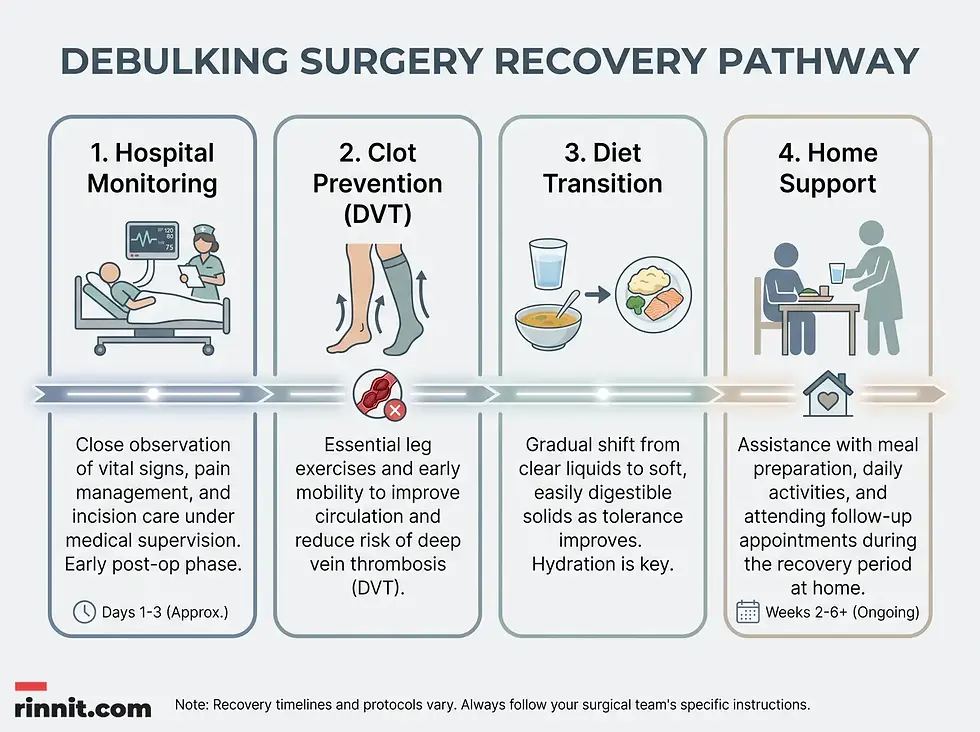
Following the surgery, patients typically remain in the hospital for two to seven days [1]. During this time, the medical team focuses on pain management, wound care, and preventing complications like blood clots or pneumonia [1]. Patients are encouraged to perform leg exercises and deep breathing techniques [1] as soon as possible after waking up.
The transition back to a normal diet is gradual, starting with water and high-protein liquids before moving to solid foods [1]. Once at home, recovery continues for several weeks. Patients often need assistance with daily tasks and should have a support system in place to help with meals and household responsibilities [1]. Common side effects during this period include fatigue, loss of appetite, and slowed bowel function [1].
Conclusion
Debulking surgery is a powerful tool in the fight against advanced abdominal cancers. By removing the bulk of the disease, it sets the stage for more effective long-term treatment and provides significant relief from symptoms [1]. While the journey through major surgery and recovery is demanding, the potential for improved survival and a better quality of life makes it a vital option for many patients facing these challenging diagnoses.
Consult Your Provider
If you experience a high fever, sudden shortness of breath, or heavy bleeding after your surgery, contact your surgical team immediately. These could be signs of serious complications that require prompt medical intervention.
Frequently Asked Questions
1. What is the main goal of debulking surgery?
The primary goal is to remove as much of the cancerous tumor as possible to improve the effectiveness of other treatments and ease symptoms.
2. How long does the surgery take?
Debulking is a major surgery that can take several hours, depending on how much cancer needs to be removed.
3. Is debulking surgery a cure for cancer?
While it may cure some cases of ovarian cancer when combined with other treatments, it is often used to prolong life and manage the disease.
4. What is HIPEC?
HIPEC stands for Hyperthermic Intraperitoneal Chemotherapy, which is heated chemotherapy applied directly inside the abdomen during surgery.
5. How long is the hospital stay?
Most patients stay in the hospital for two to seven days following the procedure.
6. Can I have this surgery laparoscopically?
Depending on your situation, your surgeon may use either minimally invasive laparoscopic surgery or an open laparotomy.
7. Why must I stop smoking before surgery?
Nicotine affects blood flow and can significantly slow down your body's ability to heal after a major operation.
8. What are the most common side effects?
Common side effects include fatigue, pain, loss of appetite, and temporary changes in bowel function.
9. Will I need chemotherapy after surgery?
Most patients require follow-up chemotherapy to target any microscopic cancer cells that could not be removed surgically.
10. What organs might be removed?
In ovarian cancer cases, the ovaries, fallopian tubes, and uterus are often removed, along with parts of the intestine if cancer has spread there.
11. How do I prepare for debulking surgery?
Your surgeon may order blood tests, imaging and an electrocardiogram to confirm you're well enough for surgery. [1] Stop all forms of nicotine, including e-cigarettes, because it affects blood flow and healing. [1] You'll typically fast beforehand, for example no food for at least six hours with clear liquids allowed up to a set time. [1] Plan for a hospital stay of several days, and arrange help with work, home tasks and meals, plus someone to stay with you for your first few days back home. [1]
12. Does debulking surgery hurt, and what anesthesia is used?
You won't feel pain or be aware of the operation, because you're given medication that puts you into a deep sleep. [1] Beforehand, an anesthesiologist will ask about past anesthesia, your medications and supplements, any drug, nicotine or alcohol use, implants, and loose teeth or dental bridges. [1] After surgery, your care team monitors your vital signs and gives pain medication as prescribed. [1] Pain, fatigue and slowed bowel function are common in the days afterward, and full recovery can take a few months. [1]
13. When should I call my doctor after debulking surgery?
Call 911 if you have shortness of breath, cough up blood, develop upper back pain, or notice a swollen or warm leg, since these can signal a blood clot. [1] Contact your provider if you get chills that make you shiver or a temperature of 100.4°F (38°C) or higher, which may mean an infection. [1] Some bleeding from the incision or vagina, tiredness and loss of appetite are expected, and you should avoid lifting more than 10 pounds until your surgeon clears you. [1]
Related Reading
References
Cleveland Clinic. Debulking Surgery (Cytoreduction Surgery). Cleveland Clinic. January 10, 2025. https://my.clevelandclinic.org/health/procedures/debulking-surgery
Fagotti A, Ferrandina MG, Vizzielli G, et al. Randomized trial of primary debulking surgery versus neoadjuvant chemotherapy for advanced epithelial ovarian cancer (SCORPION-NCT01461850). Int J Gynecol Cancer. 2020;30(11):1657-1664. doi:10.1136/ijgc-2020-001640. PMID: 33028623.
Vergote I, Tropé CG, Amant F, et al. Neoadjuvant chemotherapy or primary surgery in stage IIIC or IV ovarian cancer. N Engl J Med. 2010;363(10):943-953. doi:10.1056/NEJMoa0908806. PMID: 20818904.
Medical Disclaimer
This article is for informational purposes only and does not constitute medical advice. Always seek the advice of your physician or other qualified health provider with any questions you may have regarding a medical condition. Never disregard professional medical advice or delay in seeking it because of something you have read here.



Comments